
01 Apr 2026 | Choosing the Right University Abroad: Rankings vs Fit in 2026

0
14
Introduction: Choosing the Right University Abroad in 2026
The 2026 global education landscape is characterised by rapid technological transformation, evolving immigration policies, and a focus on employability. Colleges worldwide are reestablishing curricula to incorporate artificial intelligence, sustainability, and work-related education. At the same time, international education rivalry is intensifying, and choosing the right university abroad is one of the most significant decisions Indian students and parents can make.
The decision between a high-ranking institution or a University, which may be more career- and academically oriented, is a dilemma for most Indian families. The rankings seem to indicate success, but they are not always tied to students' strong performance. This is the root of the discussion between university rankings vs fit: a conflation of prestige and practicality.
With more than 15 years of experience mentoring Indian students in the UK, Canada, Australia, Europe, and other destinations, Gateway Educonnect l has helped students make informed decisions that enhance their prospects. This blog is designed to empower you to be realistic, balanced, and future-oriented in your choice of university abroad.
Why Choosing the Right University Abroad Is a Life-Changing Decision
Learning in a foreign country does not simply mean obtaining a foreign degree; it also encompasses the growth of a learner's academic background, professional orientation, and personal development. Choosing the right university abroad influences long-term employability, financial autonomy, and migration. For Indian students, families often face significant costs to make this decision, potentially including education loans and long-term financial planning.
According to OECD and UNESCO statistics, no other country in the world hosts as many international students as India. In this case, the role of ambition and pressure comes into the picture. Even a single difference, such as academic, cultural, or financial, may lead to dissatisfaction, poor performance, or limited employment opportunities after school.
Many of them learn too late that a wrong choice can affect visa extensions, post-study employment, and employers' interests. This is why one should carefully consider a university abroad rather than make an emotional decision based on a brand name or under the influence of friends. Conscious and impartial decision-making protects the student's future and the family's investment.
Understanding Global University Rankings in 2026
The rankings of the universities have been the first reference point for Indian students as they are choosing the right university abroad, but being aware of what they are gauging and their limitations matters in the right choice.
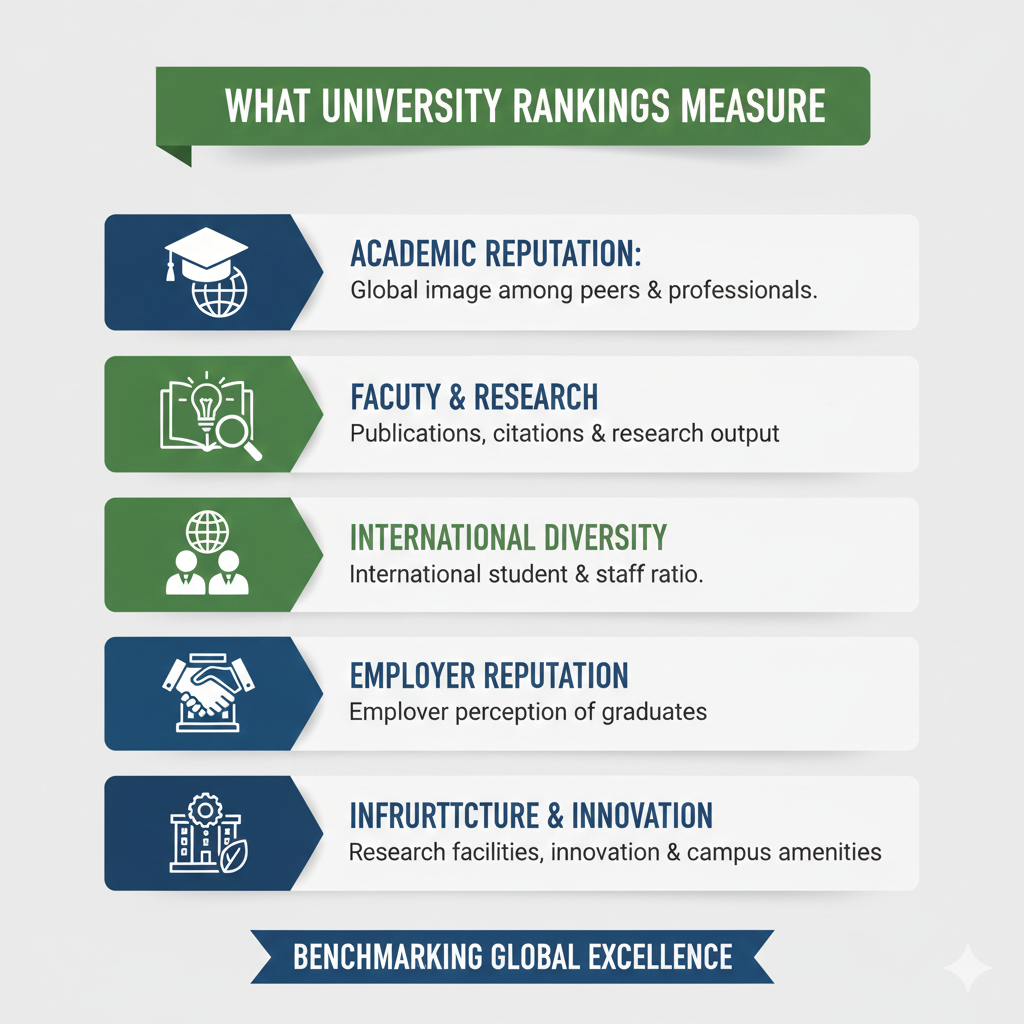
What the University Rankings Are Measuring.
Institutions are also ranked worldwide by some metrics, which may or may not be important to the priorities of the student:
- Academic reputation: The image of the university among colleagues and professionals all over the world.
- Faculty and faculty research: Publications, citations and faculty research.
- Diversity internationally: Student-to-staff ratio internationally.
- Employer reputation: The attitude of the employer towards university graduates.
- Infrastructure and innovation: Research facilities, innovations, and facilities on campuses.
These indicators are essential, but they primarily reflect the university's international standing rather than student life itself.
Popular Global Ranking Systems
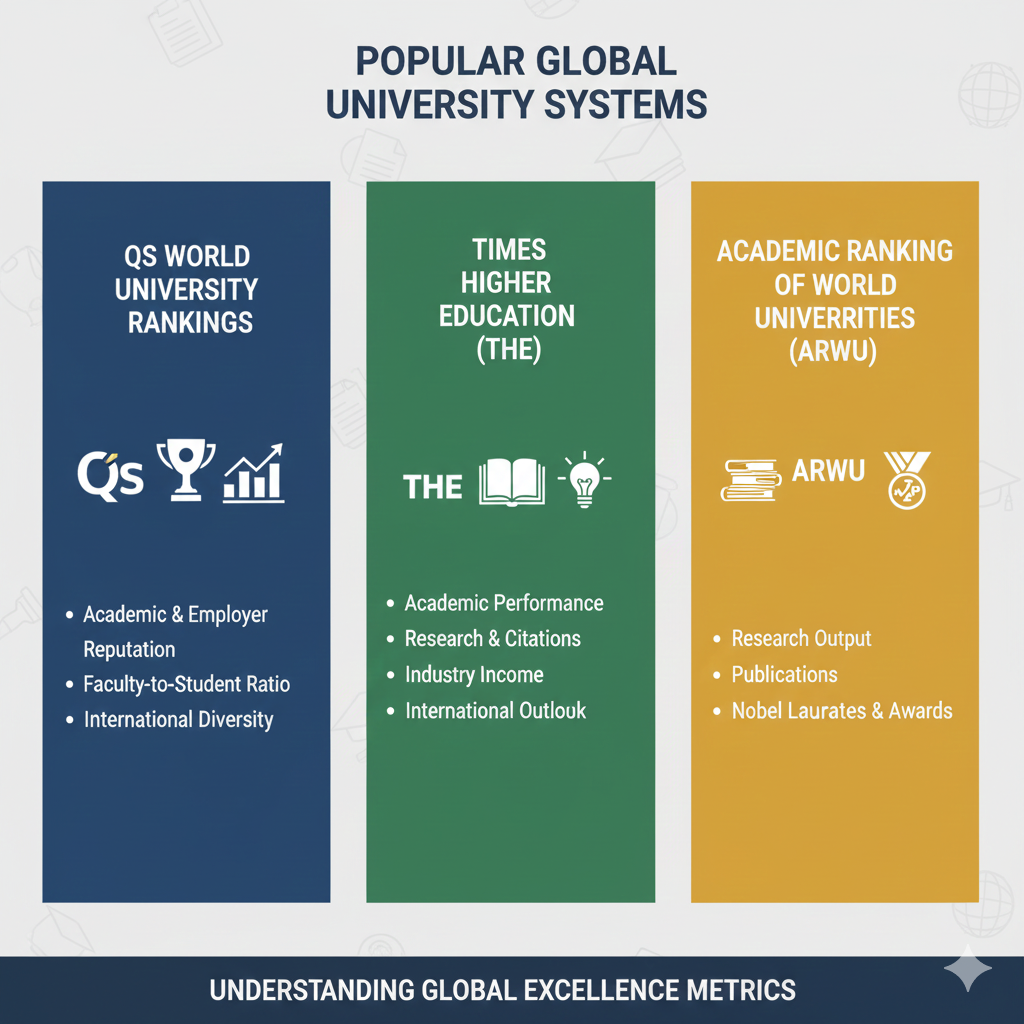
Being aware of how each ranking system works, the student can make them out in the appropriate manner:
- QS World University Rankings: The focus is on the academic and employer rankings, faculty-to-student ratio, and international diversity.
- Times Higher Education (THE): Academic, scholarship, reference, revenues of sectors, and future global.
- The Academic Ranking of World Universities (ARWU): The most popular measure of research output is the first one, which is the publications and Nobel awards.
Key Takeaways for Indian Students
- Approximate reputation is also an area that rankings provide, but not academic fit or employability.
- Universities at the top level may not fit a student with regard to learning style, cost and career goals.
- These should be in terms of rankings, as well as comparing the university rankings and compatibility with course options and campus culture.
With these rankings, whose calculations will be transparent, Indian students will be able to make more informed decisions when choosing a university abroad and compare reputation with tangible outcomes.
Limitations of University Rankings for Indian Students
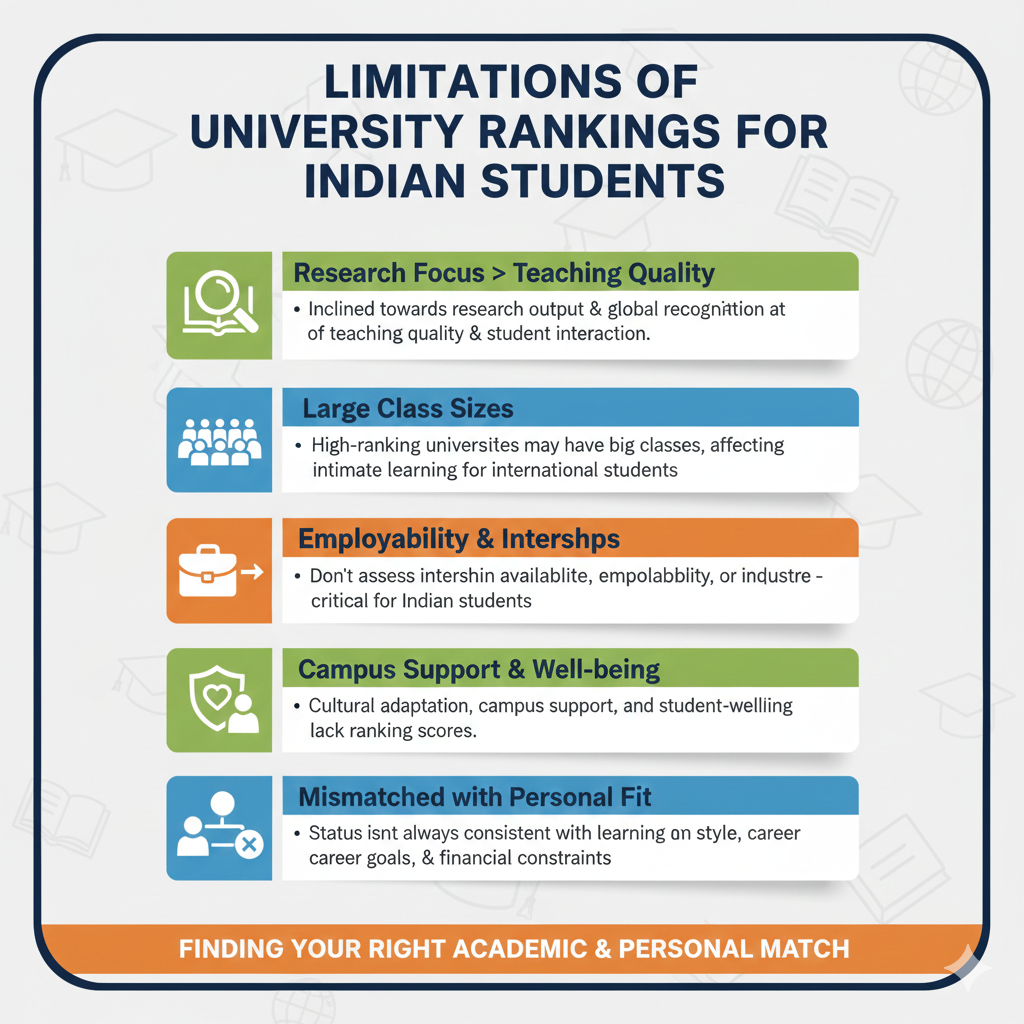
Even though university rankings create an impression of reputation, they have grave drawbacks for Indian students who are career-focused and long-term success-oriented. Using rankings will lead to misattributing results to matching expectations and missed opportunities.
- Rankings are more inclined towards the research work, faculty references, and international recognition at the expense of quality of teaching and interaction with students.
- High-ranking universities may also have big classes and not be as intimate, and this may affect the learning of the international students.
- Rankings do not help in the determination of the availability of the internships, their employability, and the reality of exposure - critical elements for Indian students to international career opportunities.
- Cultural adaptation, campus support and student well-being do not have ranking scores.
- Status does not turn out to be consistent with the learning style, career goal and financial constraints of a student.
Being aware of these constraints will help students focus on university rankings vs fit, ensuring they choosing the right university abroad by basing their choice on results, experiences, and personal fit, rather than relying solely on figures.
What Does “University Fit” Really Mean?
Fit within the university does not refer to the university's glory but to its ability to help students achieve their academic success and prepare for their personal and career goals. A university may be considered worldly enough, but it is not the place to be when teaching techniques, the learning environment, or professional orientation fall short of a student's expectations.
The real fit is an assessment of how the student's interests align with the university's curriculum, teaching approach (more interactive or more research-based), and evaluation approach. It also entails access to faculty advice, class size, academic freedom, and compelling learning experiences such as projects, internships, and industry exposure.
In addition to academics, the university's fit also considers campus culture, diversity, student well-being, and support services for international students. All these aspects will help students adapt more quickly, achieve better outcomes, and feel confident in their foreign learning experience. Such a balance is essential when selecting a university abroad or when weighing university jobs against the aptitude to succeed in the long run.
Key Factors to Consider When Choosing an Overseas University
Indian students must not base their choice of a university abroad on rankings; they must also consider the practical aspects of academic achievement, employment, and the student's experience.
- The course popularity and the accreditation too to place the degree in front of the employers and professional institutions at an international level.
- Instruction, rating and correspondence of curriculum to current industry needs.
- Good career support services, placements and internships.
- Long-term immigration and post-work study visa.
- The entire education, living and nominal costs of education.
- Scholarships, financial aid and part-time jobs are available to international students.
- Security of campus, accommodation facilities, and assistance to the international students.
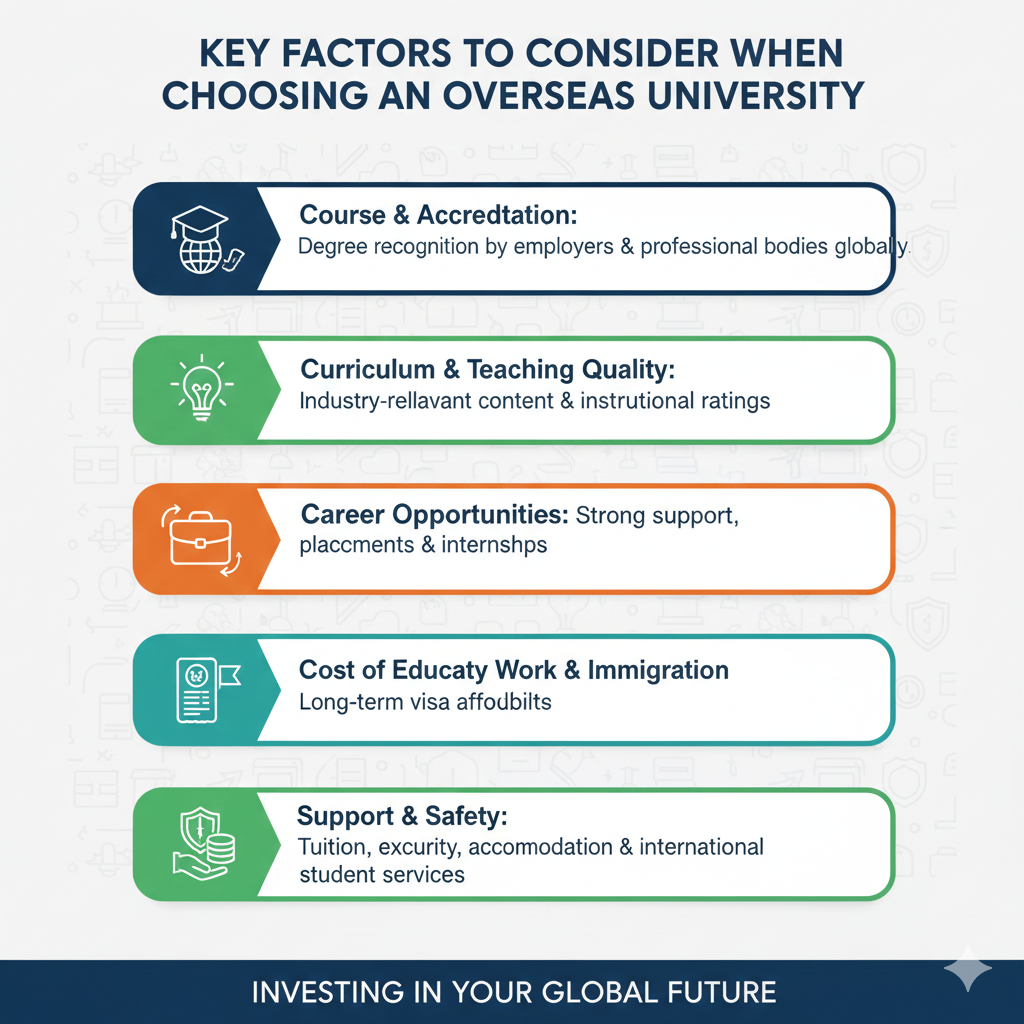
This knowledge of the factors to consider when choosing an overseas university will enable students and parents to make informed choices that balance university rankings and fit, helping them stay on course with choosing the right university abroad with clarity and long-term vision.
University Rankings vs. Fit: What Matters More in 2026?
The university rankings vs fit debate has never been as popular as it is projected to be in 2026, as perceived by Indian students seeking long-term global careers. Rankings only help identify reputable institutions but do not take into account individual learning needs, career goals, or employability outcomes. We need to consider factors beyond rankings.
|
Aspect |
Rankings-Focused Approach |
Fit-Focused Approach |
|
Decision basis |
Global reputation and ranking position |
Career goals, skills, and learning style |
|
Learning experience |
Often research-oriented and theory-heavy |
Practical, applied, and student-centric |
|
Academic support |
Limited individual attention |
Strong mentoring and faculty interaction |
|
Employability outcomes |
Not guaranteed |
Higher internship and job readiness |
|
Student satisfaction |
Mixed experiences |
Generally higher and more consistent |
As the job market grows in skills, flexibility, and practical experience, college fit can be a decisive determinant of an individual's long-term success. In most cases, academically fit students, rather than prestigious students, perform better; they fit socially and achieve superior career outcomes. To recap the discussion, the best approach to choosing the right university abroad in 2026 is not between rankings and fit, but to combine them to make an informed, future-oriented choice.
Best universities to study abroad in 2026: Thinking Beyond the Top 10
The top 10 most famous universities worldwide are not the only ones students will choosing the right university abroad; many other mid-ranking universities may offer a better teaching experience, employability, and ROI for Indian students.
- The United Kingdom universities, such as the University of Leeds, University of Nottingham, University of Birmingham, and University of Sheffield, are well connected to industry, applied learning and high graduate employability, even though none of them are necessarily ranked in the top 10 in the world.
- In Canada, the best ones are the University of Waterloo, Simon Fraser University, the University of Alberta, and York University due to the co-op programme, employer partnership, and post-study employment.
- Australian universities such as RMIT University, Deakin University and Griffith University are putting so much emphasis on industry-oriented courses, internships, and the acquisition of practical skills.
- In Europe, universities in Germany, the Netherlands, Ireland and France are providing affordable English-taught programs of good academic standard and heightened demand worldwide.
- The majority of such universities are smaller in terms of classes, have better academic support and better career performance, as compared to highly ranked research-intensive universities.
Lastly, effective outcomes are realised because successful universities in the process of choosing a university abroad align well, making it feasible to best universities to study abroad in 2026 rather than relying on university rankings.
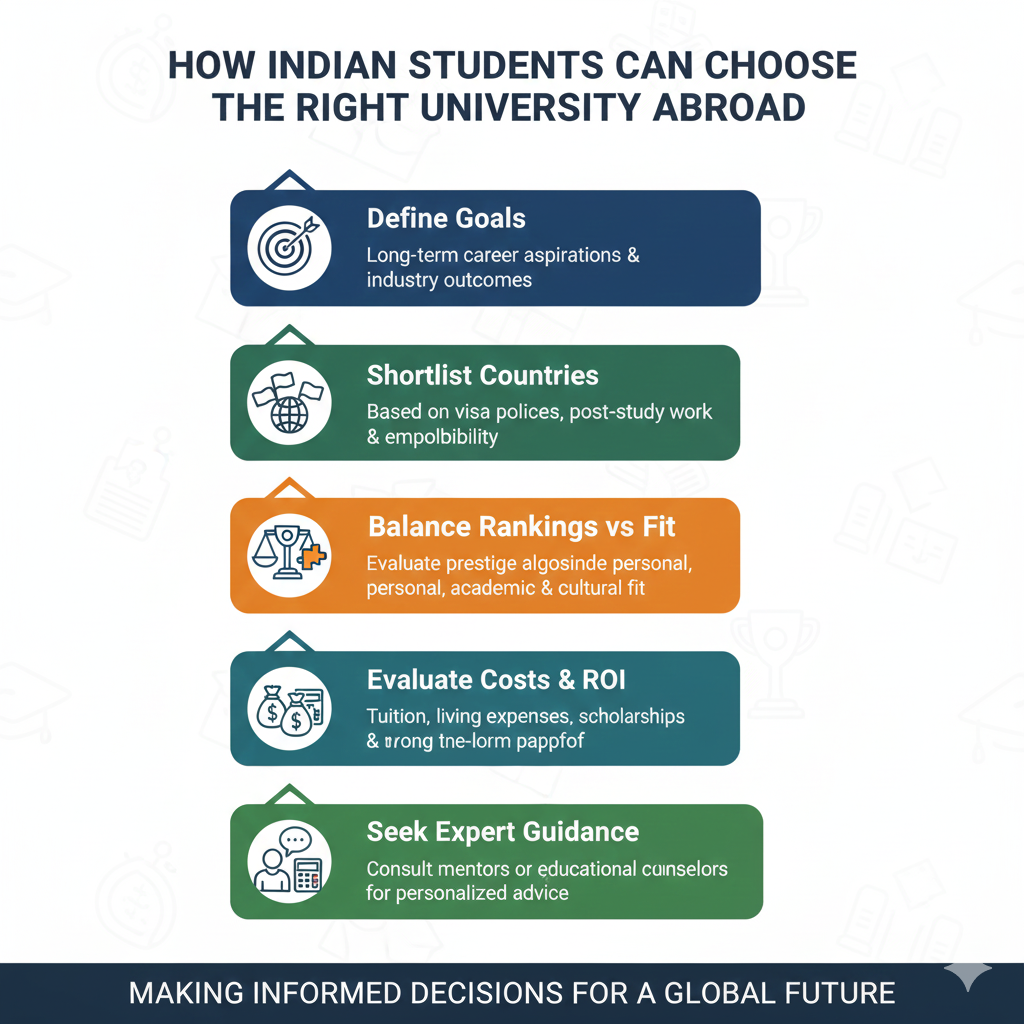
How Indian Students Can Choose the Right University Abroad
In a systematic, goal-oriented approach, where Indian students focus on choosing the right university abroad rather than relying solely on rankings as the sole determinant, the choice-making process becomes much easier.
- Develop long-term professional goals and preferred outcomes in the industry.
- Select four countries for shortlisting based on visa policies, post-study work and employability.
- Shake up universities in terms of university rankings vs fit as opposed to prestige.
- Evaluate cost, overall, scholarship and payoff.
- Seek good counsel on how to choose a university abroad.
Through these steps, students will be confident enough to identify the most significant points to consider when choosing the right university abroad and make sound judgments in the future.
Common Mistakes Students and Parents Make When Choosing Universities Abroad
Most Indian families make uninformed decisions about universities abroad, often driven by misinformation or emotion.
- Selecting the universities by global ranking, and not based on fit.
- Ignoring the outcomes of the courses, opportunities to receive internships, and employability rates.
- Underestimation of both the cost of living and visa procedures and cost of living in the long-term.
- Reliance on unreliable internet resources/ word of mouth.
- Negligence in the support systems and academic guidance of students.
Such mistakes should be avoided to learn how to choose a university abroad and strike the right balance between reputation and results.
How Gateway Educonnect Helps Students Choose the Right University Abroad
Gateway Educonnect assists students and parents in choosing the right university abroad by providing clear, personalised advice.
- Does high profiling of students to match career and academic goals.
- Join shortlists of universities that are information-based as opposed to rankings.
- advises on scholarships, costs and visa-friendly study destinations.
- Makes fair counselling directed towards long-term attainment as contrasted with admissions alone.
- Has worked in other countries and systems of education.
With the wise advice, students are clear on the distinction between university rankings vs fit. They are confident in selecting the most suitable courses to study abroad at top universities that will help them achieve their 2026 goals.
FAQs
Does it automatically imply that it is better to study overseas in an excellent university?
No. There is no ranking based on fit or employability.
Does the university's weight matter more than the rankings?
Compared to rankings, fit is a more influential factor of success.
What do you deem as the most important to consider in choosing the right university abroad?
Course relevance, work placements, visa requirements, affordability, and support services are among the key considerations when choosing an international university.
Which are the best universities to study abroad in 2026 for international students to study at?
Personal objectives will be the key to selecting the top study abroad university in 2026, rather than rankings.
Can expert counselling help?
Yes, it simplifies the process of choosing the right university abroad and reduces the risk of error.
Conclusion: Making the Right Choice for Your Global Education Journey.
In today's evolving learning landscape, choosing the right university abroad cannot be based solely on rankings or, more broadly, on hype. While global rankings can provide benchmarks, the overall decision should not be made based on them; they are only a starting point. When weighing university rankings against fit, students select institutions that support their academic objectives, career aspirations, and personal satisfaction.
When choosing a university abroad, one needs to assess the relevance of courses, employment opportunities, visa eligibility, and the overall support available to students. These are the most noteworthy points to consider when choosing an international university, especially for Indian students planning to build a long-term global career. Lastly, the best universities to study abroad in 2026 are those that align with one's identity, financial capacity, and learning methods. With the help of fit and rankings, students can make informed choices that lead to academic success, career growth, and an enriching international student experience. For more assistance please visit us study abroad consultancy, and avail of our wide range of services for students on destinations like study in USA, study in UK, study in Canada, study in Australia, study in ireland and many more country.

Author Bio
Abhinav Jain - Founder, Gateway Educonnect and Director.
B.Tech, MBA, AI and Global Education Specialist.
More than 15 years of professional experience in leading students along international routes based on politics and innovation.