25 Apr 2026 | Conditional vs Unconditional Offer Letter for Study Abroad: Key Differences

0
116
Introduction: Conditional vs Unconditional Offer Letter
Studying abroad has been the dream of many Indian students and parents as it would give them a worldwide exposure, better careers and quality education. One of the most crucial activities in the process of admission to a study abroad program is receiving an invitation to work at a university. Nevertheless, lots of learners become confused when observing various sorts of proposals. One must be aware of this difference between the conditional vs unconditional offer letter before proceeding to admissions, visa applications and financial planning. This step-by-step offer letter guide will help you simplify everything you need to know so that you can be confident in making informed decisions in a step-by-step manner.
What is a University Offer Letter?
It is advisable to understand the university offer letter meaning prior to getting into the conditional vs unconditional offer letter.
An offer letter is a formal document from an institution which informs you that you have been accepted to a course. It outlines:
- The course that you are enrolled in and its full course and curriculum.
- The school fees and any other fees that you will pay in the course.
- The conditions which should be met before the university gives the final enrolment.
- Critical time limits pertaining to acceptance, payment of fees and submission of documents.

This letter is the key to the next stage of the study abroad admission procedure, i.e. the visa application and reserving a room.
Types of Admission Offers Abroad
It is also vital that students and parents know the various types of admission offers in foreign countries to make desired choices in the process of studying abroad. In certain countries like the USA, UK, Canada and Australia, offer letters released by universities are mainly of two kinds.
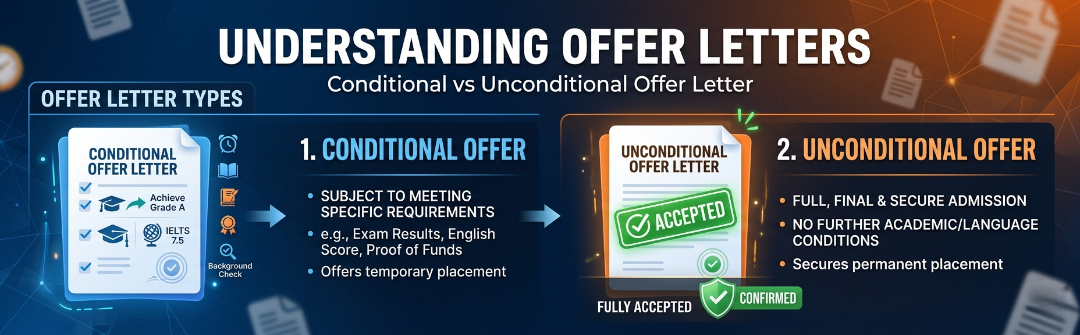
1. Conditional Offer Letter
The conditional offer letter is sent when the university has nothing against your profile, yet they require you to meet some requirements before its acceptance.
- It is usually awarded during those times when you are expecting your final grades or test results in English.
- It enables you to book a seat at an early time and finish the necessary conditions within a time frame.
- Students with pre-final applications have a characteristic role in the study abroad admissions procedure.
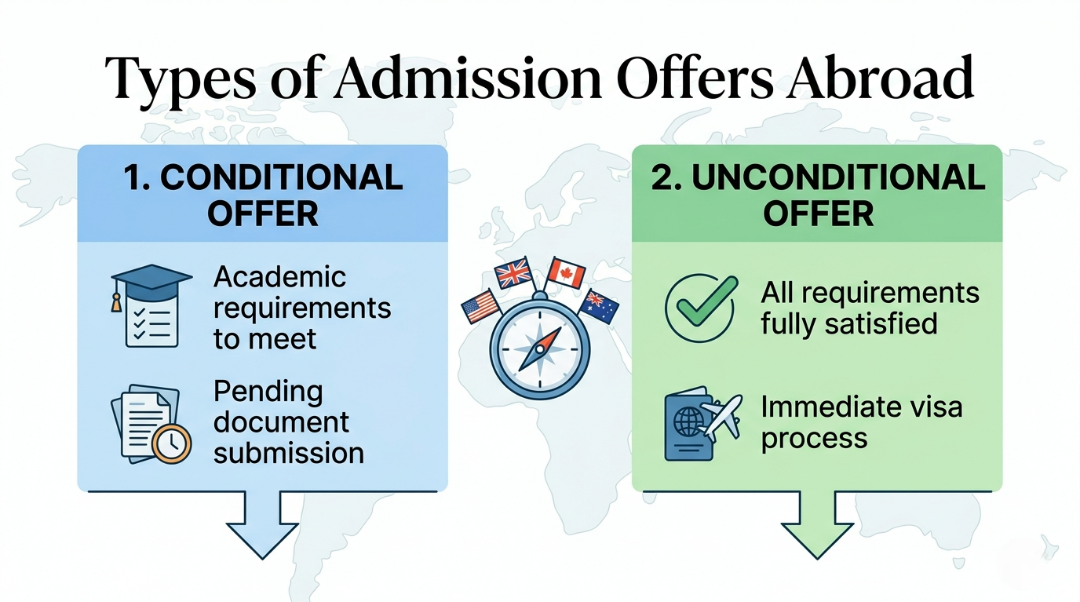
2. Unconditional Offer Letter
An unconditional offer letter is your admission, which is 100 per cent certain since all the requirements are put into place.
- It makes you feel that your college experience, by writing papers and passing tests, is true.
- It will enable you to carry on with the visa application and pay the fee.
- It is a secure and final admission at a conditional vs an unconditional offer letter.
Getting to know about such admission offers in other countries helps in laying out their future moves and being certain of their achievements.
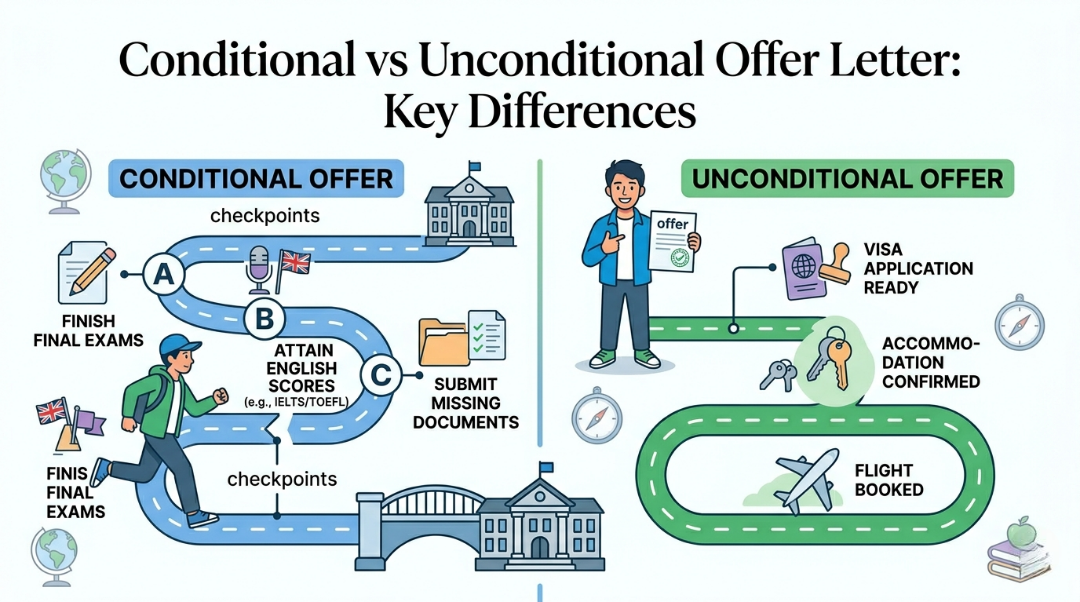
Conditional vs Unconditional Offer Letter: Key Differences
A momentary contrast to suit you precisely up-to-date with the variation is furnished below:
|
Feature |
Conditional Offer Letter |
Unconditional Offer Letter |
|
Requirements |
You must have satisfied certain academic or document-related (in English language) requirements within a deadline. |
Once offered, no other papers will be prepared. |
|
Admission Status |
Admission can be conditional, hence tentative, to meet some conditions as required by the university. |
Admission is completely verified, with no outstanding conditions. |
|
The application for a visa could either be postponed or curtailed until all the requirements have been met. |
Your student visa application can be immediately commenced. |
|
|
Documents |
Some officers have not yet been submitted, e.g. final transcripts or test scores. |
I have submitted all the required academic and support paperwork that has been confirmed and presented. |
|
Risk Factor |
The selection of the offer can be lost in case of failure to fulfil the conditions within the required time. |
Once one takes the offer of receiving the conditions and they have already been met, then there is no chance of losing the admission. |
This table simplifies the conditional vs unconditional offer letter to students and parents.
Conditional Offer Letter: What is a Conditional Offer Letter?
A conditional offer is offered in case the university is willing to know your profile, but needs additional confirmation before final confirmation.
Common Conditions Include:
- Typically, you are required to mail your final academic transcripts to the board or university upon the announcement of the board or university results.
- The university may require you to have the minimum required mark in English proficiency examinations like IELTS, TOEFL or PTE.
- When under scrutiny, you may be asked to provide some other supporting documents that might involve proofs of money, certificates you await, as well as verification papers to qualify for admission.
- If, say, you are in Class 12, or you are in the final year of graduation, you might get a conditional offer not until you get your results.
It is quite characteristic of the study abroad admissions process, especially on the part of early applicants.
👉Read More: UK vs Australia for international students
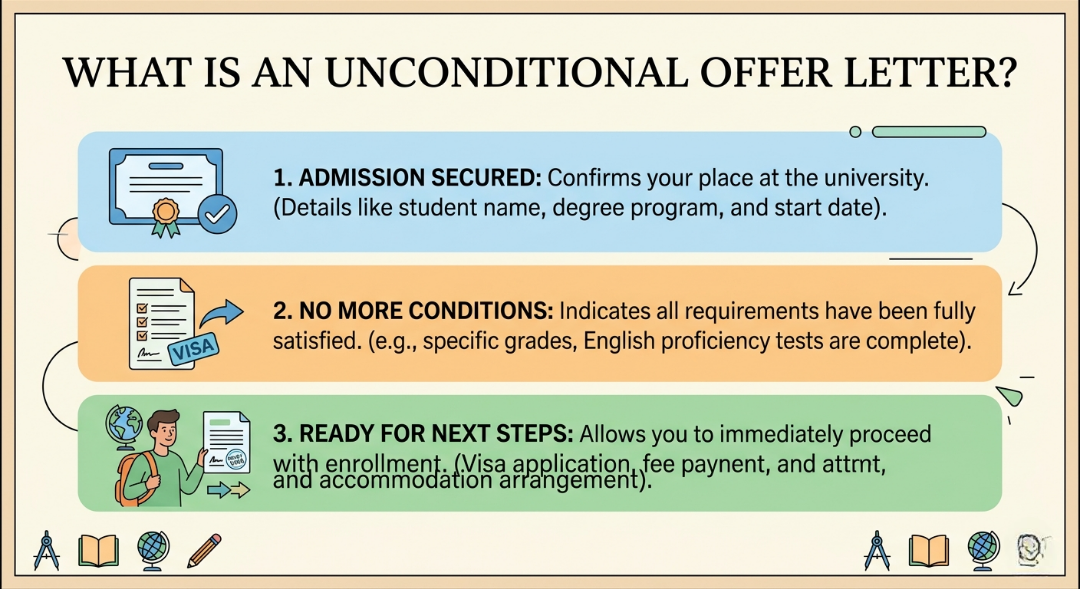
What is an Unconditional Offer Letter?
An intense offer letter. An unconditional offer letter is a formal confirmation letter, which confirms that you have already met all the requirements successfully before the university and that you have already taken your position in the university.
Key Features:
- No other academic requirement is required of you to submit to the university since you have already submitted transcripts and the English proficiency test scores.
- All your documents have been reviewed and checked effectively by the university.
- We are hastening all the assent orders on what to do next, such as remitting tuition fees, visa preparation and accommodation amenities without thinking twice.
This is the point of uncertainty in the conditional vs unconditional offer letter, where the student and parents are able to make plans since they are certain of admission.
What are Conditional offers? Why Do Universities offer them?
Conditional offers have been introduced in universities to enable students to have a fair chance of acquiring admission, which, in some cases, is not yet ready. This is beneficial to any student as well as an institution, as the process of admission is made nimbler and more efficient.
- It enables students to make their applications early and book a seat without having to wait till even their final academic outcomes have been officially announced.
- It helps the universities to identify and get hold of the most talented applicants in time prior to the admissions deadline.
- It allows a certain leeway to the admissions process in the field of study abroad, where students can complete the unfulfilled requirements without delays, to open intake lines.
This is especially beneficial to Indian students whose performance in the board exam, as well as in the entry test, is typically announced late; that is why they are able to apply early with a conditional offer.
👉Read More: IELTS score needed for scholarships
When can a Conditional Offer Be Unconditional?
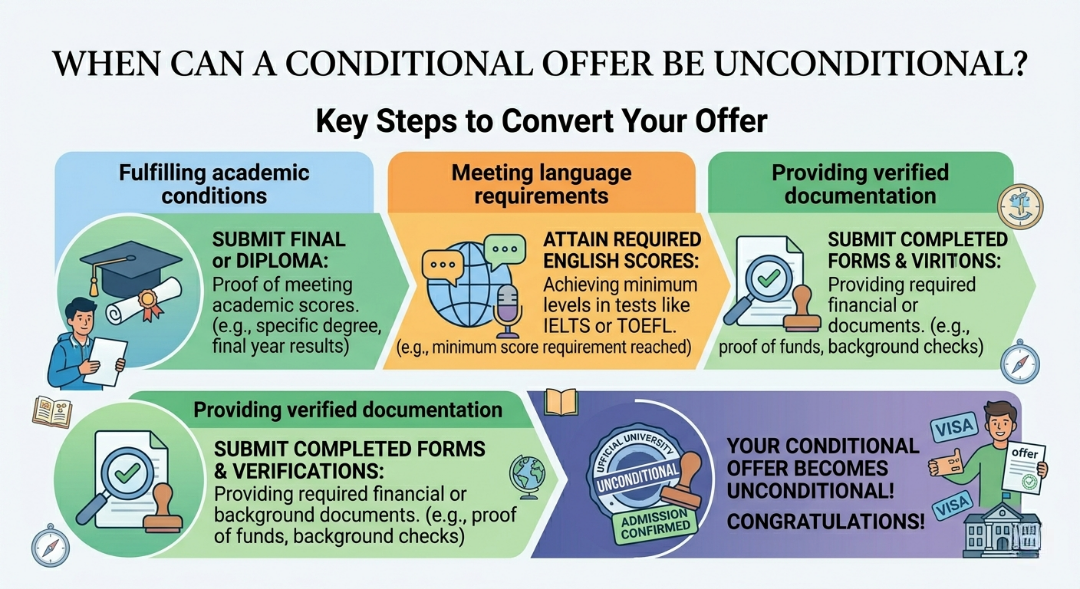
A conditional offer becomes an unconditional offer once all the requirements by the university are fulfilled within the stipulated time.
- Since you declare your results, you must provide your final academic transcripts and certificates when requested.
- Your minimum English proficiency scores, as stated in your offer letter, must be the lowest.
- You need to possess up-to-date documents or proof of verifications, etc., and hand them over within the agreed deadline.
Once these requirements and conditions are met, any admission study is modified by the university to an unconditional one. This forms a very crucial procedure in the conditional vs unconditional offer letter procedure, since you can be confident that you have taken the required measures in your course towards applications to get a visa, as well as enrollment.
Which is an Improved Offer Letter?
The importance of the conditional vs unconditional offer letter is in both cases.
Conditional Offer Improves in circumstances where:
- You would like to get into your desired university early, before the application deadlines run out.
- Your performance in school has yet to be declared, and it has not been officially declared by your school or university.
- You have not yet chosen the possible alternatives and forecasted your finances to your ultimate decision on whether to admit or decline.
Unconditional Offer is the best when:
- It is now time to proceed with your student visa application without any additional requirements or delays.
- You prefer to go through the admission process faster with fewer uncertainties likely to arise during the whole process.
- You have fulfilled all the achievements, examinations, and documentation standards of the university.
Learning of this distinction will guide students in negotiating types of admission offers overseas in a more confident manner.
Student and Parent Practical Suggestions.
Some of the tips that may be put into practice to ensure the conditional vs unconditional offer letter works are as follows:
- Reading and making notes on all bases mentioned in the offer letter is always to be followed, and the date should not run away without strictly following the stipulations.
- Make sure to study early enough so that during the time you will have prepared a lot to actually do the tests in the English proficiency, so that you attain the required scores within the required time.
- Note to have all academic and supporting materials ready on time, so that there is no rush during submission period.
- Also maintain permanent contact with your counsellor to be aware of the direction your application is taking and iron out issues before it is too late.
With an adequately designed approach, the study abroad admission can be simplified.
👉Read More: Study in Italy without IELTS
Fees and Budgeting.
It is important to know the costs of various admissions offers in foreign countries when it comes to handling their offers.
Typical Expenses Include:
- Concerning application fees it usually depends on country and university; it is between 5,000 to 10,000.
- Tuition fee can differ considerably with a range of 10 to 40 lakh annually depending on the course as well as the country.
- The costs of a visa application and health insurance have to be covered in your total budget.
- Living expenses and accommodation- again, this is determined by the place of residence and lifestyle, but is pre-planned.
An unconditional offer enables you to better plan your finances. This is the other significant aspect of the decision-making process of the conditional vs unconditional offer letter.
The Value of Gateway Educonnect to You.
Having over 15 years of experience and having placed over 23,000 students so far, Gateway Educonnect streamlines the whole study abroad admission procedure.

What makes us different:
- In our one- click application system, all you have to do is take 100 seconds to apply to international universities.
- We have a highly developed application platform where you can get your instant offer letters in less than 24 hours.
- Our team sees to it that all people are offered complete services like education loans, housing services and counselling.
Our specialists make you realise the difference between conditional vs unconditional offer letter and help you make the appropriate choice.
FAQs: Conditional vs Unconditional Offer Letter
1. What is the difference between conditional vs unconditional offer letter?
An offer with conditions means that you have to fulfill some conditional vs unconditional offer letter one assures that you have been accepted without conditions.
2. Am I being offered a conditional letter, and can I also get a visa?
You should also, in the majority of cases, convert it into an unconditional offer before applying for a visa.
3. Conditional offer: What is the time frame to convert a conditional offer?
It is pegged on the speed at which you submit the documents required, usually within two weeks.
4. 4. Is a conditional offer risky?
It contains a certain degree of risk in the event that you fail to qualify, and that is the reason why you need to be aware of what the university's offer letter entails.
5. What nations typically give conditional offers?
Conditional offers are some of the usual traditions practised by countries, including the UK, Australia, and Canada, in making admission offers to overseas students.
Conclusion
One of the differences between a conditional vs unconditional offer letter is a significant part of the admission process to study abroad. A conditional offer will help you secure admission early enough, and complete the outstanding duty; an unconditional offer provides all the confidence and assurance to take a step towards a favourable direction. Both alternatives are significant based on your level of study and preparedness. At the right time, the correct choice can cause life to become a lot simpler, not only to the students themselves, but also to the parents themselves as they go through with the application up until an eventual issuance of a visa. With proper planning and expert guidance, you can avoid feeling disoriented and take confident steps towards your goal of international education.For more assistance, please visit our study abroad consultancy services and explore our wide range of offerings for students interested in studying in the USA, studying in the UK, studying in Australia, studying in Ireland, and many other countries.
Take the Next Step with Gateway Educonnect
Prepared to learn overseas? Simple actions to be taken with the assistance of Gateway Educonnect.
- Gateway Educonnect and have an opportunity to receive professional tips towards achieving any objectives when studying abroad.
- Register now with Gateway Educonnect and have a hassle-free and quick admission process without unnecessary delays.
- Interested in exploring the opportunity of studying abroad? Gateway Educonnect will link you with scholarship opportunities in order to reduce the expense of your studies.
Contact our study abroad advisors and receive all the information about admissions, visas, etc.

Author Bio
Abhinav Jain - Founder, Gateway Educonnect and Director.
B.Tech, MBA, AI and Global Education Specialist.
More than 15 years of professional experience in leading students along international routes based on politics and innovation.