02 Nov 2026 | CPT and OPT Explained 2027-28: Complete Guide for Indian Students

0
38
CPT vs OPT Difference for International Students in the USA: Complete Guide for Indian Students
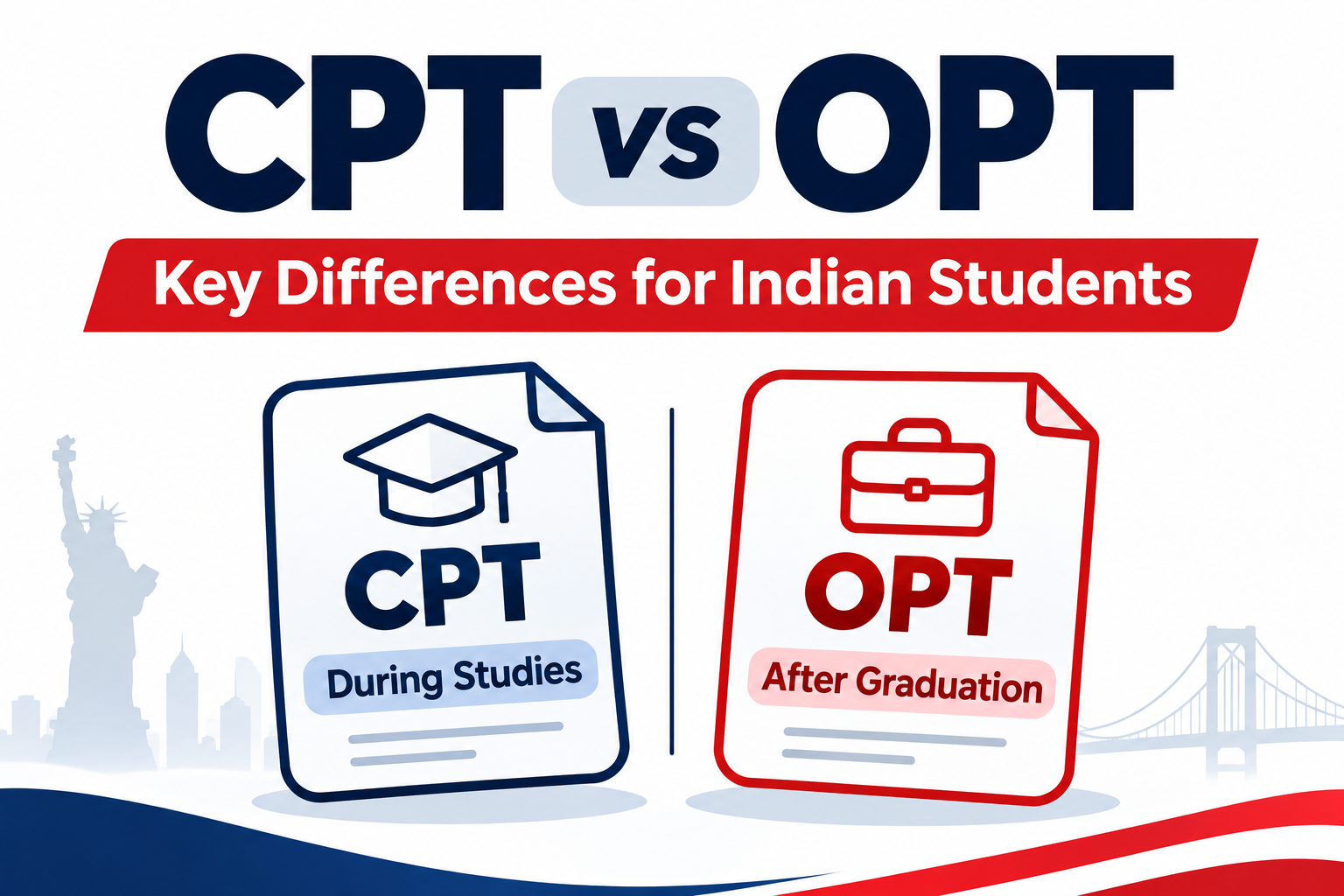
The CPT vs OPT Difference for International Students in the USA is quite simple: Curricular Practical Training (CPT) has to be the part of an approved academic program whereas an Optional Practical Training (OPT) allows eligible F-1 students to acquire some practical experience in the field directly connected with their major. CPT usually occurs as part of a study; OPT may be executed prior to or following the completion of the programme.
As an Indian master student, it is unsafe to opt to take a degree because of promises of its internship or post-study employment without thorough scrutiny of these guidelines. This guide provides you with a feasible decision model, more specific filing deadlines and queries to ask your university before making a commitment.
Immigration policies and fee of application in the US can be altered. You must apply to the USCIS before it opens, making sure to review the latest USCIS OPT guidelines and verify with your university Designated School Official (DSO) to know of your status.
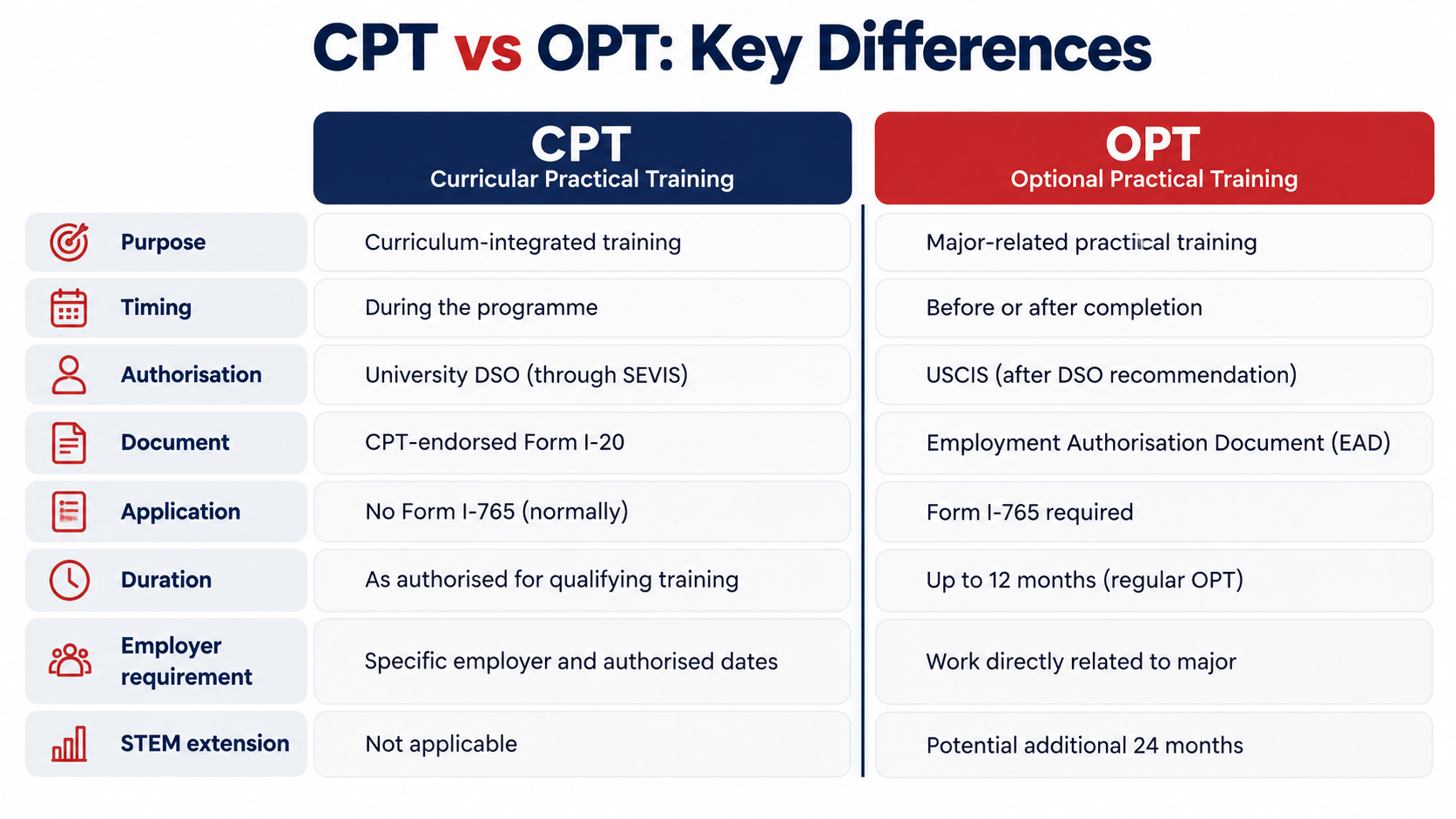
Main Differences: CPT vs OPT
The CPT vs OPT Difference for International Students in the USA is connected with the motive of the practical training, under what and when it is possible and how employment authorisation can be provided.
|
Question |
CPT |
OPT |
|
What is its purpose? |
Curriculum-integrated training |
Major-related practical training |
|
When? |
During the programme |
Before or after completion |
|
Who authorises it? |
DSO through SEVIS |
USCIS after DSO recommendation |
|
What proves authorisation? |
CPT-endorsed Form I-20 |
Employment Authorization Document (EAD) |
|
Is Form I-765 required? |
Normally no |
Yes |
|
Typical duration |
As authorised for qualifying training |
Up to 12 months of regular OPT |
|
Employer requirement |
Specific employer and authorised dates |
Work directly related to major |
|
STEM extension |
Not applicable |
Potential additional 24 months |
CPT is not an open license to work while studying. OPT is not an automatic grant following graduation. The practical training overview of DHS explains the two.
Which route fits your situation?
You can decide what to investigate, not to assume eligibility, by Use the CPT vs OPT Difference for International Students in the USA.
- Master-level training: Whether the graduate curriculum actually entails immediate involvement.
- Mandatory internship in your degree: Can the university authorise CPT?
- Work experience before graduation: Check pre-completion OPT and how it affects your subsequent allowance.
- Potential extended post study training: Certify STEM degree or classification, employer terms and extension, allow ability.
- Post-master work: Have a plan post-completion OPT more than one year before the programme final date.
CPT authorization and eligibility
An important CPT vs OPT Difference for International Students in the USA is that CPT needs a demonstrable curricular connection. A job offers on its own is insufficient.
Normally, the student must complete one full academic year of eligible study. There is a limited exception when a graduate programme requires immediate practical training. The university must decide whether the training qualifies and its DSO must authorise it in SEVIS.
Before beginning CPT:
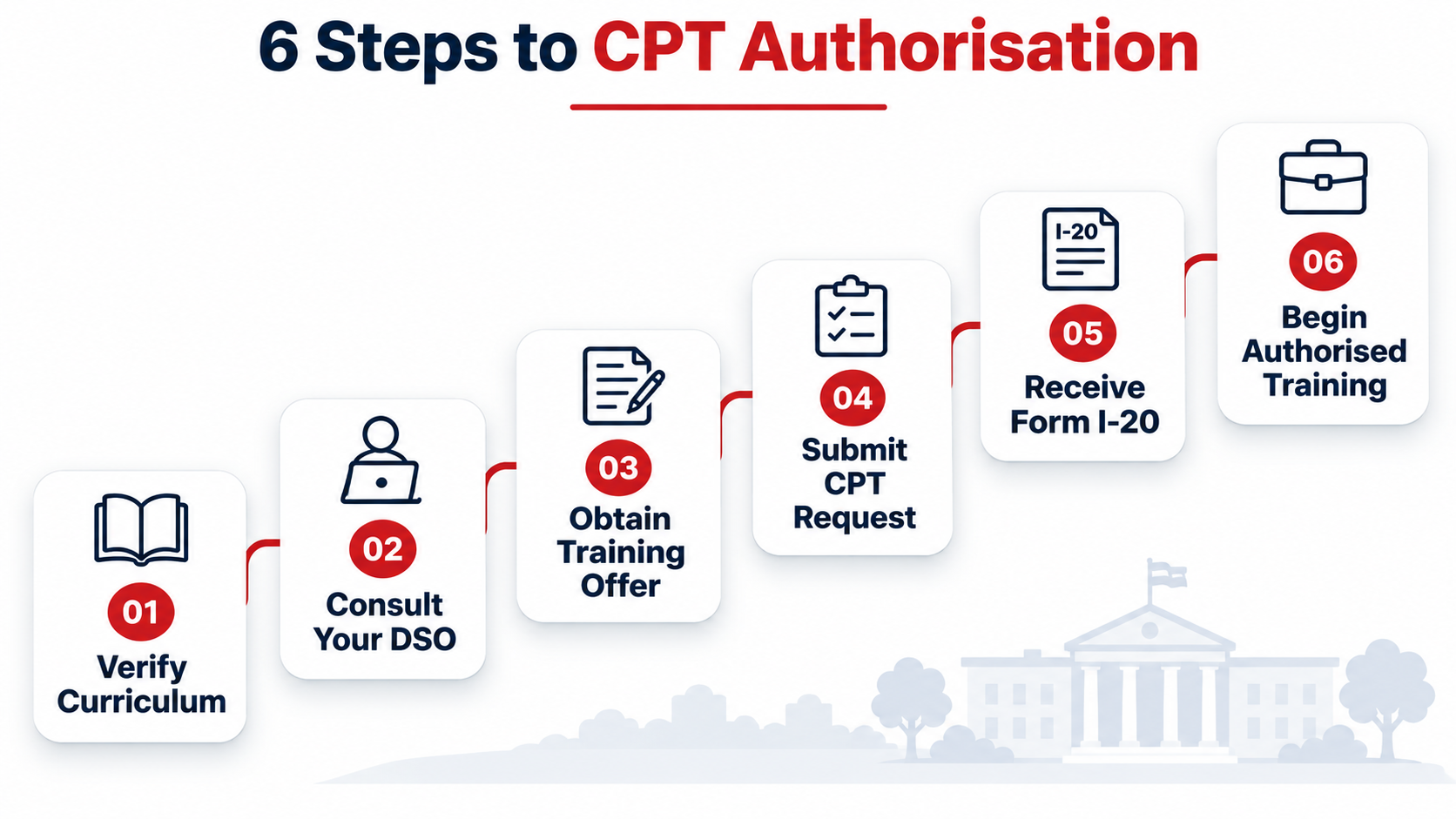
- Ensure your programme integrates the placement, as part of the formal curriculum.
- Get the training voucher and other academic approvals the university demands.
- Request the DSO to grant permission to the particular employer, time and term.
- Get Form I-20, which is updated and approved by CPT.
- Always work under the conditions mentioned; only find new authorisation when changing the employers or the dates.
Consult DHS guidance on curricular practical training.
Day 1 CPT: what to verify
CPT vs OPT Difference for International Students in the USA is of particular concern when there is a programme that claims to offer Day 1 CPT. That term does not denote a certain kind of visa or that one is guaranteed with employment.
The exception of the graduate is a case in which urgent training is pointed by the curriculum. Questions to be asked by the international student office in writing before you pay a deposit include:
- Why is immediate training needed as per an academic requirement?
- Does the institution supervise, assess or otherwise document the placement?
- What face-to-face courses and full-course-of-study requirements will work?
- Will this employer and schedule be authorised by the DSO?
- What would be the consequences of training being halted or modified?
A marketing page cannot replace individual authorisation.
OPT eligibility: before and after graduation
For the CPT vs OPT Difference for International Students in the USA, remember that ordinary OPT is recommended by the DSO but authorised by USCIS through Form I-765.
Pre-completion OPT is major related training prior to the end of the programme. It takes away some of the 12-month regular OPT allowance; part-time is deducted accordingly. This is post completion OPT provided by successful training post-completion.
Candidates typically must possess qualifying F-1 status, the academic-year history required, be able to access OPT eligibility and DSO recommendation. An application will not enable work to start.
Follow the instructions of the USCIS Form I-765 with support of the evidence of the prior CPT or OPT usage, but not on the basis of social-media checklists.
Why the Two DSO Recommendation Deadlines Matter
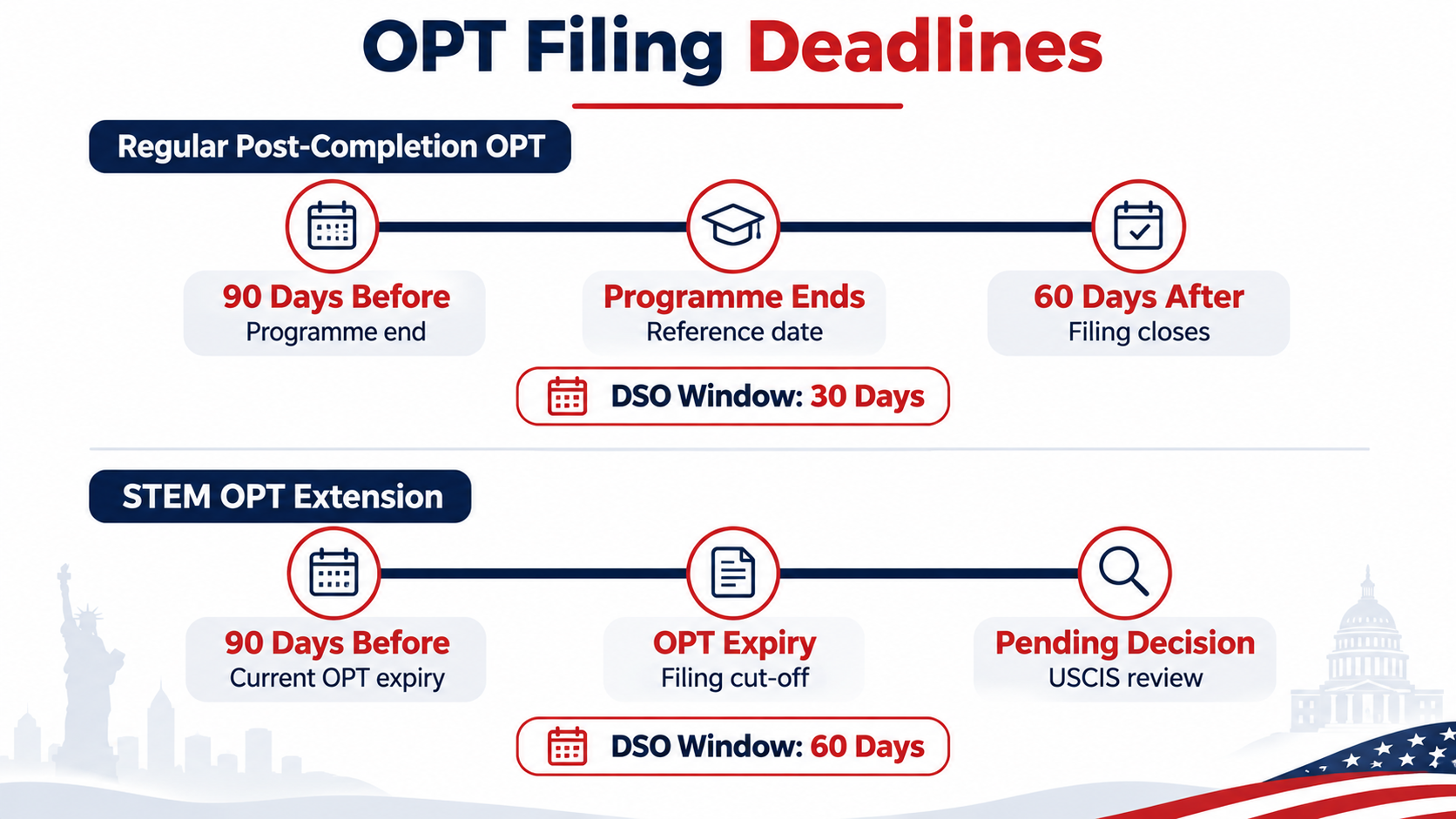
The CPT vs OPT Difference for International Students in the USA also relates to various filing spaces. There is no extension of the programme-completion deadline by an early DSO recommendation.
|
Application event |
Standard window or requirement |
|
Regular post-completion OPT opens |
Up to 90 days before programme end |
|
Regular post-completion OPT closes |
No later than 60 days after programme end |
|
Regular OPT DSO recommendation |
File within 30 days after entry in SEVIS |
|
STEM OPT extension opens |
Up to 90 days before current OPT expires |
|
STEM recommendation window |
File within 60 days after DSO recommendation |
|
STEM extension cut-off |
File before current OPT expires |
To obtain regular post-completion OPT, Form I-765 is required within 30 days of the DSO receiving the recommendation in SEVIS. It should also be within the allowed programme-completion filing window.
To receive a 24-month STEM OPT extension, a student has to submit it to 60 days of DSO recommendation and prior to the expiration of an existing OPT.
Technology error: Sometimes students believe that the deadline of the STEM OPT recommendation is the same as general OPT deadline. It is not.
On submitting an application, verify the deadline related to the programme and the corresponding date in which a particular recommendation was issued on the SEVIS.
Can full-time CPT cost you OPT?
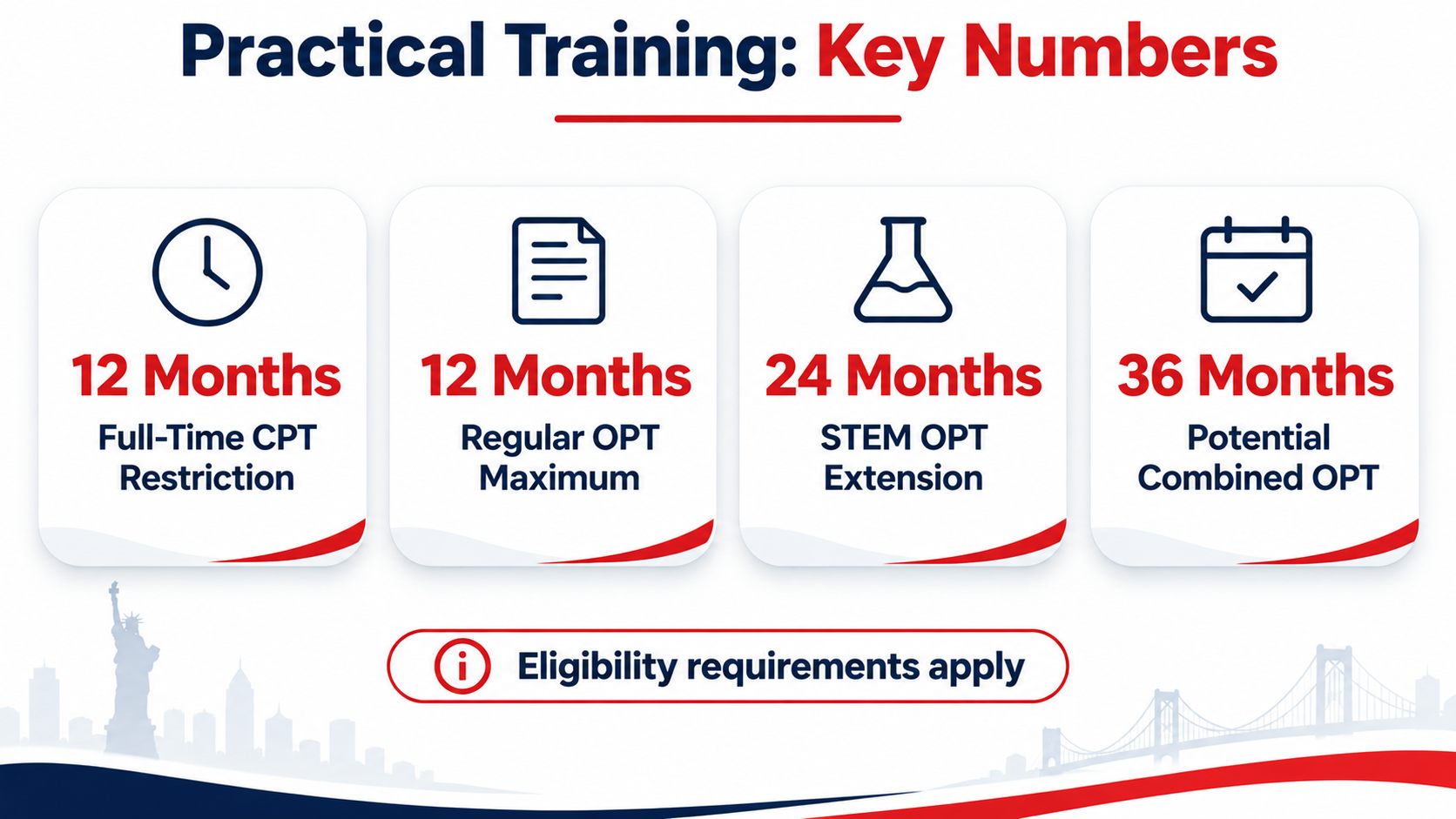
One decisive CPT vs OPT Difference for International Students in the USA is that 12 months or more of full-time CPT disqualifies a student from post-completion OPT at the same educational level. Part-time CPT does not trigger this particular bar.
Consider a master studies student going through a number of independent full-time training sessions. The timeframes need to be taken into account on a cumulative basis; learning in a different university should not be presumed to put in a fresh start. Request your DSO to consider the real authorised CPT history prior to subsequent placement.
The distinction is confirmed in the DHS practical training comparison.
STEM OPT: who gets another 24 months?
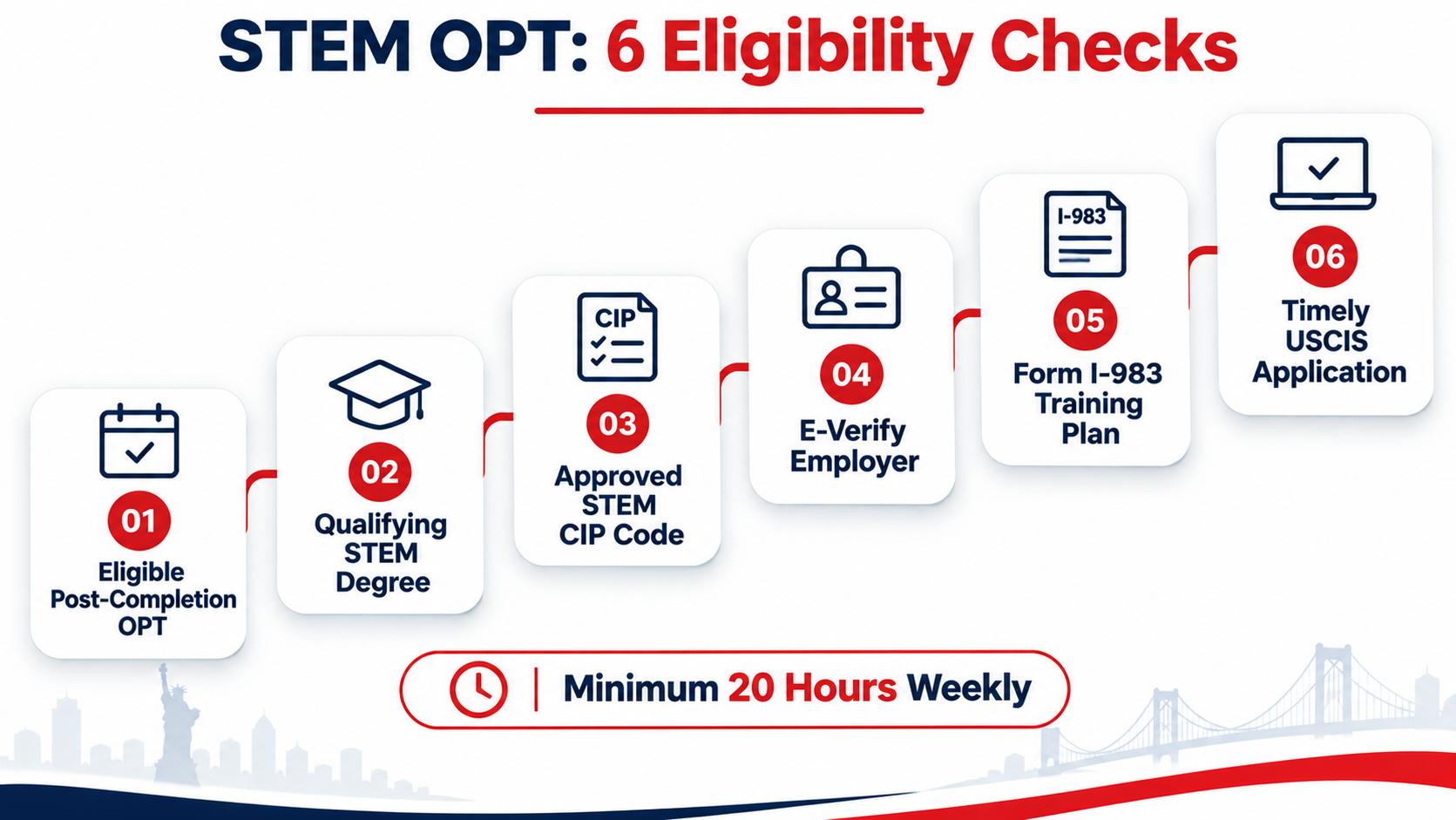
The CPT vs OPT Difference for International Students in the USA becomes especially relevant when a master's programme claims to be “STEM-designated”. Eligible students may seek a 24-month extension after regular post-completion OPT, potentially bringing total authorisation to 36 months.
Check all of these:
- You have qualified post-completion OPT and meet the degree-related requirements.
- The qualifying degree's official CIP code is on the current DHS STEM list.
- Your employer is in E-Verify.
- The qualifying position will offer a minimum of 20 hours of employer weekly work.
- You and your employer attend a real training plan Form I-983.
- You apply for a STEM extension on time and meet the reporting requirements.
A master's title in analytics or business is not a qualification, as it is too technical. Some US seminars completed so far in STEM can support eligibility in other circumstances; an Indian undergraduate certificate by itself should not be able to claim an advantage under this. Visit the USCIS STEM OPT policy update.
Can You Continue Working While Your STEM OPT Application Is Pending?
Students with an expired STEM OPT Employment Authorisation Document (EAD) may be permitted to work further provided that they submit a timely-received STEM OPT extension application.
However, further work permission is subject to the following conditions. The students will ensure that:
- USCIS received the qualifying extension application before their existing OPT expired.
- Their DSO duly approved the STEM extension.
- They have the required application and employment authorisation documentation.
- Their work is still within the relevant STEM OPT requirements.
An application does not necessarily grant a work permit in all OPT categories. Before relying on continued work authorisation, the students are advised to check the existing automatic-extension period and terms using the official USCIS guidelines.
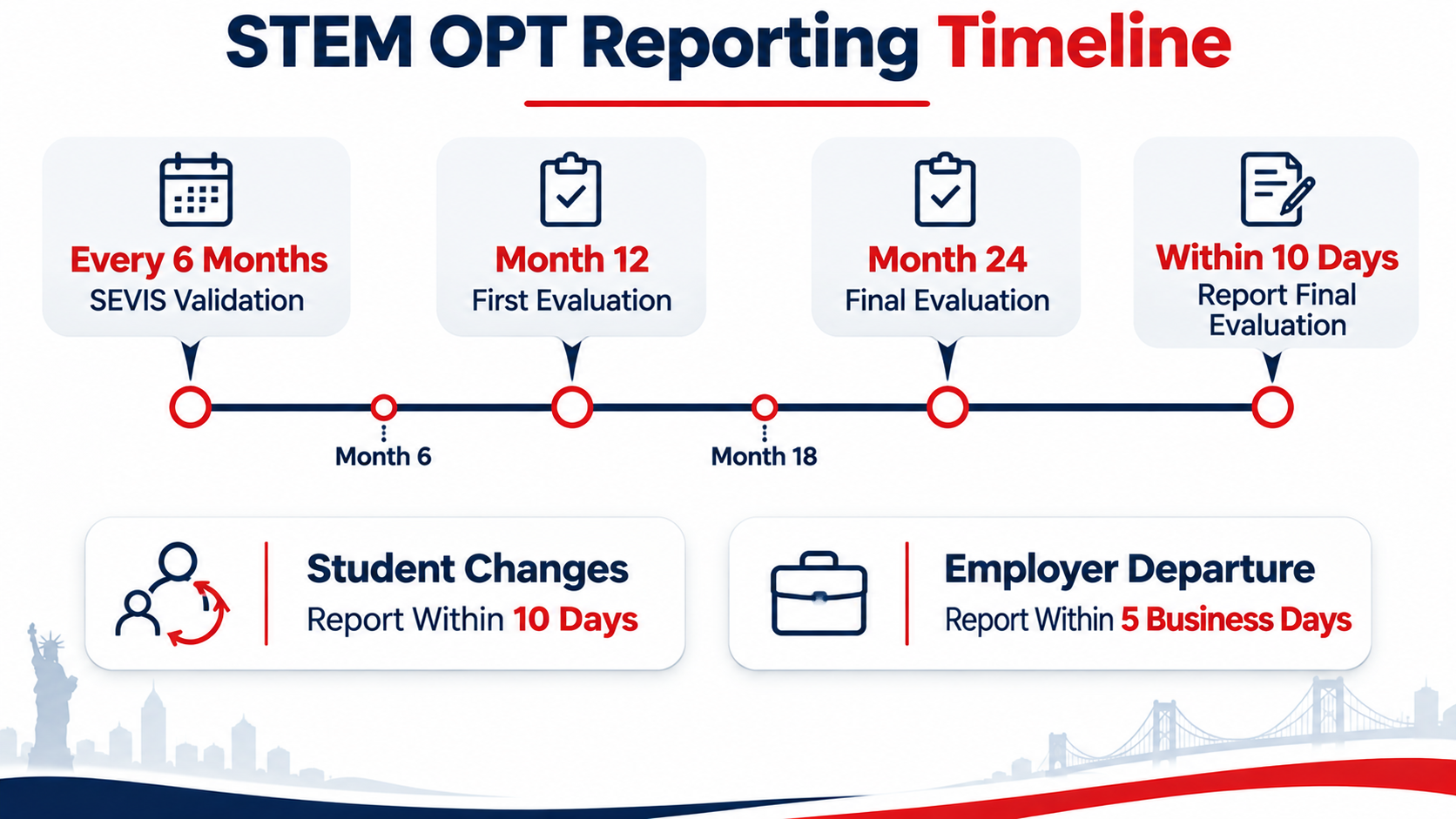
STEM OPT Reporting Requirements
The CPT vs OPT Difference for International Students in the USA does not only contain continuing obligations, it encompasses initial EAD approval.
- Every six months: Update personal and employment information with the DSO.
- After 12 months: File the initial formal self-rating on the Form I-983.
- At the end of the training: Turn in final evaluation in 10 days.
- In 10 days of any changes: Report changes of personal information, employer or the qualifying employment.
- In the event of the change of employer: Organize the following new Form I-983 and notify the DSO about the change.
- Duty of the employer: Employers are obliged to report termination or departure of student within five business days.
The students are expected to have duplicates of their training plans, appraisals and job records. Compliance with immigration can be impacted by not fulfilling reporting requirements.
To find the full requirements, check the DHS STEM OPT Reporting Checklist.
OPT Application Fees and Premium Processing
In the study CPT vs OPT Difference for International Students in the USA, differentiate between the regular fee to file to the USCIS and the suggested changes to the policy.
The cost of the application varies with the type of filing, application and USCIS fee schedule that is applicable at the time of filing.
Premium processing is an optional service where provided, and must be applied separately, using Form I-907. It includes a special fee and does not guarantee approval.
Before payment, students are to:
- See the present USCIS Fee Schedule.
- Ensure they are using the correct filing type.
- See whether online filing is available.
- Check any other premium processing costs.
- Pay according to USCIS's current instructions.
Do NOT count on the amount of any fee quoted in older university pamphlets or immigration articles.
Can F-1 Students Travel While OPT Is Pending?
The CPT vs OPT Difference for International Students in the USA can have an effect on travel documents particularly in the post completion of the programme. When initial OPT is pending, approved or undergoing an extension, the rules and risks are different. Prior to departing of the USA, verify your passport, F-1 visa, travel-endorsed Form I-20, any EAD and employment documentation with the DSO. An unsuccessful application does not assure of re-entry.
Prior to travelling, confirm your status of application:
- Initial OPT pending: Clarify the risks of undertaking travelling once the programme is complete, especially when USCIS may demand further evidence and/or make up his decision when you are offshore.
- Approved post-completion OPT: Review requirements of travel endorsement with Form I-20, employment evidence, passport, and visa and EAD.
- STEM OPT application in progress: Check the documentation and re-entry conditions of your current and future authorisations.
An application pending or a valid EAD is not a guarantee by itself to admission to the United States.
Students are to get the case-specific advice of their DSO prior to travelling to the US and consult the most recent USCIS OPT instructions.
FAQs
Is it possible to employ both CPT and OPT?
Yes, if eligible. The CPT vs OPT Difference for International Students in the USA has the full-time CPT cap that may take away the further post-completion eligibility of the OPT.
Will I be able to start working on day 1 of my master's programme?
Not automatically. You can use CPT immediately if the graduate programme requires practical training at the start and the DSO authorises it.
Does part-time CPT affect OPT eligibility?
Part-time CPT does not activate the full-time restriction of CPT. Pre-completion OPT, however, decreases the left-over regular OPT allowance.
Can I switch employers on CPT or OPT?
CPT has to be employer-specifically authorised. Regular OPT can permit eligible employer changes regularly with appropriate reporting. STEM OPT has additional employer and training requirements.
Can MBA students take advantage of STEM OPT?
It depends on the programme's official CIP code and other eligibility requirements. An MBA does not necessarily qualify as STEM. Review the DHS STEM Degree List.
Conclusion
Learner Knowledge about CPT vs OPT Difference for International Students in the USA is mandatory to Indian students intending to study a master degree in the United States of America. CPT provides a chance to gain practical experience within an academic programme. Still, OPT offers qualified graduates a chance to gain experience and pursue career opportunities in their field of study. The STEM OPT extension allows STEM graduates who meet the criteria more time to gain professional experience.
But these opportunities need to be utilized by proper planning. Selecting an appropriate university, eligibility to do internship, confirmation of STEM designation and immigration documents are all crucial factors. These factors and the interest the students have in their academics and their long term career objectives should be considered, and not the work opportunities the programme can offer.
When a student-abroad trip is well planned, decisions should be well informed and the academic direction clear. When you are drafting your master’s application in the US, visit the Gateway EduConnect SOP Writing Guide to learn how to present your academic experiences, programme choices, and career goals to your best advantage.
Author Bio
Abhinav Jain - Founder, Gateway Educonnect and Director.
B.Tech, MBA, AI and Global Education Specialist.
More than 15 years of professional experience in leading students along international routes based on politics and innovation.
Connect: https://www.linkedin.com/in/abhinavedysor/