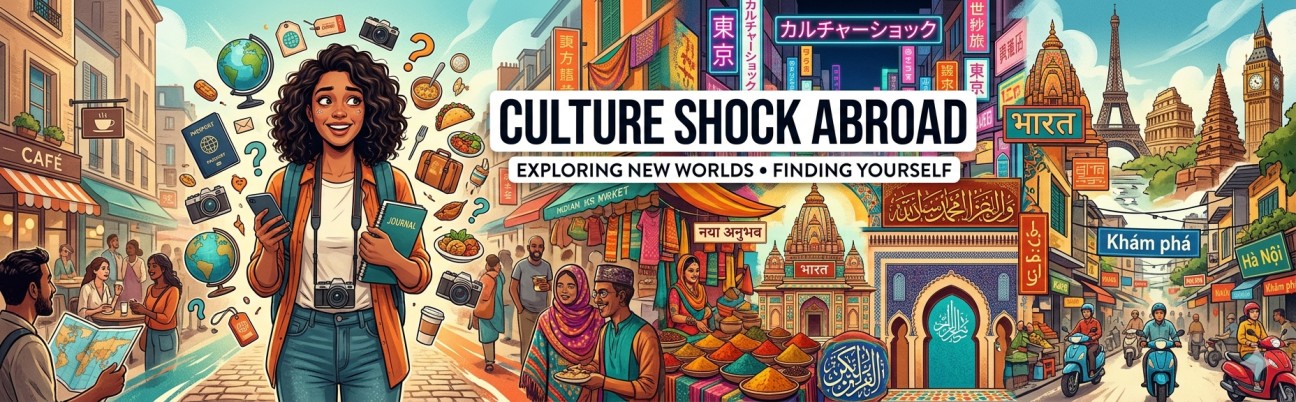
03 Apr 2026 | Culture Shock Abroad: Practical Tips for Adapting Smoothly as an International Student

0
58
Practical Tips for Adapting Smoothly as an International Student
Living abroad is an exciting experience for a scholar; they are exposed to new cultures, better education systems, and personal growth. This can, however, be accompanied by the challenges that most students, especially Indians, face due to culture shock abroad. Culture shock is a natural response to the new environment, new social norms, and differences in school. There may be a feeling of being overwhelmed, homesick, or concerned about their ability to adjust. Awareness of what a foreign country goes through in terms of culture shock and of the most effective measures to facilitate this situation is a critical aspect when it comes to an easy transition.
My personal experience has taught me the importance of proper guidance, open-mindedness, and pragmatic plans in influencing students, based on 15 years of practice guiding students in international relations. This blog will cover the most common obstacles, tips, and measures for cultural adaptation to help international students succeed.
What Is Culture Shock Abroad?
This change in the emotional, psychological, and social dimensions one experiences when moving to another country is often accompanied by culture shock abroad. It has been termed a mixture of excitement, stress, and uncertainty as students transition through new academic systems, social norms, and cultural behaviours.
Research shows that about 70 per cent of studies report that virtually all international students experience some form of culture shock abroad within the first few months of arrival (Institute of International Education, 2021). It is because even students who can communicate fluently in English face problems with communication, their daily routines, and understanding social norms.
Stages of Culture Shock
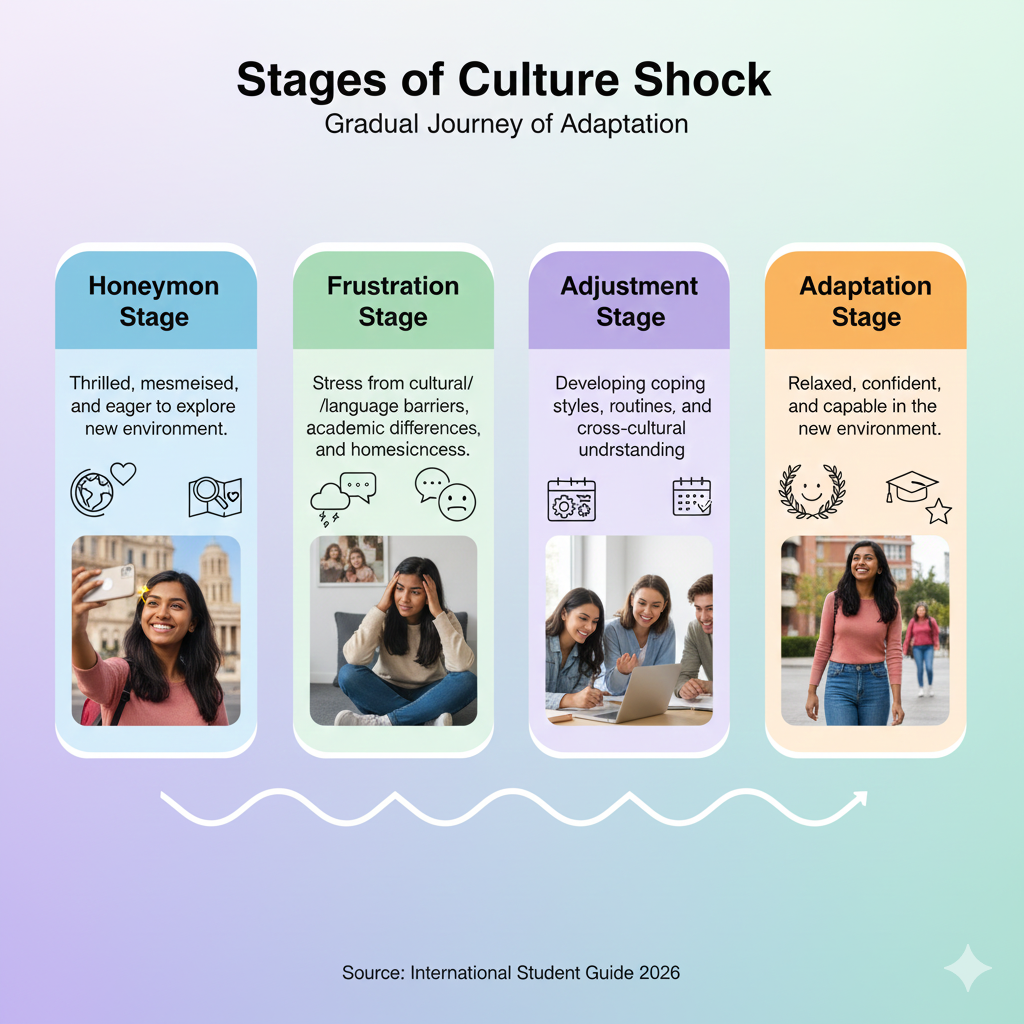
Culture shock does not come at once, but gradually. It is usually categorised into four stages:
- Honeymoon Stage - Students are thrilled, mesmerised, and interested in their new environment. There is nothing they know; students are eager to find out.
- Frustration Stage - Inequality in the culture, language, academic expectations, and societal expectations initiates the creation of stressors or frustrations. Students are also homesick or lonely at this stage.
- Adjustment Stage - Students begin to acquire coping styles, routines, and adapt to cross-cultural differences. They are conditioned to negotiate academic and social needs.
- Adaptation Stage - The last step is complete adaptation, where the students are relaxed, confident, and have the capability of working in the new environment.
Students should be made to understand that the discomfort is not chronic. This will aid students in taking the appropriate steps to advance in adjustment and adaptation by establishing their current level.
International Student Challenges
There are several issues that Indian students may face that can affect international students and might pose a challenge during the adjustment. The initial measure towards overcoming these challenges is understanding them.
Language and Communication Barriers.
Local accents, slang, or idioms may also be a problem for even students who know English well. Misunderstanding lectures, group projects, or even natural conversations can be frustrating. Reflectively, as a student who takes students to foreign states, I have discovered that students who are always ready to develop language proficiency, are prepared to talk and interact with others through questions and discussions, and also adjust faster.
Academic Differences
In foreign countries, the academic setting is usually very different from that in Indian classrooms. Most international systems, unlike the Indian education system, might focus on critical thinking, attending classes, and conducting independent research, rather than on memorising and theoretical information. Indian-origin students who appreciate this change sooner, seek advice from professors and participate in study groups will adjust more smoothly.
Social and Cultural Norms
Various countries possess varying social behaviours. Classroom etiquette, peer interaction, and professional demands may be unfamiliar to students. The inability to achieve these norms will lead to embarrassment or self-doubt. The capability of monitoring local behaviours, consulting the mentors, and socialising in the social environments gradually (with time) is effective in ensuring that the students can cope with these issues.
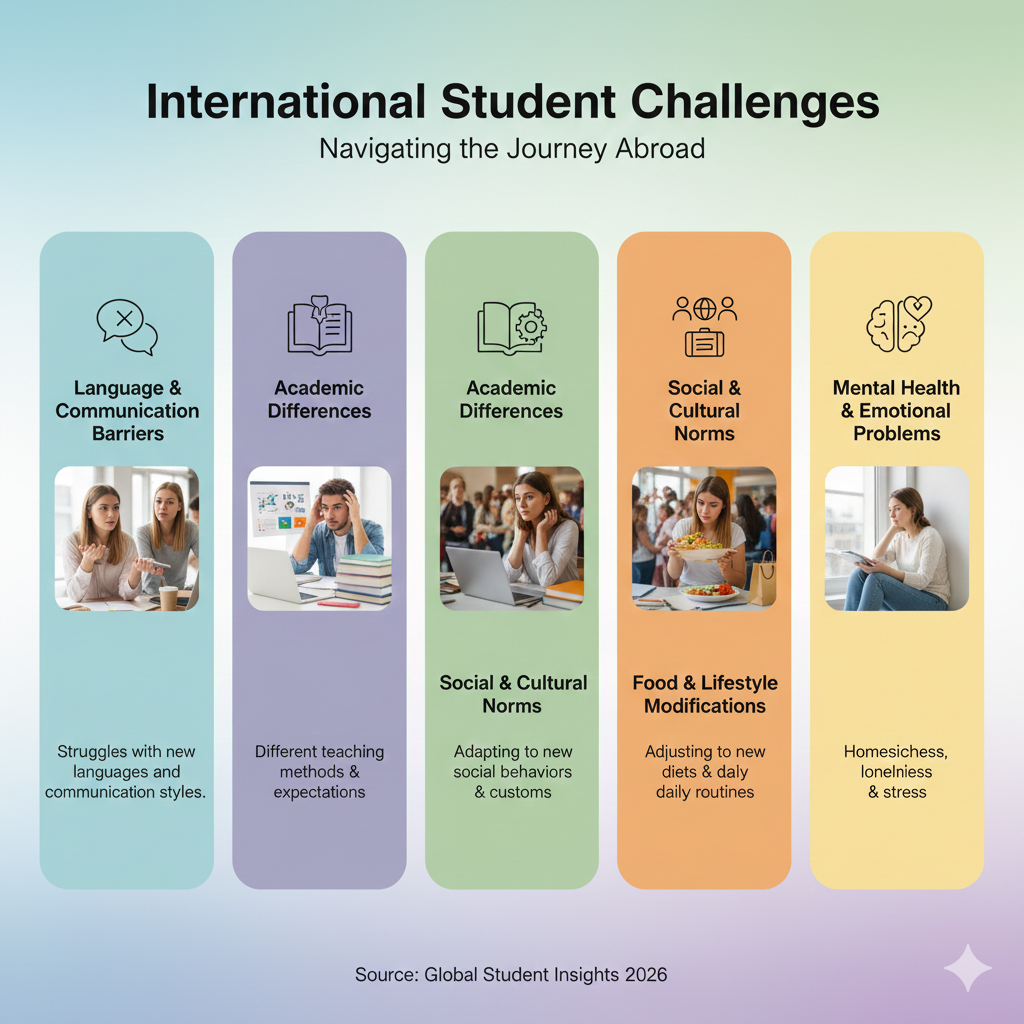
Food and Lifestyle Modifications.
Eating behaviour and supply can be among the key adjustments for Indian students. The well-known foodstuffs may not be as convenient, and students will be forced to adjust to the local food, meal schedule, and cooking methods. The level comes with a great deal of bodily and psychological pain among a number of students. The stress could be reduced by eating home-style meals or by trying local food.
Mental Health and Emotional Problems.
Homesickness, loneliness, and stress are among the challenges. According to a 2022 UNESCO report, 65 per cent of international students reported experiencing cultural adaptation-related stress. Proactive students who maintain social contacts by engaging in hobbies and professional counselling do not undergo such a dramatic adjustment process.
Early awareness of such issues will help students develop measures to reduce stress and enhance their professional and personal growth in a foreign country.
Studying Abroad Adjustment Tips
It requires conscious effort in order to adjust to a new country successfully. The subsequent studying abroad adjustment tips would provide the exact actionable measures to assist the students in getting along fine:
Be Open-Minded and Observant.
Students who view cultural differences as an opportunity to explore rather than criticise adjust more quickly. This has the capacity to transform obstacles to learning by observing local practices, posing polite questions, and trying cultural practices. For example, cultural festivals, the preservation of local food, and membership in local clubs gradually help develop confidence and reduce culture shock abroad.
Build a Support Network
Social relationships must be developed. Peer groups, student associations and mentors provide emotional support, practical advice and academic advice. Students who are anxious about social and educational relationships are identified as adjusting more quickly and under less pressure among Indian learners. Emotional stability is also fostered by maintaining contact with friends and family back home.
Maintain Academic Balance
A regular schedule will help children balance school and personal adaptation. The following is an example of the routine of international students on a daily basis:
|
Time |
Activity |
|
7:00–8:00 AM |
Exercise or mindfulness practice |
|
8:30–9:30 AM |
Breakfast and planning |
|
10:00–1:00 PM |
Classes/library study |
|
1:00–2:00 PM |
Lunch and social interactions |
|
2:00–5:00 PM |
Assignments/group work |
|
5:30–7:00 PM |
Hobbies or cultural exploration |
|
7:30–9:00 PM |
Dinner and relaxation |
|
9:00–10:00 PM |
Reflection/journaling/planning |
The fact that they are consistent in their learning process and that they are in a new setting can help the students to feel stable and safe.
Local Culture Step by Step.
Due to gradual immersion into the culture, stress is reduced. Students are more relaxed when they attend local events and festivals and explore the cuisine. Indian students who have fewer experiences in their daily lives will adapt more quickly and enjoy their stay in a foreign country.
Take Care of Mental Health
Self-care is essential. Some activities that help reduce stress and build resilience include meditation, hobbies, exercise, and counselling sessions. Special attention can be paid to international students in universities. Students who are actively addressing mental health issues are less likely to face adjustment challenges and more successful in school.
Cultural Adaptation Strategies
The cultural adaptation plans are long-term undertakings. The plans propagate social integration and individual growth:
Get Involved in Community Services.
To become friends and learn about local culture, students can join clubs, volunteer, or attend campus events. In my situation, student community participation leads to faster growth and greater self-confidence in their social relationships.
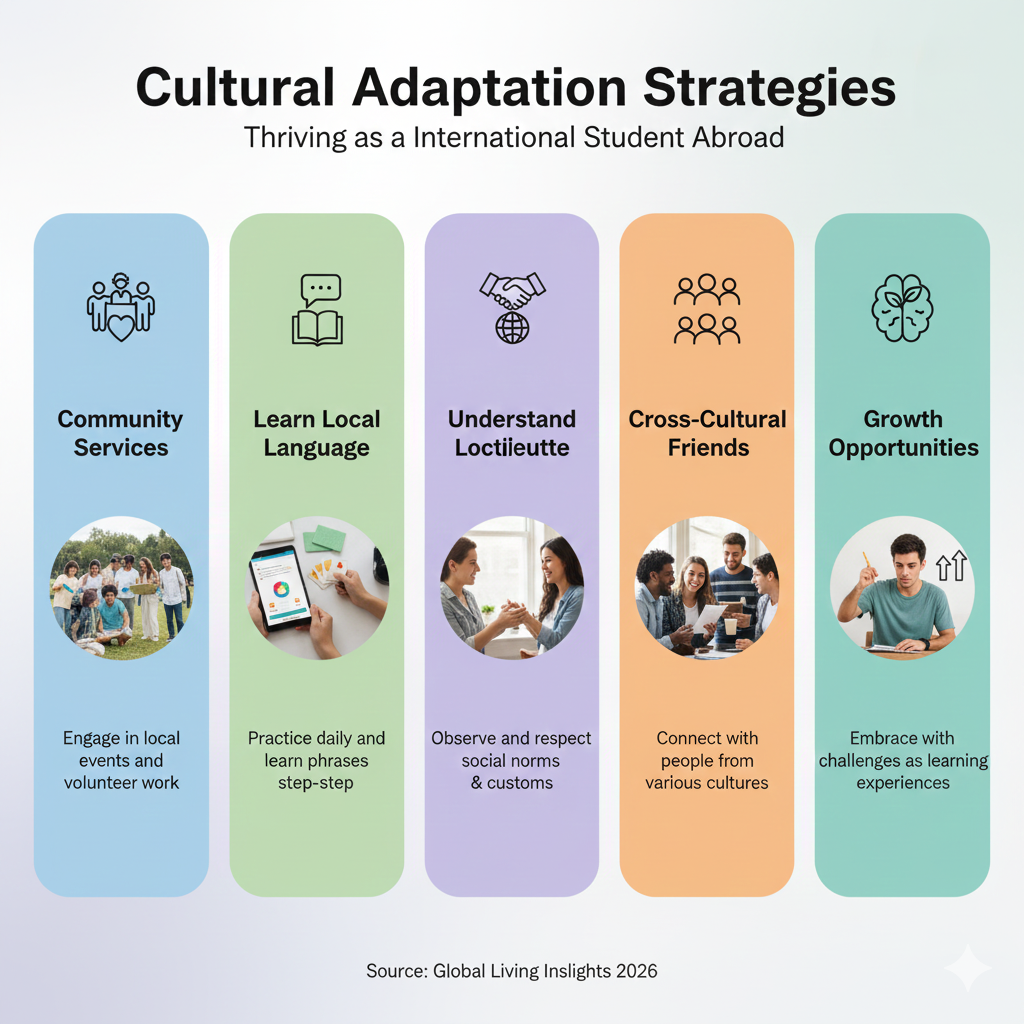
Learn the Local Language Step-wise.
Even a basic level of knowledge improves communication and helps with daily chores. Communicating with people or enrolling in language classes or language applications may be very beneficial in the process of adjustment.
Understand Local Etiquette
Confusion is prevented by being sensitive to social norms, classroom conduct and professional requirements. The interactions and consultation with mentors are also very successful to observe.
Make Cross-Cultural Friends.
Building relationships with local and foreign colleagues will enhance their awareness of cultural peculiarities and provide a support system. These are essential friendships for socialisation and emotional stability.
View Cultural Challenges as Growth Opportunities
The cultural adaptation endorses resilience, problem-solving, and an international perspective. By viewing challenges as a way to learn, such students develop highly significant skills not only at school but also in the workplace.
Common Mistakes to Avoid While adapting to a new culture
The culture shock abroad may seem quite natural, but most students make blind mistakes, which postpones their adaptation and assimilation into a new country.
- Social isolation, in which you are just associating yourself with other students in the country that you belong to, which restricts the extent of exposure and makes it difficult to adapting to a new culture.
- When one compares academics, food or lifestyle in a foreign country versus home all the time, it brings frustration and mishaps in the international student life.
- Ignoring the emotional and psychological well-being in favour of academics and self-care is one of the leading solutions of most studying abroad adjustment tips.
- Failure to intervene in the local experiences, events, or conversations due to the fear of the language barrier or cultural differences, despite the fact that it is imperative to utilise these strategies as one of the cultural adjustments.
- The lack of will to seek intellectual or personal assistance from universities, mentors or counselors, when they can do it easily.
By avoiding common pitfalls and being open, active, and motivated, students will be able to experience culture shock abroad with less fear and make their study abroad experience productive and fruitful.
Gateway Educonnect Support for Students Abroad
Proper guidance and support would suffice to make the process of culture shock abroad and adjusting to a new lifestyle much more comfortable.
- Individual counselling, which includes academic preparation, career goals and general international student challenges faced in foreign education.
- The admissions, scholarships and visas were step-by-step assisted, and the students were helped in their focus to study rather than worry about the processes.
- Practical production of tips on how to study abroad in terms of academics, routine establishment, and personal well-being sustenance is involved.
- Consulting services and counselling that assist one in locating the pathway through which they can settle in a new culture with ease and demystification.
- Constant assistance with the purpose of long-term success because of proven cultural adaptation strategies based on the destination of a particular student.
The experienced help of Gateway Educonnect will allow students to better deal with culture shock abroad and experience the international education process without finding it as hard, but rather enjoying it.

FAQs About Culture Shock Abroad
What is culture shock, and how long does culture shock abroad?
Culture shock abroad is a natural response to new cultural arrangements. The duration can range from a couple of weeks to months, depending on the support and coping measures and an individual's personal flexibility.
What can be done to enable Indian students adapt quickly to the new culture?
By staying receptive, joining certain groups of students, studying the fundamentals of the local language, and maintaining schedules. The gradual acculturation augments the adjustment.
Is feeling homesick normal?
Yes. Most students get sick at home first. Communicating with peers, engaging in activities and communicating with family can be beneficial.
Will cultural adjustment get in the way of academic performance?
To start with, the problem of adjustment can influence academic performance. The impact can be minimised by maintaining habits, seeking guidance, and balancing study with cultural exploration.
What is the assistance of mental health available to a student in a foreign country?
In universities, counselling services, peer support, and online resources are provided. Gateway Educonnect also introduces the students to good services and mentors.
Conclusion
Culture shock abroad is a common experience for international students, especially when Indian students are confronted with new academic, social, and cultural environments. The sense of being overwhelmed at the beginning might be easy to feel. Still, by implementing tested studying abroad adjustment tips, such as maintaining a routine, building a support network, and focusing on mental well-being, one will find it much easier to feel at ease. Through such active adapting to a new culture through adhering to the local ways of doing things, attending community events and picking up the language in the long run, one is sure to develop confidence and apprehend a sense of belonging. Applying realistic cultural adaptation strategies, such as finding friends among their peers, embracing local events, and viewing adversity as a learning opportunity, is a realistic approach to ensuring that students do not merely adapt but also excel. Another way in which students can transform the initial negative experience into a positive and enriching one is by recognising that international students have gone through the same challenges and by equipping them, enabling them, and building their strength to deal with them. The experience of culture shock abroad can be a stepping stone to self-development, success at school, and valuable insights from studying abroad, with the right attitude. For more assistance please visit us study abroad consultancy, and avail of our wide range of services for students on destinations like study in USA, study in UK, study in Canada, study in Australia, study in ireland and many more country.
Author Bio
Abhinav Jain - Founder, Gateway Educonnect and Director.
B.Tech, MBA, AI and Global Education Specialist.
More than 15 years of professional experience in leading students along international routes based on politics and innovation.