
03 Apr 2026 | Budgeting Abroad in 2026: How Students Can Manage Living Costs While Studying Overseas

0
115
Introduction
Studying abroad has been a dream for students and their families in India. Nevertheless, with rising education expenses worldwide, budgeting in 2026 has emerged as a key aspect of international education. These parents are inquiring not only about the university's position and employment prospects, but also about whether their child can sustain daily life in a foreign country.
Through firsthand experience over the past 10 years of working with Indian students and parents in class, we have observed that students who budget their finances are less stressed and more successful in school. The 2026 guide to budgeting abroad will also assist students and parents in understanding prevailing pricing, pitfalls to avoid, and how to make sound financial decisions if they intend to relocate to a foreign country.
Why Budgeting Abroad in 2026 Is Crucial for International Students
The Importance of Budgeting Abroad in 2026 To International Students.
The successful program is strategic budgeting abroad in 2026. The fluctuation in the affordability of international students in the post-global-inflation, unstable exchange-rate environment implies that they can no longer rely on unreliable cost-of-living estimates and may be unable to meet the high costs of studying abroad.
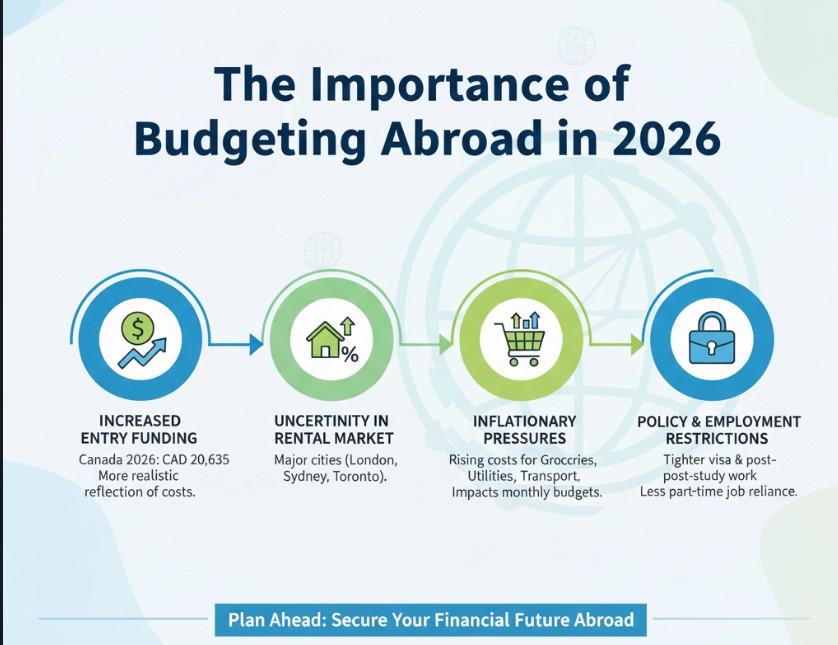
The Importance of Budgeting in 2026 Abroad.
- Increased entry funding: Several countries have raised entry funding requirements. As a reflection of this, the amount of funds required by Canada to cover the 2026 fee was CAD 20,635, which is a more realistic depiction of the actual cost of studying abroad in 2026 compared with the last few years.
- Uncertainty in the rental market: Rental prices in major student cities such as London, Sydney, and Toronto have been very high, reaching up to 12 per cent in the UK, making accommodation one of the highest costs for students in foreign markets.
- Inflationary pressures: With inflation projected to increase in 2026, the share of monthly budgets allocated to groceries, utilities, and transport will rise, which is part of the cost of living for international students.
- Policy and employment restrictions: The tightening of visa regulations and the post-study work policy will discourage the use of part-time employment, which promotes sound money-management habits among students.
Radical approaches to foreign budgeting in 2026.
- 2026 budgeting abroad using the 50/30/20 model.
- Install hybrid learning solutions to lower the cost of early living for international students.
- Cross-shop destinations to control the total expenditure of studying abroad in 2026 and regulate the cost over the long term.
Understanding the True Cost of Studying Overseas in 2026
The Financial Entry Bar: Proof of Funds
It will also require strong initial financial evidence to obtain a visa in 2026, so budgeting abroad in 2026 is mandatory. These are the actual expenses of living costs for international students:
- Canada: CAD 20, 635 (≈ ₹13 lakhs) and tuition, which is nearly equal to studying abroad in 2026.
- Germany: €11,208 (≈ ₹10 lakhs) for a blocked account to cover the annual maintenance of international students.
- Australia: The average student spends approximately AUD 30,000 in yearly living expenses, and that is a considerable percentage of the student expenses abroad.
Tuition vs. Value: 2026 Comparison
|
Destination |
Avg. Annual Tuition |
Avg. Total Annual Cost |
|
UK |
£11,400 – £38,000 |
₹25.9L – ₹50.9L |
|
USA |
$25,000 – $60,000+ |
₹38L – ₹66.5L |
|
Canada |
CAD 15,000 – 35,000 |
₹20.5L – ₹37.7L |
|
Singapore |
$20,000 – $40,000 |
₹15L – ₹25L |
|
Australia |
AUD 20,000 – 45,000 |
₹27.9L – ₹49.9L |
|
Germany |
Minimal (€100–€350/sem) |
₹8.3L – ₹26.1L |
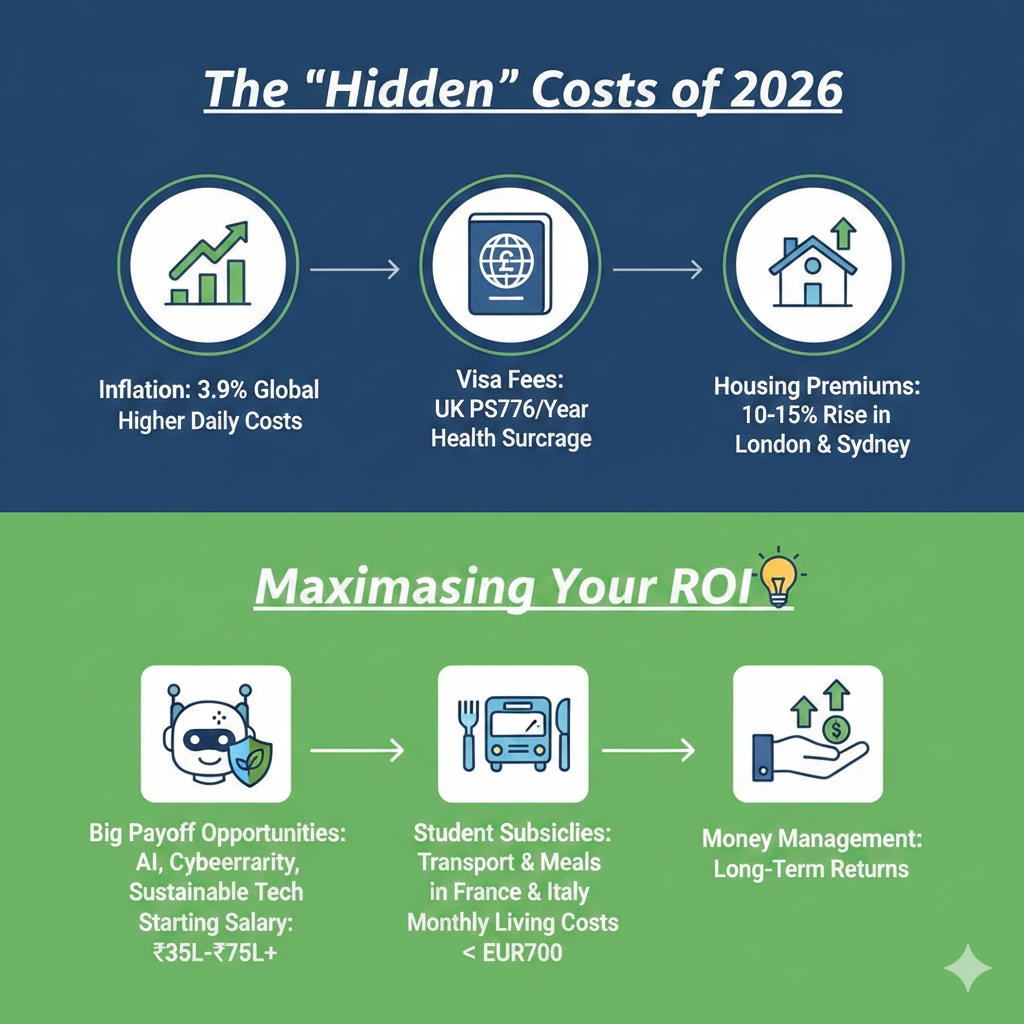
The "Hidden" Costs of 2026
Besides the apparent expenses, student costs have many drivers in the host countries:
- Inflation: The world inflation is predicted to be at 3.9% in 2026, which will result in higher daily living costs for international students.
- Visa fees: Online visa processing is characterised by obligatory fees, such as the PS776 health surcharge yearly in the UK, which increases the cost of studying overseas in 2026.
- Housing premiums: In other cities like London and Sydney, renting accommodation will rise by a 10-15% buffer, which will strengthen spending cautiousness in 2026 in foreign countries.
Maximising Your ROI
Money management for students is intelligent: Long-term returns improve with better management.
- Big payoff opportunities: AI, a course on cybersecurity and sustainable technologies, has a starting base salary of ₹35L–₹75L+, so it is possible to even break even on student expenses abroad.
- Student subsidies: International students are able to reduce the cost of studying overseas in 2026 by having the transport and meals subsidised in countries like France and Italy in order to make the monthly living costs remain below EUR700.
Country-Wise Living Costs for International Students
International students have different living expenses across countries; the most expensive are in the USA and the UK, with costs averaging USD 1,200 or more; Germany and Malaysia are below USD 1,000. It is imperative to be smart in budgeting abroad in 2026.
The table below is an expression of the average monthly expenditure of one international student in a large city, in local currency:
|
Expense Category |
UK |
USA |
Singapore |
Canada |
Australia (Sydney) |
Germany (Berlin) |
|
Food & Groceries |
£200–£350 |
$400–$600 |
S$300–S$600 |
CAD $300–$500 |
A$350–A$550 |
€200–€250 |
|
Accommodation |
£600–£1,000 |
$800–$1,500 |
S$500–S$1,500 |
CAD $800–$1,500 |
A$900–A$1,600 |
€450–€650 |
|
Transportation |
£70–£180 |
$50–$150 |
S$80–$150 |
CAD $80–$150 |
A$100–A$200 |
€70–€100 |
|
Utilities / Internet |
£150–£250 |
$100–$200 |
S$100–S$150 |
CAD $100–$250 |
A$150–A$250 |
€150–€250 |
|
Personal / Misc. |
£100–£300 |
$100–$300 |
S$200–$400 |
CAD $150–$500 |
A$200–$400 |
€100–€200 |
|
Total Monthly |
£1,310–£2,280 |
$1,550–$2,800 |
S$1,200–$2,500 |
CAD $1,550–$2,800 |
A$1,680–$2,950 |
€1,070–€1,750 |
In cities such as New York, London, Sydney, Toronto, and Munich, actual costs are higher, whereas in central Singapore, they are lower.
Key Considerations
- Accommodation is the most significant expense; the university residentials or shared housing reduces the standard of living among international students.
- The majority of student visas will need to have health insurance, and it will contribute to the overall cost of studying overseas in 2026.
- With the enhanced control of money and minimisation of costs incurred on day-to-day expenditure, it is good that the students use the public transport passes.
- Germany is also reasonably priced with lower tuition; however, a blocked account of two thousand six hundred EUR 11,904 is compulsory.
- The portions of the student expenses abroad can be met by part-time employment (usually not more than 20 hours per week), but can very rarely be met all the way through.
How Indian Students Can Budget Smartly Before Leaving India
The ideal budgeting abroad in 2026 will begin a few months before departure from India. Lakhs in exchange rate, travel, and interest costs could be saved through proper financial planning at the beginning of the year.
Pre-Departure Financial Strategy.
- Total Cost of Healthy Farming Maximum Mindset: Tuition and one-time settlement fees (housing deposits, winter wear) tend to be ₹80,000-₹1,50,000 depending on the country.
- Currency Monitoring: 12-18 months forward. Monitor the INR-to-destination-currency exchange rate to transfer funds when rates are favourable.
- Forex Card over Cash: No 3.5%+ GST conversion charge; no-forex-markup cards are available, such as Niyo Global, AU Ixigo or IDFC First Wow.
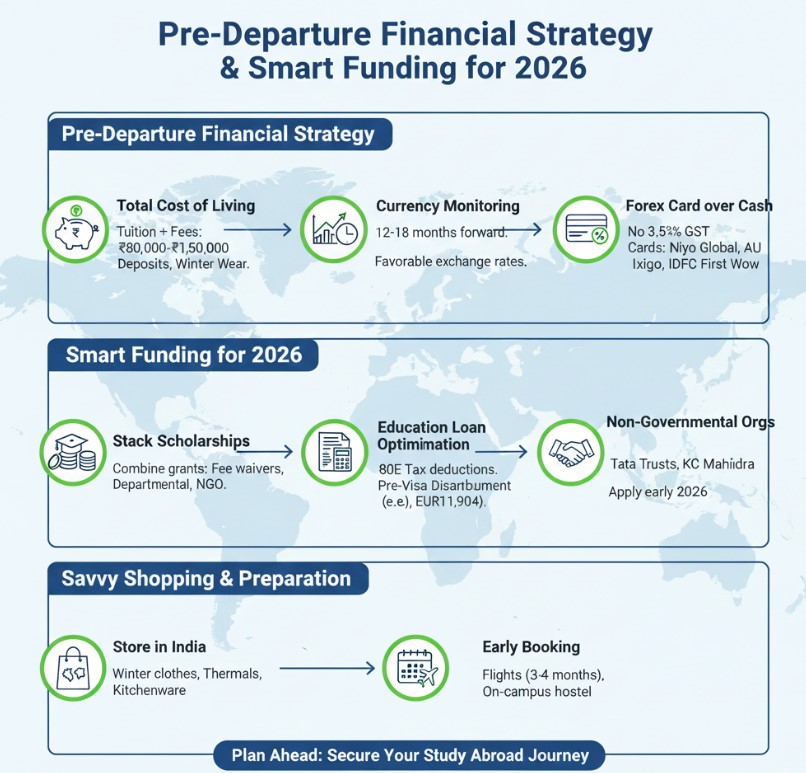
Smart Funding for 2026
- Stack Scholarships: Combine a large number of smaller grants- waiver of fees, Departmental grants and grants provided by outside foundations.
- Education Loan Optimisation: Tax Deductions: Claim 80E Tax deductions on interest up to 8 years in total. Select lenders that offer Pre-Visa Disbursement for blocked accounts (e.g., EUR11,904 for Germany 2026).
- Non-governmental organisations: Tata Trusts or KC Mahindra would be good. Applications should be made in early 2026.
Savvy Shopping & Preparation
- Store in India: Winter, Thermals, and kitchenware are cheaper in the home country.
- Early Booking: Book the flights 3-4 months before, book an on-campus hostel, and save the initial price on the furniture and utilities.
Smart money management for students
By 2026, as the world faces high inflation and fluctuating exchange rates, students will need to be prepared to withstand a financial crisis. It will not be a cost-follow-up operation in 2026, but rather an international budgeting activity enabled by digital software and intelligent lifestyle choices to achieve optimal ROI on your education.
Master Digital Budgeting Tools.
- YNAB (You Need a Budget): It is zero-based budgeting where all dollars have a purpose.
- Mint / PocketGuard: Expenses and safe-to-spend tracking.
- Splitwise: This is an essential requirement in the situation of living together to spend and pay bills.
- Automation: Set up a low balance warning system to avoid overdraft fees.
Strategic Banking and Forex
- Open a local student account to avoid international transaction fees on a daily basis.
- No DCC, pay in local currency either at ATMs or POS.
- Wise Multi-currency cards (Wise) and Revolut Multi-currency cards (Revolut) offer superior exchange rates compared to banks.
High-Impact Savings Tactics
- 50/30/20 Rule: 50 per cent needs (rent, groceries), 30 per cent wants, 20 per cent emergency savings.
- Accommodation: Shared apartments can reduce the rent by 45 per cent. Choose destinations with affordable transportation options.
- Food: Have meals prepared beforehand in order to avoid eating at the cafe on a daily basis.
- Student Discounts: UNiDAYS, Student Beans or ISIC cards are accepted at the groceries, and in software and technology.
Build a Sustainable Emergency Buffer
- Keep a separate account with at least 500-1000 (3-6 months of spending) amount.
- Get to know about health insurance co-payments and locate in-network clinics to avoid astronomical medical bills.
Reducing Living Costs While Studying Abroad
This is because reducing the cost of living for international students is a key measure for efficient budgeting abroad in 2026.
- Share accommodation or opt to select rooms in student dorms in order to pay less for monthly charges.
- Cook for yourself and plan a budget for food expenditure.
- Ride the buses and ride pass instead of ride-hailing and taxis.
- Purchase something you need in your town, or use student promotions and reward cards.
- Use the applications to organise your budget; do not waste money in a foreign country, and manage your student expenses abroad.
Such strategies will enable students to spend 2026 abroad and enjoy themselves.
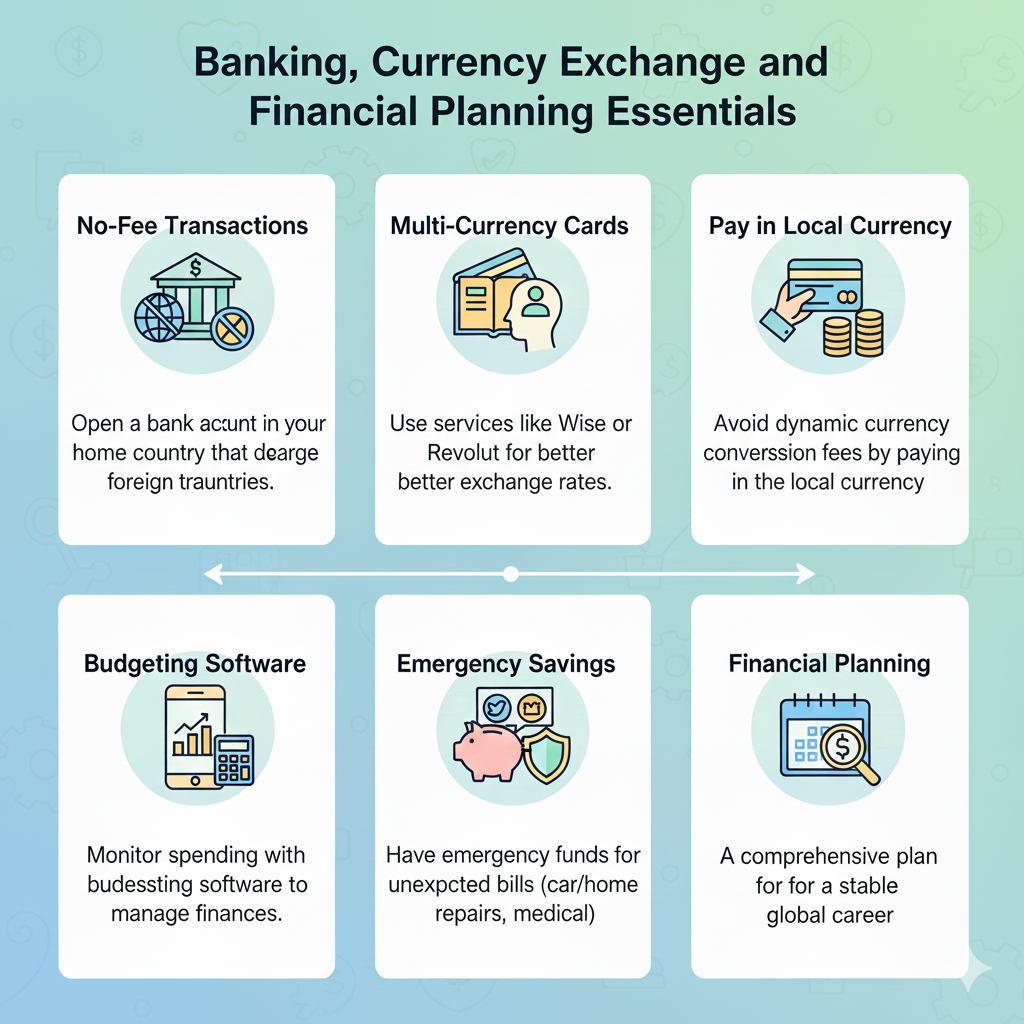
Banking, Currency Exchange, and Financial Planning Essentials
For students studying budgeting abroad in 2026, it is crucial to have a strategy in place for currency exchange and financial planning.
- To avoid being charged exchange rate fees, consider opening a current account in your home country with a bank that does not charge for foreign transactions.
- Consider using Wise or Revolut as multi currency bank cards. These bank cards enable you to have access to better foreign exchange rates.
- Pay in the local currency to avoid being charged a dynamic currency conversion fee by your bank.
- A lot of international students can benefit by monitoring their spending by using budgeting software.
- It is a good idea to have emergency savings to cover unexpected bills like car or home repairs or medical emergencies.
The fact that students from India will be studying budgeting abroad in 2026 should prompt them to take control of their finances.
Health Insurance, Emergency Funds, and Hidden Expenses
For those budgeting abroad in 2026, protection against unexpected expenses, health insurance and setting up an emergency fund will be crucial.
- In order to avoid any unpleasant surprises, it is advisable to familiarise yourself with the details of your health insurance policy and any co-payments that may be applicable.
- It is recommended that you keep three to six month's worth of living expenses in a savings account to be used in case of emergency.
- These should be factored into the overall study costs. Consider visa charges, together with deposits on accommodation and the cost of course materials.
- Little wealth tends to follow small, recurring outlays, like coffee shop visits or a daily newspaper subscription.
Efficient financial development and a moderate level of student charges will be guaranteed by this readiness for such an expense.
Common Budgeting Mistakes International Students Make
International students often find the general cost of living is a major issue for them.
- For the sake of simplicity, let us assume that there are no bank transfer charges.
- Many people find it difficult to budget for costs such as accommodation, food and transportation.
- Many students miss out on cheaper higher education due to not claiming student discounts.
- People tend to fall behind in their budgeting due to not keeping track of their daily spending.
By being aware of these errors, students can make more informed budgeting abroad in 2026 trip abroad and avoid unnecessary stress.
How Gateway Educonnect Supports Students with Budgeting Abroad
To help students manage spending overseas and plan for success as they budgeting abroad in 2026, Gateway Educonnect will demonstrate this to students.
- Provides personalised budgeting abroad in 2026 and estimates of financial planning for places of study.
- Provides scholarships, loaning tips and cost-saving tips.
- Gives recommendations on banking and planning of an emergency fund, currency exchange.
- Educates students on the hidden costs and helps them develop realistic budgets for their monthly spending.
Under the patronage of Gateway Educonnect, students will have hassle-free access to international education without pushing up international students' living costs.
Conclusion
It's not just about the budgeting abroad in 2026. This is a matter of religiousness, independence and long-term chances of winning. By adopting good money management habits and a realistic understanding of their financial prospects, Indian students can achieve their academic goals. To succeed, these students must have a clear understanding of their budget, the ability to set realistic targets and engage in responsible financial behaviour. The parents will also be relieved at the thought of their child building a new life in a foreign country.
Those looking to budgeting abroad in 2026 and requiring advice on financial arrangements may contact The Gateway Educonnect Figure out your financial budget and book a meeting with a financial advisor to get advice on budgeting. Do you have a clear, concise and well-planned itinerary for your trip or are you hoping to get some expert advice and travel plans?
For more assistance please visit us study abroad consultancy, and avail of our wide range of services for students on destinations like study in USA, study in UK, study in Canada, study in Australia, study in ireland and many more country.

FAQs
So, how much money will an Indian student require per month in order to study abroad in 2026?
The monthly expenditure of tourists in the region is generally in the range of $800-$1,500 and varies depending on both the country visited and the holiday maker's lifestyle.
What are the cheapest nations to be an international student in?
Generally, a lower cost of living and standard of living can be found in countries such as Germany.
Could they even earn their livelihoods in other countries through part-time work?
Limited to the number of hours which may be worked part-time employment serves as a means of earning income, offering relief.
Which do you consider to be the most critical yet least noticeable costs of studying abroad?
Some examples of the expenses students incur while abroad include a security deposit for their accommodation, health insurance and emergency funds.
In 2026, will it be more challenging to budget abroad than it was in the past?
Given the increasing volatility of exchange rates and inflation, planning is more crucial than ever.
Author Bio
Abhinav Jain - Founder, Gateway Educonnect and Director.
B.Tech, MBA, AI and Global Education Specialist.
More than 15 years of professional experience in leading students along international routes based on politics and innovation.