03 Apr 2026 | Staying Safe Overseas in 2026: Essential Security Tips for International Students

0
120
Staying Safe Overseas in 2026: Essential Security Tips for International Students
Studying abroad is an exciting experience, as it offers students the opportunity to contribute to a new cultural environment, gain international exposure, and build a global network—the more opportunities, the more, however, the risks. International students will be required to exercise caution when making decisions about international student safety tips. Research shows that, on average, one in five students in study abroad programs encounter security issues during their learning experience, ranging from petty theft to more severe emergencies.
It is a comprehensive instructional manual on safety measures for international students, designed to help students and their parents make informed decisions, prepare, and ensure a safe learning experience. The blog will ensure that safety is not a second thought, drawing on his over 15 years of experience guiding Indian students in international education, as well as on students' real-life experiences.
Why Safety Matters for International Students
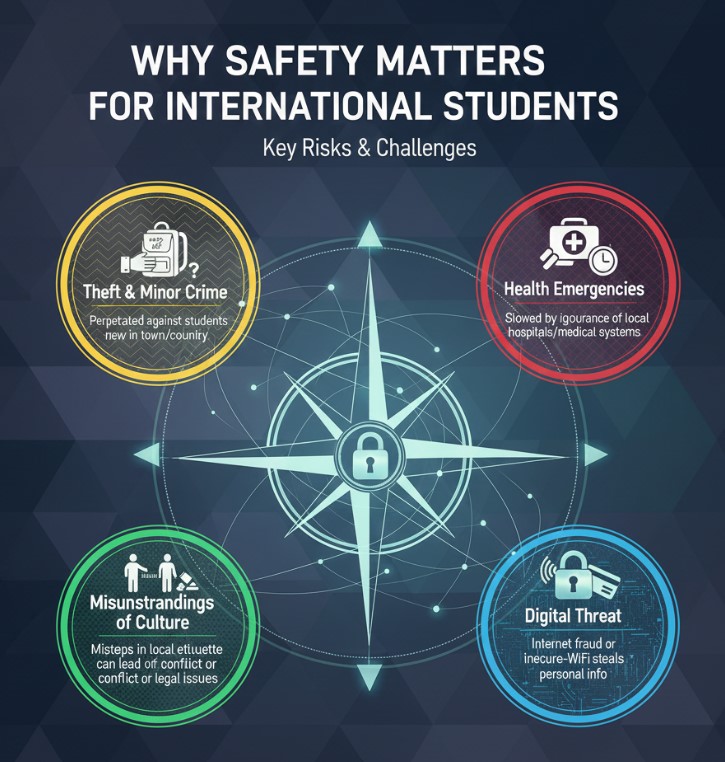
Living and studying abroad is a life-changing experience that entails risks that may affect physical, mental, and academic performance. The most common safety problems that the international students have to face are:
- Theft and minor crime: It is usually perpetrated against students because they are new in town/country.
- Health emergencies: This is bound to be slowed because of the ignorance of the local hospitals or medical systems.
- Misunderstandings of culture: The missteps in the local etiquette can lead to either conflict or legal issues.
- Digital threat: Internet fraud or insecure Wi-Fi networks could steal personal information.
In 2025, a survey found that nearly a third of international students experienced some form of theft or scam during their first year abroad. Awareness and preparedness can go a long way to avoiding these risks.
Safety Tips Abroad Students
Before leaving, it is highly significant to plan. These international student safety tips should consider can significantly improve the experience of beginning their overseas adventure in a hassle-free manner.
Document Preparation
The initial step toward safety is to arrange all required documents and ensure they are readily accessible. On digital and physical copy, have the following:
|
Document |
Tip |
|
Passport & Visa |
Keep copies separately in your luggage and on cloud storage. |
|
Travel Insurance |
Ensure it covers health emergencies, theft, and travel delays. |
|
Medical Records |
Carry vaccination records and prescription inf.o |
|
Emergency Contacts |
Include family, local embassy, and campus contacts. |
Local Laws and Customs Research.
Before travelling, students should be familiar with local laws, road rules, and cultural norms. To illustrate, some countries have harsh regulations when it comes to drinking alcohol, acting in the street or dressing. A lack of awareness can lead to punishment, lawsuits, or unsafe working conditions.
Financial Safety
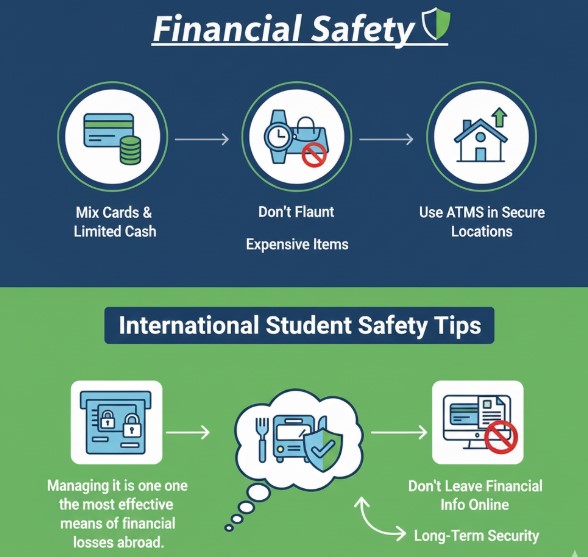
Managing it is one of the most effective means of avoiding financial losses abroad. International student safety tips include:
- Mix cards and limited cash.
- Do not flaunt expensive items in front of the crowd.
- Use ATMs in secure locations.
- Do not leave financial information on the Web.
This is the painful experience of one of my students in Australia, who forgot to leave a wallet at the hostel. These accidents can be avoided by a simple routine of ensuring that valuables are locked at all times.
Staying Safe While Studying Overseas
Once the students are settled, they are concerned with their daily safety. These are some of the solutions that would help in staying safe while studying overseas and make the experience stress-free and manageable.
Choosing Safe Accommodation.
The area and house that is to be chosen should be under control and safe. Consider:
- CCTV, lock security and physical security.
- Admission to emergency services, campus and public transportation.
- Recommendation of local students of respectability or society.
This is according to one of the students I mentored in Canada, who reported that after joining a safe student hostel, anxiety levels decreased and performance improved.
Maintaining Awareness & Connectivity.
One needs to know what is happening and to keep in touch with people and family members. Use:
- Post your position to your close companions.
- Watch systems and alert systems at campuses.
- Most of the time, meets family, especially in late evening travel.
Students who have maintained communication networks report feeling less apprehensive about new surroundings.
Health & Wellbeing
Vaccinations are not the priority for health and safety. Students should:
- Know local hospital location, emergency number.
- Join athletics or college counselling departments.
- Make sure that it has regular practices to prevent burnout and mental illness.
Personal safety abroad entails self-care abroad, and in most instances, it is a concern because stress and homesickness may increase students' risk.
Travel Safety for Students
Travel may be very demanding at both the local and international levels. The key rules of travel safety for students include the following:
Airport Safety and Public Transport.
- Travelling at night, one should prefer not to travel alone.
- It is always advisable to keep bags locked and that traveling plans are never to be shared with others.
- Use government cabs instead of illegal cabs.
Emergency Planning and Travel Insurance.
Travel insurance that covers medical emergencies, theft, and cancellations is always welcome. Maintain contact with the local embassies and prepare your emergency plan.
Baggage and Travel Safety.
- Use locks on bags and luggage.
- Keep no expensive articles about you.
- Password and encrypt electronic devices.
As an Indian student who relocated to the UK, keeping essential documents on a phone and in cloud storage enabled timely retrieval after a lost passport incident.
Personal Safety Abroad
Issues of consciousness, preparedness, and work routines pertain to personal safety abroad.
Digital Safety
- Avoid making monetary transactions using the public Wi-Fi.
- Be careful about sharing personal information online.
- Use two-factor authentication and use tough passwords for any account.
Emergency Preparedness
- Know the local emergency numbers and also the location of the embassy of the country you are in.
- Carry a mini first aid kit with health supplies and contact information.
- Get used to some basic self-protective/safety measures.
Cultural Insensitivity/Etiquette.
The risk of misunderstanding will be mitigated by leveraging local culture. What can prevent unreasonable confrontations is respect for social norms, gender-specific rules, and people's ways.
I had one student in Germany who was educated about the etiquette of using public transport, which helped him avoid confrontations and build confidence in navigating the city without supervision.
Additional Safety Recommendations
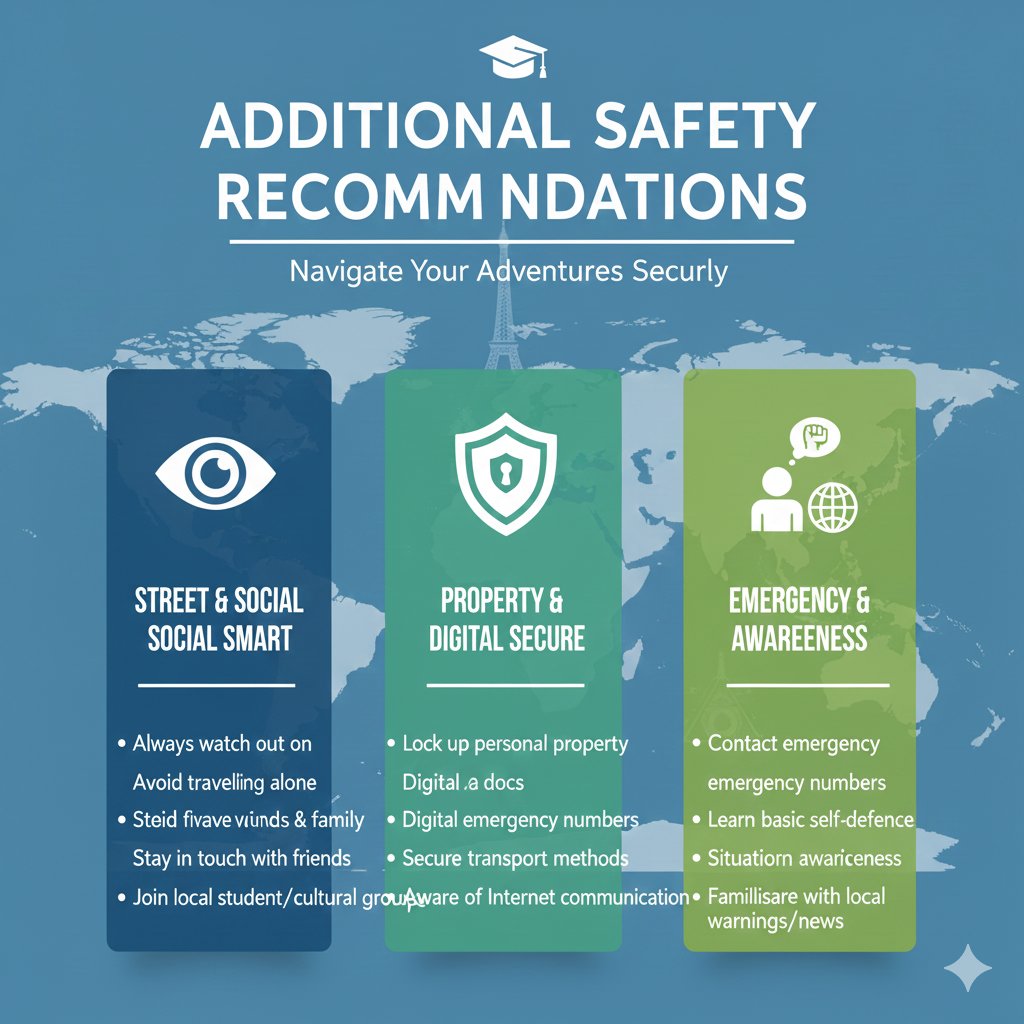
Along with the safety tips abroad students, one can also speak about the practical international student safety tips should not disregard in order to enhance personal safety abroad and reduce the risks in case of staying abroad:
- Always watch out on the open street: Never have a phone conversation whilst walking, especially in a foreign or crowded place.
- Avoid travelling alone: Safety in numbers refers to the fact that people would be less susceptible, particularly at night or in places with low population.
- Stay in touch with your friends and family: messaging apps or other applications to send your location to the people you trust.
- Contact the emergency numbers: Have the local emergency numbers, your embassy contacts and university security numbers near to hand in your phone and wallet.
- Use secure methods of transportation: Take official cabs, ride-hailing apps with verified drivers or take a ride on the transportation during safe hours. Do not hitchhike or take illegal transit.
- Lock up your personal property: Lock up the valuables like passports, wallets and electronics in secure and concealed places. Use anti-theft bags or lock-ups.
- Have a digital copy of essential documents: scan or take pictures of passports, visas, insurance papers, and academic papers and store them somewhere on the Internet.
- Be aware of your Internet communication: do not post your travel plans in social networks, and do not accept the invitation to become friends with unverified Internet users.
- Learn basic self-defence and situational awareness: Learn the safe routes, emergency exits, and even some basic methods of addressing any confrontation.
- Join local student or cultural groups: The active communication with other students or with cultural groups can prove to be helpful since it provides a range of international student safety tips and assistance along with a sense of security.
- Familiarise oneself with the local safety warnings and news: include subscriptions to local authorities or university warnings so as to be informed about the risk or emergency.
By consistently adhering to these safety measures, students can reduce the risk of accidents, theft, or other emergencies, thereby ensuring a safer and more enjoyable stay in a foreign country.
FAQs
What will be the international student safety tips in 2026?
The security risks include theft, fraud, medical crises and cultural misunderstandings. The majority of the risks may be mitigated through awareness, preparation, and connectivity.
What will I do to stay safe in a foreign land when I am studying abroad?
Get to safe areas to reside, stay in touch with family, follow local rules and practice common-sense care.
Are there any applications or tools that can be recommended to students to ensure their safety abroad?
Yes, location-sharing, campus safety, emergency alert, and translation applications are highly recommended.
What should one do in case of a foreign medical emergency?
Call the emergency services in the area, notify your insurer, and contact your embassy if you require assistance. Basic medical information is always in order.
How can parents ensure that their children are safe when studying abroad?
Stay in touch with them, assist them in researching safe areas, encourage them to attend orientation programs, and familiarise them with local laws and safety resources.
Conclusion
The issue of safety should be a concern for every international student in 2026. These international student safety tips will help students benefit from studying overseas without undue pressure or exposure. Preemptive action helps establish documents, secure the digital environment, raise health awareness, and raise travel awareness.
One should keep in mind that ensuring the safety of every student is a personal responsibility. On-the-job preparation and real-life experiences, coupled with a high level of self-awareness, enable one to study abroad in a rich and secure environment.
Contracting with a foreign institution to study abroad is typically a complex process that requires the full attention of both parties to ensure mutual trust and support. Contact Gateway Educonnect for personal advice and consultation. For more assistance please visit us study abroad consultancy, and avail of our wide range of services for students on destinations like study in USA, study in UK, study in Canada, study in Australia, study in ireland and many more country.

Author Bio
Abhinav Jain - Founder, Gateway Educonnect and Director.
B.Tech, MBA, AI and Global Education Specialist.
More than 15 years of professional experience in leading students along international routes based on politics and innovation.