01 Oct 2026 | Ireland vs UK for Indian Students 2027-28: Complete Guide for Indian Students

0
5
Introduction
In the programme examples we have verified, the Irish masters courses are at present cheaper published than the other (UK) examples, but with a range of fees according to university, subject and year of entry. In 2027-28, Trinity College Dublin charges the one-year MSc Business Analytics & AI for Management at a fee of €24,600, whereas the fees of some UK master's degrees vary widely in response to the university and the course. The other revision is the post-study period: in Ireland, level 9 graduates with a master's degree are eligible to receive up to 24 months of Stamp 1G, whereas in the UK, the Graduate visa lasts 18 months with applications made after 1 January 2027. This is one of the Ireland vs UK study abroad guides which provide comparison of the cost, visa, work permit, scholarships and post-study facilities which Indian masters consider to be most important. All the figures, which have changed, were confirmed by an official source on 29 September 2026.
In this Guide
- The quick Ireland vs UK study abroad comparison and which country suits you
- Fees, visa money, visa rules and English tests
- Work rights, post-study stay and scholarships
- A five-step plan, mistakes to avoid and FAQs
What is the Quick Ireland vs UK Study Abroad Comparison?
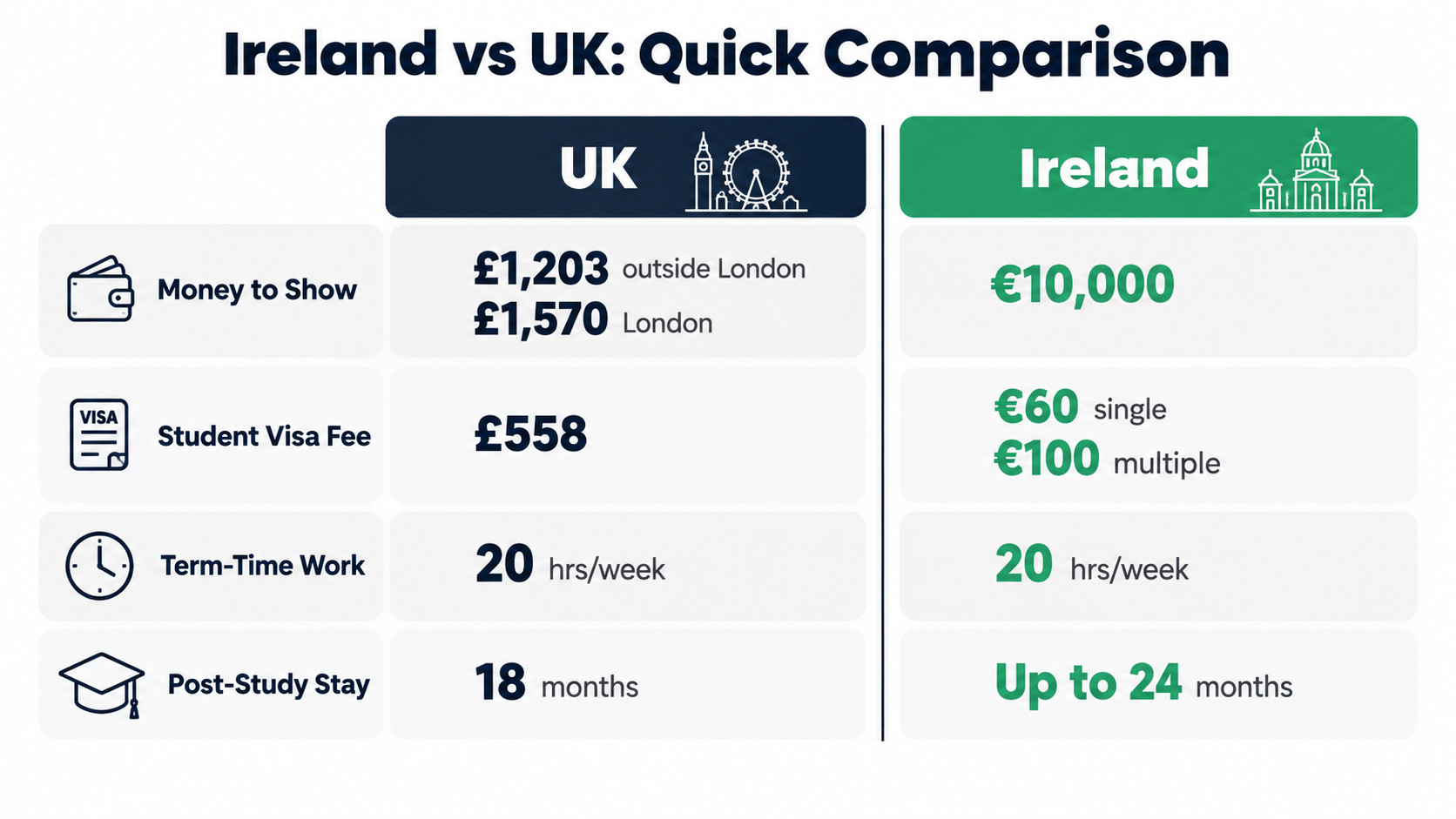
Table 1: Ireland vs UK study abroad at a glance (checked 29 September 2026)
|
Point |
UK |
Ireland |
|
Money to show |
£1,203 (outside London) or £1,570 (London) a month, up to 9 months |
€10,000 for a one-year course |
|
Student visa fee |
Out of the UK £558. |
€60 single entry, €100 multiple entry |
|
Stay after the degree |
Graduate visa: 18 months of 1 January 2027. |
Stamp 1G: 12 months, renewable for 12 more |
|
Term-time work |
20 hours a week |
20 hours a week |
The countries have similar headline term-time work limits, while the clearest confirmed difference for 2027 master's applicants is the length of the post-study route. Costs vary significantly by university, course and location.
Ireland vs UK for Indian Students: Which is Better for Indian students?
In Ireland vs UK study abroad, neither country wins for everyone. Ireland suits you if low published tuition and a longer post-study window matter most. The UK suits you if your course is offered there or you plan to apply for Chevening. Compare the same subject in both countries, because data and management courses are priced differently.
Ireland vs UK for Indian Students Cost Comparison: What does a Masters Cost?
This Ireland vs UK study abroad comparison uses each university's own fee page. Rupee figures use the RBI reference rates of 28 September 2026: £1 = ₹127.0320 and €1 = ₹109.2043.
Table 2: Ireland vs UK study abroad tuition fees per year
|
Course |
Entry |
Country |
Fee |
INR at your stated rate |
|
2027/28 |
Ireland |
€24,600 |
₹26.86 lakh |
|
|
2026/27 |
Ireland |
€26,180 |
₹28.59 lakh |
|
|
Sep 2027 |
UK |
£41,500 |
₹52.72 lakh |
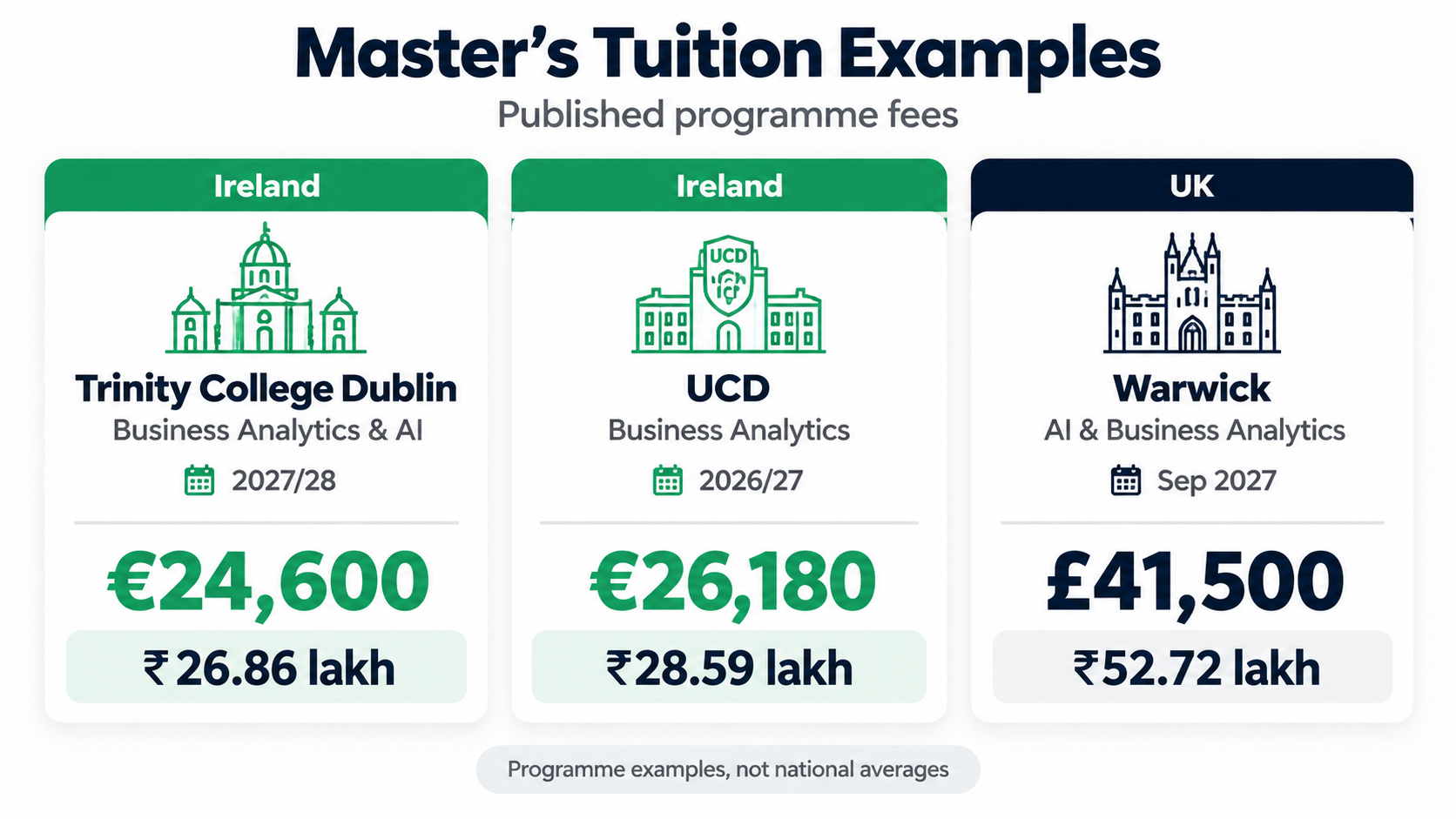
Trinity and Warwick already publish 2027 entry fees, while the UCD figure shown is for 2026/27 and may change for the following intake. The figures should therefore be treated as published programme examples rather than proof of the average cost of studying in either country. Using the stated RBI reference rates, Trinity's €24,600 fee is about ₹26.86 lakh, UCD's €26,180 fee is about ₹28.59 lakh, and Warwick's £41,500 fee is about ₹52.72 lakh.
Check out: Digital Education Counselling: The Future of Student Guidance in India
How much Money must I show for Ireland vs UK Study Abroad Visas?
The UK asks you to show your first-year course fee plus living costs for up to 9 months, held for 28 days in a row. Indian applicants must show these funds, as the GOV.UK money rules explain. The monthly rate rises for applications made on or after 30 November 2026 under Statement of Changes HC 584. A September 2027 student can apply 6 months before the course, so the new rate applies.
Table 3: Ireland vs UK study abroad, UK living-cost funds by application date
|
Application made |
Outside London, per month |
London, per month |
|
Before 30 November 2026 |
£1,171 |
£1,529 |
|
On or after 30 November 2026 |
£1,203 |
£1,570 |
The second row is the one a September 2027 student will use. Nine months outside London is £1,203 × 9 = £10,827, about ₹13,75,375. In London it is £1,570 × 9 = £14,130, about ₹17,94,962. These totals are our arithmetic, because the rules give monthly figures.
Ireland asks for at least €10,000 for a one-year course, about ₹10,92,043 (€10,000 × 109.2043). For loan assistance, see our education loan service, which is a Gateway EduConnect service and not a government body.
What do Visas, English tests and the TB Test Involve?
UK
- The UK Student visa costs £558 when applying from outside the UK. You can apply up to 6 months before your course starts, and GOV.UK states that applicants applying from outside the UK will usually receive a decision within 3 weeks, although complex applications can take longer.
- The healthcare surcharge is £776 a year for students.
- English must be CEFR B2 for degree-level study, and your university may set its own test.
- India is on the TB test list. You need a TB test if you are staying 6 months or more, have lived in India for 6 months or more, and were living in India or another listed country within the last 6 months.
- Some masters courses need an ATAS certificate.
Ireland
- The standard Irish visa fee is €60 for single entry and €100 for multiple entry. Some applicants may qualify for an exemption depending on their circumstances.
- The English minimums for visa purposes are IELTS Academic 5.0, PTE 30, TOEFL iBT 61 or Duolingo 75. Your certificate must be within 2 years of your course start, and your college may ask for more.
Can I work while I study?
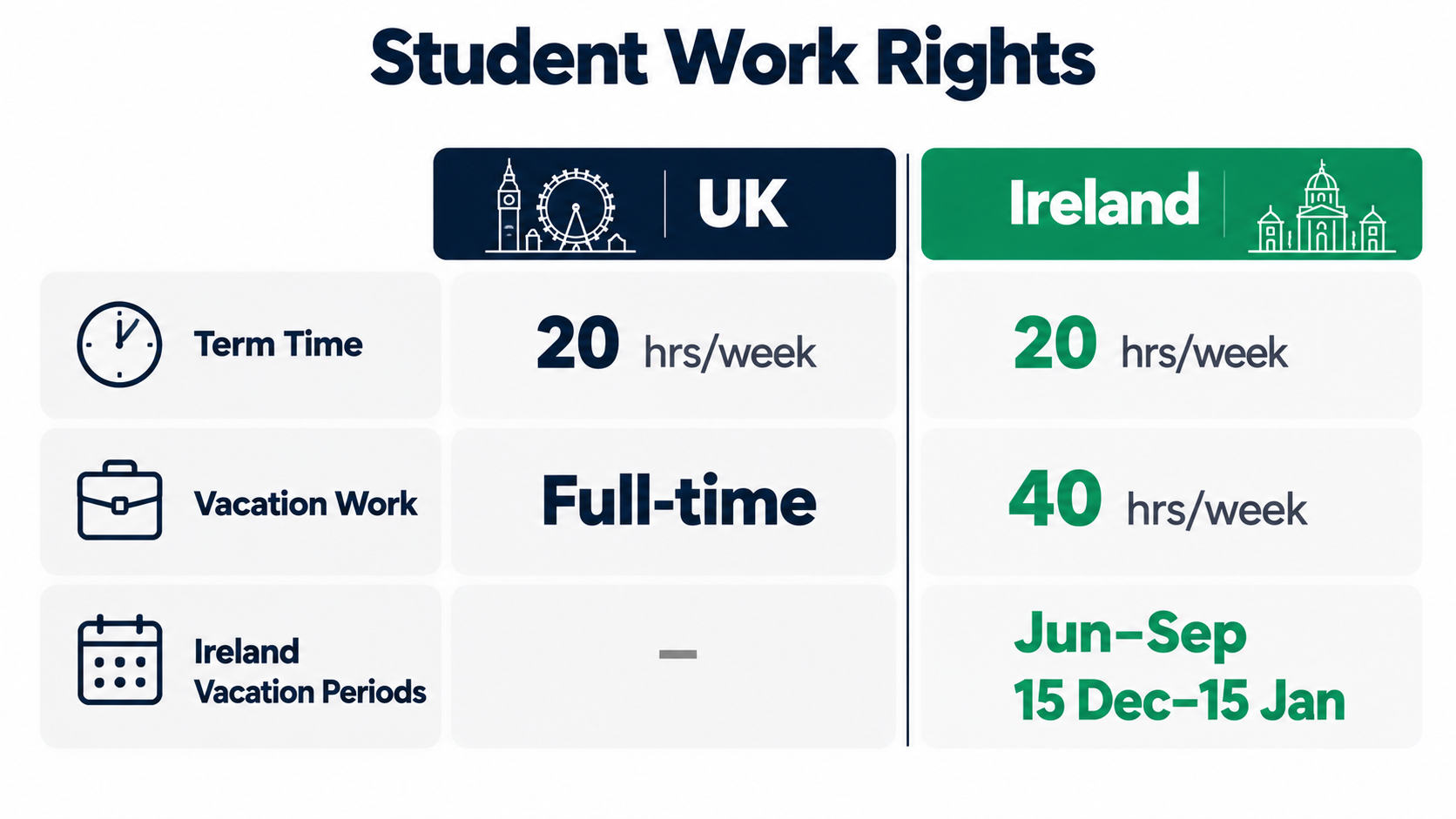
Work rights are similar in Ireland vs UK study abroad, because both countries allow 20 hours a week in term time. In Ireland you may work 40 hours a week from June to September and from 15 December to 15 January, according to the Irish student permission page. In the UK you may work full time in official vacations. The UK weekly limit includes paid and unpaid work and is calculated from Monday to Sunday, according to the University of Manchester's student immigration guidance.
Ireland vs UK for Indian Students post study work visa: what do you get?
UK: The Graduate visa lasts 2 years if you apply on or before 31 December 2026 and 18 months if you apply on or after 1 January 2027. A student who completes an eligible master's and applies in 2027 or later would therefore normally receive 18 months. The graduate visa is not renewable, but an eligible graduate can be transferred to a new immigration pathway.
An 18-month Graduate visa costs, as of now, using the current GOV. UK fee page, UK fee page has an application fee of £937 and an Immigration Health Surcharge of £1,152.50. Before applying, all these charges must be revisited since immigration charges fluctuate.
Ireland: The Stamp 1G lasts 12 months and can be renewed for 12 more if you show an active job search, per the graduate programme document. You must hold Stamp 2 and apply within 6 months of your award.
Ireland vs UK for Indian Students for masters: Which Scholarships can I apply for?
Both countries have major government-backed scholarship programmes relevant to international master's students, but their application cycles are different. The UK's Chevening 2027-28 cycle is currently open to eligible Indian applicants, while the latest published Government of Ireland International Education Scholarship call is the closed 2026 round. Students planning for 2027 should check the HEA website when the next Irish call is announced.
- Chevening (UK): The India page says 2027-28 applications are open. The deadline is 6 October 2026 at 11:00 UTC.
- Government of Ireland International Education Scholarship: The HEA page lists a €10,000 stipend and a full fee waiver for one year of master's or PhD study. Sixty are awarded a year, and applicants need a domicile outside the EU, EEA, Switzerland and the UK. The 2026 call has closed, so check the HEA page for the next call.
Check out: UK Scholarships for International Students: Up to £10,000 in Funding 2026
What is a Five-step Plan for Ireland vs UK Study Abroad?
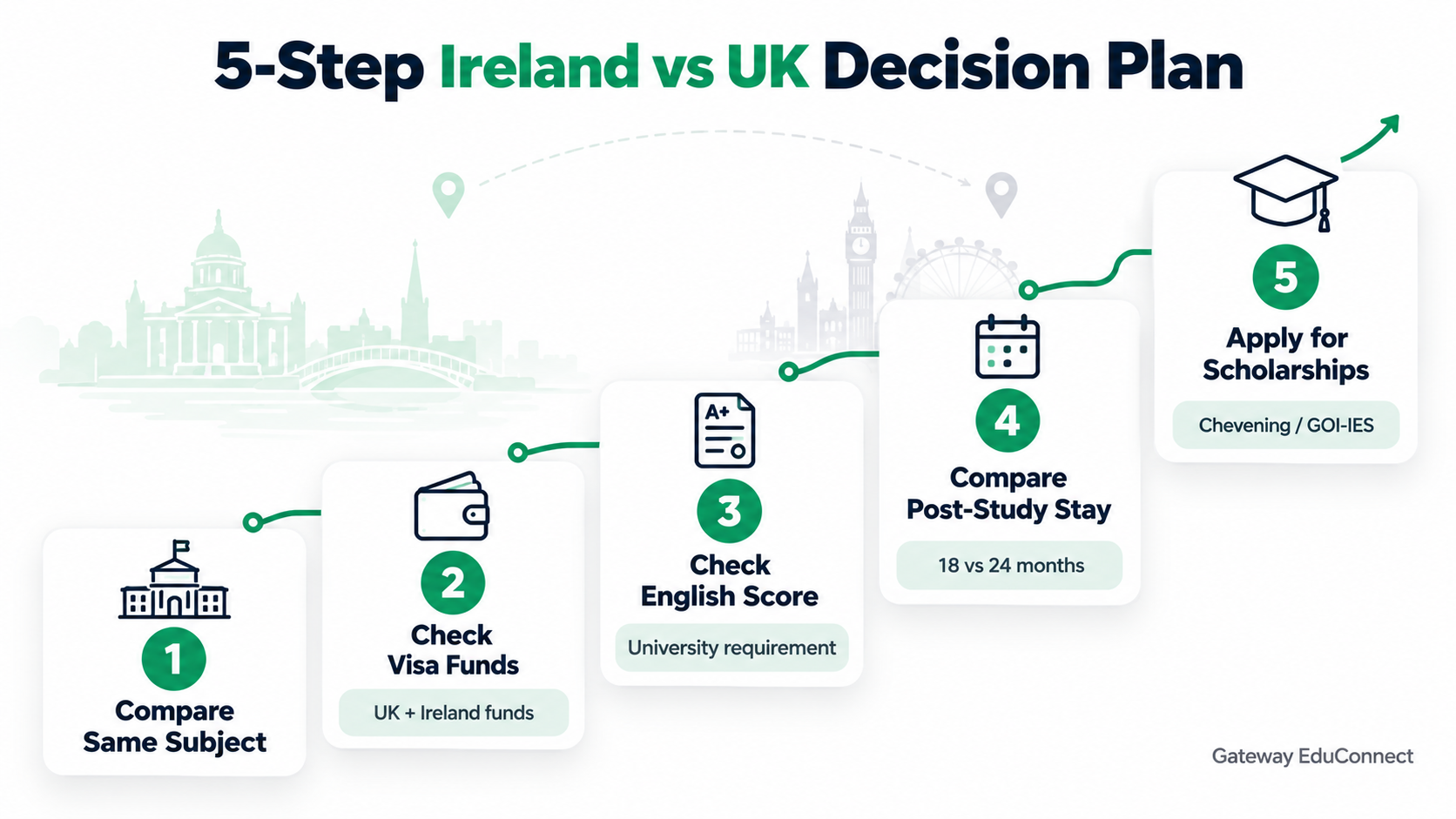
- Pick one subject and compare the same course in both countries using Table 2.
- Check the visa money in Table 3 against your family budget, and the Irish €10,000.
- It is not only the visa minimum that you have to check in your university.
- Decide how long you want to stay after the degree.
- Apply for scholarships you qualify for, and book counselling with Gateway EduConnect if you need help.
What Mistakes should I avoid in Ireland vs UK Study Abroad?
- If the current price in the year 2027 is incomparable to the previous year 2026 fee.
- Applying the amount of 1529,000 (use London) when any application is made, post 30 November, 2026.
- The UK Graduate visa will still be 2 years old in the case of a student completing in 2028.
- Over 20 hours per week of work in a week in the UK in term time.
FAQs on Ireland vs UK study abroad
Is Ireland cheaper than the UK for a master's?
In the programme examples reviewed, the Irish courses currently have lower published tuition than the UK examples. This though does not imply that Ireland is universally cheap. Universities and institutions have different fees depending on university, subject and intake, to ensure you compare confirmed fees to your shortlist.
Which country gives the longer stay after a masters?
Ireland's Stamp 1G can run up to 24 months in two parts. The UK Graduate visa is 18 months from 1 January 2027.
How much money do I need to show?
For Ireland, at least €10,000 for a one-year course. For the UK, £10,827 outside London or £14,130 in London for 9 months, plus your first-year course fee.
Can I work during my masters?
Yes. Both countries allow 20 hours a week in term time.
Do Indian students need a TB test for the UK?
Yes, if you will stay 6 months or more and have lived in India for 6 months or more.
Are scholarships available to Indian students?
Yes. Eligible Indian students can apply for Chevening in the UK. Ireland's Government of Ireland International Education Scholarship is also open to eligible applicants domiciled outside the EU/EEA, Switzerland and the UK, but the latest published 2026 call is closed, so 2027 applicants should wait for the next official HEA call.
Conclusion
Ireland vs UK study abroad comes down to your budget, your subject and your plan after graduation. In the programme examples reviewed, the Irish courses currently show lower published tuition than the UK examples, but this should not be treated as proof that Ireland is universally cheaper. The fees differ depending on the university, course and intake. The more obvious attested difference is the post-study time: eligible Level 9 masters graduates in Ireland are entitled up to 24 months under Stamp 1G whereas the UK Graduate visa allows a 18 months application period in 1 January 2027. UK and Ireland have varying visa-fund regulations and scholarship years; Chevening 2027-28 is an open scheme whereas the most recent GOI-IES scheme is the closed 2026 round in Ireland. Compare the equivalent object in both nations, in which case consider Table 2 your Ireland vs UK cost comparison before Indian Students invite, and validate each date correspondently on the official site. If two sources seem to disagree, speak to a counsellor before you decide.
Speak with Gateway EduConnect for free video or home counselling and support with your study abroad consultancy services and explore our wide range of offerings for students interested in Study in Australia, Study Abroad in Poland, Study in Canada, Study abroad UK, Study in Germany, Study Abroad in Ireland, Study Abroad in the USA, Study in Finland, Study Abroad in Italy, and many other countries