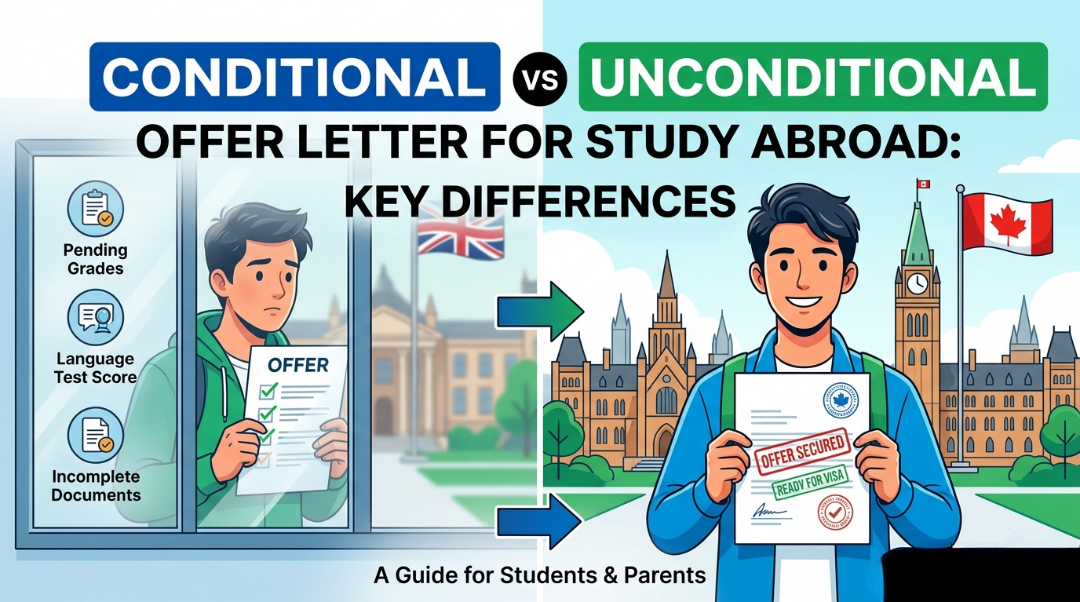
21 Apr 2026 | Minimum Percentage Required for Study Abroad for Indian Students 2026 Guide

0
9
Introduction
The Indian students have a dream of studying abroad but questions, very often posed by parents and students, are: What is the minimum percentage for study abroad? It is not necessarily a yes answer and is subject to the country, the university and the course.
All the information you need to understand about the minimum percentage for study abroad, including requirements, GPA conversions, tips which can be used practically to increase your profile even when your marks are above average, is made simple in this 2026 guide. You may be planning to study undergraduate or postgraduate courses, but this guide will assist you in making the right decision.
Knowledge of the Minimum Percentage for Study Abroad
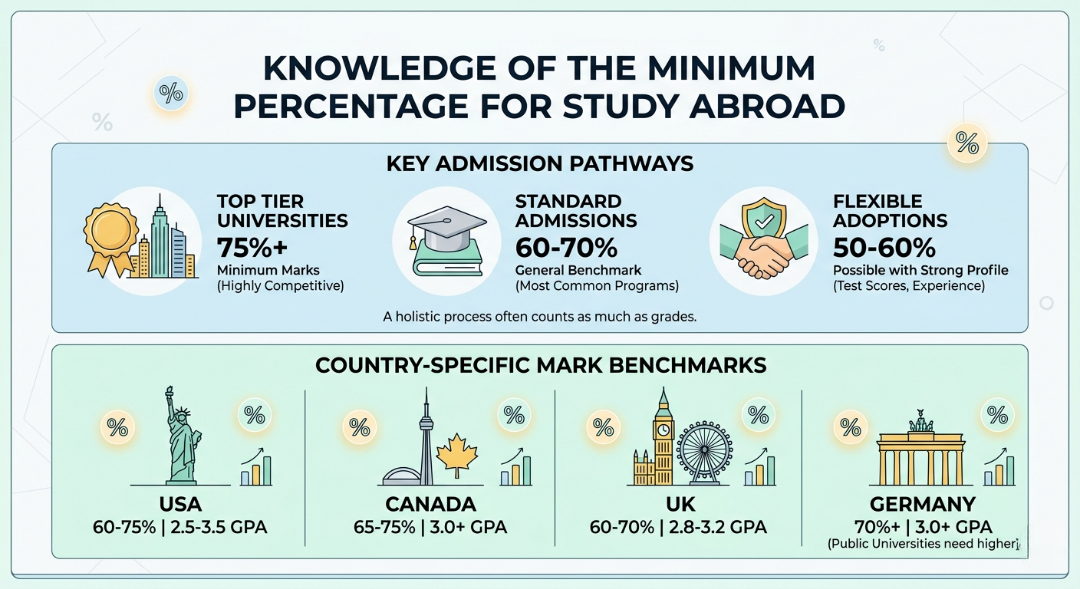
The minimum percentage for study abroad varies based on various factors like country, type of course and ranking of the university. Many foreign universities have a holistic admissions process as opposed to that in India.
General Benchmark of the Indian student:
- The general range of eligibility is the 60-70 percent in academics in most of the programs in various countries since most universities require it as the standard eligibility.
- The 75-85 percent or higher amount demanded by the most elite universities may be requested on competitive courses like engineering, business or medicine.
- Other universities would accept 50-60 percent with high profile particularly when the students subsidize the profiles with test scores or other sources of experience.
The grades they require in abroad colleges are crucial, but not the most influential factor.
Country-Wise Study Abroad Eligibility Marks
The expectations of the various countries regarding the marks that allow study abroad vary. To make a short comparison:
|
Country |
Minimum Percentage Required |
Required GPA Abroad |
Key Notes |
|
60% – 75% |
2.5 – 3.5 |
Most universities will require postgraduate courses to be taken with GRE or GMAT scores. |
|
|
60% – 70% |
2.8 – 3.2 |
Some universities will be able to take in 55% of applications, depending on the course. |
|
|
Canada |
65% – 75% |
3.0 and above |
There is competition among college applicants, especially among those who desire admission to highly rated colleges and marketable college degrees. |
|
Australia |
60% – 70% |
2.5 – 3.0 |
Universities have eased admission requirements and have more than a single intake. |
|
Germany |
70% and above |
3.0 and above |
It requires good performance in academics and, in the case of the public universities, even better. |
|
France |
60% – 70% |
2.5 – 3.0 |
There are a lot of universities where English-taught programs are offered to international students. |
This table indicates that the minimum percentage for study abroad is different, but it has alternatives for all academic levels.
Percentage Below Abroad (minimum)
When considering a postgraduate degree, and by far STEM courses, it is essential to know what percentage goes to MS abroad.
Typical Requirements
- The minimum eligibility of most universities in other nations is a minimum of 60% in an undergraduate degree.
- Top universities should have a preferred range of 65%-75 per cent where competition is more and academic excellence is an important consideration.
- The scope of competence in successful academic qualifications in the particular or technical courses is paramount, especially in specialisation.
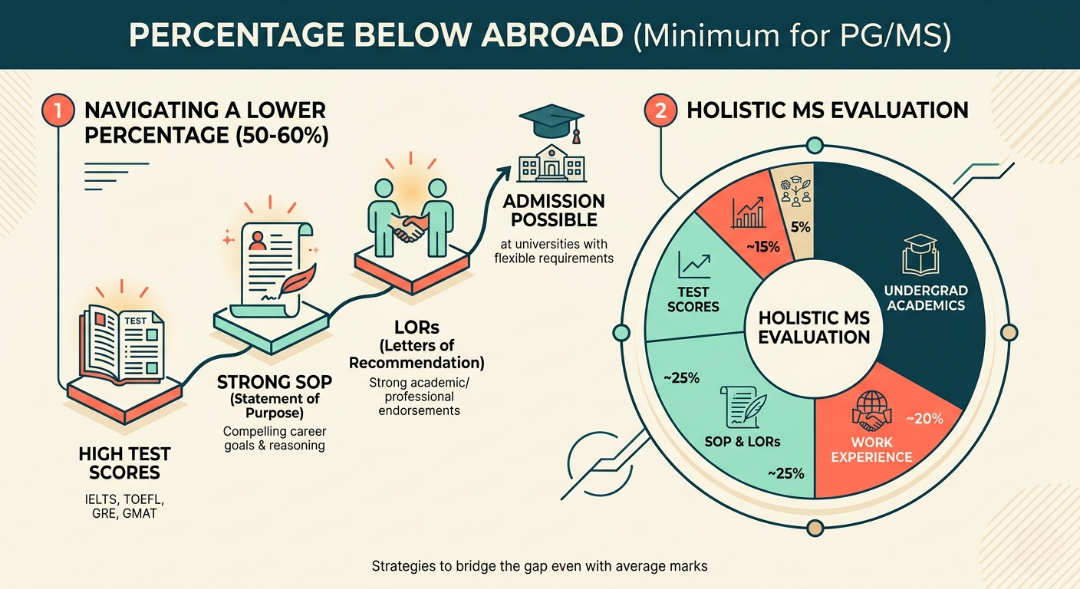
Most Universities take into consideration:
- Statement of Purpose (SOP), which says in straightforward terms what you are seeking to accomplish in your academics and the selection of the program.
- Letters of Recommendation (LORs) are letters that create authenticity and both your study/job strengths point of view.
- Work experience (not mandatory but helpful) could potentially be of great help to your application for competitive courses.
Your total profile can be advantageous, despite the fact that you might have a slightly lower percentage of MS abroad.
The Conversion of the GPA is Based on these Principles:
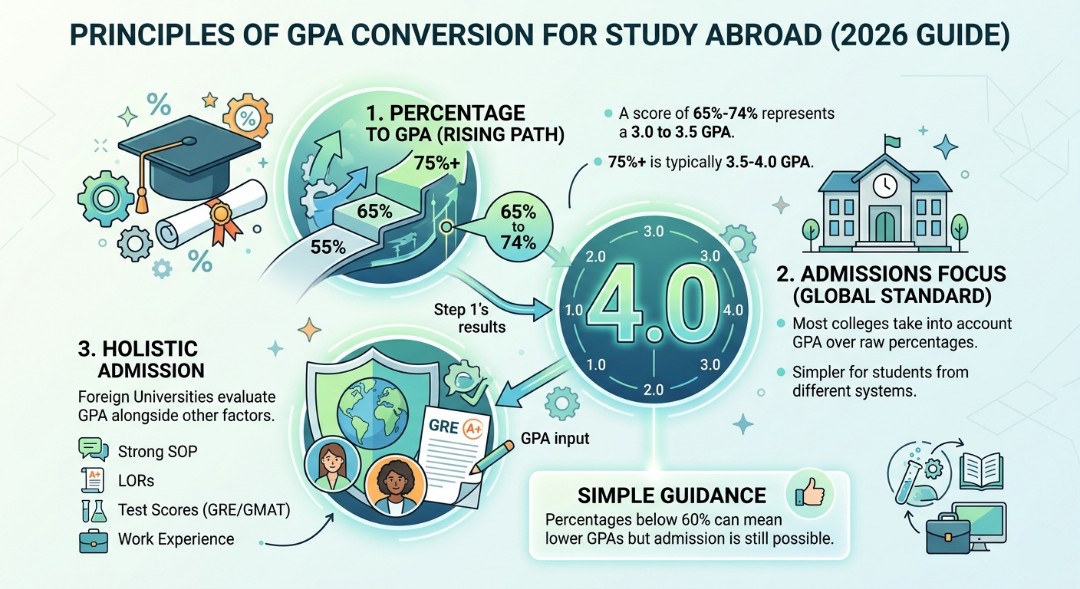
Most colleges take into account GPA. Therefore, knowledge of GPA in a foreign country is imperative.
Rough Conversion Guide
- An average score of 75 per cent and above is typically a 3.5-4.0 GPA that is still good in the highest Universities.
- Approximately 65-74 per cent would represent a 3.0 to 3.5 GPA, which is satisfactory in many good universities of the world.
- The 55-64 percentage will mean a GPA of 2.5-3.0, which will be sufficient to obtain admission to a variety of universities with a decent number of entry requirements.
The GPA required in foreign universities is not pegged on percentages, but rather on the GPA itself and therefore it is simpler to use with students in other systems.
Is it Possible to Study Abroad with a Low Percentage?
Yes, absolutely. The myth that toppers are the sole ones who can go abroad is just a myth.
Even if you have:
- 50-60 per cent, you might still be accepted to universities that have lenient admission practices and a complete evaluation procedure.
- Lack of scholarly opportunities, which can be explained by a solid SOP and explanation of your career plan.
- Backlogs (have been endorsed by several universities, as long as your overall grades are improved).
It has other substitutes. The majority of universities underline general study abroad eligibility marks, amongst others.
Making up the Low Marks.
- The strong SOP gives you a chance to convincingly discuss your experience, goals of achievement and career goals with the admissions board.
- Relevant work experience will add to your qualifications, showing that you are prepared to take the course.
- High grades in IELTS, TOEFL, GRE, or GMAT can score out of the ballpark and compensate for poor academic grades.
- By applying to the universities with relaxed standards, it will imply that you will be applying strategically in the areas where your profile suits well.
This means that there is no restriction on the minimum percentage for study abroad as long as you make plans.
Real-life Advice to Hike Your Odds.
The practical steps that may be followed to make the study abroad profile better and more competitive are as follows:
- You ought to prepare early to take the tests, which will be carried out in English, and you could then score higher and finish the test at the end.
- To be at the frontline of the success process, identify the universities which are relevant to your academic profile, and not only rankings, to increase the possibility of acceptance.
- Develop a strong SOP which draws a picture of you, your strengths, achievable career and future goals.
- To strengthen your selection bargain, apply to a mixture of secure, fair, and abundant colleges.
- Consult an interpreting professional to know what is expected of a student in terms of GPA in overseas studies and the expectations of the university.
The above measures will go far when it comes to increasing your chances, even with minimum percentage for study abroad.
What is So Good about Gateway Educonnect?
With a record of over 15 years of experience and a record of successfully placing 23,000+ students, Gateway Educonnect has facilitated students to achieve their education goals in the USA, the UK, Canada, Australia, Germany, France and Dubai.

What Do We Have in Common?
- One-Click applications can be filled within a time span as low as 100 seconds, and that too, the students will have an easy and hassle-free ride to their destination.
- Immediate offer letter within 24 hours, and the students would save time in the decision-making process.
- Up to $2499 cashback, making the foreign study more cost-effective and financially beneficial.
- End-to-end service including lending, housing and counselling to make certain that students are completely oriented.
You may be concerned about the marks needed for foreign universities or uncertain about your eligibility; nevertheless, our professionals can help you along the way.
FAQs
1. What is the minimum percentage for study abroad for Indian students?
Minimum percentage for study abroad generally starts at 60 per cent, despite the fact that various universities can accept students with 50-55 per cent, presuming that they have a fine overall profile and test scores.
- Which are your study abroad qualifications in the best universities?
In top universities, eligibility marks are usually higher than in other universities with the mark usually being between 70-85 and good academic track records or extra curricular performances.
3. What will be the minimum GPA of Indian students in overseas countries?
A 2.5 to 3.5 GPA in the host nations is what is normally required on a 4.0 scale, although this may be changed by the universities, as well as the programs you wish to pursue.
4. Percentage requirement of MS in other countries?
The percentage can be generally around 60-70 per cent in your undergraduate degree, in the case of MS abroad, where it might require higher scores.
5. Do countries differ in the marks required by foreign universities?
Yes, marks required in foreign universities vary widely in relation to the country, course and ranking of the university, and countries such as Germany, Canada and others were likely to be very strict on the marks required.

Conclusion
You need to be conversant with the minimum percentage for study abroad, though this should not hinder your wishes. Today, universities do not only consider the academic performance of their students, but also skills, tests or an overall profile strength when judging them. No matter how your marks are average or excellent, you will find opportunities as long as you do it strategically. Successful students who study abroad can succeed in their endeavours by selecting the right country, college and advisor.
Willing to study in another country? Get Gateway Educonnect to show you the way. Book your free check-up and take the first step towards your global future. For more assistance please visit us study abroad consultancy, and avail of our wide range of services for students on destinations like study in USA, study in UK, study in Canada, study in Australia, study in ireland and many more country.
Author Bio
Abhinav Jain - Founder, Gateway Educonnect and Director.
B.Tech, MBA, AI and Global Education Specialist.
More than 15 years of professional experience in leading students along international routes based on politics and innovation.