12 Nov 2026 | Eligibility for New Zealand Universities 2027-28: Complete Guide for Indian Students

0
41
New Zealand University Eligibility for Indian Students 2027–28: Master's Guide
A graduation guide, based on evidence, of graduation rates, three-year degrees, English waivers, admission deadlines, and cost of study.
The New Zealand university eligibility for Indian students hinges on the master's programme that a student is pursuing, past qualifications, grades and evidence of English language proficiency. There is no universal minimum graduation percentage for admission to all New Zealand universities.
The chosen programmes accept three-year Indian bachelor's degrees, and some require specific subjects, higher grades, or other courses. This is a New Zealand university eligibility guide for Indian students based on the official university and immigration checks as of 12 November 2026.
What Are the Minimum Entry Criteria?
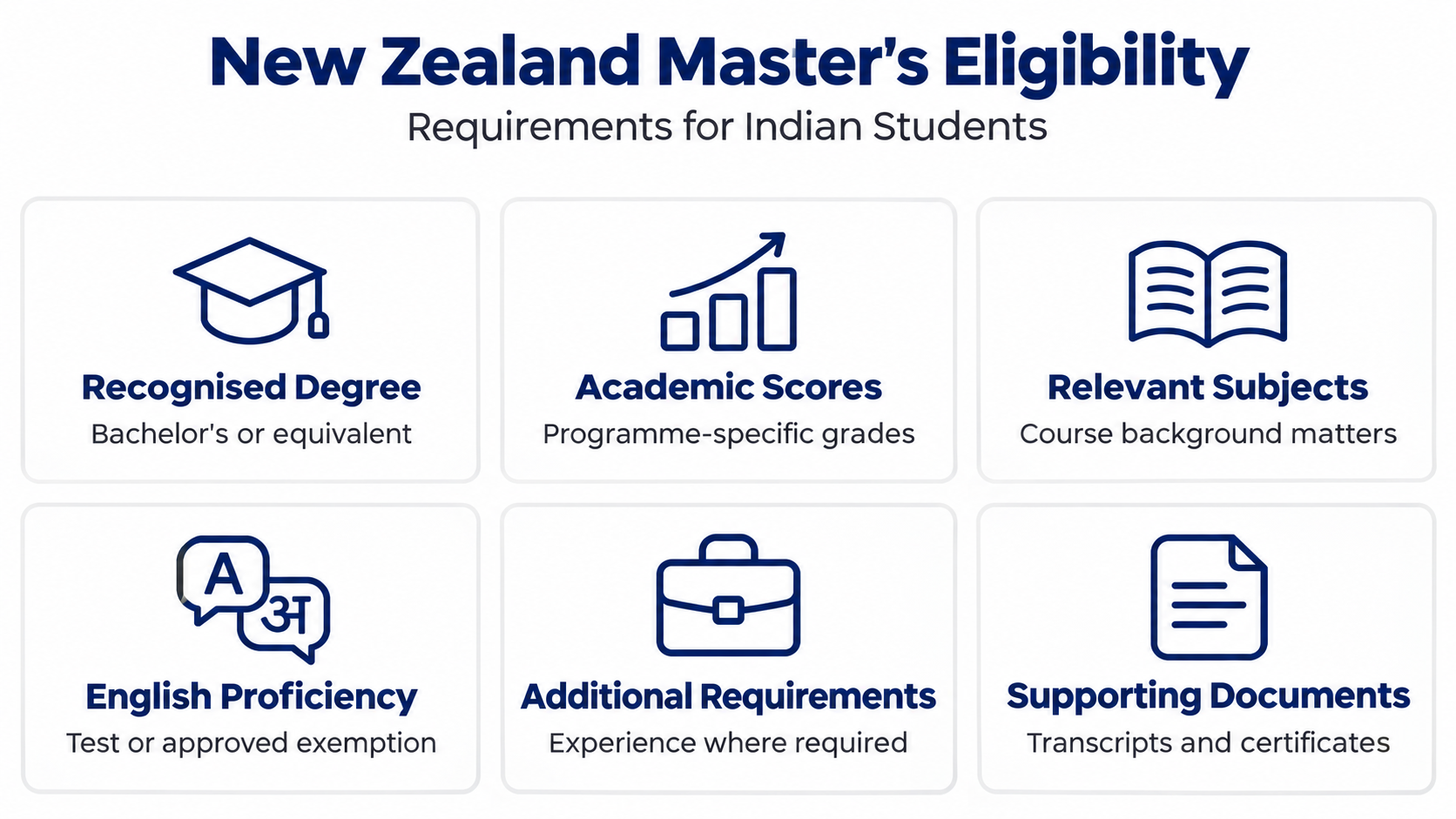
Indian students must hold a qualification recognised by their chosen New Zealand university.
The majority of master's programs have the precondition of a bachelor's degree or some reasonable alternative. Nevertheless, fulfilling the overall requirements is not a guarantee of admission.
|
Requirement |
What Indian applicants should check |
|
Academic performance |
Programme-specific marks, CGPA or grade |
|
Documents |
Transcripts, qualification evidence and course-specific requirements |
|
Undergraduate qualification |
Recognition, duration and equivalence |
|
Subject background |
Whether a relevant undergraduate major is required |
|
Additional selection |
Work experience, portfolio or research preparation, where specified |
|
English proficiency |
Accepted test or recognised exemption |
Prior to application: Authenticate degree recognition, separately academic marks and subject requirements.
What is the minimum percentage of graduation?
New Zealand does not have a minimum percentage that students should study.
Students: In order to determine New Zealand university eligibility for Indian students, India-specific examples like those of the official postgraduate entry criteria at AUT are helpful.
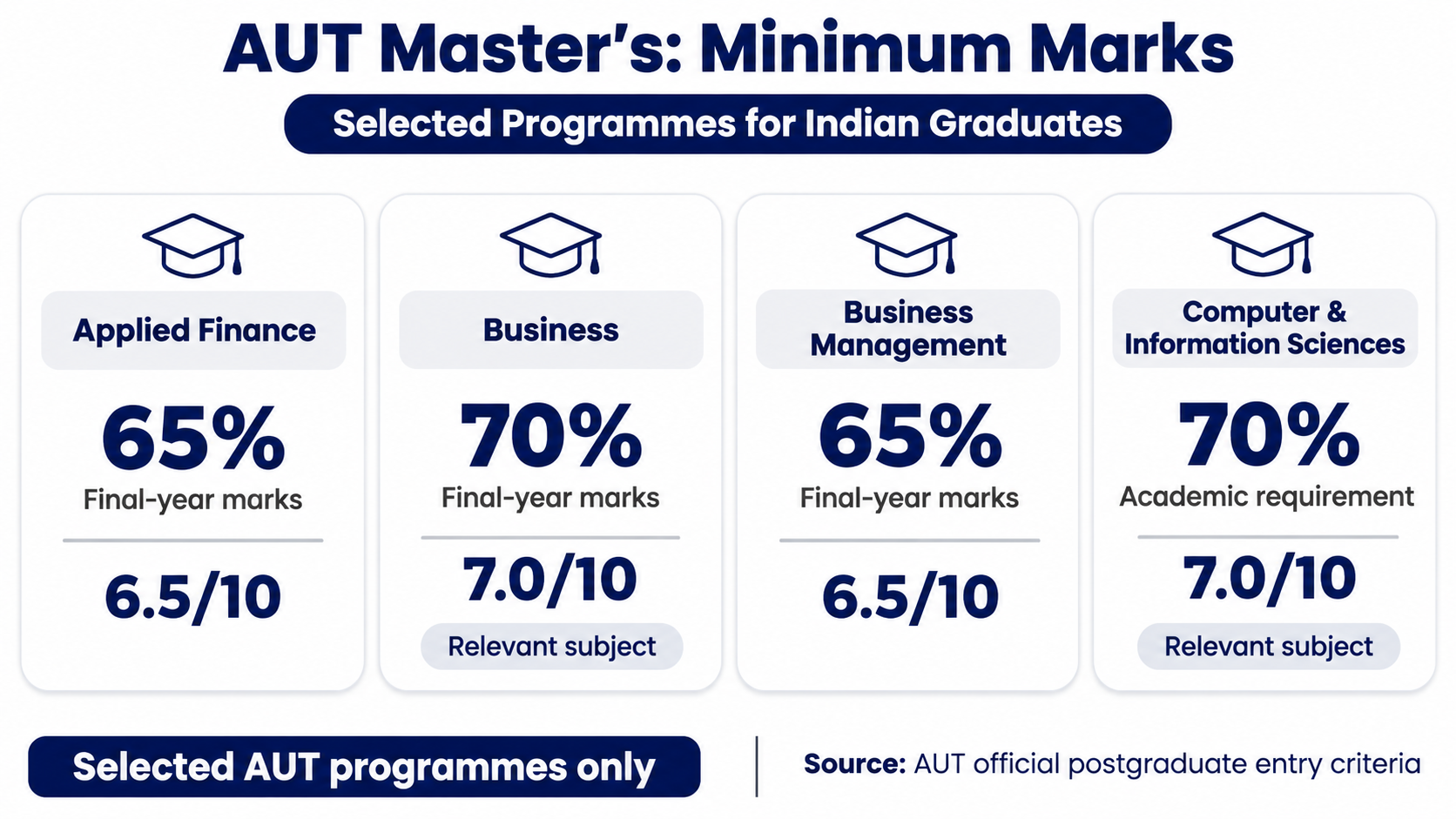
Minimum marks in graduation to select Master programs of AUT.
|
AUT master's programme |
CGPA on a 10-point scale |
Indian academic requirement |
|
Master of Business |
7.0 in final year |
70% in final year; relevant subject |
|
Master of Applied Finance |
6.5 in final year |
65% in final year |
|
Master of Computer and Information Sciences |
7.0 in final year |
70%; relevant subject |
|
Master of Business Management |
6.5 in final year |
65% in final year |
These are the figures for the listed programmes at AUT and not all universities in New Zealand.
Noteworthy: Final-year percentage cannot be used instead of overall graduation percentage. There are ways to evaluate time periods in universities.
New Zealand grades can be used by other institutions, such as B or B-minus. Instead of making a direct conversion to Indian percentages, applicants are to request an assessment.
Are Three-Year Indian Bachelor's Degrees Accepted?
Yes, there are specialised master's degrees which take three-year Indian bachelor's degrees.
The programmes listed in the table above under AUT have a minimum three-year undergraduate degree requirement, although there may be other requirements.
But the qualification required for understanding New Zealand university eligibility for Indian students must hold BA, BCom, BSc, BBA or BCA based on academics and relevance of the programmes.
Universities may examine:
- Recognition of the awarding institution.
- Length of degree and equivalency of the qualification.
- Past courses and college major topics.
- Advanced academic training, honours level.
- Relevant professional experience, where required.
As an illustration, a specialised computing course could be a course that demanded previous coursework in computer science or a comparable subject.
In case of formal overseas qualification assessment requested, consult the guidance of New Zealand Qualification Recognition by the New Zealand Qualifications Authority.
Not all Indian degrees will necessarily qualify an individual to be assessed in an International Qualification Assessment. Get approval on the need with the taking institution.
What is the Difference between academic requirements in universities?
New Zealand university eligibility for Indian students should be compared at the programme level, as opposed to comparing the general rankings in universities.
A student who grades 60% on graduation might not meet the above published requirements to apply to AUT, but this does not necessarily mean that it will not be considered elsewhere.
Through examples specific to the university, consider the following examples:
- Auckland University of Technology: Releases Indian scholarly percentage qualifications and agreeable undergraduate degree timeframes of designated programmes.
- University of Waikato: Its Master of Management fulfils bachelor's qualification and advanced level grade requirements with detailed provisions of alternative admission.
- Lincoln University: The Master of Management in Agribusiness requires a relevant qualification and the required B average in final advanced study.
- University of Auckland: University-taught and research master's degrees can have other criteria. Browse its postgraduate application.
- Massey University: Its master's degree application rules guide students to the programme requirements for academics and documentation.
- University of Otago and University of Canterbury: Conditionalities for admission will be based on the chosen qualification and past academic preparatory training.
You divide programmes into three categories: those where you meet the published requirements, those where you need clarification on admissions and those where you fail to meet the stated minimums.
Do not confuse an alternate admissions route with assured direct admissions.
Acceptable English Tests and Scores?
English language proficiency is an essential requirement for New Zealand university eligibility for Indian students applying for master's programmes.
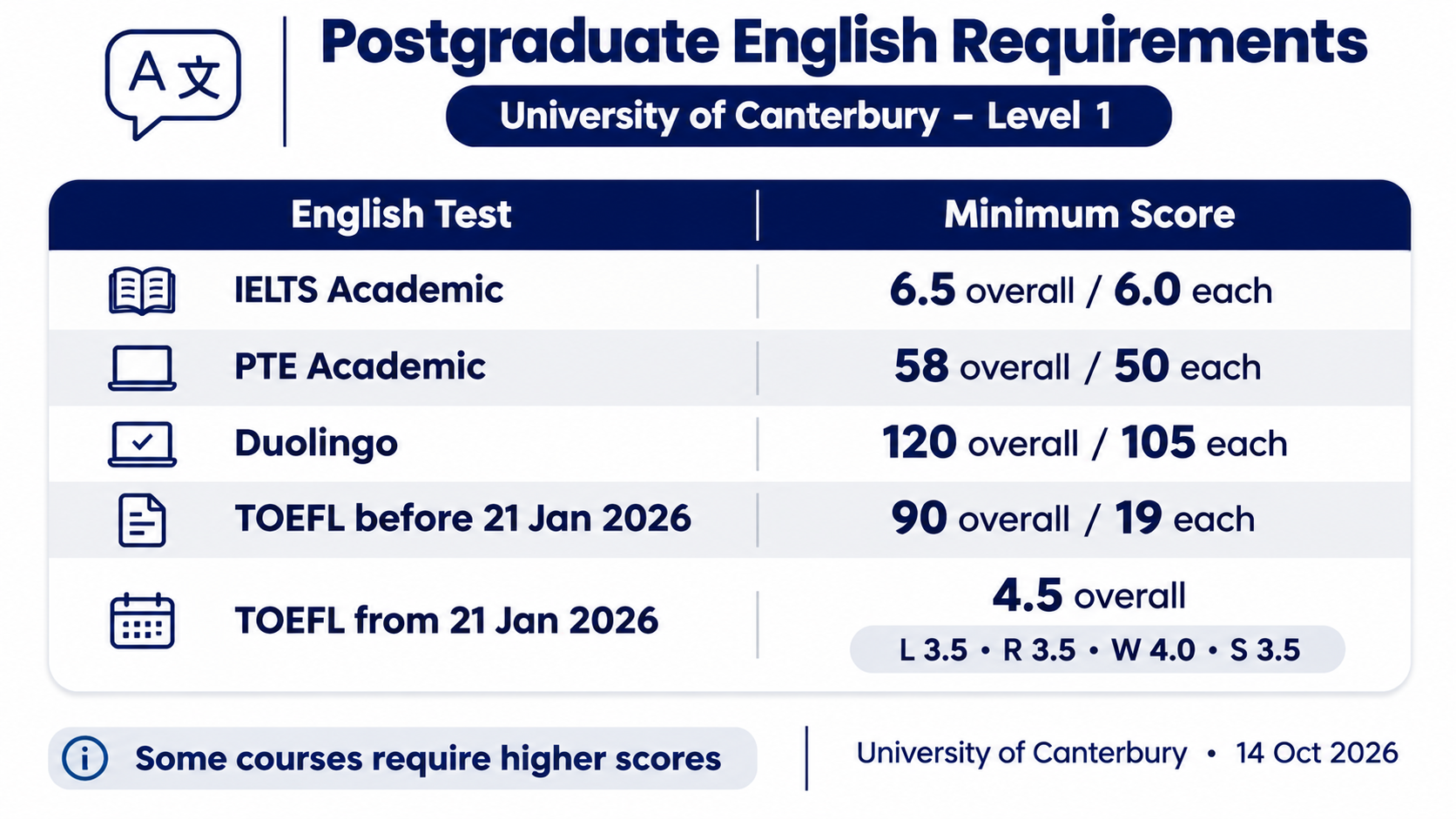
A good example is the postgraduate Level 1 English requirements of the University of Canterbury, as of 14 October 2026.
Canterbury Postgraduate English Requirement: Level 1.
|
English test |
Minimum requirement |
|
PTE Academic |
Overall 58; no communicative skill below 50 |
|
IELTS Academic |
Overall 6.5; minimum 6.0 in each skill |
|
Duolingo English Test |
Overall 120; no individual band below 105 |
|
TOEFL iBT from 21 January 2026 |
Overall 4.5; Listening 3.5, Reading 3.5, Writing 4.0, Speaking 3.5 |
|
TOEFL iBT before 21 January 2026 |
Overall 90; minimum 19 in each section |
These are the requirements for Level 1 of postgraduate study in Canterbury. Some programmes demand an increase in the scores.
TOEFL's scoring requirements also depend on the test date.
Applicants should confirm the approved version of the test, the component scores and the validity of the results they want prior to applying to the test.
Can Indian Students apply without IELTS?
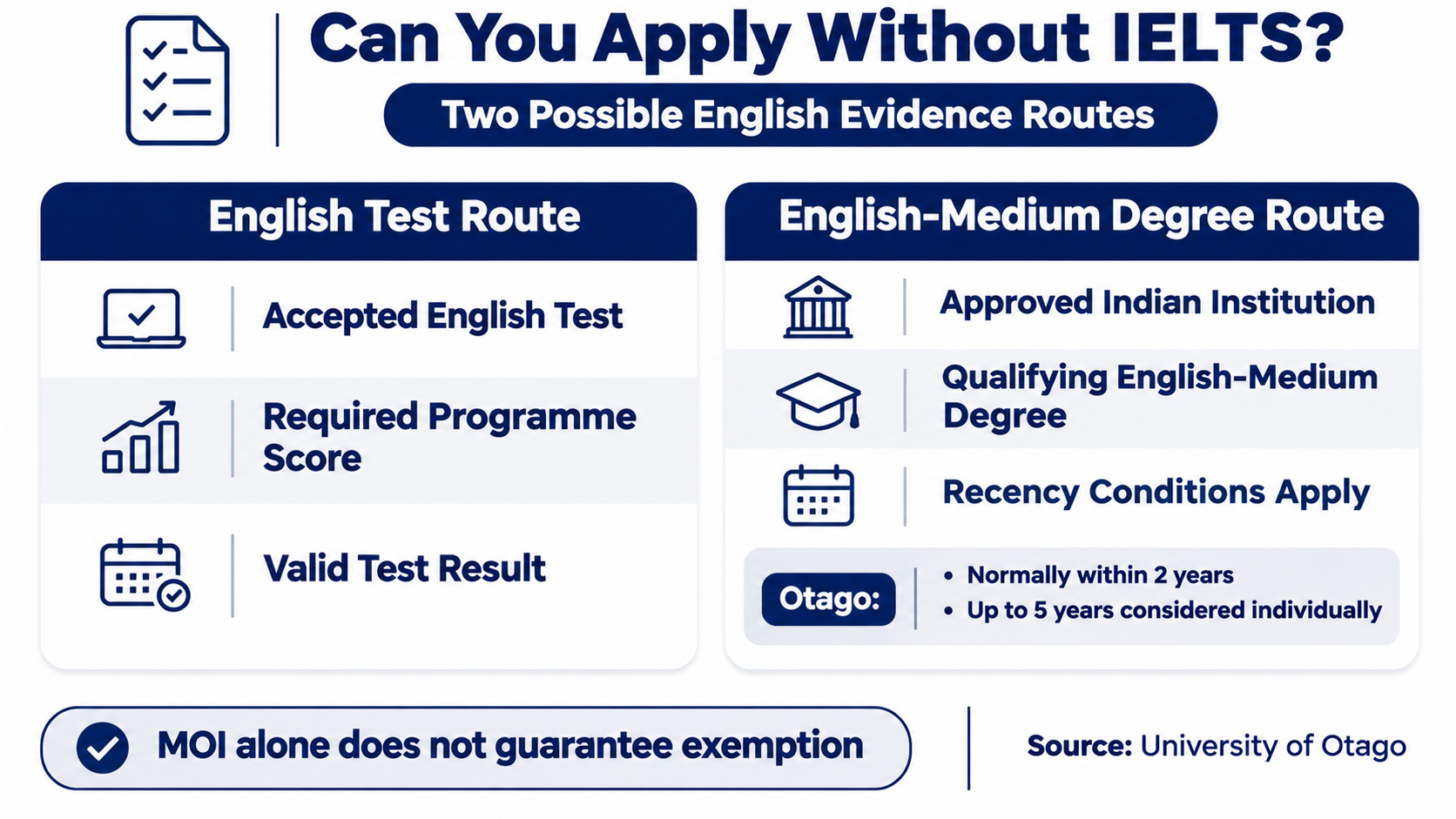
New Zealand university eligibility for Indian students can also be met through an approved alternative English language test or a qualifying degree previously completed in English, subject to the university's admission requirements.
English-language requirements of the University of Otago permit the consideration of completed (in English) tertiary qualifications.
An approved list of Indian institutions is also published by Otago.
The Institutions found on the list are the University of Delhi, the University of Mumbai, Jadavpur University and various Indian Institutes of Technology.
The qualifying English-medium study should be one that was, as a rule, completed within two years prior to joining the programme.
Otago may consider qualifications completed within five years, subject to evidence of continued English proficiency
Check before relying on a certificate of MOI:
- Whether your awarding institution is authorized.
- The sufficiency of the condition of the completed qualification in English.
- The amount of time allowed to the qualification.
- Whether your course work requires more English on your selected masters programme.
MOI certificate may not necessarily be accompanied by an IELTS waiver.
The students are supposed to provide the university with their degree information, transcripts and MOI evidence and to request to be written into the chosen programme.
Are Backlogs, Study gaps, and low marks approved?
The New Zealand university eligibility for Indian students with lower marks has to be evaluated against the reality of programme needs.
Certain qualifications might have an alternative route of entry or post-graduation preparation. Nevertheless, such admissions are not guaranteed.
There is no single maximum number of backlogs and maximum duration of study-gap as has been confirmed in all New Zealand master programmes.
The students are expected to have proper records of:
- Current academic backlog and cleared academic backlog.
- Date of graduation and completion of qualifications.
- Work or professionalisation in between studies.
- Relevant experience or other training.
Enquire with the admissions department about the effect of these situations on the selection.
The experiences gained in the workplace might help with some applications, but they do not exempt the necessary academic credentials.
What Documents Are Required for New Zealand University Admission?
Complete academic records are required for a New Zealand university eligibility for Indian students.
Examples of typical application documents are:
- Acceptable identification or a valid passport.
- Baccalaureate degree certificate or temporary completion certificate.
- School certificates and grades.
- Accepted evidence of approval tests of English language or exemption.
- CV/resumé as requested.
- Personal statement or statement of purpose, as requested.
- Reference or portfolio/research proposal on the programmes that have to be done.
The University of Auckland's supporting-document guidance explains the documentation process.
Note: Not all master's programmes require an SOP, recommendation letter or research proposal as part of their admissions.
Always depends on the official checklist of the chosen programme.
What Are the New Zealand University Application Deadlines for 2027–28?
New Zealand university eligibility for Indian students should apply only when the desired programme is open to applications.
The postgraduate application calendar of the University of Auckland has the following official information regarding their postgraduate applications:
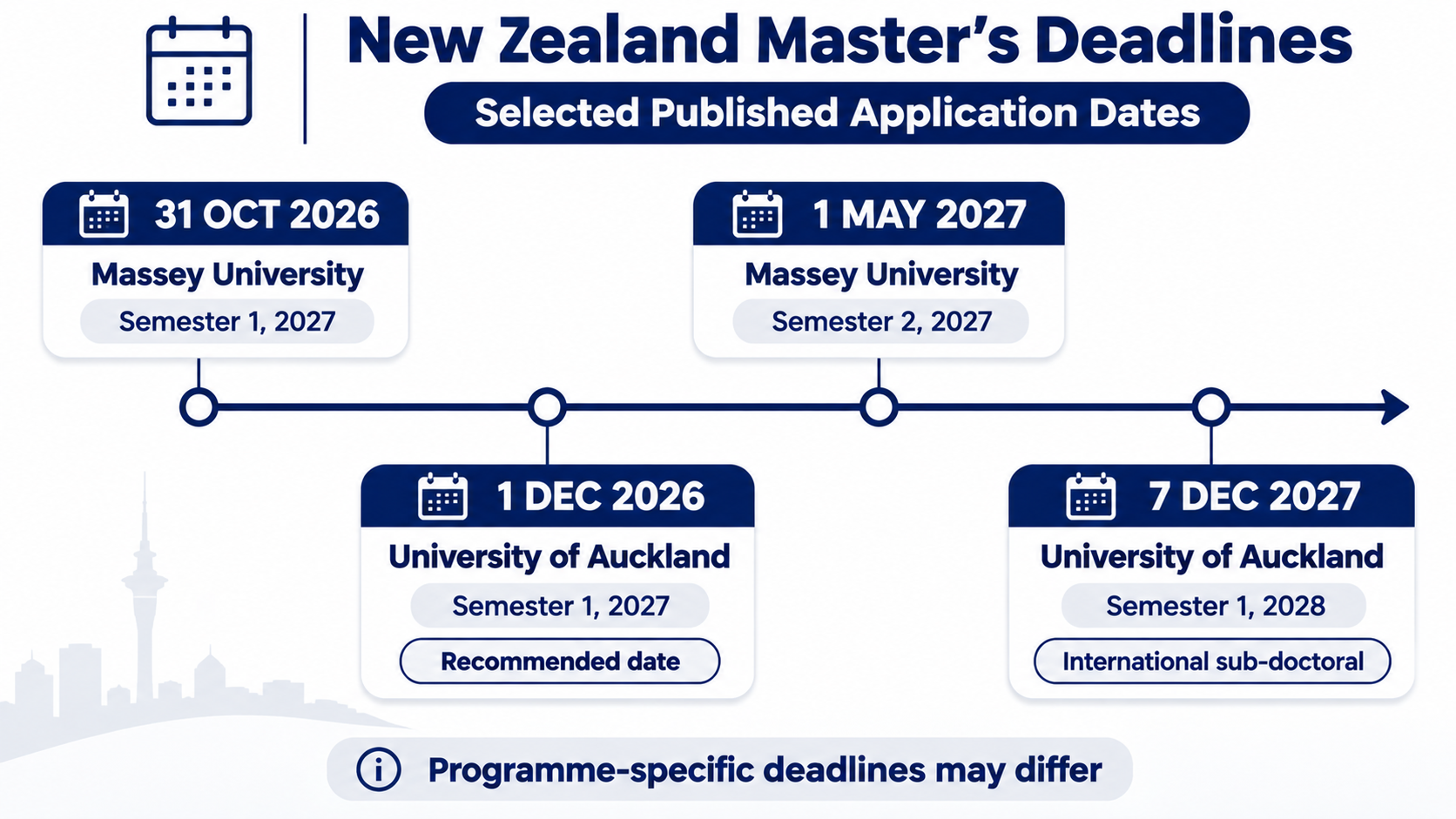
- 1 December 2026: Recommended international application date: Semester One 2027.
- 8 December 2026: The last day to apply to postgraduate programmes not specified is the general Semester One 2027.
- 8 June 2027: International Sub-doctoral (excluding otherwise specified) 2027 Semester Two deadline.
- 7 December 2027: International postgraduate sub-doctoral Semester One 2028 unspecified application date.
The overall Semester Two 2027 final date of programme not otherwise specified is 4 July 2027, although the early 8 June date must be considered by the applicants concerned (relevant to international applicants).
On the other hand, Massey University has the following admissions calendar:
- 31 Oct 2026: New global applications to standard Semester One 2027 qualifications.
- 1 May 2027: New international Semester Two 2027 qualifications.
Where places still exist, it is possible to consider Late applications. It is possible to shut down selected-entry programmes sooner.
In 2027, a few Semester One 2027 deadlines have already been surpassed as of 12 November 2026. Not all programmes have been posted with their complete 2028 deadlines.
What Are the Master's Tuition Fees and Financial Requirements?
New Zealand university eligibility for Indian students also be accorded at the same time as regards the cost of study.
For example, the University of Canterbury issues the following fees for the Master of Business Management:
- 2027: NZ$59,400
- 2028: NZ$62,400
These are the published special programme charges of the university, rather than the average national tuition. Note the payment conditions of the official Canterbury master's fees and additional fees.
Insurance, student services levies and other charges could be utilised.
Students who intend to apply for a scholarship ought to verify their eligibility, the winning and the deadline of the application to the university of their preference.
Student Visa Financial Requirement.
Conditional upon a new one-year or longer fee-paying student visa requirements by Immigration New Zealand, tertiary applicant students must typically:
- The amount that can be spent on living in a year is NZ$20,000 annually.
- How to reasonably establish tuition financing.
- Adequate resources or satisfactory means of travelling outside.
- Additional documentation and insurance that is needed.
- The visa cost is now beginning at NZ$850.
Based on their visa status, the students can be allowed to work as many as 25 hours per week during their studies.
Prior to relying on an education loan or sponsor, applicants must read the official requirements of Immigration New Zealand student funding requirements.
Students must follow Immigration New Zealand's official financial-evidence rules regardless of which loan service they use, Foreign EduLoans, which is under Gateway EduConnect.
An acceptable sanction letter for funding a visa is not provided solely by a loan sanction letter. The documents provided in support of finances should meet the requirements of Immigration New Zealand.
How Should Indian Students Apply?
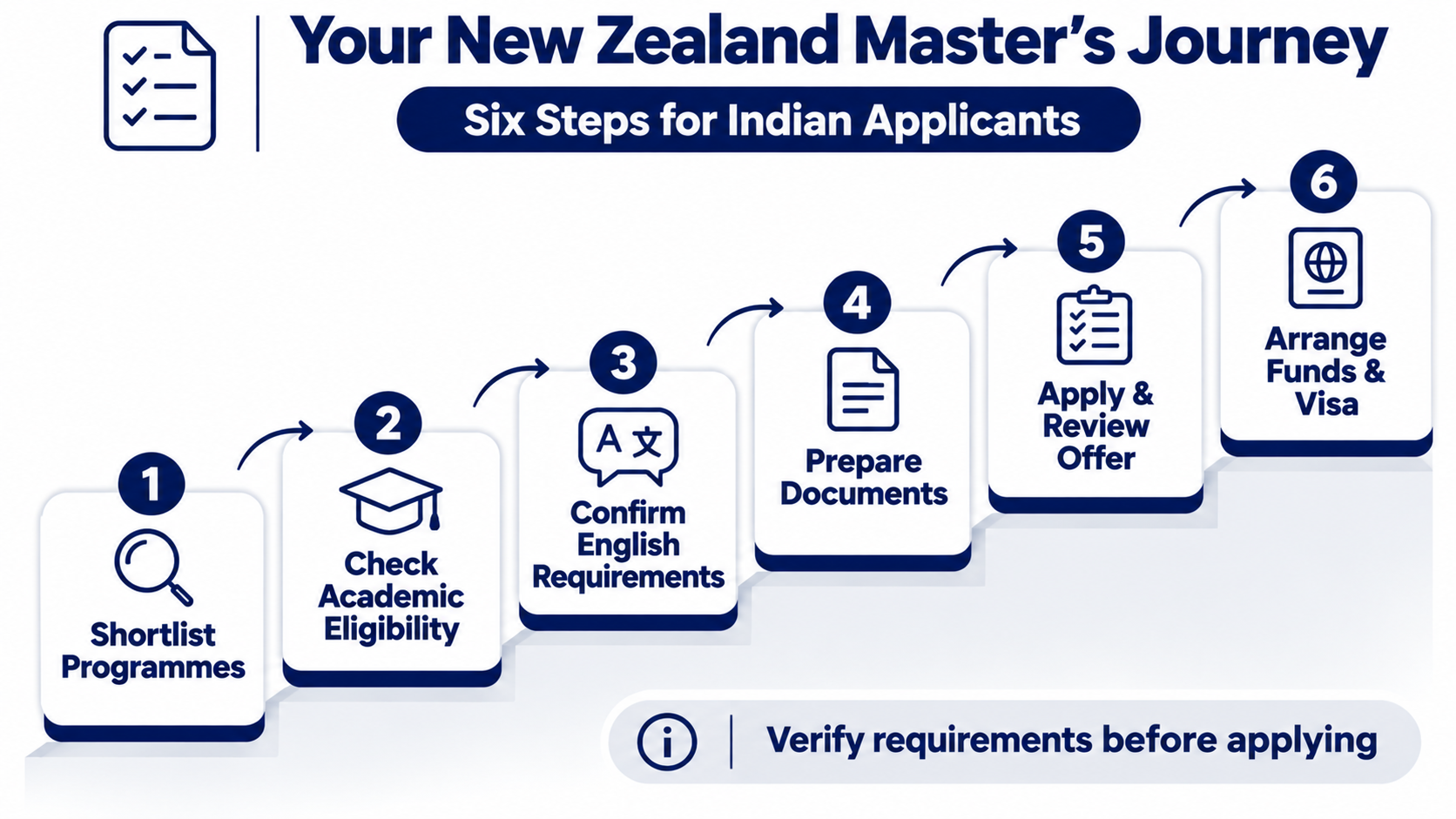
A practical application sequence for New Zealand university eligibility for Indian students is:
- Select a good master’s programme: Correlation to your academic history and career goals.
- Verify academic eligibility: Recognition of check qualification, grades and other related subjects.
- Confirm English requirements: Evaluate accepted exams and exemption.
- Prepare official documents: Adhere to programme specific application checklist.
- Check intake availability. Submit your application before the applicable deadline.
- Review your offer: Concludes any scholarly or documentary provisions.
- Arrange acceptable funding: Gather financing documents according to latest immigration regulations.
- Send in your student visa application: Go through the official Immigration New Zealand.
FAQs
Does New Zealand require 50 or 60% to have a master's?
Neither of the percentages is a national admission cutoff. The enumerated AUT master's programme is a master's course, where a greater number of marks is required. Other programme requirements or documented alternative routes should be checked, not assumed, by applicants.
Will a three-year bachelor's degree qualification work?
Yes. Chosen programs endorse accepted Indian degrees (three years) on condition of academic grades, application of the subject and qualification completion.
Is IELTS compulsory?
Not always. Some universities use alternative English exams or, under certain circumstances, qualifying degrees in English medium.
Are backlogged students allowed?
Possibly. It is based on the requirements of the programmes and the academic records. There is no proven nationwide allowance for a backlog.
Is there an automatic rejection due to a gap in the study?
Not necessarily. Higher institutions can look back at prior academic achievements, credentials and experience. Whenever necessary, applicants were requested to be forthright with the information given.
Is a university guarantee to give a student a visa?
No. Immigration New Zealand makes an independent decision depending on the requisite visas.
Conclusion
New Zealand university eligibility for Indian students according to the programme level, as opposed to individual percentage of graduation, IELTS requirement or backlog allowance.
The master's degrees are chosen, and Indian bachelor's degrees are recognised as three-year degrees, but specialisation needs an extra period in academics.
Begin by ascertaining subject relevance and grade-academics. Next, check English-language evidence, the deadline and the documents needed. Lastly, compare tuition fees and visa finance.
Where the exemption of MOI or other entry route is important, get an affirmation, often by the university itself.
Check New Zealand Eligibility with Gateway EduConnect to get free video or home counselling regarding appropriate master's programmes.
Author Bio
Abhinav Jain - Founder, Gateway Educonnect and Director.
B.Tech, MBA, AI and Global Education Specialist.
More than 15 years of professional experience in leading students along international routes based on politics and innovation.
Connect: https://www.linkedin.com/in/abhinavedysor/