
27 Apr 2026 | Study Abroad Alternatives: What to Do If You Don’t Get Admission Abroad

0
3
Introduction: Study Abroad Alternatives
It can be disheartening to be rejected in your dream university in a foreign country. But it should be noted that it is not a conclusion of your studies abroad. Little known by many students and parents, there exist a number of viable study abroad alternatives options, which can also result in worldwide exposure and career success. The right attitude leads to a step ahead to bigger things during a rejection.
With over 15 years of experience and having helped 23,000 students study abroad, Gateway Educonnect has been in a position to guide and advise thousands of students in making the right decision among the available options for studying abroad. This manual will assist you in studying the feasible backup choices for studying abroad and take the subsequent step with certainty.
Why Do Students Experience Rejection when Studying Abroad?
The first step towards arriving at the right study abroad alternatives would be to know about the applications rejected.
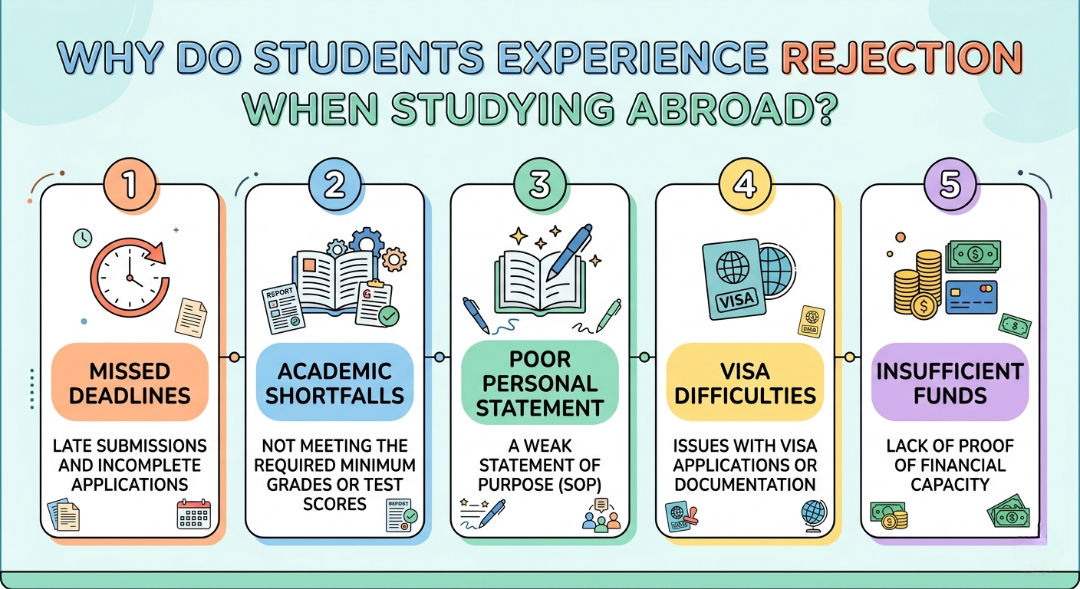
Common reasons include:
- Many of the students do not meet the required academic cut-offs of competitive universities which may greatly affect the chances of admission.
- Delays in submission of applications or submission of lifestyle documentation are often discarded without any additional review.
- The Statement of Purpose (SOP) can be poor, or the letters of recommendation (LORs) can be bad in writing, which does not create a good impression on the admission committees.
- The best universities with high competition and seat limits, even for those who deserve it, make it difficult to be guaranteed admission.
- Other policies or visa matters specific to the country also affect the admissions outcome in other regions indirectly.
And instead of allowing these challenges to stop your plans, it will be worthwhile to do research on possible options for studying abroad so that you can be right on time without wasting your time.
Best Study Abroad Alternatives You Should Consider
1. Apply to Universities that have flexible enrollment requirements.
Many of the popular universities have relaxed admission requirements all over the world, thus leading to the most appropriate rejection due to studying abroad.
- The opportunities are present to concentrate on the relatively lesser-requiring universities regarding IELTS, TOEFL, or GRE and maintain a decent academic level.
- Other universities have conditional admission, wherein students are able to join the school as they pursue their possible requirements.
- Prior to starting their degree courses, they can choose to take pathway or preparatory courses so that they can fill the academic gap.
This is among the most feasible study abroad options for students who just miss eligibility requirements.
2. Consider Pathway or Foundation Programs.
Pathway programs are created to help students successfully meet the requirements for university entry.
- These programs are used to aid with the increase in academic preparation and mastery of the English language before enrolment into a full-degree program.
- Those students who are able to meet the demand of the pathways programs are normally assured of enrollment in all universities.
- Such programs tend to have fairly relaxed entry requirements as compared to direct university admissions.
They are among the most certain second-way programs in a foreign country that students with the intention of achieving admission to the best universities would have.
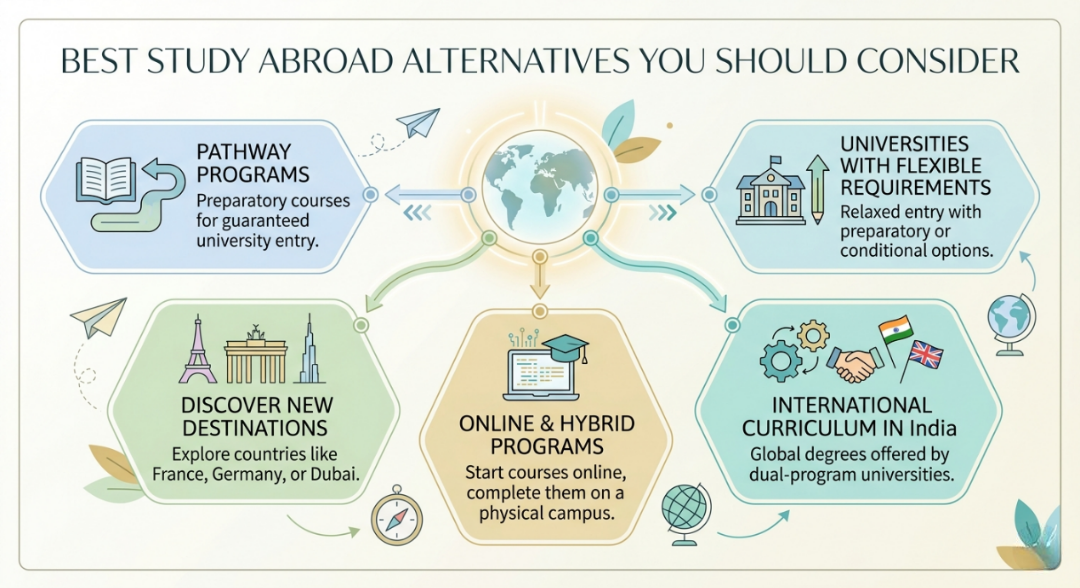
3. Discover New Study Destinations.
Being out of the ordinary can offer some terrific study abroad opportunities with superior career opportunities.
|
Country |
Key Benefits |
Average Cost (INR/year) |
|
France |
Provides inexpensive education and international contacts and enrollment in reputable colleges. |
₹10–15 Lakhs |
|
Germany |
Offers limited or no tuition and good technical training, especially in the engineering departments. |
₹8–12 Lakhs |
|
Dubai |
They are characterised by global campuses, minimal visa hassles and proximity to India. |
₹12–18 Lakhs |
These are the most preferred Indian student-friendly backup places to study abroad.
4. Repeat in Next Intake.
Suppose that you have chosen to participate in a specific university, reapplication in foreign countries can be a solid strategy.
- You are able to enhance your IELTS or TOEFL, etc scores to qualify for the desired test by the university.
- Having internships, certifications, or any other relevant work experience may also help a lot in enhancing your application profile.
- With the help of a professional, rewriting your SOP can also be a good way of reminding people of your targets and accomplishments.
The approach has been one of the most reliable study abroad rejection plans for long-term success.
5. International Curriculum of Study in India.
One of the other potential study abroad programs is to choose global education opportunities in India.
- Nowadays, numerous Indian universities have an international branch campus where they offer international degrees.
- Dual-degree offers learners an opportunity to complete their education in half in India and complete the other half in a foreign nation.
- Transfer programs enable the student to continue his or her education in India and bring transfer to a foreign country in the future, thus saving more.
It has been an extremely handy study abroad alternatives and is cheap for the students.
6. Online or Hybrid International.
Another avenue which has been highly adopted and is a good alternative in other countries is online and hybrid learning.
- The learners can start their degree online and later relocate to a foreign campus where they can complete the degree.
- This assists in saving a lot of new expenses like travelling and accommodation.
- It enables students to acquire global exposure, as well as be flexible in their studying schemes.
These programs offer contemporary and adaptable study abroad choices to contemporary students.
Step-by-Step Plan After Rejection
The rejections and heartaches can be unjust, but the right plan will help you move on to do so with confidence. Instead of wasting time, take a methodical procedure of researching the most ideal choice of studying abroad and remain current.
Step 1: Discuss the reason of rejection.
You must make a keen consideration of whether it was rejected based on the performance on the academics, missing documents or on time.
Step 2: Act Without Delay
Never wait too long after being rejected, by doing so at early stages, you will have time to open up to new opportunities and make better applications.
Step 3: Shortlist the right university.
Name a list of universities that would be suited to you, and list safe, moderate and ambitious universities that will provide higher chances.
Action 4: Explore Alternative Pathways Abroad
Regarding the difficulty in direct admission, some pathway programs/foundation courses are effective options to access the finest universities in different countries.
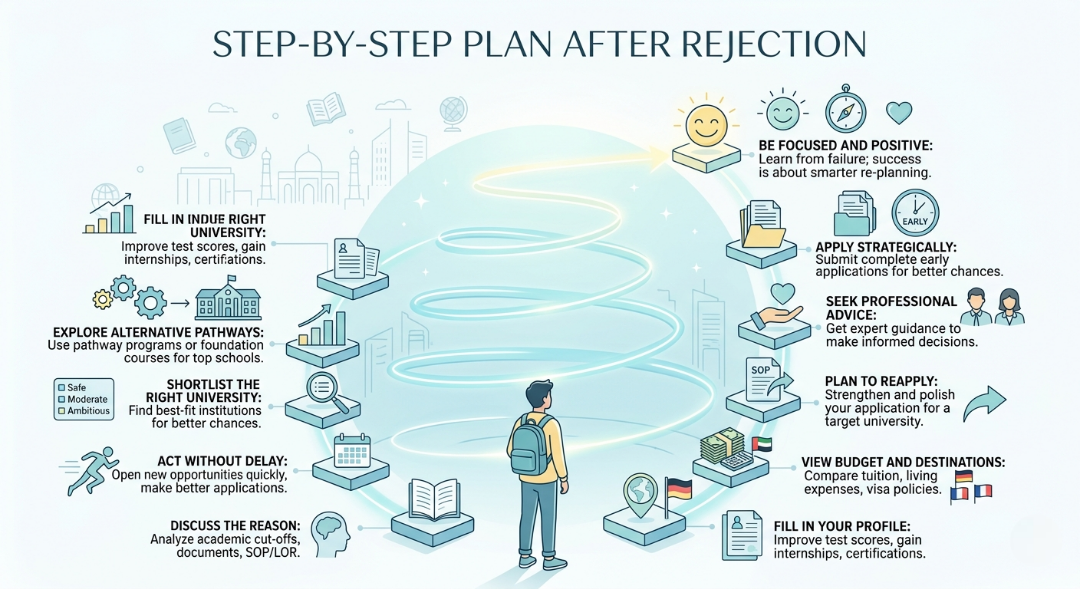
Step 5: Fill in Your Profile.
Focus on improvement of test scores, acquisitions or internships to complement your overall application.
Step 6: View Budget and Destinations.
Research and compare countries by tuition, living expenses and visa policies to find viable alternate decisions to study abroad.
Step 7: Plan to Reapply Abroad
And in case the university that you have desired is on the list, you will probably reapply to the same university in a foreign country and with an improved and better-polished application.
Step 8: Expert Advice.
Seek professional advice from counsellors to know the most appropriate study abroad rejection and make informed decisions.
Step 9: Apply Strategically
Early application of the applications with full documentation would enhance your possibility of being admitted and receiving scholarships.
Step 10: Be Focused and Positive.
Remember in your future that it was not a single failure that defines your future, as well as that there is a group of students who study out due to smarter re-examinations.
How Gateway Educonnect Invites You to Make Progress?
It takes expertise and experience to choose the appropriate study abroad alternatives.
Gateway Educonnect will help students:
- A One-Click Apply, which enables the student to begin applications to any international university within 100 seconds without hassle.
- Instant offer letters within 24 days, enabling students to proceed fast within the competitive admission processes.
- Cashback incentive was as high as 2499 dollars, and it rendered international education more affordable to the students and families.
- Complete services which include education loans, living assistance services and tailored counselling services.
With leading destinations to offer, including the US, the UK, Canada, Australia, Germany, France and Dubai, we offer our students the best 496 study abroad alternatives.

Practical Tips to Strengthen Your Next Application
When you do this tactfully, preferably when the study abroad option has been taken into consideration, or when devising a scheme to reapply abroad, you are likely to get a better chance to polish your application.
- Improve your IELTS, TOEFL or other tests to fit a bit more in university needs.
- Include internships, certifications, or projects to add to your academic profile.
- Research overseas universities and countries to discover appropriate backup options for studying abroad.
- Think about other avenues in other countries, such as foundation or pathway programs, where necessary.
- Keep your applications in order so that you are able to have various intakes; this way, you can easily reuse the same in foreign countries.
- Seek professional advice to come up with the correct rejection decisions for the study abroad.
- On the one hand, make sure that you thoroughly proofread your application in order to avoid small yet costly errors.
FAQs
1. What are the best study abroad possibilities in the event of rejection?
The most study abroad alternatives would include the application to universities with liberal requirements, to pathway programs, a visit to new study areas or studying in India with overseas transfer feasibility.
2. May I be reapplied for when not originating in the USA, where the policy was repudiated in the first instance?
Shopping, yes, it is possible to be used in a second intake abroad. You can increase your chances of being accepted by ensuring that you enhance your test scores, gain the related experience, and strengthen your SOP.
3. What will be the most favourable study abroad alternatives?
Taking up foundation programs, applying to other universities, or deciding to stick with hybrid educational programs are the most suitable forms of rejection that may be effective in studying abroad, which may later allow them to adopt other countries.
4. Do Indians students have cheap study abroad back-up programs?
Though there are budget-friendly backup options, study abroad in such states as Germany, France or Dubai with good education, lower tuition and good career opportunities.
5. What do other outlets not in the country of low-scoring students look like?
The students with low grades in academics or English are granted a choice of alternative courses of study in other nations, such as foundation courses, diplomas, and conditional admission to full degree programs.
Conclusion
Rejections are disappointments, though they tend to give way to other acceptable and suitable opportunities. By researching the right study abroad programs, students do not have to lose time or energy to extend their international studies. The point is that you have three options: to reapply overseas, to pursue other study abroad alternatives, or to pursue cost-effective backup opportunities to study overseas; all you have to do is be strategic and be up-to-date.
This would be very practical under the tutelage of the experts. Gateway Educonnect has the necessary experience, has successful students in its track record and can guide you to make the right choices each and every step along the way.
Get your study abroad dreams with Gateway Educonnect. For more assistance, please visit our study abroad consultancy services and explore our wide range of offerings for students interested in studying in the USA, studying in the UK, studying in Australia, studying in Ireland, and many other countries.

Author Bio
Abhinav Jain - Founder, Gateway Educonnect and Director.
B.Tech, MBA, AI and Global Education Specialist.
More than 15 years of professional experience in leading students along international routes based on politics and innovation.