
01 Apr 2026 | Education Fairs Go Virtual: Making the Most of Online & Offline Events

0
62
How Students & Parents Can Maximise Online & Offline Opportunities
The international education business is evolving rapidly, and study abroad fairs in 2026 have been among the most effective tools for planning higher education abroad for students and their parents. In-person, online, or hybrid, these fairs provide a unique opportunity to meet with universities face-to-face, learn more about global curricula, and familiarise yourself with the abundance of scholarships and financial aid. For most Indian students, participation in such events is the first step toward sound decision-making about their future.
I have been guiding students through international admissions for the past 15 years, helping them navigate the complex process and make the most of available opportunities. This is based on the personal experience of students who receive more resources (scholarships, admissions, and mentorship) when they take initiative and attend fairs, webinars, and workshops. In this guide, I provide virtual education fair tips and real-life examples to help my mentored students make the most of the study abroad fairs in 2026.
Understanding Study Abroad Fairs in 2026
The study abroad fairs in 2026 will be events where universities present their programs and interact with prospective students. They are typically offline activities that include physical booths, workshops, and one-on-one counselling. Online and hybrid classes would allow students to participate from any location, enable them to explore multiple colleges and universities simultaneously, and allow them to view video recordings later.
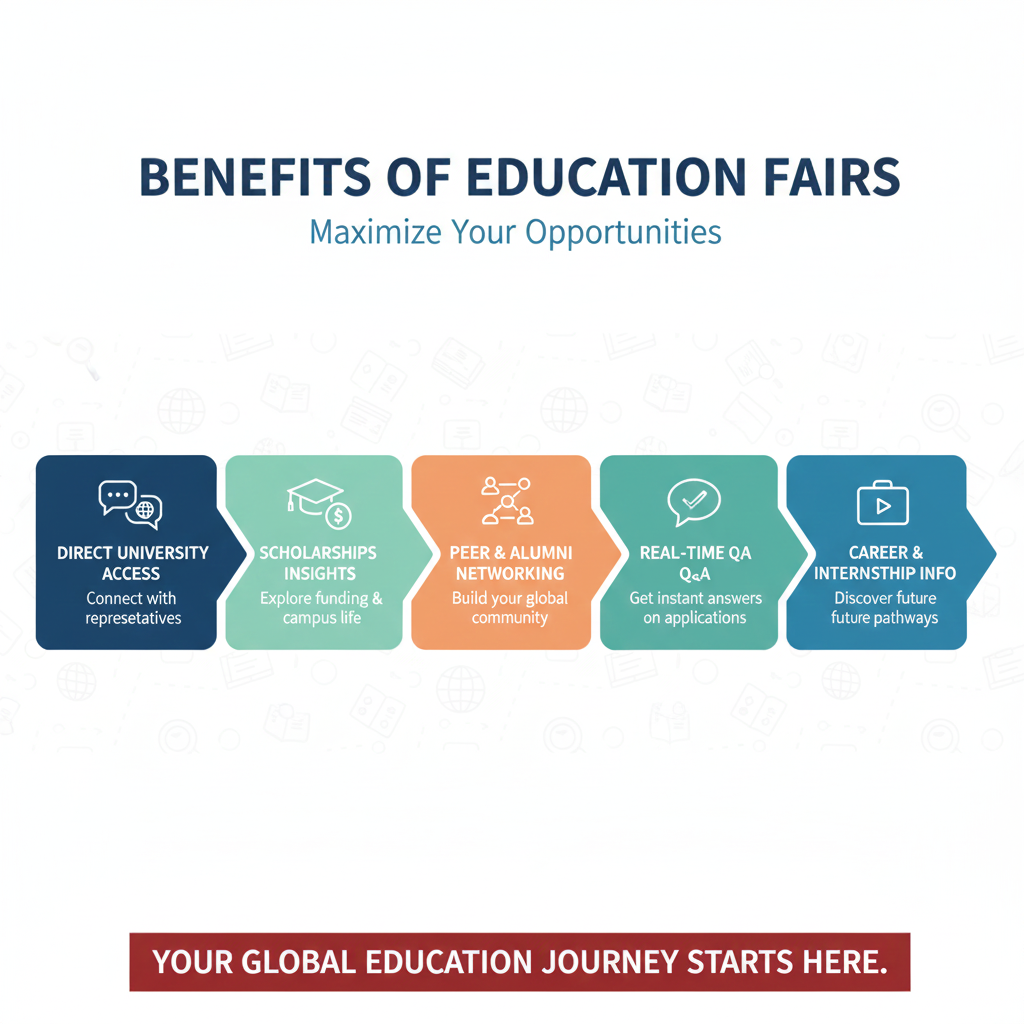
Such fairs have the following benefits:
- Close association with foreign universities and the program representatives.
- Have the chance to research scholarships, internships and campus life.
- Peer networking and alumni and faculty networking.
- Real-time answer to requests on application and admission.
Bengaluru One student attended a hybrid fair last year. She might visit certain universities in person and host webinars with them, and she could shortlist them to precisely match her career goals.
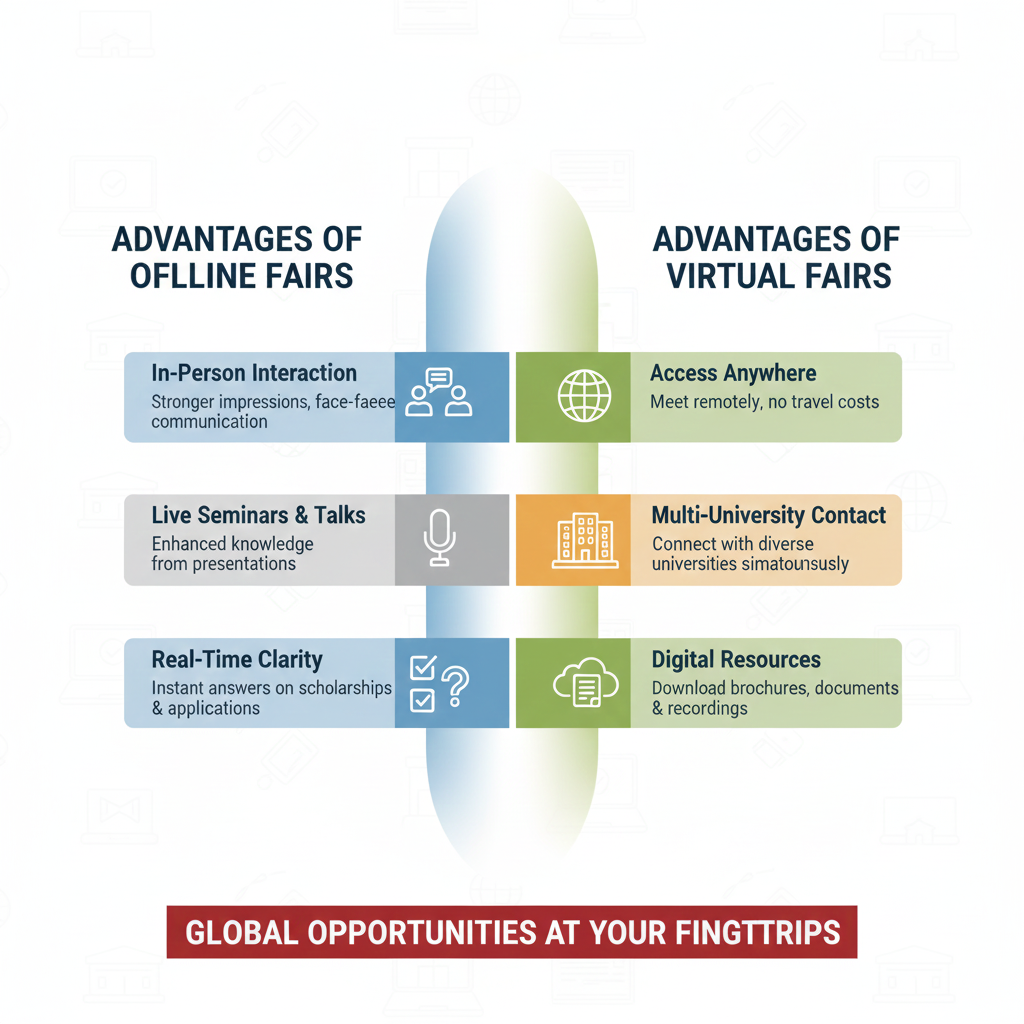
Advantages and Challenges of Virtual and Offline Education Fairs
Despite the fact that the two types of formats provide many opportunities, both types of formats have advantages and disadvantages:
Advantages of Offline Fairs
- Face-to-face communication is stronger when it comes to impression.
- Knowledge is enhanced through live seminars and talks.
- Real-time elucidation of scholarships and applications.
Advantages of Virtual Fairs
- Meet anywhere without incurring travelling costs.
- Contact different universities simultaneously.
- Materials in stores should be in soft copies (brochures, documents, recordings).
Challenges Students May Face
- Distraction and fatigue through the Internet.
- The technical issues, such as connection or glitches in the platform.
- Issue with making personal contacts at online-only fairs.
- Unplanned sessions were too many.
Tips to Overcome Challenges
- The internet and pre-test equipment.
- Plan to concentrate on the key meetings.
- Take notes and follow-ups on the universities of interest.
Why Indian Students Should Attend Study Abroad Fairs
The study abroad fairs in 2026 will benefit Indian students and their parents. Students can develop a clear understanding of international programs, learn about universities they have not considered, and gain a general overview of the support services available in other countries. Parents will have the opportunity to attend specially designed sessions to learn about safety, accommodation, and cultural adjustment.
In my case, students who prepare in advance to attend such fairs have a better chance of succeeding. One of the students from Mumbai was not very familiar with the Canadian universities. By attending an online fair and webinars, he not only selected a university to participate in but also received a merit-based scholarship. It can be considered an illustration of how planning and engagement can transform opportunities into real action.
Other advantages include:
- International: Be familiar with differences in course structure, credit structure and mode of teaching.
- Knowledge about scholarship: Universities tend to advertise during fairs on exclusive opportunities.
- Networking: The alumni and the current students are able to provide information about life on campus and progress.
Education Expo Preparation: How to Get Ready
The expo setup requires adequate education to achieve optimal results for any fair, whether offline or online. This has been my experience: students who organise their time in advance are more likely to attract attention and impress universities.
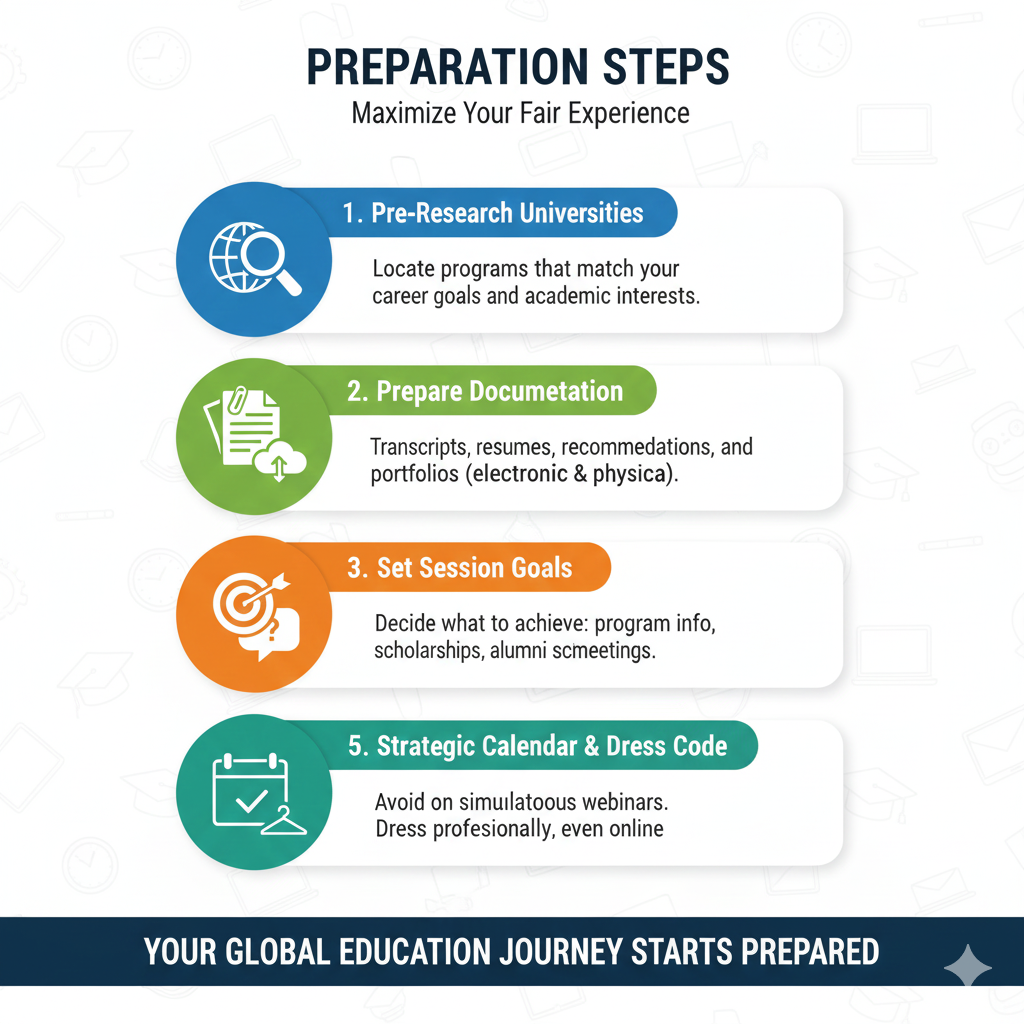
Preparation steps
- Pre-research universities: Locate a program that can meet your career goals and academic interests.
- Prepare documentation: Prepare transcripts, resumes, letters of recommendation and portfolios, both electronically and physically.
- Set goals at each session: Decide what you want to achieve- learn about programs, research scholarships, and hold alumni meetings.
- Plan questions: Focus on the information about the program, about internship opportunities, about life on campus, and about scholarships.
- Plan the calendar strategically: do not conduct the webinars and workshops simultaneously.
- Dress professionally: It is no laughing matter, even on the internet, where an individual should dress well.
Preparation Checklist Table – Online vs Offline
|
Step |
Online Fairs |
Offline Fairs |
|
Documents |
Digital PDFs, scanned copies |
Physical copies |
|
Engagement |
Live chat, Q&A, webinars |
Face-to-face conversations |
|
Scheduling |
Flexible time slots |
Fixed sessions |
|
Networking |
Virtual booths, discussion forums |
Seminars, workshops |
|
Technology |
Stable internet, headset, camera |
Venue logistics |
A virtual fair's digital portfolio was created by one of the Delhi students with whom I had gone through these steps. By planning his queries and participating in various sessions, he was able to interview with three universities, one of which offered him a scholarship.
Making the Most of University Webinars 2026
In university webinar 2026 can give students an absolute advantage in determining which courses to pursue, which scholarships are available, and what life will be like on campus.
- Meet faculty and admissions officers, get first-hand information on course architecture and career prospects.
- Get details of scholarships, internships and research programs.
- Ask about details of the program and conditions to be satisfied in order to get accepted.
- Get some real-life exposure by networking with other former students or current students.
- Write and call the representatives to receive one-on-one instructions.
Inclusion in the university's 2026 webinar will help students make informed decisions and maximise their participation in online education fairs.
University Webinar Maximisation.
The study abroad fairs in 2026 now include webinars. They provide a comprehensive platform where students can gain detailed information on programs, admission requirements, and career opportunities.
Tips to maximise webinars
- Show up early to make sure connectivity and audio/video are fine.
- Ask thought-provoking questions about courses, internship, scholarship and post-graduation successfully.
- Note-taking/recording sessions (where feasible).
- Be actively involved in polls, chats and question and answer.
- The contact university representatives on special instructions.
During a university webinar 2026, a student asked questions about internship placements and research opportunities, raising specific concerns about their availability in Chennai. The university faculty appreciated her preparation and offered her personalised scholarship counselling, demonstrating how engagement would directly affect her opportunities.
Virtual education fair tips
Online fairs are not fixed; they must be strategy-driven. In my experience, students who think ahead and take virtual classes are more likely to receive opportunities to contribute valuable insights.
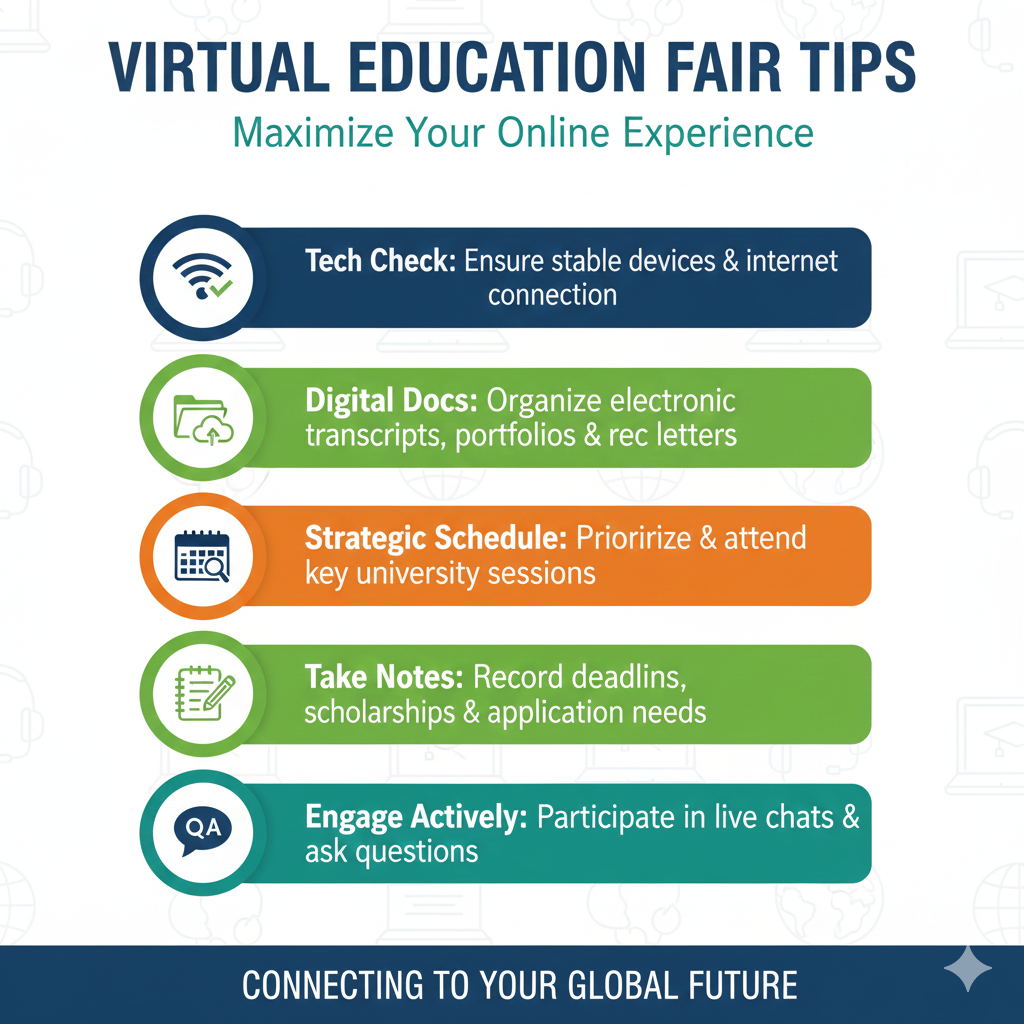
Actionable tips:
- Ensure the devices and the internet connection are good.
- Get together all your electronic files (transcripts, portfolios and recommendation letters).
- Conduct a number of meetings, most strategically, to contact the major universities.
- Note down due dates, scholarships and application necessities.
- Participate directly in live chats, ask questions, and answer them.
- Provide updates to the universities on their social media.
To illustrate the point, one of the students in Mumbai attended three online fairs in a month and ensured they made notes on each university's scholarship requirements. He received invitations to two scholarships at two universities after this method of tracking down, demonstrating the effectiveness of his preparation and participation.
Tracking and Evaluating Opportunities from Education Fairs
A significant number of students attend fairs without a monitoring and evaluation mechanism for opportunities. One way to make decisions is to be organised.
Tracking Tips:
- Make a list of universities, courses, deadlines, scholarships and follow-ups.
- Record key points of any session or any webinar.
- Target universities such as those where fit, scholarship and career objectives are concentrated.
This method was used by a Pune-based student who attended a hybrid fair, thereby narrowing the list to three universities and securing admission with a merit scholarship.
Post-Fair Actions: Turning Opportunities into Results
The employment is not limited to the fair visit. The events leading up to the fair are significant.
- Get in touch with the representatives by emailing or making an appearance.
- The applications and scholarship forms must be timely.
- Supervise deadlines and other specifications.
- Maintain long-term networking using professional communication.
Students who follow these steps perform better than those who attend sessions without follow-ups.
Common Mistakes and How to Avoid Them
The best intentions always go wrong, as the students are likely to make avoidable mistakes at the study abroad fairs in 2026:
- Both under preparation: Flying by without program research.
- Neglecting follow-ups: There is no response in terms of emails or contacts with the representatives.
- Lack of implementation of scholarships: Lost scholarship announcement or sessions.
- Poor listening: This is where one fails to pose questions or have a conversation.
- Technical issues: Impossibility to test the equipment, browsers, or platforms before usage.
Mistakes vs Solutions Table
|
Mistake |
How to Avoid |
|
Lack of preparation |
Research universities, programs, and sessions |
|
Ignoring follow-ups |
Email or message representatives after the fair |
|
Missing scholarships |
Attend dedicated scholarship sessions. |
|
Poor engagement |
Prepare questions and actively participate |
|
Technical issues |
Test devices, the internet, and platforms beforehand |
Students who avoid such errors tend to receive more interactions, scholarships, and admission offers.
How Gateway Educonnect Helps Students
Gateway Educonnect has over 15 years of experience directing students, and the study abroad fairs in 2026 offer the most opportunities.
- Recommends courses and colleges that become the goal of all students.
- Fairly presents such documents as resumes, portfolios and recommendation letters.
- Demonstrate to the students how to communicate with the university people and identify scholarships.
- Helps in follow-ups, subsequent applications, and tracking of fair deadlines.
- Makes the students achieve results and is based on practical approaches and years of experience in mentoring students.
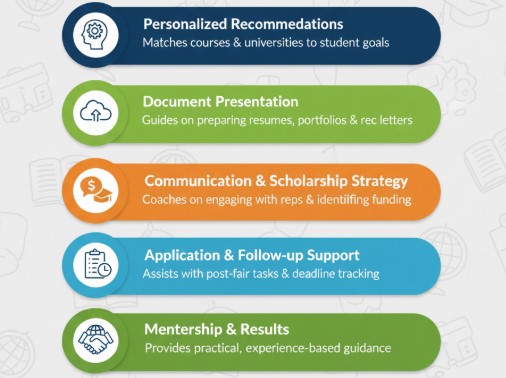
The partnership with Gateway Educonnect will help students make their study abroad fairs in 2026 a reality, leading to success in admissions and scholarships.
Key Takeaways for Students and Parents
- Preplan: Research about universities, resolve appointments and organise documents.
- Be active: ask questions, visit different booths, take part in webinars and so on.
- Make the most of offline and online opportunities: The two together will represent the whole picture.
- Fair follow-up: Call university representatives for other guidance or scholarships.
- Get professional help: Students are advised to use the services of consultants like Gateway Educonnect because they help to negotiate fairs and improve success.
Adherence to the strategies will help students leverage the study abroad fairs in 2026 and take meaningful steps toward international studies.
Frequently Asked Questions (FAQ).
Are virtual and offline study abroad fairs in 2026 different?
The ability to interact face-to-face and gain real-world experience from offline fairs is an advantage compared with the convenience and flexibility of virtual fairs, and the accessibility of different universities is an advantage. Both advantages apply to hybrid fairs.
What can be done students for an education expo preparation?
The students are expected to prepare for university, write papers, compile question lists, organise sessions effectively, and set clear goals.
Should webinars in universities be attended?
Yes. Webinars are a source of new knowledge, an opportunity to interact with faculty, and a pathway to scholarship.
What are the papers to be done at online fairs?
Keep online transcripts, letters of recommendation, resume and portfolios. File vet test and submit.
What can parents do to assist their children with online fairs?
Parents will be able to participate in parent-focused webinars and receive support with reading brochures, scheduling, and guidance on questions to ask.
What is the purpose of virtual fairs in securing student scholarships?
Exclusive scholarships are generally posted at university fairs. Both preparation and active participation, along with follow-ups, increase the likelihood of receiving offers.
Conclusion
The study abroad fairs in 2026 provide Indian students with the opportunity to study overseas. With proper preparation, active participation, and guidance from professionals, students will be able to make the most of the opportunities offered by such events. Online and blended channels are more adaptable and accessible, while offline activities are more immersive. The use of such fairs can help parents secure admissions, grants, and mentorships that will make the international learning process successful for students.
For personal recommendations on attending study abroad fairs in 2026, attending university webinar 2026, and receiving scholarships, contact Gateway Educonnect service. For more assistance please visit us study abroad consultancy, and avail of our wide range of services for students on destinations like study in USA, study in UK, study in Canada, study in Australia, study in ireland and many more country.

Author Bio
Abhinav Jain - Founder, Gateway Educonnect and Director.
B.Tech, MBA, AI and Global Education Specialist.
More than 15 years of professional experience in leading students along international routes based on politics and innovation.