
04 Apr 2026 | UK Credit Transfer for Bachelor’s Degree: Save Time and Tuition Fees

0
11
UK Credit Transfer for Bachelor’s Degree: Save Time and Tuition Fees
Having worked for over 15 years advising students on international education avenues, I have witnessed how strategically arranged UK credit transfers have transformed students' academic and financial choices. A number of students begin their undergraduate programs in India before deciding to pursue their studies in the UK for global exposure. As opposed to revisiting Year 1, credit transfer in the UK would enable them to continue their studies without wasting time or tuition fees.
The Higher Education Statistics Agency (HESA) indicates that the UK has a population of more than 600,000 international students every year. Also, UCAS data indicates growing flexibility of admission routes, such as advanced entry routes. This is a clear indication of why UK credit transfer is becoming a preferred choice for students intending to earn a bachelor's degree in the UK.
Introduction to UK Credit Transfer
UK credit transfer is an educational route that enables learners to bring in credits they have already earned at UK universities and join a UK bachelor's degree program in Year 2 or Year 3. Students can proceed with their studies uninterrupted, rather than registering for modules they have already completed.
As my case study illustrates, several students who joined B.Tech, BBA or B.Sc programs in India later realised their desire to pursue education in the UK. After appropriate academic mapping, we assisted them in transferring their credits to the UK to minimise study time and costs.
Rohan (anonymity upheld) was one of my students who had attended two years of Computer science in India. He gained entry into Year 3 in the UK through UK credit transfer, thus avoiding almost one year of tuition and living costs.
What is UK Credit Transfer and How Does It Work?
The UK adheres to the Regulated Qualifications Framework (RQF), in which every module has academic credits assigned to it. On the application of the UK credit transfer, universities determine the compatibility of the curriculum.
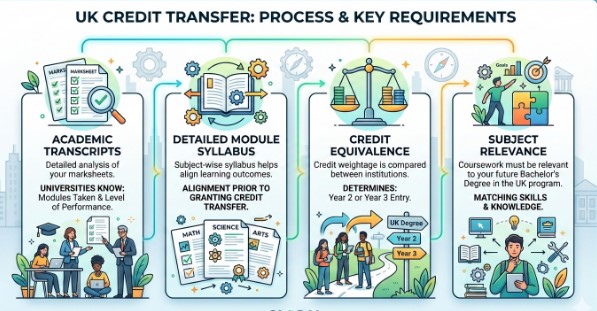
In order to be successful in transferring credits to UK universities, institutions consider:
- Academic Transcripts: Your marksheets are carefully analysed by the universities, and they know the module taken and level of performance.
- Detailed Module Syllabus: A subject-wise syllabus assists universities in aligning the learning outcomes prior to granting UK credit transfer.
- Credit Equivalence: Credit weightage is then compared between institutions to find out whether you can get Year 2 or Year 3 entry.
- Subject Relevance: The coursework that you are doing should be quite relevant to your future bachelor's degree in the UK program.
When conducting my counselling, I would always inform my clients that the UK credit transfer is more of a subject alignment rather than a general percentage.
Benefits of UK Credit Transfer for Bachelor’s Degree
There are several benefits of selecting the UK credit transfer:
- Savings 1-2 Years of Study: Students in the UK can get through to their bachelor's degree and access the job market sooner.
- Lower Tuition: The students will be saving one year of tuition, and the total tuition will be significantly lower.
- Reduction of Living and accommodation costs: The reduced duration of stay in the UK leads to a direct decrease in the cost of living and accommodation.
- Shorter Payback Period (ROI): With early graduation, you are able to earn sooner once you graduate in the UK.
- International Academic Exposure: Students are still able to get a full UK qualification and have the added advantage of advanced entry.
Throughout the years, I have observed that families do not always know how effective UK credit transfer can be in saving money without affecting the quality of degrees.
Eligibility Criteria for Transfer Credits in UK Universities
The UK credit transfer does not automatically qualify all applicants. To transfer credits successfully in the UK universities, students need to fulfil some standards.
- Minimum Academic Percentage: In most universities, the minimum academic percentage is 55-70 per cent, based on the course and the institution.
- Relevant Academic Background: Your past topics need to be related to the selected bachelor's degree UK specialisation.
- English language proficiency: To study in the UK, one must have IELTS or similar scores.
- Full Academic Paperwork: Transcripts and comprehensive syllabi are necessary in order to map out credit perfectly.
As far as my experience shows, the most frequent issue that leads students to not be approved for a UK credit transfer is the lack of complete documentation.
Step-by-Step Process for UK Credit Transfer
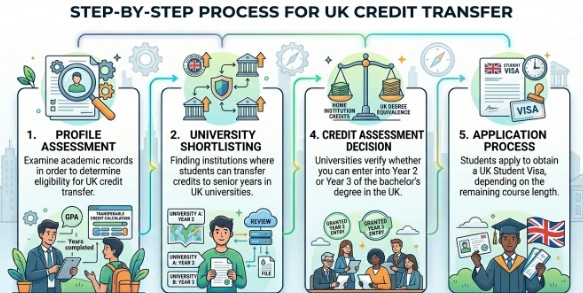
The following is a step-by-step outline of my approach to credit transfer with students to the United Kingdom:
- Profile Assessment: We examine academic records in order to determine eligibility for UK credit transfer.
- University Shortlisting: It involves finding institutions where students can transfer credits to senior years in UK universities.
- Document Submission: Transcripts and syllabi are presented to be evaluated in an official academic manner.
- Credit Assessment Decision: Universities verify whether you can enter into Year 2 or Year 3 of the bachelor's degree in the UK.
- Application Process: Students apply to obtain a UK Student Visa, depending on the remaining course length.
This systematic planning enhances the success rate of credit transfer in the UK by a great margin.
Top UK Universities Accepting Credit Transfers
The UK credit transfer flexibility is provided in a number of reputed universities, particularly in business, computing, and engineering:
- University of Hertfordshire.
- Coventry University
- University of Greenwich
- Northumbria University
The policies differ depending on each course; however, these institutions have often allowed the transfer of credits from UK universities to Year 2 or Year 3 of a bachelor's degree in the UK.
Important Factors to Consider Before Applying
Students should take into consideration the following before deciding to use UK credit transfer:
- Credit Approval does not come on a silver platter. Every university selectively considers and then gives UK credit transfer.
- You should have Compatibility in the structure of the course: Minor variations in modules can have an effect on whether or not you can transfer credits to UK universities.
- Financial Planning is Necessary: The tuition fees vary based on the remaining time of your bachelor's degree in the UK.
- Length of Visa is determined by the year of entry: In case you study in the UK with the help of the advanced entry, the visa will last as long as your course.
I would never give a student an assumption and always have it be evaluated by the experts before they do any application regarding transfer of credit in the United Kingdom.
Cost Comparison: Regular Entry vs UK Credit Transfer
|
Aspect |
Regular Entry |
UK Credit Transfer |
|
Duration |
3 Years |
1–2 Years |
|
Tuition Fees |
Full 3-Year Cost |
Reduced Due to Advanced Entry |
|
Living Expenses |
Higher |
Lower Due to Shorter Stay |
|
Career Start |
Delayed |
Faster |
In numerous actual situations I have dealt with, UK credit transfer has saved students PS13,00020,000 based on course and city.
Common Mistakes Students Should Avoid
The most frequent mistakes to be made by students wishing to transfer credit to the UK should be avoided:
- Disregard of Module Compatibility: To apply modules without determining subject alignment, approval is less likely.
- Application of Incomplete Syllabus: Universities are not allowed to credit transfer to the UK without academic details.
- Late Submission of Deadlines: Late submissions restrict transfer credit choices in the UK universities.
- Underestimating English Requirements: Excellent language scores enhance admission and visa success when you study in the UK.
FAQs
What is a UK credit transfer?
UK credit transfer enables students to transfer already acquired credits to UK universities and join higher levels of a bachelor's program.
Would you allow the transfer of credits after 2 years of education?
Yes, assuming that your curriculum is compatible, then you are eligible to get a UK credit transfer to Year 2 or Year 3.
Are transfer credits from UK universities allowed in all universities?
No, the policies are not similar across institutions and programs.
Is the cost of UK credit transfer reduced?
Indeed, the less time, the better in terms of tuition and living costs.
Is IELTS required when studying in the UK for a credit transfer?
Yes, one has to speak English to study in the UK.
Conclusion
UK credit transfer is among the cleverest ways to complete a bachelor's degree in the UK in an efficient manner, if it is planned properly. It enables students to study in the UK without having to repeat years, saving time and fees.
Being an education specialist with 15+ years of experience, I am convinced that informed choices ensure global education is affordable and available. The UK credit transfer is a revolutionary academic endeavour when students embrace the process thoughtfully and select the appropriate universities to transfer credits to.
For more assistance please visit us study abroad consultancy, and avail of our wide range of services for students on destinations like study in USA, study in UK, study in Canada, study in Australia, study in ireland and many more country.