08 Oct 2026 | Work Rules While Studying in Canada 2027-28: Complete Guide for Indian Students

0
4
Work Rules While Studying in Canada 2027–28: Complete Guide for Indian Students
Minimum wages, working hours, part-time jobs and employment eligibility of Indian master's students. Indian students studying any of the eligible master's degrees in Canada now have the option of working up to 24 hours per week off campus during normal school semesters. They are allowed to work as long as they do it during qualifying scheduled breaks and, provided they are qualified, during employment on campus. Nevertheless, it is dependent on the terms of study permits, enrolment status and the type of job where employment occurs.
Reading about work while studying in Canada international student rules will assists applicants in preventing immigration infractions, comparing possible income, and saving money prior to immigration. This is a guide on the minimum wages, regulations, internships, post-graduation, and work documentation options for students intending to enroll in the 2027-28 intake.
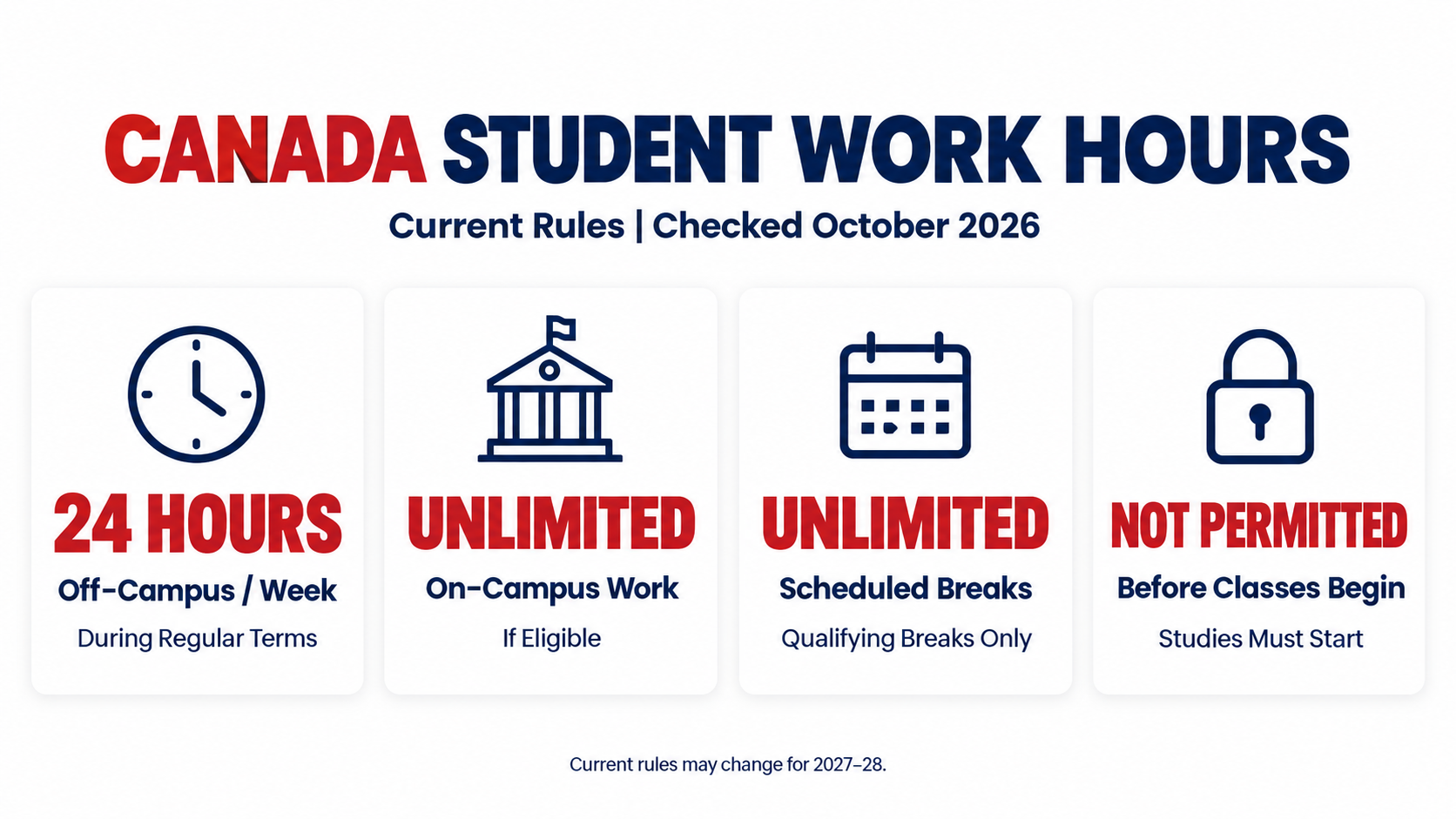
Overview: Canada Student Work Rules
|
Employment category |
Current permitted hours |
Conditions |
|
Off-campus employment |
24 hours/week |
Regular academic terms |
|
On-campus employment |
Unlimited |
Subject to eligibility |
|
Scheduled academic breaks |
Unlimited |
Qualifying scheduled breaks |
|
Before programme commencement |
Not permitted |
Studies must have started |
|
Eligible compulsory internships |
Hours under placement rules |
Institutional approval required |
|
Authorised academic leave |
Work generally prohibited |
Applicable student work conditions |
|
After graduation |
Depends on authorisation |
PGWP or another qualifying route |
Who is Welcome to Work During Study in Canada?
Indian master's students may work without a separate ordinary work permit when they satisfy IRCC's eligibility requirements.
The work while studying in Canada international student rules generally require students to:
- Have a valid study permit with suitable conditions of employment.
- Have started their academic programme.
- Undergo education at some kind of school (DLI).
- Have full-time enrolment, except in certain cases.
Undertake an eligible programme not less than six months and resulting in a recognised credential.
Get a Social Insurance Number to work. Only students with language-only or general-interest courses are not granted the automatic right to work off campus.
There is a narrower exception that enables eligible students to work during their last semester studying part-time, as they must have successfully passed the full-time status requirement in the prior semesters.
The official IRCC off-campus eligibility assessment should be used by students before taking employment.
What are the Maximum Hours allowed by International Students to work off campus?
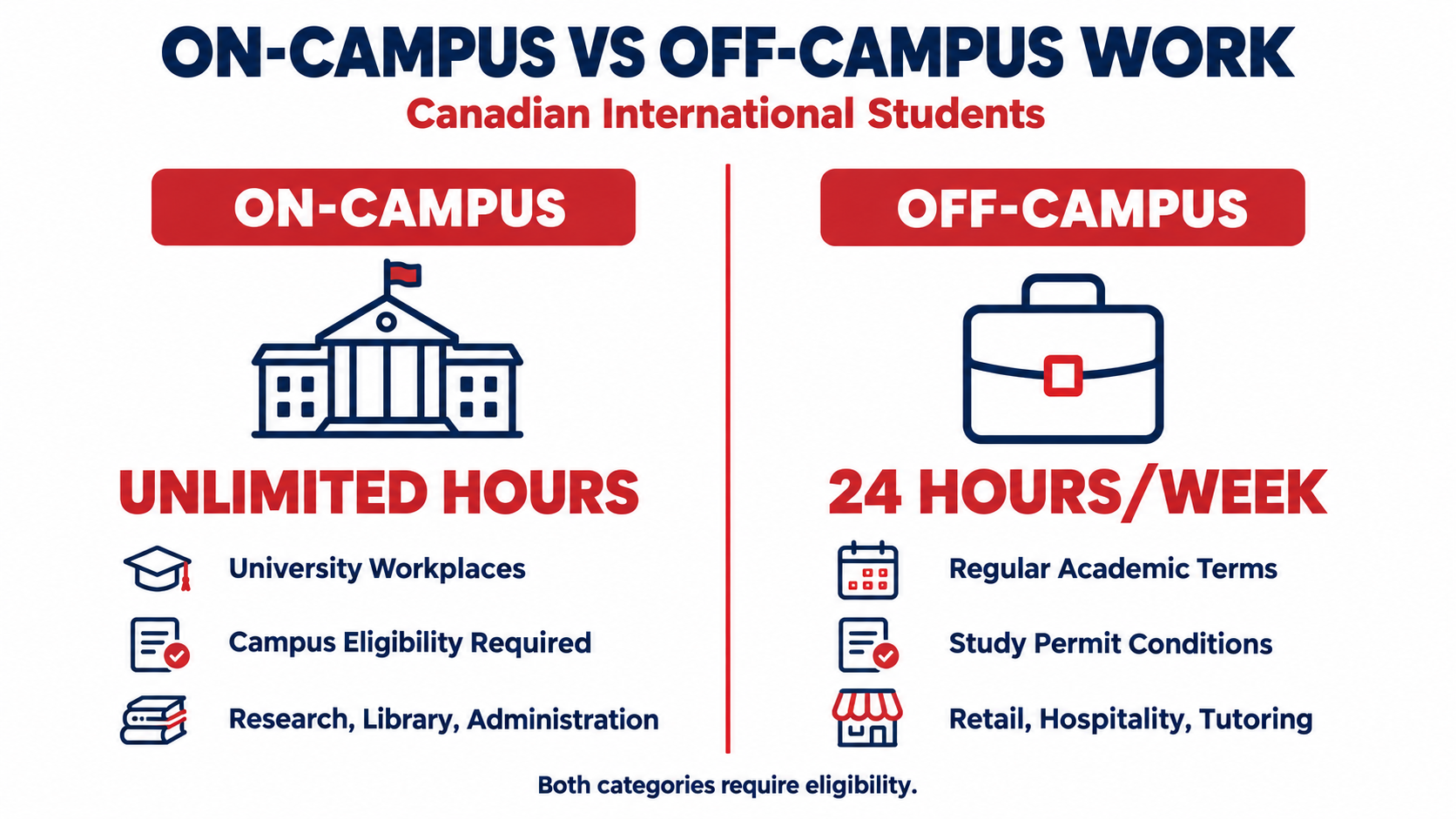
In the existing rules regarding work while studying in Canada international student, students in this category are allowed to work no more than 24 hours per week and only off campus and when their regular classes are in progress.
This limit applies to all off-campus jobs combined.
Example: Two part-time jobs
|
Employment |
Weekly hours |
|
Retail assistant |
14 |
|
Restaurant assistant |
10 |
|
Total |
24 |
This exemplary combination is at the weekly off-campus limit.
The ordinary restriction would be violated by working more off-campus hours than this amount in the regular term.
Students are supposed to keep the right timesheets, particularly when taking employment with different people or receiving freelance payment.
Official IRCC off-campus employment policy clarifies the calculation of working hours and conditions of eligibility.
Are Students allowed to work during a scheduled break if the scheduled hours are unlimited?
Yes; however, the work while studying in Canada international student policies differentiate qualifying academic vacation from regular holidays.
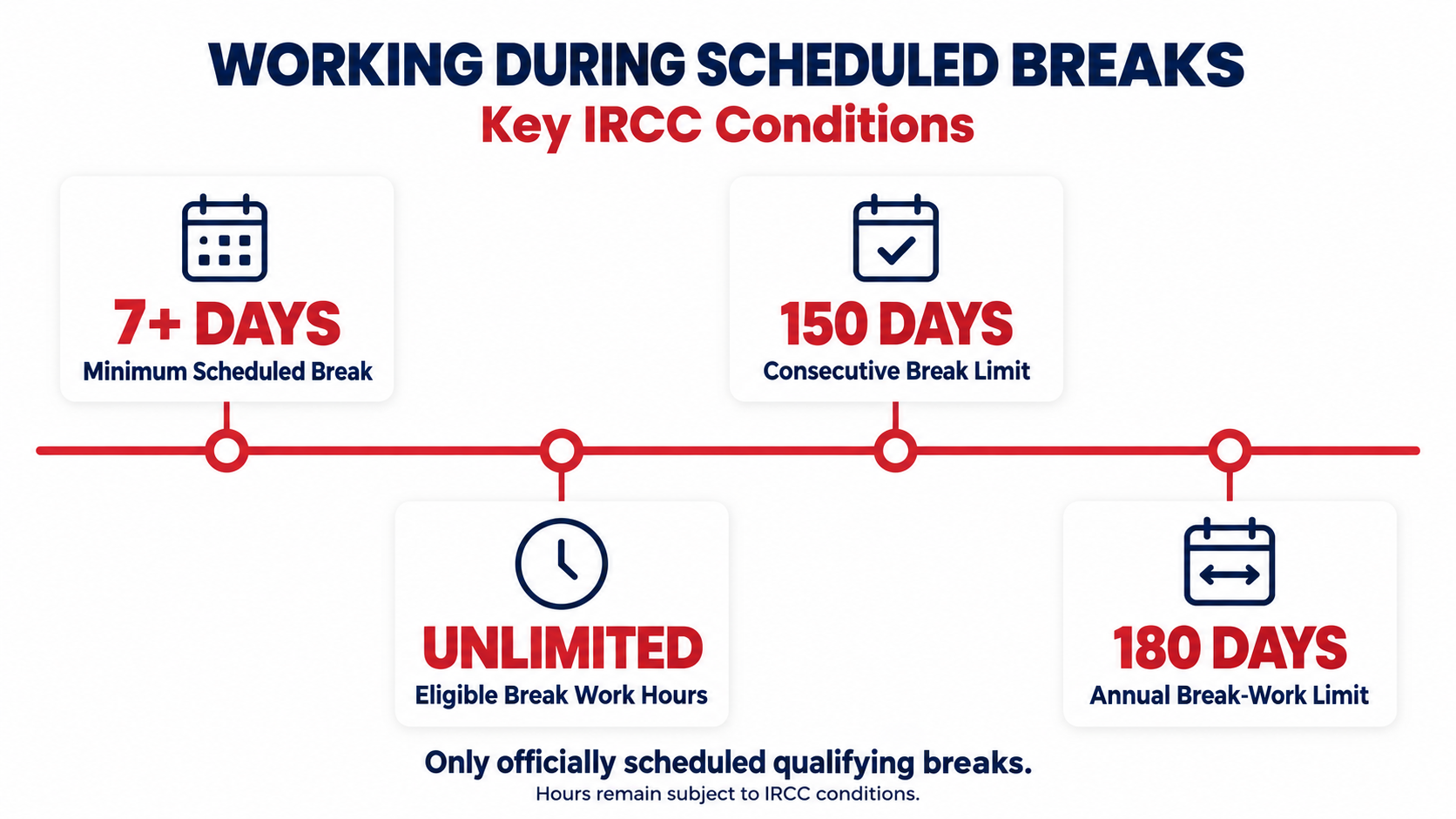
Students who are eligible are allowed to work during breaks that are unlimited, off-campus, and during those breaks that:
- Have their school year scheduled.
- Last at least seven consecutive days.
- Satisfy the work eligibility requirements.
An ordinary long weekend or a statutory holiday in itself is not an eligibility.
Important restrictions
IRCC currently specifies that:
- Limitless work off campus on consecutive scheduled breaks is limited to the initial 150 consecutive days in which the sum of the breaks surpasses the specified time.
- Students can have unrestricted off-campus work during scheduled breaks not exceeding 180 days within a calendar year.
These requirements are also more critical in the case of research-based master's programmes where a lectures-free period could not be a formal academic break.
Students are to check their university calendar with the explanation of scheduled breaks provided by IRCC.
Is it Possible that International Students Work Through to the semester?
During regular breaks and semesters, eligible students are allowed to work an unlimited number of hours on campus.
The rules governing the work while studying in Canada international student thus differ with respect to qualifying on-campus work and with respect to ordinary off-campus work.
Potential opportunities include:
- Research and teaching assistantships
- University library assistance
- Campus administration
- Student organisation employment
- University food services
A business that is close to campus, however, does not necessarily qualify to be an on-campus employer.
The place of work and the employer sponsorship, both of which are dictated by the institution, must comply with the requirements in the IRCC on-campus employment guidelines.
The students also need to keep working hard on their academic programmes.
Are Master Students Required to have a separate Co-op Work Permit?
There was a major policy shift as of 1 April 2026.
Eligible post-secondary international students can no longer apply for a separate co-op work permit in order to qualify for a compulsory internship or student work placement.
These approved academic placements are differentiated by the work while studying in Canada international student rules as compared to regular part-time jobs.
Eligible placement requirements.
The placement must generally:
- Form an essential component of the academic programme.
- Get accreditation with the specified learning organisation.
- Pass the IRCC eligibility criteria.
- Engage an employer under the programmes of the institution.
Written confirmation must be provided to students regarding eligibility to work before they start working.
The independently scheduled internship does not necessarily fall under the exemption for the placement.
The IRCC guidance on student work placement is used to explain the requirements, and the current government confirming the effective date of the requirements is through its April 2026 co-op permit announcement.
How much is the minimum wage for international students in Canada?
International students in Canada have a minimum wage subject to provincial laws on employment, occupation and exemption.
There is no single general wage rate exclusively covering international master's students nationwide.
Selected provincial minimum wages
|
Province |
Effective date |
General hourly minimum wage |
|
Alberta |
Current official listing |
CAD 15.00 |
|
British Columbia |
1 June 2026 |
CAD 18.25 |
|
Ontario |
1 October 2026 |
CAD 17.95 |
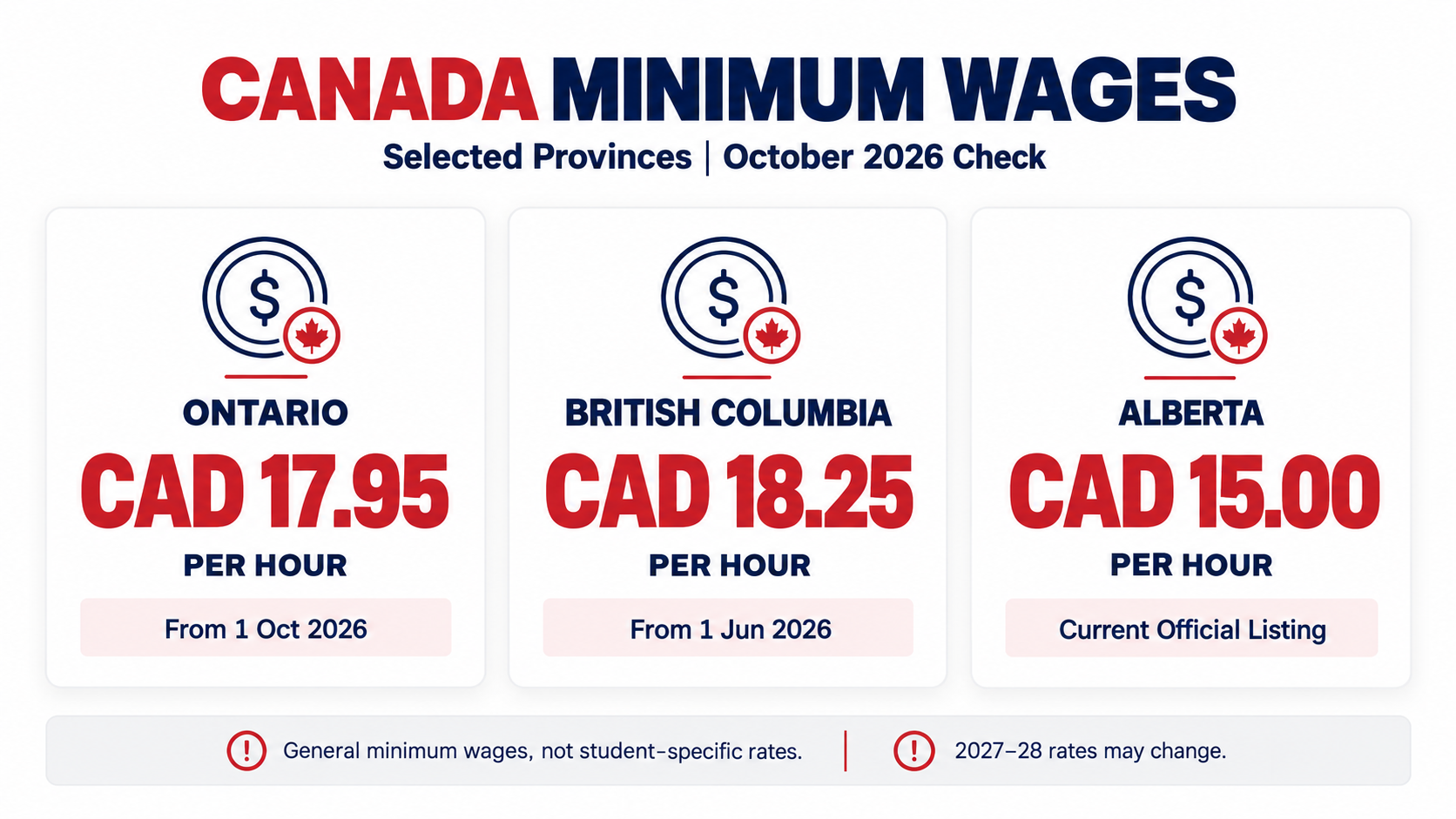
These amounts are the approximate rates that will be confirmed in October 2026, not the confirmed wages through the full 202728 school year.
Depending on the destination, students need to review the Ontario minimum wage regulations, British Columbia employment standards or Alberta minimum wage requirements.
Important: Ontario's separate student minimum-wage category applies to certain workers under 18. Adult Indian master's students should not assume it applies to them.
The knowledge gained on the labour conditions of employment and work while studying in Canada international student, as well as the labour standards of the province, make student evaluate employment opportunities correctly.
What can Indian students make by working part-time?
The pay is hourly, based on the working hours and the availability of shifts.
Using Ontario's October 2026 general minimum wage of CAD 17.95, the following figures demonstrate potential gross earnings.
|
Weekly hours |
Four-week gross earnings |
Weekly gross earnings |
|
10 |
CAD 718.00 |
CAD 179.50 |
|
15 |
CAD 1,077.00 |
CAD 269.25 |
|
20 |
CAD 1,436.00 |
CAD 359.00 |
|
24 |
CAD 1,723.20 |
CAD 430.80 |
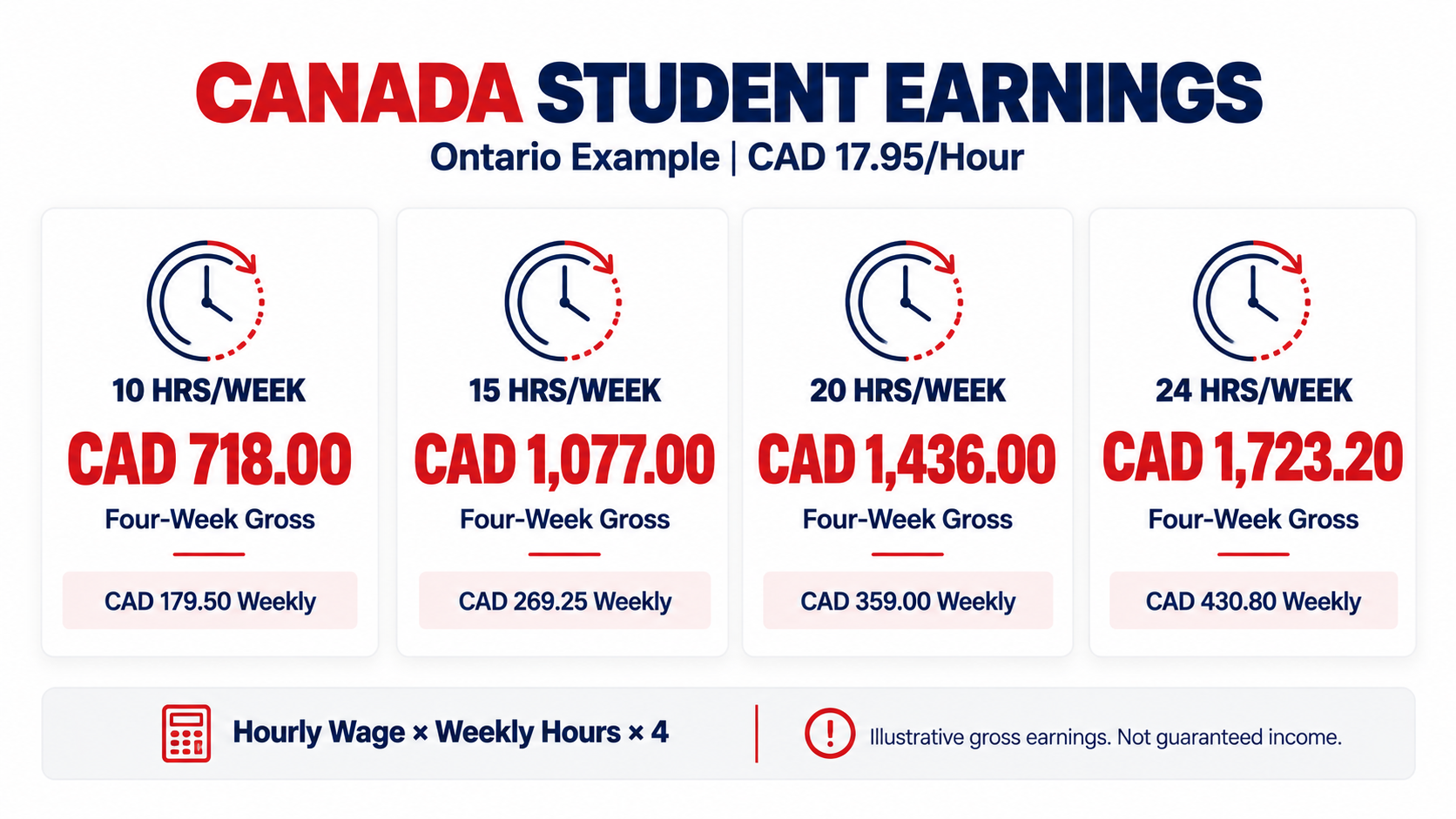
Calculation: Hourly wage x working hours 4 weeks. It is not a guaranteed amount of income or weekly wage, but an illustration.
Work while studying in Canada international student in consideration of building the work ought not to equate the trouble imposed as a positive employment.
Part-time income can be used in meeting living expenses, though the students need to make enough arrangements on their own.
To assist in comparing education financing options, one may use the services of the Foreign Edu Loans education loan assistance service, the commercial education loan platform of Gateway EduConnect.
What Part-Time Jobs Do International Students Have?
Students seeking part-time employment outside the university can find opportunities on campus and off-campus in Canada according to their qualification and their academic schedule.
|
Job category |
Potential workplace |
Important consideration |
|
Retail assistant |
Stores |
Flexible shift availability |
|
Food-service assistant |
Restaurants |
Evening or weekend shifts |
|
Research assistant |
Universities |
Academic qualifications |
|
Library assistant |
Campus libraries |
Available positions |
|
Administrative assistant |
Offices |
Employer requirements |
|
Tutor |
Educational services |
Work classification |
These are only some of the possible jobs, not confirmed jobs that are open.
Ways of seeking appropriate jobs.
- Go to college career websites.
- Find opportunities on the Government of Canada Job Bank.
- Write a brief, pertinent CV.
- Check the employer and conditions of employment.
- Check hours allowed prior to shift acceptance.
When comparing employers and making working schedules, it is imperative to understand work while studying in Canada international student regulations
No professional adviser can assure students of getting a job post-arrival.
What Are the Documents to be Present Before Employment?
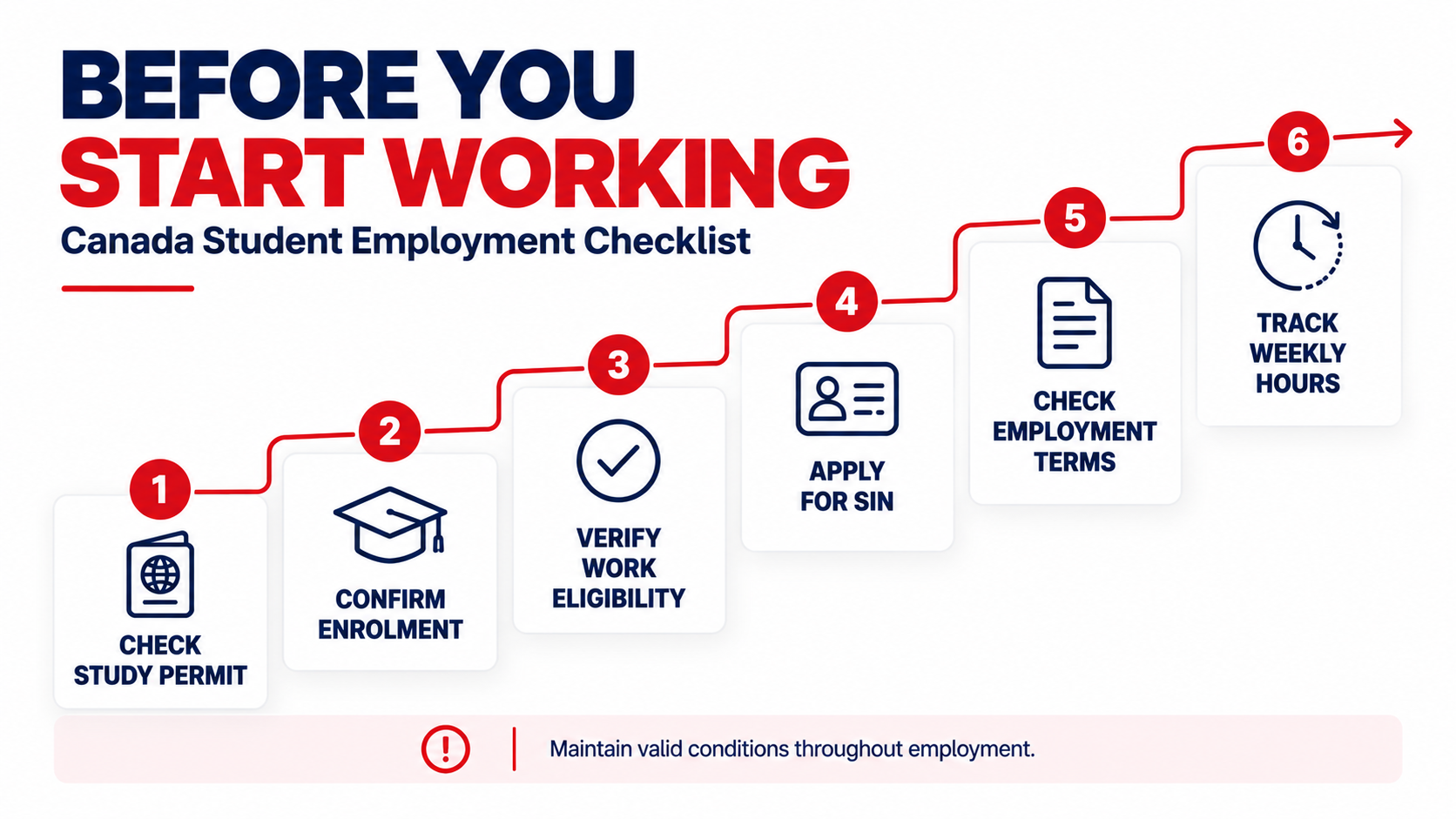
International students need appropriate employment authorisation and a Social Insurance Number (SIN).
Under the work while studying in Canada international student rules, students must ensure their study permit conditions allow the proposed employment.
Basic employment checklist
- Valid study permit
- Appropriate employment conditions
- University enrolment evidence, where required
- Social Insurance Number or qualifying application evidence
- Identification requested by the employer
- Relevant employment agreement
Application: The duly qualified applicants might apply to Service Canada using the SIN application guidance through the internet, in-person or by mail.
Are earnings taxable?
International students may have Canadian tax responsibilities depending on their income and tax residency.
The Canada Revenue Agency's international student guidance explains how residency and tax obligations are assessed.
Employment records, tax slips, and other documents pertaining to finances should be kept by them.
Permit Students to Freelance or Work Remote?
Certain freelance and remote employment practices are allowed, although the issue of classification is important.
The work while studying in Canada international student guidelines require self-employed students to record qualifying off-campus working hours.
IRCC keeps stating that with a remote job by an employer based outside Canada, the ordinary 24 hours off-campus restriction should not be added to the ordinary job requirement terms as long as material conditions are being met on the study permit.
Nevertheless, students cannot presume that remote working with a Canadian employer is not an exemption.
Freelancers also have to bear in mind relevant tax and business requirements.
These differences are elucidated in the IRCC off-campus work guidance.
What Do You Think Happens When Students Breach Canadian Work Rules?
Violation of terms of employment is subject to repercussions on immigration and re-application.
The rules governing the work while studying in Canada international student hold students accountable to keep a record of their hours and remain eligible.
Common mistakes to avoid
- Working prior to starting the academic programme.
- Exceeding permission for off-campus work.
- Using standard long weekends as planned.
- Working on a banned academic leave.
- Not keeping a record of working hours of freelance workers.
- Presuming that work restrictions do not apply to unpaid internships.
Severe offences are liable to result in loss of status as a student, refusal of future applications or even a demand to leave Canada.
Whenever the academic or employment situation of the students varies, they are supposed to examine the IRCC study permit conditions.
Can Master's Graduates Work in Canada After Graduation?
Master graduates who are eligible can get a Post-Graduation Work Permit (PGWP).
Under the prevailing regulations, eligible master graduates can be given a three-year PGWP even if their programme took two years, but all the required requirements are fulfilled.
Mastery of The IRCC PGWP eligibility criteria has CLB/NCLC 7 language requirement among four skills applicable degree graduates.
Graduates of university degree programmes are also not limited in the field of study used, as required of some other programmes.
These post-graduation work permits are independent of the work while studying in Canada international student regulations.
Students are also supposed to verify the official PGWP information prior to presuming that they can start employment upon the completion of the programme.
FAQs
Will Indian students be able to work 40 hours per week in Canada?
Not staying off campus during regular school quarters. The maximum at present is 24 hours per week. There are various criteria for qualifying scheduled breaks and employment that is eligible on campus.
Is it possible to have two-year employment in two companies?
Yes, so long as a limit on their joint off-campus working hours is adhered to.
Are students eligible to work as soon as they have come?
No. Before the academic programme, it is not possible to get ordinary student work authorisation.
Should students also have a separate permit for part-time work?
Not generally, where their study permit conditions and IRCC eligibility requirements permit the employment.
Is it possible to make a living on part-time income?
It should not be expected of students. The availability of employment, salaries, and the allowed working time and cost of living are quite different.
Are students permitted to work during permitted leave?
Normal on-campus and off-campus student employment during approved academic leaves is not allowed.
Conclusion
Learning the work while studying in Canada international student is crucial to Indian students planning to enter master's studies in 202728. The existing regulations allow qualifying students to work a maximum of 24 hours in the off-campus colleges up to the regular terms, with the various qualifying scheduled breaks and on-campus job following other terms. The students are also required to know provincial minimum wages, SIN requirements, tax obligations, and internship eligibility. Employment on a part-time basis is to be used in compliance with proper financial planning and not to displace it.
Gateway EduConnect provides free video and home counselling, education money and accommodation support and test preparation to offer personalised study-abroad advice.
Prior to travelling, revise the work while studying in Canada international student rules once again to consider changes in policies.
Get the Canada Work Rules Checklist.
After beginning your Canadian master's programme, use this checklist to review the issues of your eligibility, restrictions on working hours, employment documentation and compliance requirements.
Author Bio
Abhinav Jain - Founder, Gateway Educonnect and Director.
B.Tech, MBA, AI and Global Education Specialist.
More than 15 years of professional experience in leading students along international routes based on politics and innovation.
Connect: https://www.linkedin.com/in/abhinavedysor/