25 Nov 2026 | AI Calling CRM Integration for Education: How Call Outcomes Update Your Pipeline

0
10
AI Calling CRM Integration for Education: How Call Outcomes Update Your Pipeline
A practical guide for study-abroad consultancies to turn student conversations into accurate CRM records, meaningful pipeline updates and actionable counselling tasks.
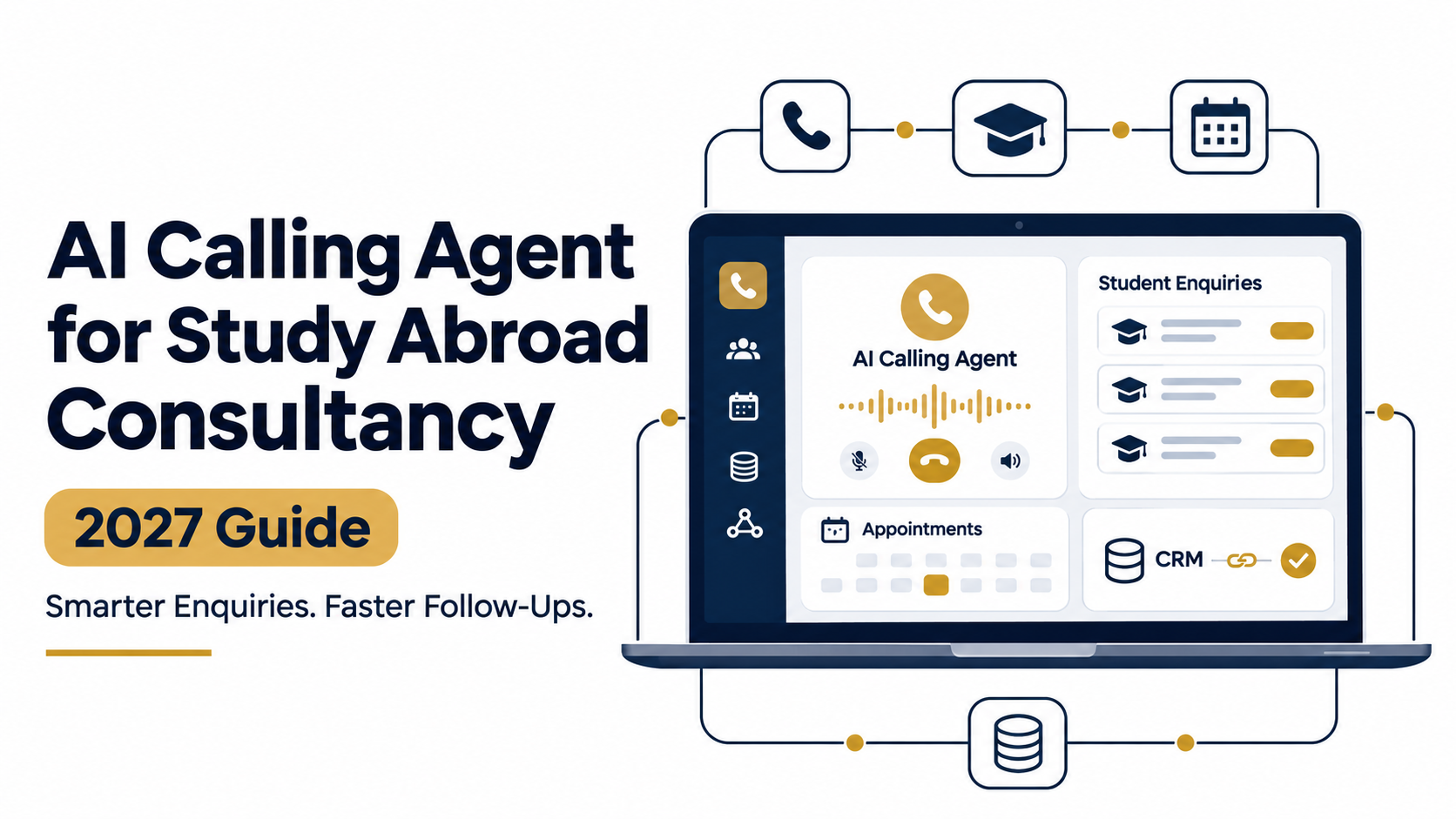
AI calling CRM integration for education connects student conversations with customer relationship management (CRM) systems, enabling configured workflows to capture call outcomes, update student records and trigger counselling follow-ups.
Imagine a student expressing interest in studying in the UK and requesting a callback. The AI conversation ends successfully, but the student's CRM record remains unchanged.
The call is completed, but the business action is not.
Through AI calling CRM integration for education, consultancies can connect conversations with recruitment activities, reduce repetitive administrative work and establish clearer follow-up responsibilities.
The objective is not simply to automate calls but to ensure that meaningful student interactions produce appropriate operational actions.
Why Education Consultancies Need Connected AI Calling and CRM Workflows
The migration of valuable student data can be hindered when calling platforms and CRM systems are not integrated, leaving schedules outside the admissions pipeline.
Typical operational issues are:
- Unfinished and inconsistent call notes.
- Missed calls back by students.
- Incorrect recruitment stages.
- Duplicate student records.
- Repeated information collection.
- Unclear counsellor responsibilities.
AI calling CRM integration for education aims to resolve these challenges by integrating student communication with organised admissions control.
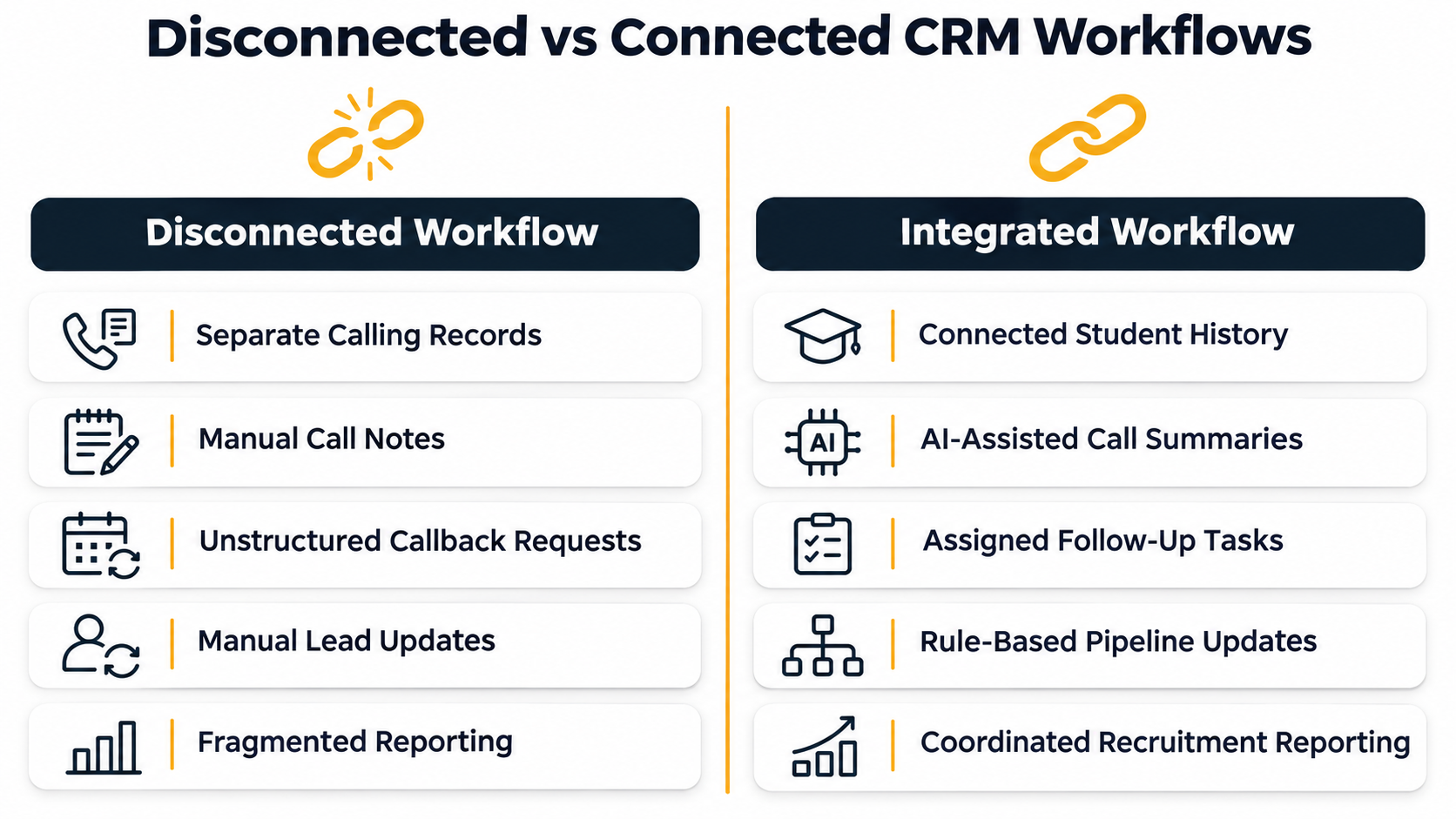
|
Disconnected workflow |
Integrated workflow |
|
Separate calling records |
Connected student interaction history |
|
Manual conversation notes |
AI-assisted call summaries |
|
Unstructured callback requests |
Assigned follow-up tasks |
|
Manual lead status changes |
Rule-based pipeline updates |
|
Fragmented reporting |
Coordinated recruitment reporting |
These features depend on the combination of the selected integration setup and applicable business regulations.
How AI Calling CRM Integration for Education Works
The integration entails deriving information from conversations and adding it to the corresponding student records.
The official post-call analysis documentation for Retell AI details configurable conversation data extraction. In contrast, Vapi's end-of-call reporting documentation explains how structured call outputs can be used to start downstream operations.
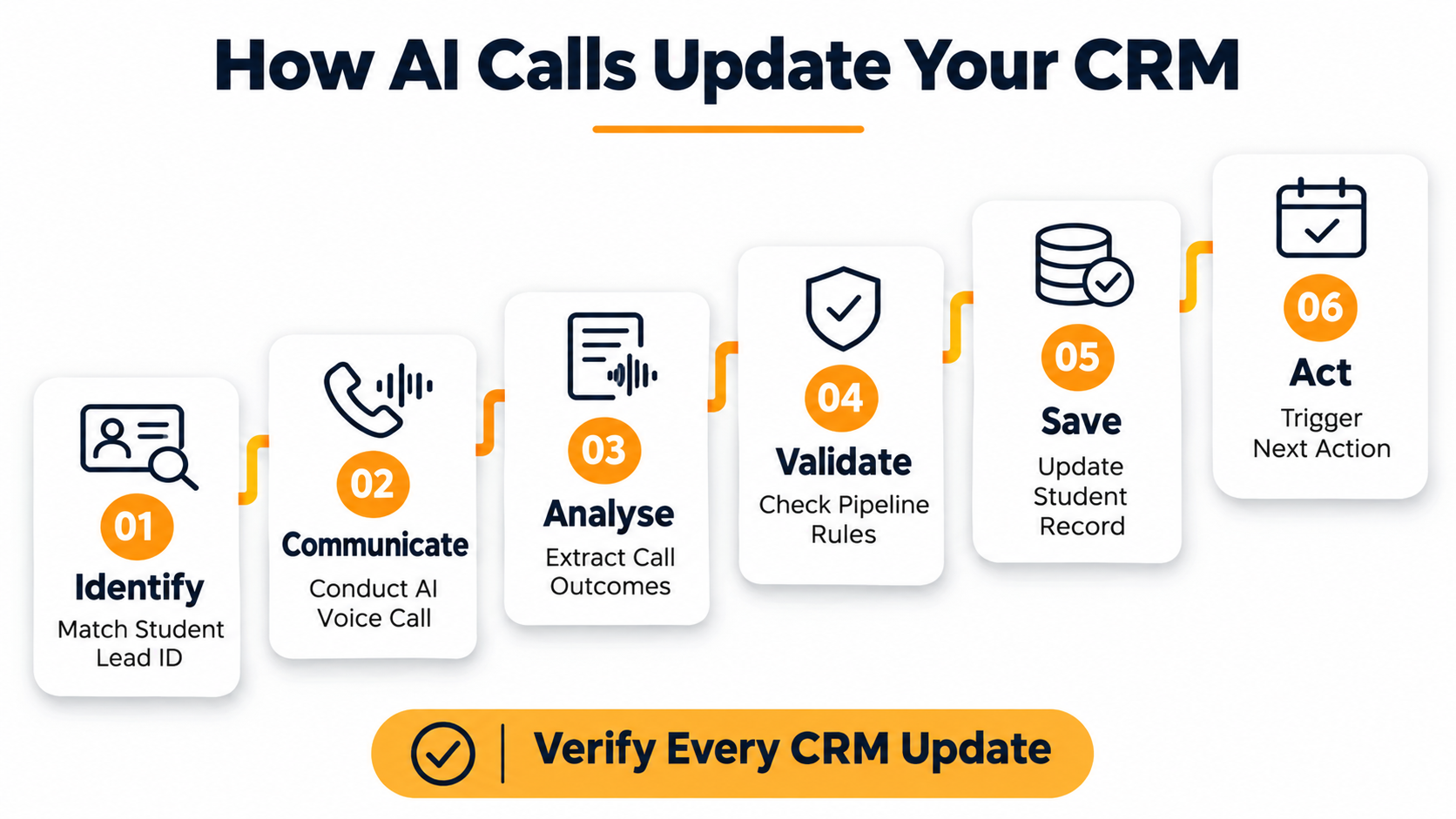
An average workflow is composed of six steps:
- Identify: Find the conversation with matching CRM lead ID.
- Communicate: Make the AI call and gather pertinent information.
- Analyse: Summarise the conversation and structure the results.
- Validate: Process information requirements and pipeline transition requirements.
- Save: Cumulatively save edits to the appropriate student record.
- Act: Prepare a follow-up action, check an appointment or human review.
Application programming interfaces (APIs) and webhooks allow compatible systems to share information.
Detecting a CRM-intended update saved would be the closest reaction to the success of AI calling CRM integration for education, and it would not be merely the transmission of information.
What Student Information Should AI Capture?
To introduce AI calling CRM integration for education as a value-producing undertaking, consultancies need to specify the scope of information by the stage of a student's recruitment.
Relevant fields include:
- Intended university intake.
- Professional destination, course and level of study.
- Indicative education budget.
- Preference for counselling and callback.
- Status in English language test.
- Excellent questions and communication preferences.
The first query needs disparate information from an already existing application.
As an illustration, the Gateway EduConnect blog, "Welcome an AI receptionist to education consultants no matter what time of day," gives instructions on how a consultation can record first-time inquiries during off-office hours.
Information provided by students must not be intertwined with skill, qualification, paperwork and eligibility checks.
How Call Summaries in CRM Improve Counsellor Handoffs
CRM call summaries can give counsellors helpful context from a conversation before further interactions with students.
Nevertheless, it is not enough to make a summary. Data should also be organised into structured sections and actionable tasks.
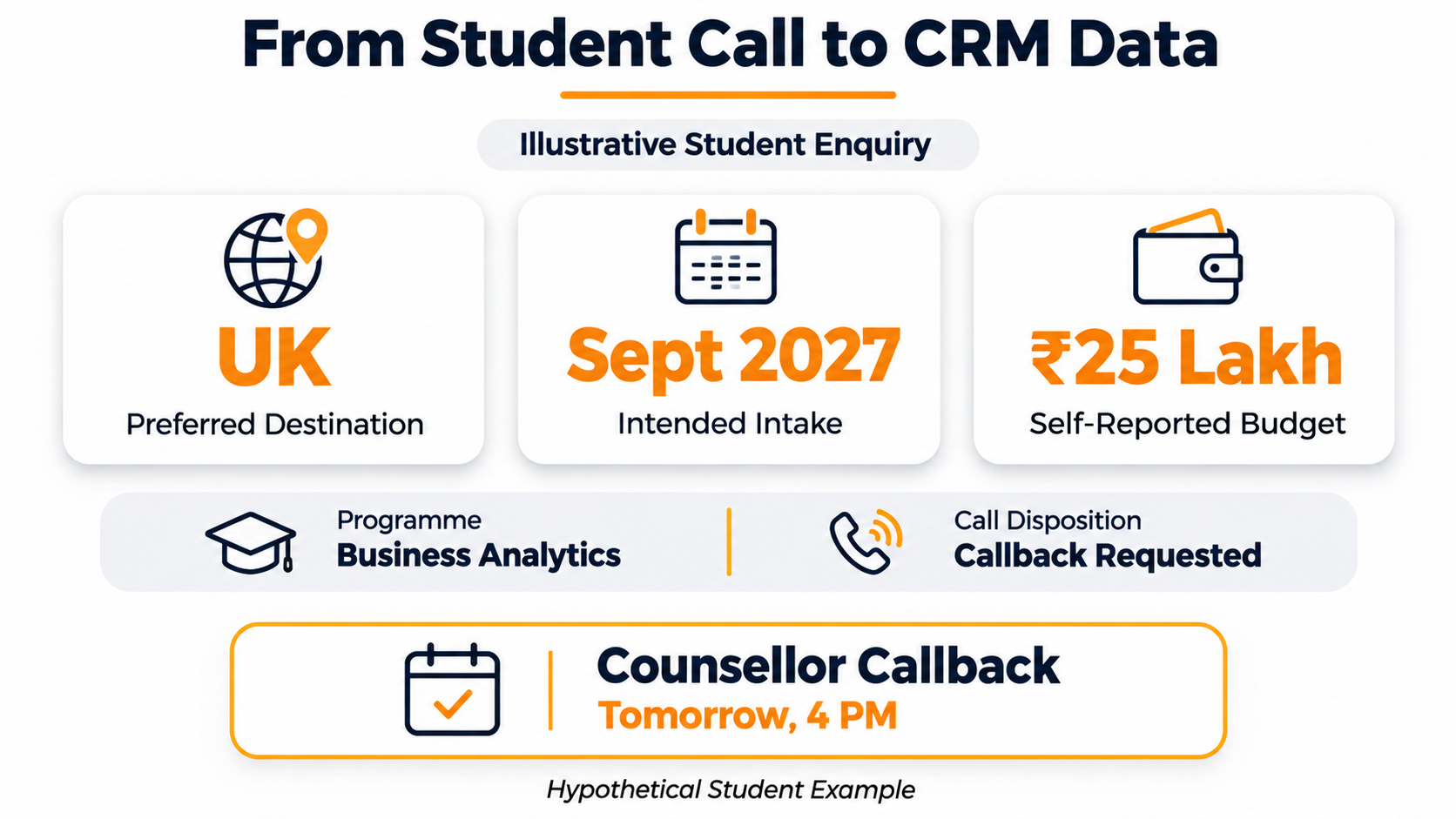
Practical example: Conversation between the student and CRM action.
Consider the following hypothetical conversation:
“My desired course in the UK, starting in September 2027, is Business Analytics. My budget is around ₹25 lakhs. Is it possible for a counsellor to call me tomorrow at 4 PM?”
The integration could capture:
- Destination: United Kingdom.
- Programme: Business Analytics.
- Intake: September 2027.
- Self-reported budget: ₹25 lakhs.
- Call disposition: Callback requested.
- The following step: Write and delegate a counsellor callback.
As shown in the HubSpot Calls API documentation, it is possible to correlate call activity and outcomes with CRM records.
As AI calling CRM integration for education, counsellors get both context and practical information from the conversation.
The student's academic eligibility is to be assessed independently.
Automatic Lead Status Update: Mapping Call Outcomes to Your Pipeline
Automatic updates to lead status should be made by satisfying predefined recruitment rules only when a conversation outcome is satisfactory.
There are two concepts which should not be mixed:
- Call disposition: How a call ended.
- Recruitment stage: The student's general status in admissions.
For example, a student who has already sent an application should not be sent back to the first stage of enquiry because they did not receive a follow-up call.
AI calling CRM integration for education safeguards ongoing recruitment progress and enables corresponding updates.
Call Outcome-to-Pipeline Mapping Matrix
|
Existing stage |
Recommended CRM action |
Latest call outcome |
|
Initial engagement |
Update to counselling booked |
Appointment confirmed |
|
New enquiry |
Move to initial engagement if permitted |
Student expresses interest |
|
Counselling completed |
Create task without resetting stage |
Callback requested |
|
Offer received |
Assign specialist counsellor |
Visa-related question |
|
Application submitted |
Preserve application stage |
Call unanswered |
|
Any stage |
Update communication preference |
Opt-out requested |
|
Any stage |
Flag integration exception |
CRM update fails |
|
Any stage |
Retain stage and request review |
Unclear conversation |
They are examples of workflow rules and are not verified capabilities of a specific CRM system.
There should be an automatic update of lead status that reflects the true progress of recruitment, rather than showing all changes in the calling activity.
When Should AI Update Records and When Should Humans Intervene?
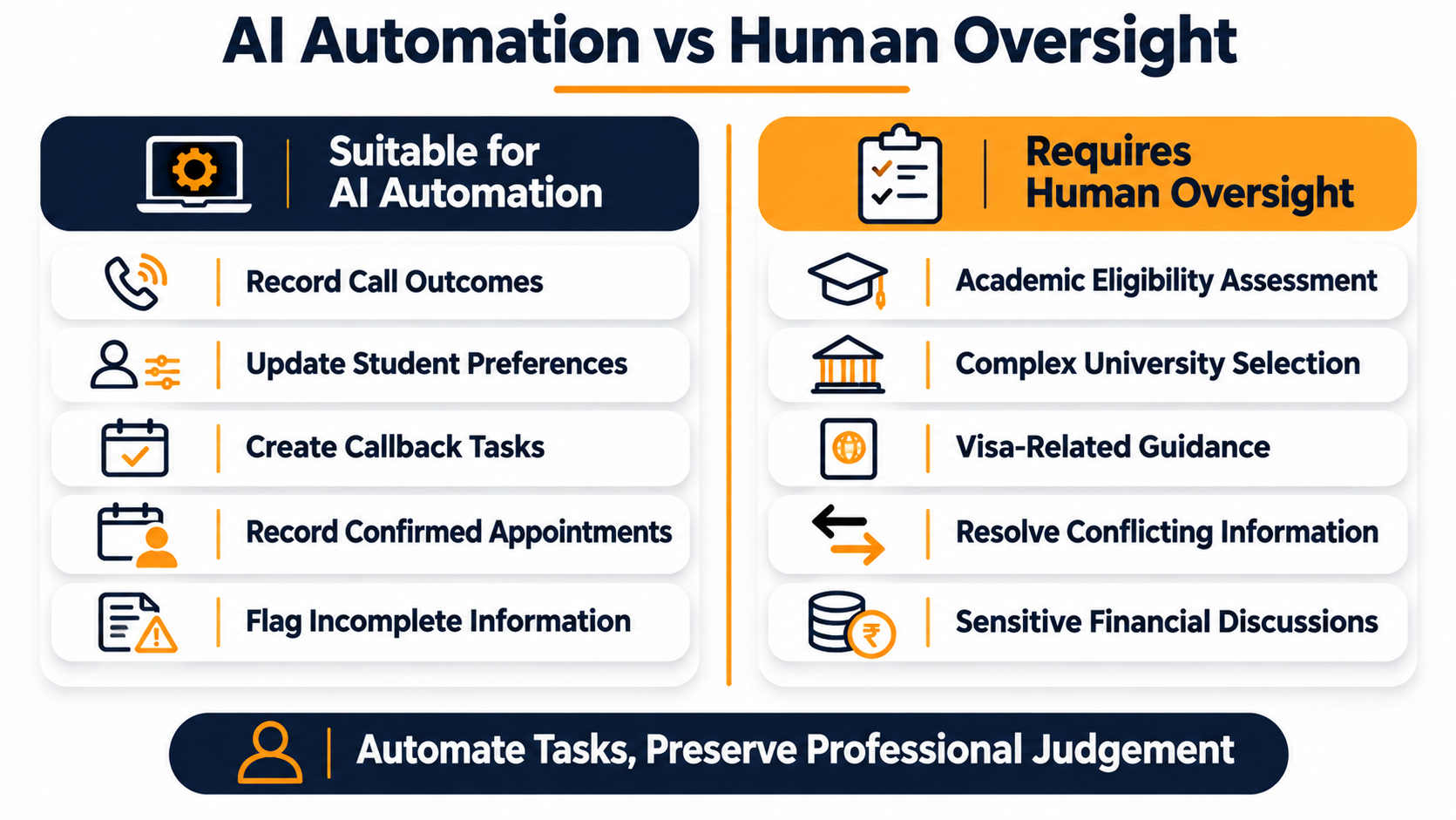
AI calling CRM integration for education must distinguish between routine administrative tasks and decisions that require professional judgement.
Appropriate to configure automation:
- Documenting call results and summaries.
- Updating student-reported preferences.
- Creating callback tasks.
- Recording confirmed appointments.
- Flagging incomplete information.
Requires human oversight:
- Academic eligibility assessments.
- Complex university selection.
- Visa-related guidance.
- Conflicting student information.
- Sensitive financial discussions.
The same is true for family communication. The guide to AI by Gateway, proposing study-abroad parents, describes the right paths to escalation and communication.
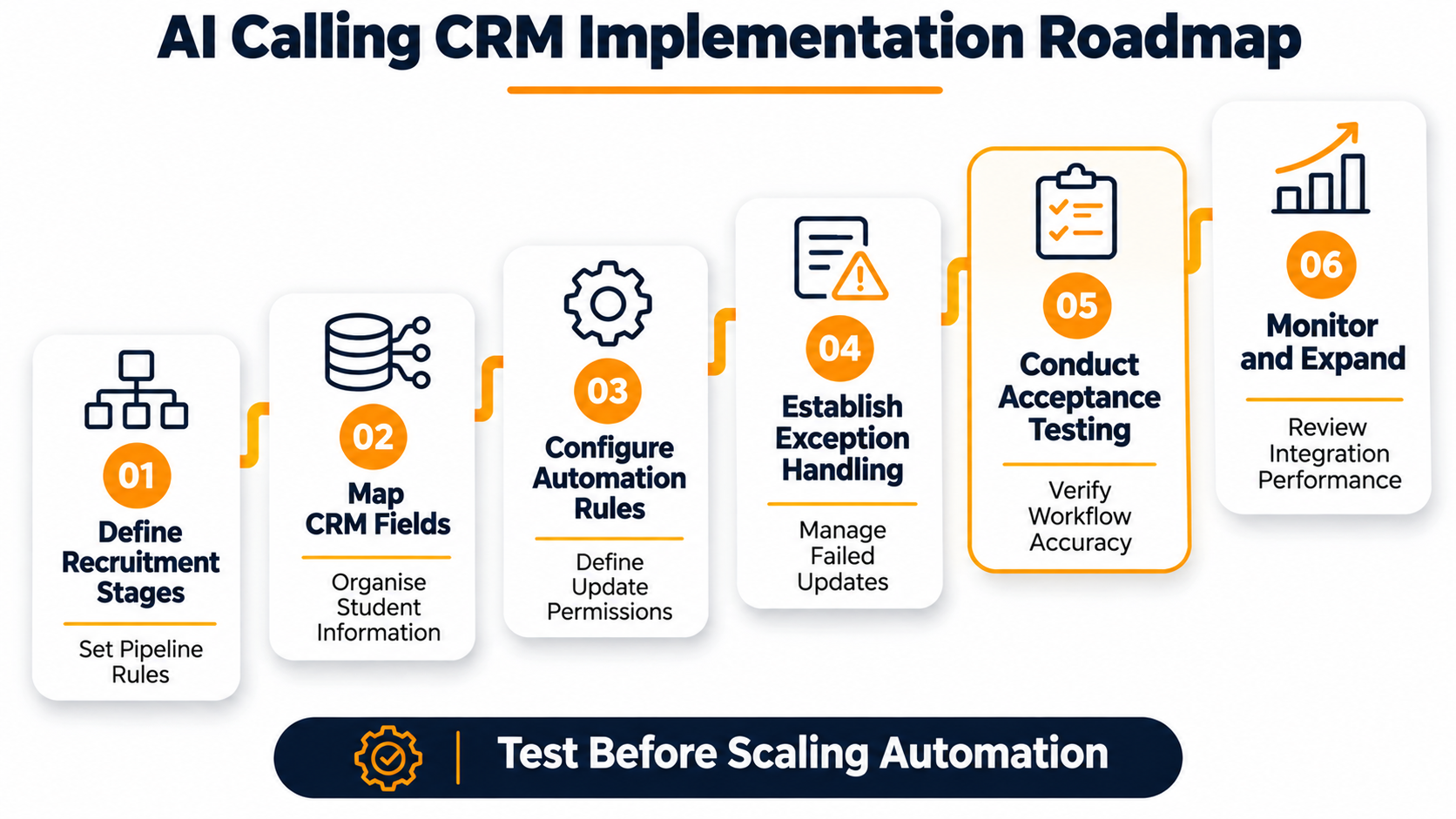
How to Implement AI Calling CRM Integration for Education?
It should be implemented successfully through clear operational rules, healthy information exchange, and measurement of acceptance standards.
1. Define recruitment stages
Normalise pipeline stages, entry requirements, and counsellor roles.
2. Create mapping of CRM fields.
Identify the location where preferences are to be extracted, summaries of conversations, dispositions of calls and callback information are to be stored.
3. Configure automation rules
Identify which information and recruitment phase can be automated and changed through the integration, and which must be approved manually.
4. Establish exception handling
Develop an incompleteness review process, differences in records and unsuccessful CRM updates.
5. Conduct acceptance testing
Prior to expanding AI calling CRM integration for education, ensure that:
- The information from the conversation is passed to the appropriate student record.
- Mandatory fields are properly filled.
- Only allowed pipeline transitions are available.
- When you receive a duplicate notification, it does not create a duplicate of the task.
- Updates that fail are reported.
- After action tasks are sent to the designated counsellor.
- Appropriate opt-out requests are implemented appropriately.
6. Monitor and expand
Evaluate local counsellor feedback and integration performance, and consider further automation for additional branches or recruitment exercises.
The same framework can be used to send automated calls to students to follow up on pending documents, university fees, and IELTS results.
What Happens When CRM Updates Fail?
An effective AI dialogue does not determine whether the corresponding CRM update is completed.
Microsoft documentation on Event Grid delivery shows that event-driven systems can experience failed deliveries, create duplicate events and notifications, and produce out-of-order events.
Five vital safeguards would ensure reliability in AI calling CRM integration for education:
- Unique identifiers: Correlate the matched conversation information with a student record.
- Duplicate prevention: Prevent duplicate notifications and avoid creating two or more follow-up tasks.
- Controlled retries: Retry permission for technical failures as allowed.
- Conflict protection: Do not allow older information to overrule more recent decisions made by the counsellor.
- Reconciliation: Check planned CRM updates and recorded changes successfully.
For example, when a counsellor manually transfers a student to the application phase, even though a delayed AI call report would transfer the student to the previous phase.
The integration must be based on the most recent authorised recruitment decision.
Data Privacy and Calling Compliance in India
Education Consultancies that are pursuing AI calling CRM integration for education would need to take into account relevant telecommunications regulations and personal data processing requirements.
TRAI business communication needs.
The consolidated commercial communication regulations by the Telecom Regulatory Authority of India are the regulatory framework for commercial communications.
Official guidance by TRAI on preference registration considers education as a commercial type of communication and admits preferences that are associated with voice calls and automated methods of calling.
Consultancies need to check the appropriate calling permissions, manage consent logs and adhere to communication preferences.
The submission of a student enquiry does not grant a license to call freely to promote the products of the company.
Digital Personal Data Protection requirements.
The commencement notification of the Digital Personal Data Protection Act of India is introducing a phased implementation of the Act, and most of the substantive data processing responsibilities will start in May 2027, as indicated in the notification.
Consultancies ought to prepare to review:
- Recording and collection of information and call recording.
- Policy of data access and retention.
- Third-party processing arrangements.
- Student protection against individuals below 18.
- Correction procedure in case of mistaken information about the student.
Regulatory compliance is not automatically established when using AI calling software or CRM software.
KPIs to Measure AI Calling and CRM Integration Performance
The success of AI calling CRM integration for education ought to be assessed based on credible CRM updates, accurate information, and completed counselling actions, not on the number of calls.
|
KPI |
Purpose |
Calculation |
|
Disposition accuracy |
Classification quality |
Correct dispositions ÷ reviewed dispositions × 100 |
|
CRM update success rate |
Integration reliability |
Successful updates ÷ intended updates × 100 |
|
Follow-up completion rate |
Operational execution |
Completed follow-ups ÷ follow-ups due × 100 |
|
Summary completeness |
Information quality |
Complete summaries ÷ reviewed summaries × 100 |
|
Appointment attendance rate |
Counselling outcomes |
Attended appointments ÷ appointments due × 100 |
|
Counselling booking rate |
Student engagement |
Unique contacted leads with bookings ÷ unique contacted leads × 100 |
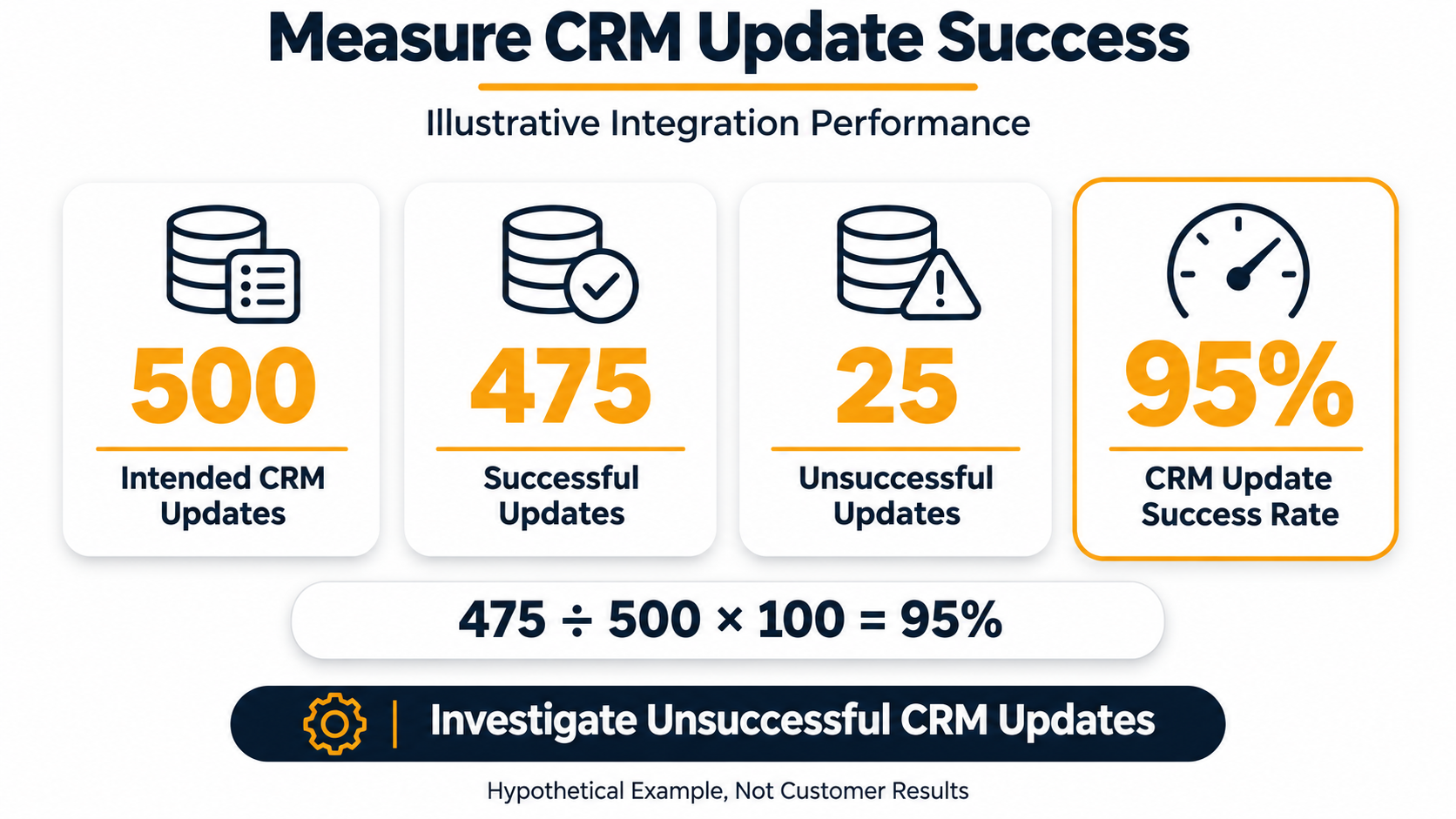
To illustrate, assume that a consultancy anticipates 500 CRM updates and achieves 475:
- Unsuccessful updates: 25.
- Success rate of CRM updates: 95%.
- Action required: Report and investigate unsuccessful updates.
These numbers are hypothetical and not industry standards or published customer outcomes.
The indicators monitored help management differentiate between calling performance, integration failures, and weaknesses in counsellor follow-up.
How GuaranteeAdmit Supports Connected Admissions Workflows
As a consultancy assessing the applicability of AI calling CRM integration for education, a significant step is choosing a CRM to accomplish structured admissions management.
The GuaranteeAdmit B2B CRM is developed targeting education agents, aggregators, and admissions operations teams.
Being able to:
Centralised student management
Evaluate student inquiries, applications and membership phases, records and the history of activities in a centralised workspace.
AI-assisted conversation management
The documented GuaranteeAdmit services home page includes AI-generated notes, smart lead scoring and call summaries under its functionality.
Follow-up coordination
AI follow-up recommendations, schedules of reminders, and automated tasks help to arrange admissions processes.
Operational visibility
The ownership of the pipeline, role-based access, activity and reporting logs assist teams in the task of recruitment.
Prior to implementation, consultants who are owners of their respective consultancies need to establish whether the proposed voice integration will support flexibility to map fields automatically, create lead stages when a user makes a call, create callbacks, and failed updates.
The goal is to determine the integration requirements as opposed to the assumption that all the automation capabilities are default.
FAQs
What is AI in education called when integrated with CRM?
It links AI calling CRM integration for education, enabling pertinent information, call results, and follow-up needs to facilitate recruitment efforts.
Is it possible to automatically update the lead status of students using AI?
Yes, so long as calling and CRM systems are compatible and allow the integration needed, permissions and pre-established pipeline transition rules.
What ought to be the contents of call summaries in CRM?
Relevant student preferences, results of a conversation, unreported questions and necessary actions. The information reported by students must always be differentiated from the verified ones.
Can an artificial intelligence calling supplant education counsellors?
No. Routine communication and administrative activities can be supported with AI, whereas the complex academic tests, university selection and expert advice involve the professionals.
What does an automatic lead status update do when it fails?
The integration must identify the failed update, re-attempt successful failures when possible or divert the problem to manual investigation, but not inaccurately alter the current stage of recruitment.
Conclusion: Build a Smarter Admissions Pipeline with Gateway EduConnect
AI calling CRM integration for education helps study-abroad consultancies connect student conversations with structured recruitment activities, accurate records and timely counselling follow-ups.
However, effective automation requires reliable information transfer, clearly defined pipeline rules, appropriate human oversight and measurable operational outcomes.
Gateway EduConnect supports education agents and consultancy partners through technology-enabled admissions coordination and application management using GuaranteeAdmit CRM.
By combining organised CRM workflows with appropriately configured AI calling solutions, consultancies can establish clearer follow-up responsibilities and improve pipeline visibility while keeping important admissions decisions in human hands.
Are your completed student calls translating into meaningful recruitment actions? Explore GuaranteeAdmit's CRM capabilities and discuss the integration requirements specific to your consultancy.
Request a GuaranteeAdmit CRM Demo
Author Bio
Abhinav Jain - Founder, Gateway Educonnect and Director.
B.Tech, MBA, AI and Global Education Specialist.
More than 15 years of professional experience in leading students along international routes based on politics and innovation.