23 Nov 2026 | AI Follow-Up Calls for IELTS Scores, Documents and Fee Deadlines

0
9
Automated Follow-Up Calls for IELTS Scores, Documents, and Fee Deadlines
Automated student follow-up calls help study-abroad consultancies remind applicants about pending IELTS results, missing documents and approaching university fee deadlines through structured, milestone-triggered communication.
The goal is not to make more calls. It is to contact the right student at the right stage while ensuring counsellors can focus on cases requiring professional judgement.
Consider a consultancy managing 150 active applicants across several destinations. Each student may have different test dates, document requirements and university payment deadlines. Without centralised tracking, follow-ups can become inconsistent.
Automated student follow-up calls offer a potential way to organise these activities, provided student records, communication permissions and escalation processes are reliable.
This guide covers practical workflows, CRM requirements, implementation safeguards and performance measurements for Indian study-abroad consultancy owners.
Why Student Follow-Ups Become an Operational Bottleneck
International admissions entail several processes that may not necessarily follow each other.
A student may take an English test and postpone the result. Others may submit school papers and ignore the university deadline.
When data is compiled in spreadsheets, WhatsApp dialogue and individual counsellor diaries, several issues may arise:
- Missed milestones: Important requirements remain unresolved.
- Repeated reminders: Students are contacted about documents already submitted.
- Unclear responsibility: Staff members cannot identify who owns a pending task.
- Poor prioritisation: Routine status checks compete with urgent admissions issues.
- Limited reporting: Managers see call activity without knowing whether application requirements were completed.
Consultancies should have a process that links student records, a reminder schedule and staff roles.
The international partner platform of Gateway EduConnect explains a partner workflow that encompasses profile assessment, applications, and live progress tracking via GuaranteeAdmit. It illustrates application visibility and the coordinated automated student follow-up calls it requires.
How Automated Student Follow-Up Calls Work
A student with a confirmed milestone can be an effective starting point for a calling workflow, instead of a mass campaign to all applicants.
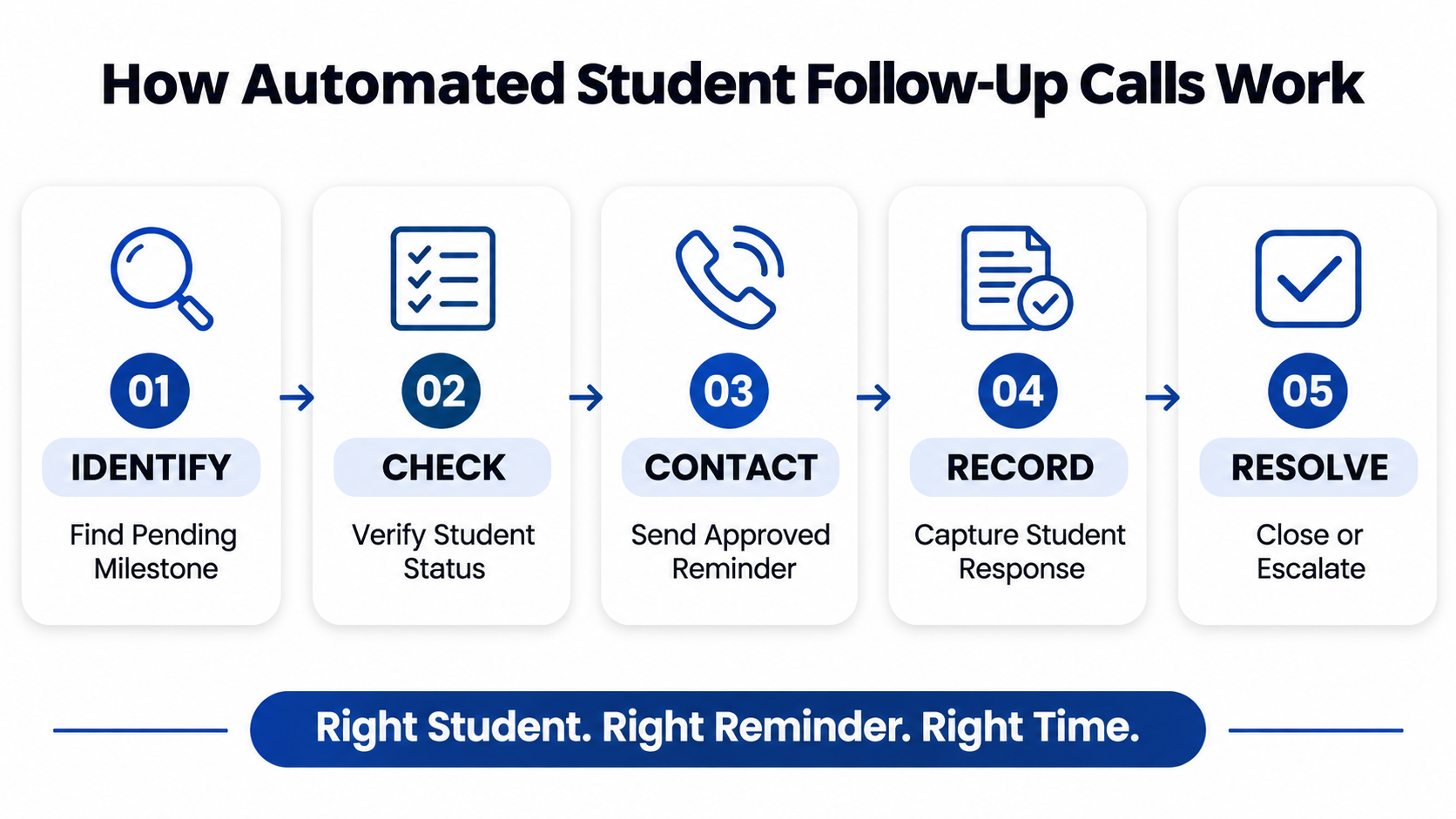
It is a process that consists of five stages:
- Identify: Identify a result, payment or document issue on IELTS that is outstanding.
- Check: Check the student's latest status, deadline, and contact eligibility.
- Contact: Using an approved calling system, make an approved reminder call.
- Record: Note down the follow-up response and amend the follow-up record.
- Solution: Finish task, set a time/date reminder or designate a counsellor.
Stop conditions are also required for automated student follow-up calls. A requirement that is done or cancelled should not initiate any unwarranted reminders.
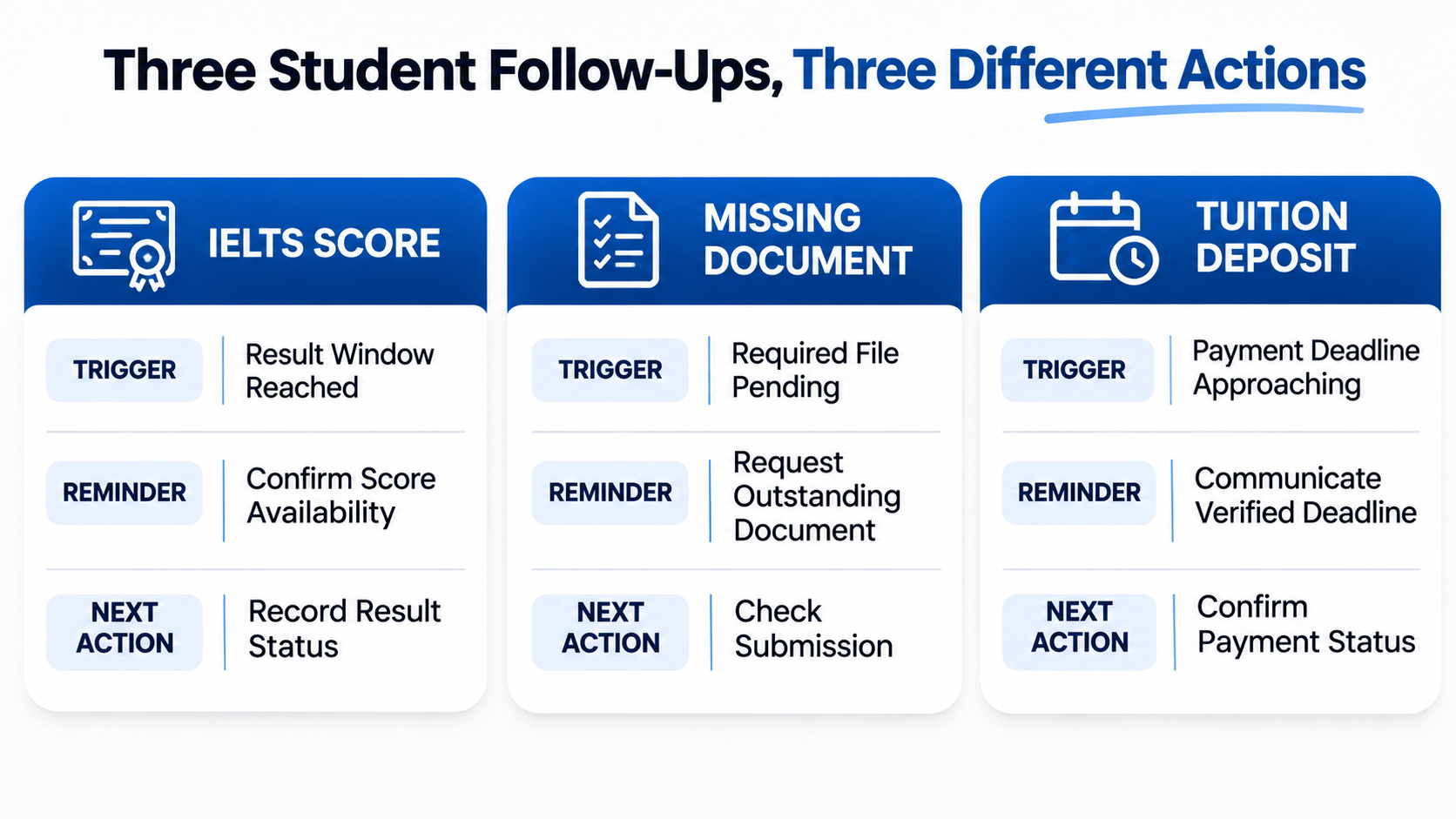
|
Milestone |
Next action |
Reminder objective |
Trigger |
|
Missing document |
Check submission |
Request outstanding file |
Required item remains pending |
|
IELTS result |
Record result status |
Confirm score availability |
Expected result window reached |
|
Tuition deposit |
Confirm payment status |
Communicate deadline |
Verified payment deadline approaches |
|
Student needs assistance |
Assign counsellor |
Collect basic context |
Question requires judgement |
|
Unanswered reminder |
Stop or escalate |
Request a status update |
Permitted retry remains available |
These triggers are illustrative. Real-time schedules ought to rely on confirmed deadlines, authorised communication, and the capabilities of the chosen systems.
IELTS Score Reminders: Build Follow-Ups Around Actual Test Dates
Applicants applying to universities that require proof of English proficiency will have an important milestone: IELTS results.
As per official guidance on IELTS results, the average time for computer-based IELTS results is 1-5 days, whereas the average time for IELTS Online results is 6-8 days.
The timing is not identical for every test format or candidate.
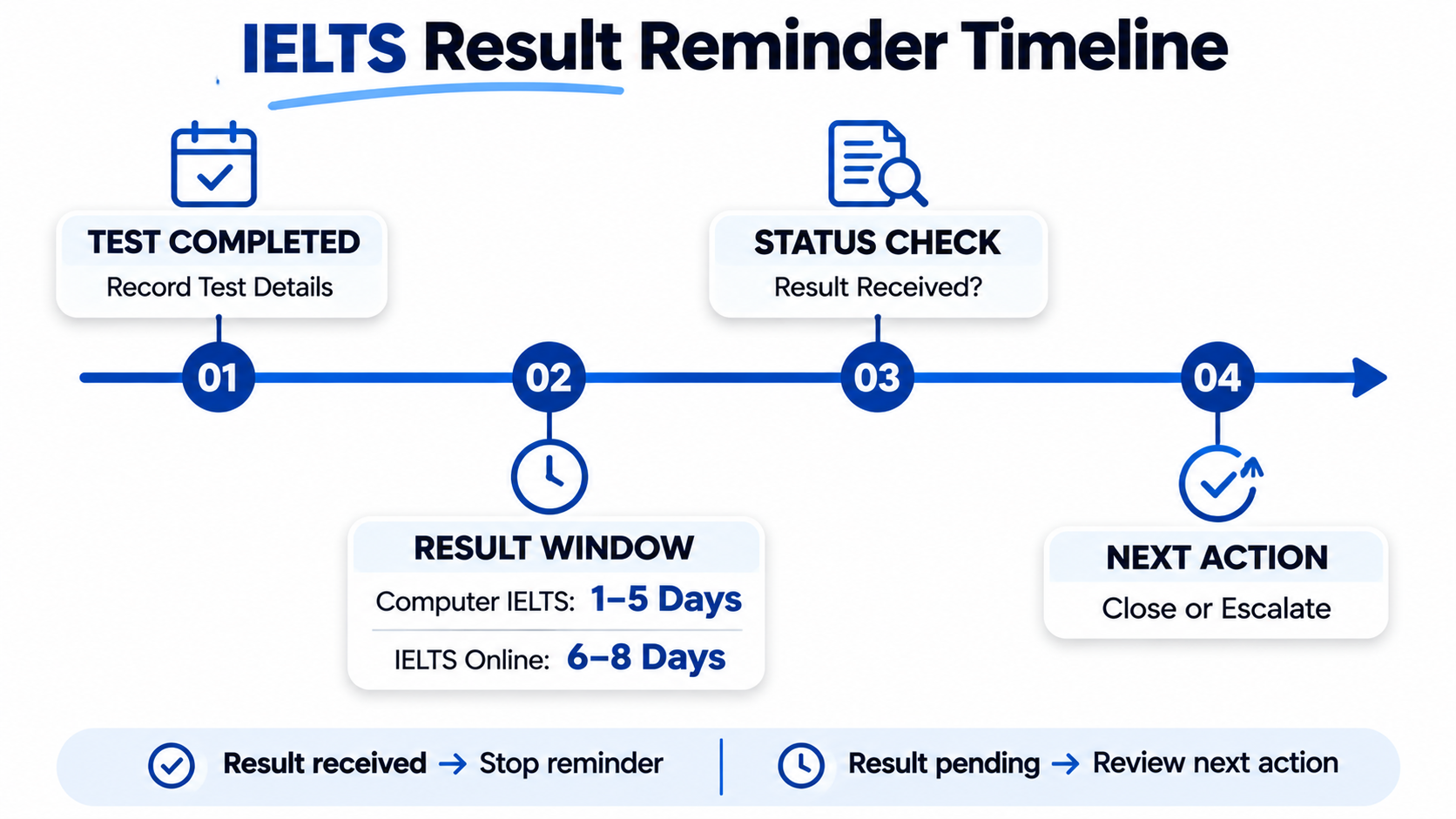
The consultancy ought to document:
- The form and date of the student's confirmed test.
- The anticipated outcomes time frame.
- Indicate whether the score has been received.
- The institution's requirements for score submission.
- The counsellor for any unresolved questions.
Automated student follow-up calls, once a verified pending status has been met, can then be set up at a set point (this point may be defined by several days or by a specific number of days after registration).
Scenario: One of the learners passes the IELTS computer-based test and anticipates the result within the official time frame. If the result is not recorded, an eligible reminder inquires whether it is available.
The response to the delay must update the follow-up record in case the student reports a delay. It adds little value to repeat the same request and does not address the response.
Once a score is available, the applicant might be required to share the official Test Report Form. IELTS outlines existing result distribution and checking processes, including electronic distribution to institutions.
Human counsellors are supposed to determine the required score at the university and the option of alternative applications. AI agents must not promise eligibility or admission.
Document Reminder Automation: Request the Right File
Unfinished documents may delay application processing, especially when different universities require different evidence.
Typical documents such as transcripts, passports, evidence of taking English tests, purpose statements, and financial statements are in demand.
The study-abroad application document checklist published by Gateway can be a valuable resource for organising document categories. Separate checks will have to be done for individual university and destination requirements.
A Better Document Collection Workflow
Rather than contacting applicants with a vague request to submit their documents, consultancies should:
- Develop a checklist aligned with the actual institution's requirements.
- Determine precisely what items are outstanding.
- Differentiate between pending, received, under-review and accepted status.
- Use a valid submission medium.
- Stop reminders when the pending condition is resolved.
- Resolve escalated controversial, erroneous, or unavailable papers.
Automating document reminders may be assisted by automated student follow-up calls who have not filled out the form and document by calling them and registering their response.
For example, when a student is awaiting a final transcript from their university, a counsellor might have to consider whether provisional evidence can be presented.
Not calling repeatedly can answer that question.
Notice: Received (ie. marked as such) does not automatically mean authentic, complete or approved.
Fee Deadline Reminders: Prevent Incorrect Communication
University payments should be given special attention, as a missed deadline or incorrect payment selection may affect a student's financial choices.
The consultancy must check the university's official instructions on payment, currency, amount, and due date before it starts using automated student follow-up calls.
Different institutions do not have the same payment schedules.
For example, in the Gateway UK intakes and application deadlines guide, the deadline for any student is based on a broader planning timeline. However, the specific offer letter and official university instructions must calculate the deadline for the individual student.
|
Situation |
Human responsibility |
Potential automated action |
|
Student reports payment |
Verify receipt where required |
Record reported status |
|
Verified deadline approaching |
Confirm offer conditions |
Send factual reminder |
|
Payment problem reported |
Discuss available options |
Flag urgent assistance |
|
Extension requested |
Obtain authorised confirmation |
Escalate enquiry |
AI agents are not allowed to create extensions, guarantee refunds or confirm payments without showing the relevant evidence.
When making calls, students must be referred to a certified university paypoint instead of being asked to provide sensitive banking information.
Practical Example: A Consultancy Managing 150 Students
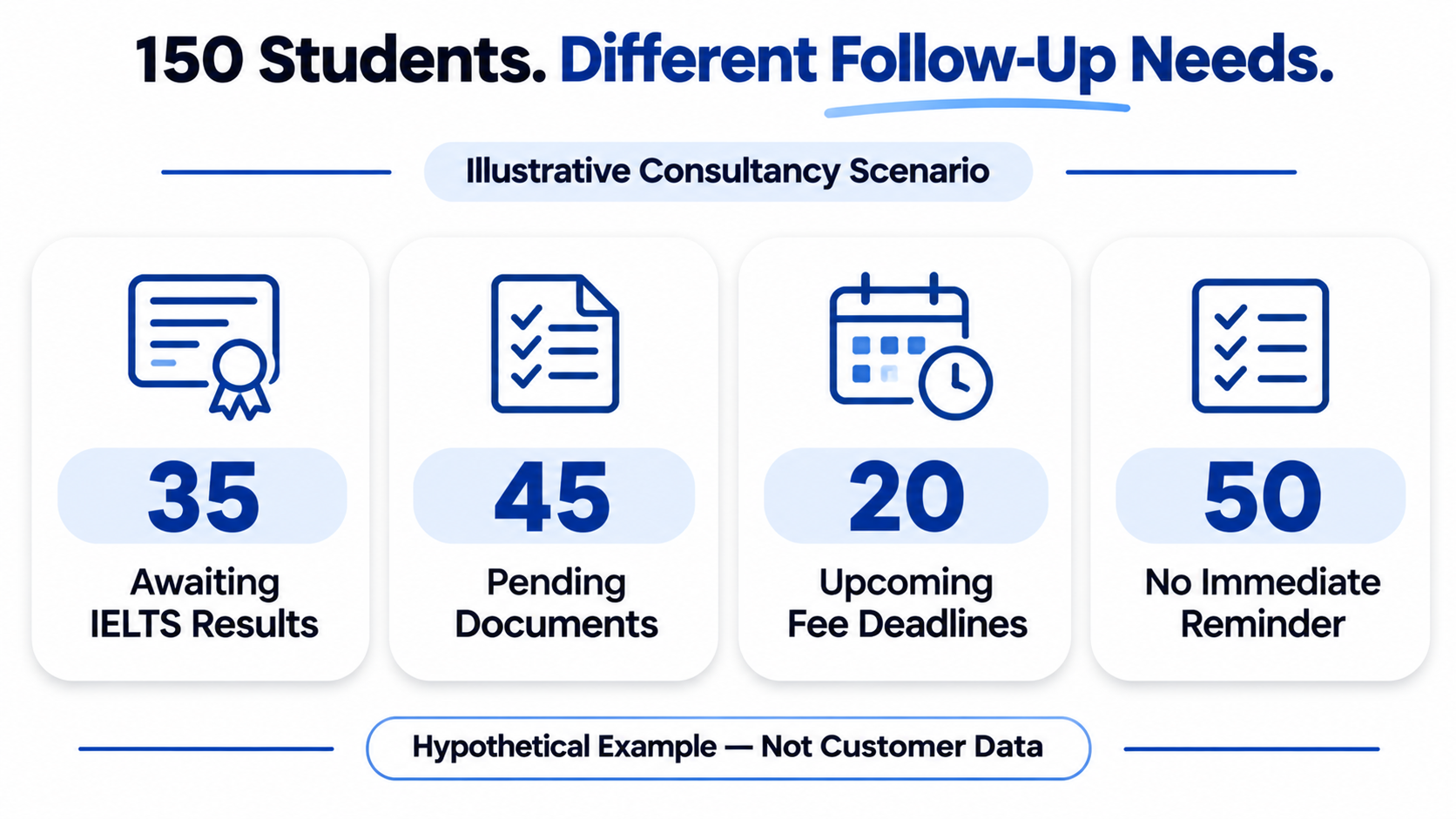
Consider a hypothetical consultancy with three counsellors and 150 active applicants.
Its records show:
- 35 candidates awaiting English test results.
- 45 applicants who have pending documents.
- 20 applicants who have verified fee due dates.
- 50 applicants not requiring an immediate reminder.
These figures illustrate a possible workflow. They are not verified Gateway customer results or industry benchmarks. Real applicants may also have overlapping requirements.
These figures help depict a potential workflow. They have not been tested with Gateway customers or industry standards. There are also likely overlapping requirements of real applicants.
There are four priorities that the team could base its daily process on.
- Review in the morning: Confirm upcoming due dates and milestones.
- Qualifying calls: Make approved calls to students who need to be contacted.
- Counsellor escalation: Emphasise disagreements, eligibility issues and finances.
- Review by management: Review outstanding requirements, completed tasks, and redialed contacts.
This strategy treats automated student follow-up calls as part of a coordinated admissions effort, rather than a separate telecalling initiative.
Consultant proprietors seeking a partner-based entry help will examine the B2B companion network of Gateway EduConnect in India, which elucidates partner help and admissions tracking alongside partner backgrounds and admissions.
Connecting AI Calling with GuaranteeAdmit CRM
The intelligent call centre for following up with students is based on accurate data on the application stage, outstanding requirements, past correspondence, and assigned personnel.
A CRM can maintain that working environment.
The official page for GuaranteeAdmit CRM services explains what a lead pipeline is, provides a checklist of documentation, reminders via WhatsApp or email, AI-offered follow-up recommendations, and a summary of calls.
Its B2B CRM overview also details application phases, service-level tracking, role access, and group workflow.
These are documented capabilities applicable to follow-up management. Nor do they confirm, but point to, that GuaranteeAdmit automatically initiates outbound AI calls.
What Demo Checks should the owners of a consultancy undertake?
Prior to selecting automated student follow-up calls and a CRM, ensure that it will be able to:
- Notification of approved milestones within applications.
- Enable long-term actions upon completion of requirements.
- Align call results with the corresponding student record.
- Keep counsellor ownership and counsellor escalation histories.
- Support the required telecommunications integrations.
- Manage unsuccessful calls, duplicate calls, and opt-outs.
- Report on follow-up completion and outstanding milestones.
The key issue is whether the described combination supports your actual workflow, not that both products promote automation.
When Should AI Hand Over to a Counsellor?
There are certain strategies for student discussions that can be appropriately automated. Others are decisions that are unsafe to be handled by a fixed calling program.
Certain criteria for automated student follow-up calls need to be clear:
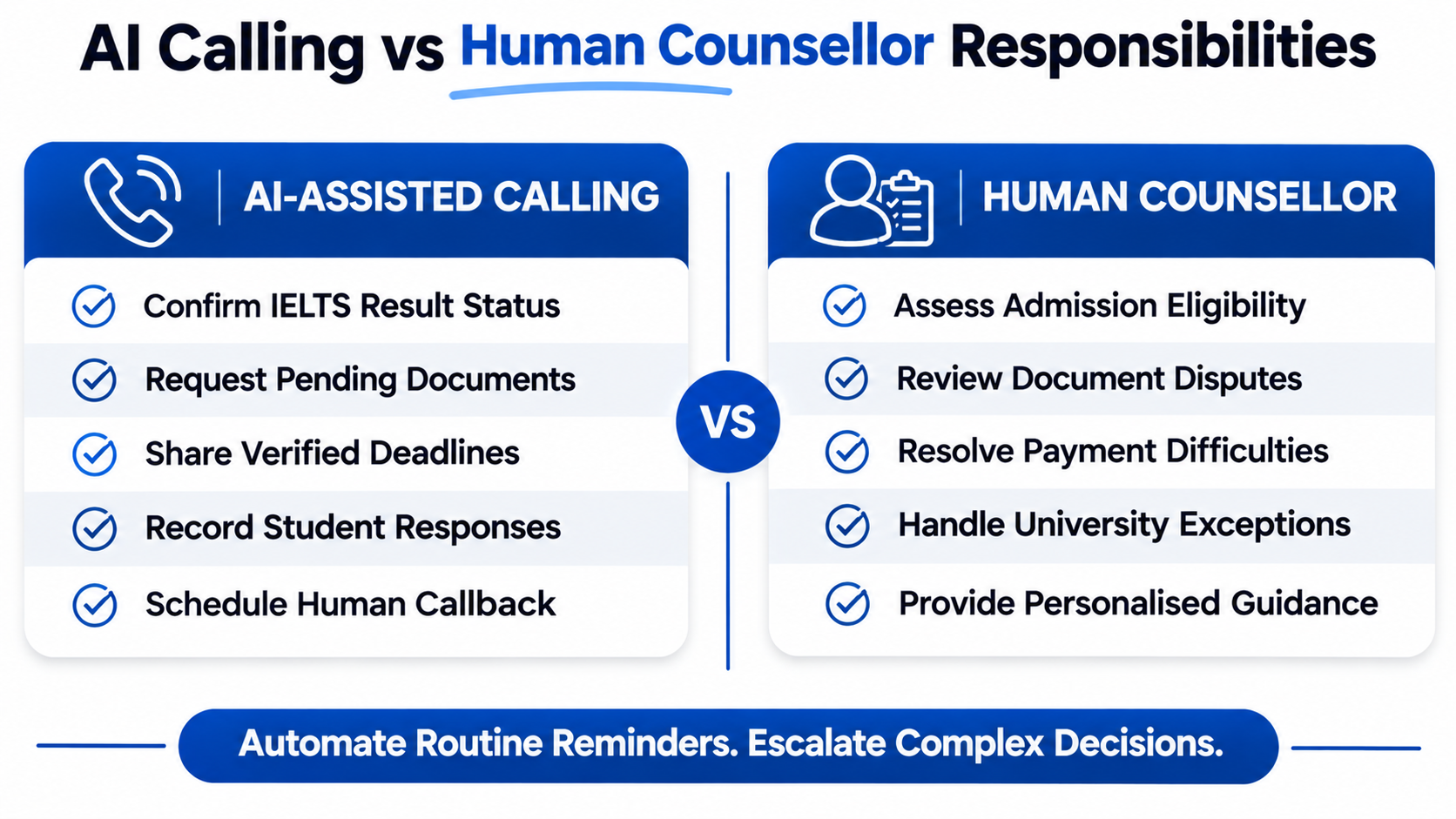
The common uses of AI-enhanced interactions could consist of:
- Confirming whether a test has been received.
- Requesting a missing checklist document.
- Converting information about a confirmed deadline.
- Scheduling a desired callback time.
Human intervention should be involved in instances that:
- A question is formed by an English score that forms an eligibility question.
- One of the students challenges a document requirement.
- There is a lapse in the payment date.
- A university applies for an exception/extension.
- There is missing, inconsistent or sensitive information.
The counsellor should receive relevant call context so the applicant is not forced to repeat everything unnecessarily.
Regulatory Safeguards for AI Calling in India
Automated student follow-up calls should be scheduled in line with relevant telecommunication and personal-data regulations.
TRAI Commercial Communication Regulations.
TRAI commercial communication regulations and amendments include the Third and Fourth Amendments, which came into force on 18 September 2026 and 4 November 2026, respectively.
The November 2026 amendment directly alters the effect of commencing Regulation 35A and, as such, it is important to ensure that the then-active requirements are checked.
Before campaigns are launched, consultancies must check call classifications, the requirements of the telecommunications providers, the applicable number resource, permissions, and the opt-out procedure.
Even an existing application relationship does not necessarily exempt all calls from commercial communication controls.
Student Data and Rules of DPDP.
The Digital Personal Data Protection Rules in India have phased commencement dates.
The MeitY update dated 14 November 2026 acknowledges that the provisions on major Data Fiduciary obligations and the rights of the person whose data is considered to be the Principal (i.e., the individual) are planned to take effect on 13 May 2027.
The way contact information, application history, call results, and communication preferences are gathered, accessed, stored, and shared should be reviewed by the consultancies.
The use of software capabilities cannot determine legal compliance.
Measure Outcomes, Not Call Volumes
The effectiveness of automated student follow-up calls should be assessed by their usefulness in promoting student milestones, not by the number of calls made.
|
KPI |
Why it matters |
Formula |
|
Follow-up completion |
Tracks execution |
Completed reminders ÷ eligible scheduled reminders × 100 |
|
Contact rate |
Measures reachability |
Connected calls ÷ attempted calls × 100 |
|
Milestone completion |
Tracks application progress |
Completed due milestones ÷ eligible due milestones × 100 |
|
Cost per completed milestone |
Assesses efficiency |
Attributable cost ÷ completed milestones |
|
Escalation rate |
Measures human intervention |
Escalated connected calls ÷ connected calls × 100 |
Compare values with an appropriate manual-process standard, taking into consideration the intake timing, student mix and other applicable operating variations.
No, and do not think that AI alone brings about any improvement.
Implementation Checklist
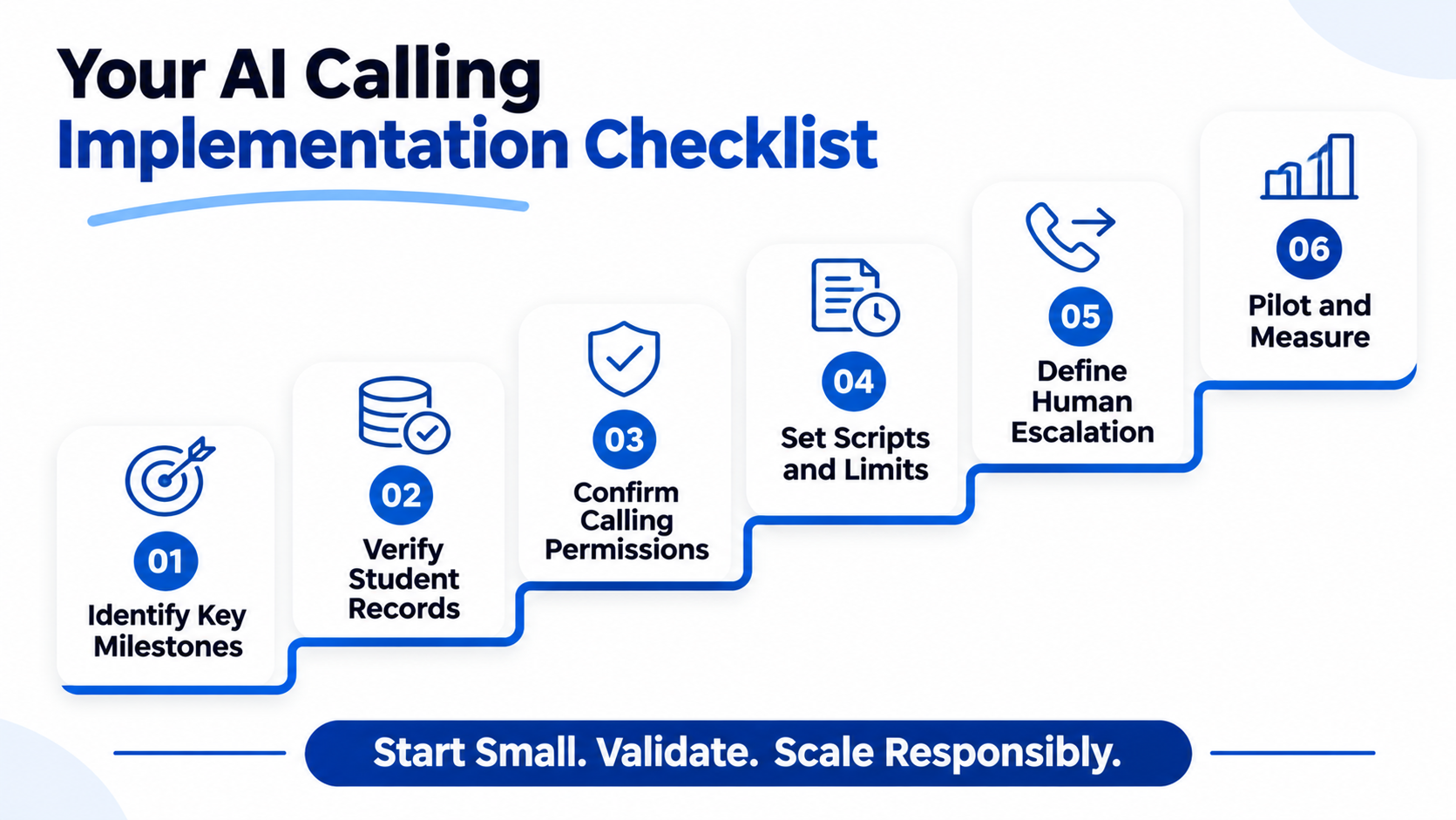
A consultancy ought to:
- Determine application milestones that should be reminded.
- Check student records and deadlines.
- Obtain permission for checking and relevant regulations.
- Prepare approved scripts and contact schedules.
- Specify patterns of retries and stop patterns.
- Set counsellor escalation ownership.
- Pilot one milestone workflow prior to their expansion.
- Track milestones achieved and expenses.
Start with a controlled process. Scaling unreliable information only increases the number of incorrect reminders.
FAQs
What are automated student follow-up calls?
They are either grid-based or milestone-based voice messages that help consultancies remind students about the requirements they are about to fulfil, record feedback, and plan the next step.
Is it possible for the AI to remind students of IELTS scores?
An appropriately programmed system can transmit an IELTS score reminder with verified test data. Eligibility checks and anomalous situations should be taken care of by counsellors.
Do missing documents have any chance of being gathered with the assistance of AI?
Yes. It can help automate reminder features in the documentation process by identifying unmet needs and tracking feedback. The document verification process is independent.
Can automated calls handle call fee deadlines?
They can send confirmed payment due dates and receive feedback. Controversies, time overruns and financial exceptions must be authorised.
Will GuaranteeAdmit automatically use AI voice calls?
GuaranteeAdmit publicly mentions CRM notices and AI-supported follow-up aspects. It will have to ensure that direct outbound voice-calling integration is available with its team.
Conclusion: How Gateway EduConnect Helps Consultancies Build Smarter Student Follow-Ups
Automated student follow-up calls can help study-abroad consultancies manage IELTS score reminders, document collection and university fee deadlines through structured, milestone-based communication.
However, effective follow-ups require more than automation. Accurate student records, timely reminders, clear counsellor responsibilities and reliable application tracking are equally important.
Gateway EduConnect supports education agents and consultancy partners through admissions coordination, university application assistance and application tracking powered by GuaranteeAdmit CRM.
By combining organised CRM workflows with appropriately configured AI calling solutions, consultancies can build a more consistent automated student follow-up calls while keeping important admissions decisions in human hands.
Explore Gateway EduConnect's B2B Solutions
Discover how Gateway EduConnect's B2B partner network supports consultancy operations, and explore GuaranteeAdmit CRM for application tracking, reminders and workflow management.
Connect with Gateway EduConnect to Explore B2B Partnership and CRM Solutions.
Author Bio
Abhinav Jain - Founder, Gateway Educonnect and Director.
B.Tech, MBA, AI and Global Education Specialist.
More than 15 years of professional experience in leading students along international routes based on politics and innovation.