
31 Jul 2023 | Choosing the Perfect Study Destination Abroad

0
440
Choosing the Perfect Study Destination Abroad
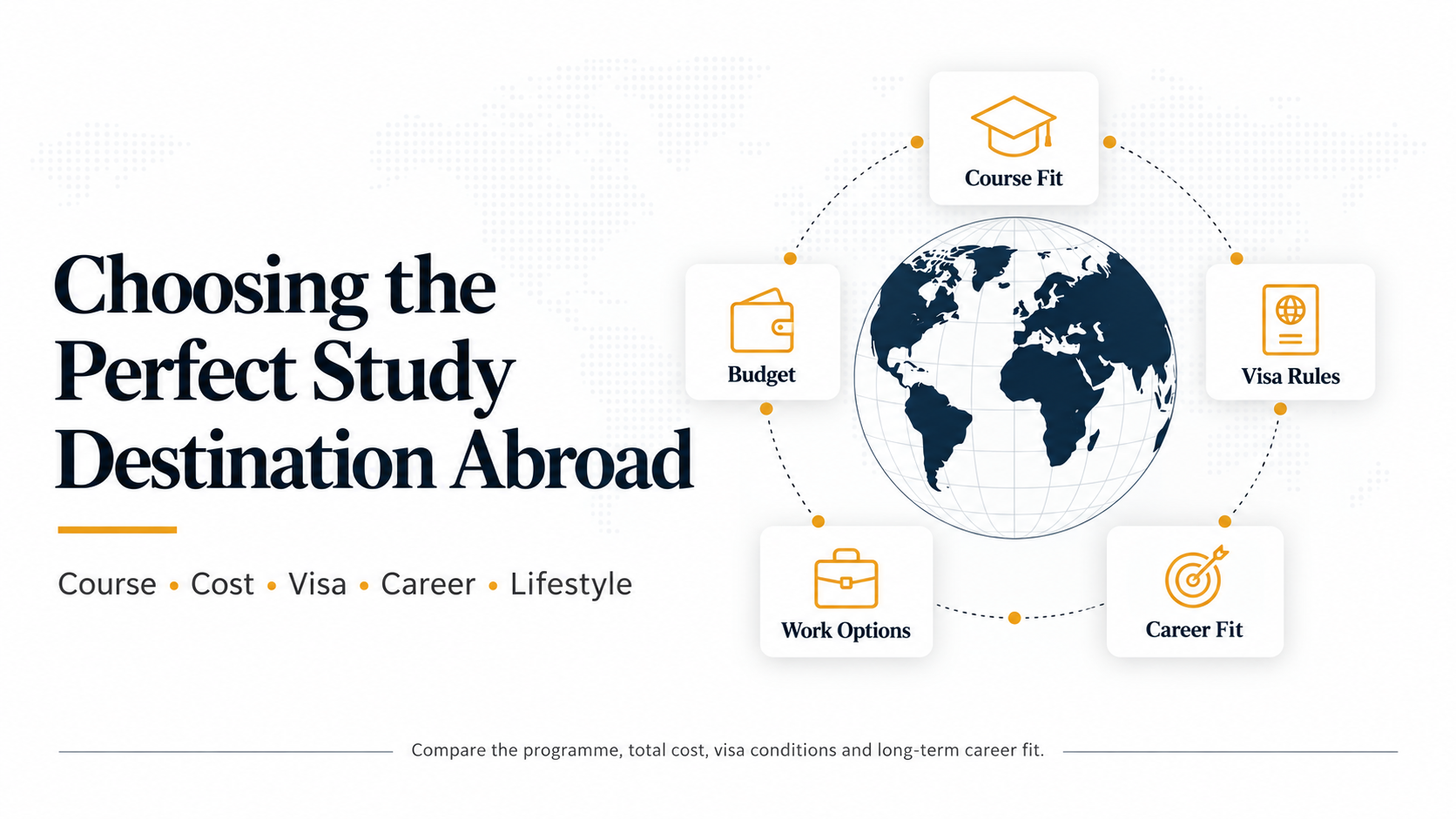
Making a decision on where to study should be a last factor after determining what you want to study, what you can comfortably afford and what is the career outcome you desire. When facing the question of selecting a country where you will study abroad, start by not following the rankings, trends on social media or assurances of quick access to permanent residence. Compare the actual programme, total financial commitment, admission fit, visa conditions, work rights, professional recognition and life you would have in that country.
The right destination is therefore different for every student. A country that suits a computer science graduate with a high budget may make little sense for a student pursuing healthcare, finance or another regulated profession.
How to Choose a Country to Study Abroad: At a Glance
|
Decision factor |
What you should compare |
What not to do |
|
Course fit |
Curriculum, specialisation, accreditation, teaching style |
Choose a country before choosing a suitable course |
|
Budget |
Tuition, accommodation, insurance, visa, travel and emergency fund |
Compare tuition alone |
|
Admission fit |
Academic requirements, prerequisites, English requirements |
Apply only because a university is highly ranked |
|
Visa |
Financial evidence, conditions and documentation |
Assume one country has an “easy visa” |
|
Work during study |
Permitted hours and eligibility |
Build your entire budget around a part-time job |
|
After graduation |
Current post-study route and eligibility |
Treat post-study work as guaranteed employment or PR |
|
Career fit |
Industry, professional recognition and location |
Follow generic “best country for X subject” claims |
|
Lifestyle |
Language, climate, city size, healthcare and support |
Ignore day-to-day living preferences |
What this means: learning how to choose a country to study abroad is mostly about comparing trade-offs. No destination leads on every factor.
1. Start With the Course, Not the Country
A common mistake is deciding, “I want to study in the UK” or “I want to move to Canada” before comparing programmes.
Reverse the process.
First define:
- the qualification you need
- the specialisation you want
- two or three realistic career outcomes
- subjects or modules you want to study
- whether your profession requires accreditation
- whether internships, placements, laboratories or research matter to you
Then shortlist universities that genuinely provide those features.
For example, two programmes called “MSc Data Science” can differ significantly in mathematics, machine learning, programming, dissertation requirements and industry projects. The course title alone tells you very little.
If you need help with programme selection specifically, Gateway EduConnect already has a separate guide on how to choose the right course abroad.
Ask these questions for every programme
- Which modules are compulsory?
- Are there useful electives?
- Is there an internship, placement or industry project?
- Who awards the qualification?
- Is professional accreditation required for my intended career?
- What are the entry requirements for Indian applicants?
- Does the programme require prior study in specific subjects?
This programme-level comparison should come before university prestige.
2. Calculate the Complete Cost, Not Just Tuition Fees
Students trying to understand how to choose a country to study abroad often compare tuition fees and stop there. That can produce a badly distorted comparison.
Your budget should include:
- tuition fees
- university deposits
- accommodation
- food and utilities
- local transport
- visa or residence-permit costs
- health insurance or required health charges
- flights
- books, software or equipment
- English-language or standardised tests
- initial setup expenses
- emergency funds
- currency movements
A shorter programme can sometimes reduce total living costs even if annual tuition is higher. A cheaper university in an expensive city may also cost more overall than a higher-fee course elsewhere.
Current Financial Requirements Worth Checking
|
Destination |
Current official financial rule or planning check |
|
UK |
Student visa applicants generally need course fees plus £1,529 per month in London or £1,171 outside London, for up to nine months, where the financial requirement applies. |
|
Canada |
For applications submitted on or after 1 September 2026, one applicant outside Quebec needs CAD 23,448 for first-year living expenses, excluding tuition and transportation. |
|
Germany |
A study visa can be supported through a blocked account containing at least €11,904 in 2026, or another accepted form of financial proof. |
|
Ireland |
A visa-required student on a one-year course must show immediate access to at least €10,000, plus appropriate funding for subsequent years. |
|
New Zealand |
Tertiary students funding themselves generally need NZD 20,000 per year for living expenses, or NZD 1,667 per month for study shorter than one year. |
Interpretation: these are immigration financial requirements, not complete estimates of what you will actually spend. University fees and real living costs still need to be calculated separately.
3. Compare the Student Visa Rules Properly
There is no useful universal ranking of countries by “easy visa”.
A better approach to how to choose a country to study abroad is to ask whether you can realistically satisfy the rules for the specific destination and programme.
Check:
- whether your university or programme is eligible for the student route
- required financial evidence
- English-language requirements
- medical or health-insurance requirements
- documentation requirements
- restrictions attached to your student status
- the latest government rules for your intended intake
For Australia, for example, the duration of student status is linked partly to the course and required Overseas Student Health Cover, which must at minimum cover the course period.
For the United States, students normally need acceptance from a SEVP-approved school, SEVIS registration and Form I-20 before applying for the relevant student visa.
Do not choose a country simply because an agent says its visa is “easier”.
4. Can You Work While Studying?
Part-time work can provide experience and supplementary income, but it should not be the foundation of your funding plan.
Current rules show how different countries can be:
|
Destination |
Selected current student-work rule |
|
UK |
Providing that they meet the appropriate degree level, eligible students of qualifying providers can normally work 20 hours a week during term time and full time during vacations. |
|
Canada |
International students may also work a maximum of 24-hours per week not on campus in normal semesters and unlimited hours during qualified scheduled breaks. |
|
Australia |
International student work during study periods is generally capped at 48 hours per fortnight. |
|
Germany |
International students may generally work 140 full days or 280 half days per year, or up to 20 hours per week under the alternative rule. |
|
Ireland |
Eligible Stamp 2 students may work 20 hours per week while studying and 40 hours during specified vacation periods. |
|
New Zealand |
Eligible student visas can permit work for up to 25 hours per week and full-time during qualifying holidays. |
Ireland's immigration guidance explicitly states that students must demonstrate sufficient funds without relying on casual work.
That is a sensible budgeting principle for every destination.
5. Consider Post-Study Options, but Do Not Assure PR.
Post study opportunities are important, especially when students are interested in having an international work experience. Even now, they must be considered as current immigration options rather than employment or a permanent residence.
Examples: September 2026 checked:
- UK: The Graduate visa will initially be two-year old provided the application is made by the end of 31 December 2026 but it will reduce to 18 months starting 1 January 2027. Three years are given to doctoral graduates.
- Germany: qualifying international graduates can obtain a residence permit for up to 18 months to look for skilled employment.
- Ireland: Level 8 graduates can receive up to 12 months, while qualifying Level 9 or above graduates can receive up to 24 months, normally in two 12-month stages.
- New Zealand: qualifying graduates may obtain a Post-Study Work Visa for up to three years, depending on their qualification.
- Canada: PGWP eligibility depends on factors including the institution, programme and current eligibility requirements. Degree graduates have language requirements, while field-of-study requirements apply differently depending on programme type.
- USA: qualifying F-1 students can generally receive up to 12 months of OPT, with an additional 24-month STEM OPT extension available in eligible circumstances.
This is why how to choose a country to study abroad should never be reduced to “Which country gives the longest stay-back?”
A longer visa does not guarantee a relevant job.
6. Quality of Check Programmes, Recognition and Career Relevance.
Rankings in the universities can aid in preliminary the research, but cannot be the last judgment of the case.
Compare:
- exact curriculum
- faculty expertise
- facilities
- research opportunities
- internships and practical projects
- professional accreditation
- employer relevance
- graduate outcomes where the university publishes reliable data
- location relative to the industry you want to enter
In the case of controlled professions, like nursing, medicine, psychology, architecture and law, professional reputation might be more important than the total university rating.
A fancy qualification that is not conducive to the licensing route that you need may be a misjudgment.
Take into account Language, Lifestyle, Healthcare and Safety.
7. The appropriate study site also should be working outside the classroom.
Before finalising a country and city, consider:
- languages used in daily life
- language expectations in your intended profession
- climate
- accommodation availability
- public transport
- healthcare and insurance
- city size
- food and lifestyle preferences
- student support
- distance and flight connectivity from India
Check university accommodation guidance, official local information and current student-support resources instead.
8. Compare Scholarships and Funding Realistically
For each scholarship, verify:
- eligible nationality
- eligible programme
- academic criteria
- separate application requirement
- application deadline
- scholarship value
- what expenses it covers
- whether it is renewable
- conditions you must maintain
If you are considering an education loan, compare the complete borrowing cost rather than only the advertised interest rate. Gateway EduConnect's related education-loan service is available through Foreign Edu Loans.
9. Use a Country Selection Scorecard
A simple scoring exercise makes how to choose a country to study abroad much more objective.
Score every shortlisted destination from 1 to 5.
|
Factor |
Suggested weight |
|
Course and curriculum fit |
25% |
|
Career relevance |
20% |
|
Total affordability |
20% |
|
Admission/profile fit |
10% |
|
Professional recognition |
10% |
|
Current visa and work conditions |
5% |
|
Lifestyle and location |
5% |
|
Scholarships/funding |
5% |
Do the scoring at the programme level, not simply the country level.
For example, compare:
University A + Course A + City A
against:
University B + Course B + City B
This produces a much more useful decision than comparing “UK vs Canada” in isolation.
For a broader destination-by-destination comparison, see Gateway EduConnect's separate best countries to study abroad for Indian students guide.
10. When Should You Start?
|
Time before intake |
Priority |
|
12–15 months |
Define career goal, course area, countries and realistic budget |
|
10–12 months |
Research programmes and prepare required tests |
|
8–10 months |
Finalise shortlist and prepare SOP, CV, LORs or portfolio |
|
6–9 months |
Submit university and scholarship applications |
|
3–6 months |
Compare offers, arrange funding and review deposits/refunds |
|
1–3 months |
Complete visa, accommodation, insurance and travel planning |
Some Mistakes When Choosing a Study Destination
Avoid these:
- selecting the country before researching the course
- assuming the highest-ranked university is automatically the best fit
- comparing tuition but ignoring living and setup costs
- relying on part-time work to fund essential expenses
- treating current immigration policy as permanent
- assuming a post-study visa guarantees a job
- treating study as an automatic permanent-residence route
- ignoring professional accreditation
- depending on social-media claims instead of government sources
- choosing a destination only because friends are going there
- applying without a realistic backup option
To select a country in which to study abroad, there is no better way to narrow down a list of countries than to cut off those who do not meet your non-negotiable factors and then have a look at the ones that remain.
FAQs
Which nation should Indian students choose to study in as an expatriate?
It is not possible to have a best country. It all depends on your programme, academic profile, finances, career plans, need of professional recognition and your present immigration status.
What should I do with choosing between two countries where I can study my Master?
To start with compare the precise courses. Next, compare the overall cost, time of the programme, hands-on experience, professionalism, fit to the college, and the visa status and course. Do not take up the decision based on rankings only.
Would opportunities of acquiring work after studying influence my choice of where to study?
They are to be taken into account, although not the yardstick. The immigration policy is subject to change, but so will the quality and relevancy of your qualification have an effect on your career over a much longer period.
Will I be able to finance my education by working on part-time basis?
It is not something you should plan on. Work entitlements are conditional and restricted and in some governments, it is expressly mandatory on you to have shown that you do not rely on casual employment to sustain yourself.
Is the lowest cost country necessarily the one to go?
No. A cheaper programme can provide inappropriate curriculum, little professionally or of limited personal interest to your desired career. Compare value not price only.
Are university ranking important in the selection of a country?
They may be useful in preliminary research, but still, the strength of the subjects, curriculum, accreditation, expenses, location, career-practicality, and other factors are to be investigated. One of the inputs must be rankings and not the decision in its entirety.
When do I need to make my decision about my study-abroad destination?
Plugging into your final intake date of about one year in advance means you have more time to do research and tests in the programme, applications, scholarships, education-loan planning and visa preparation. Certain programmes or at least some will need to open even earlier.
Conclusion
Seeing how to pick the country to study abroad will imply substituting suppositions with a frameworked comparison. Start with your career and academic ambition, filter out the relevant programmes, add up the total cost and finally look at the admission requirements, the profession as a whole then the recent requirements on visa allowance and work status, after study then the lifestyle and decision after your study.
Do not go to a given country due to certain popularity, someone being promising you easy-visa, or the current immigration policy looking good. Policies change. The appropriate path, realistic budget and viable career plan puts you in a better place.
With the combination of programme + university + city + affordability + career fit, the country name alone is not enough and thus the final decision has to be based on it.
Get a free video or home counselling session with Gateway EduConnect to compare your shortlisted study destinations and courses.
Author Bio
Abhinav Jain - Founder, Gateway Educonnect and Director.
B.Tech, MBA, AI and Global Education Specialist.
More than 15 years of professional experience in leading students along international routes based on politics and innovation.
Connect: https://www.linkedin.com/in/abhinavedysor/


