
03 Aug 2026 | How to Choose the Right Course Abroad 2026-27: Complete Guide for Indian Students

0
40
Introduction
To select the appropriate international programme, it is not enough to choose a popular subject or a university with a prestigious position. Before making a choice, students should relate academic and career goals, long-term and budget development, as well as interest areas. It is a guide how to choose course for study abroad using an evidence-based approach and on a practical basis. It includes career mapping, comparison of curriculum, qualification, accreditation, practical learning, suitability of country, cost and planning of applications. Instead of solely depending on the title of courses, students ought to compare compulsory courses, methods of assessment, exposure to the industry and recognition of the course by the industry. Some requirements are country-specific, university/programme specific, and any licensed career may come with other licensing requirements. Through financial planning, structured scorecard and official course pages, Indian students and their parents can get course ideas with proper clarification.Ready to turn your study abroad dream into reality? Explore top online programs and expert guidance at Gateway Educonnect Online Courses.
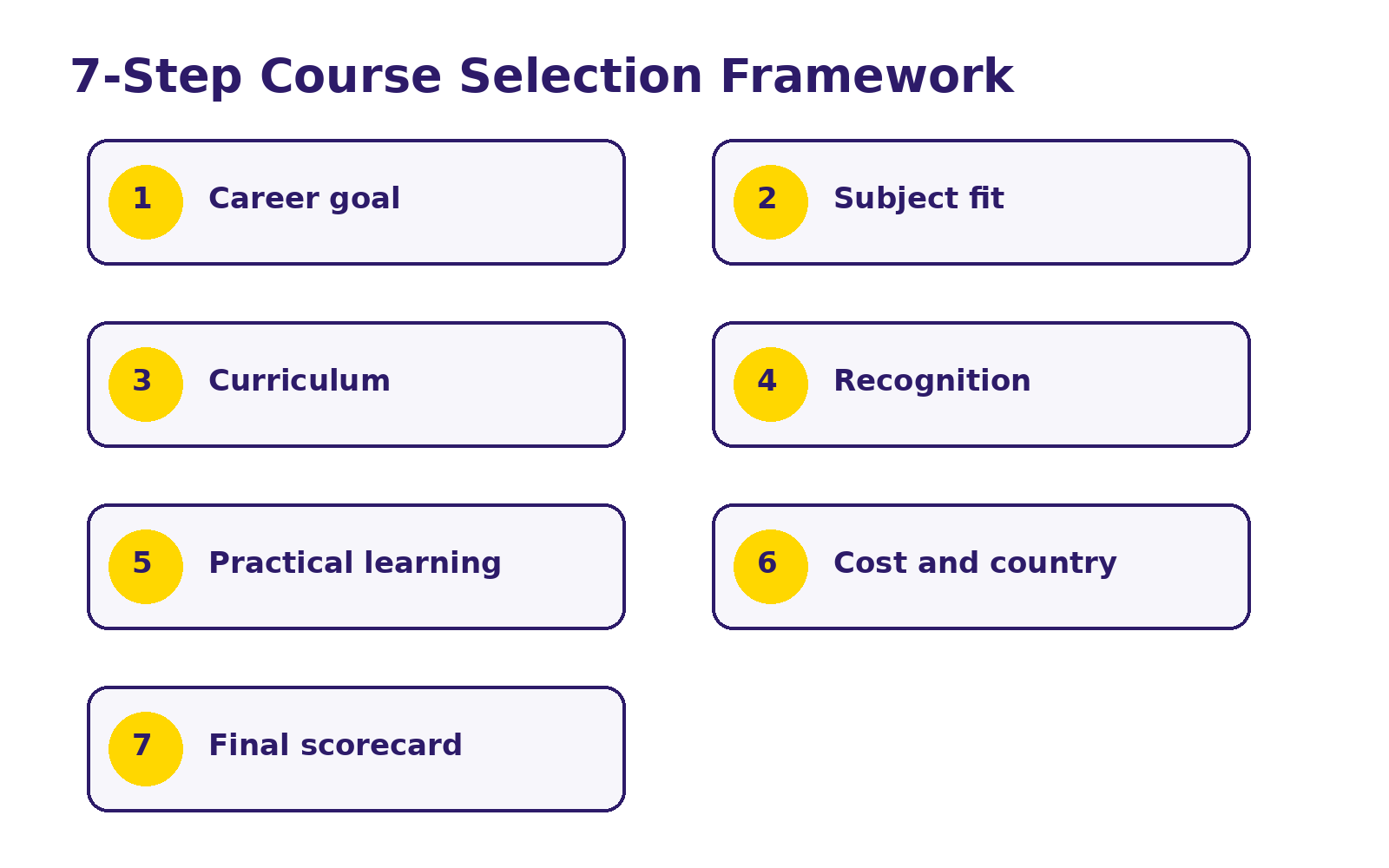
Seven Practical Steps on How to Choose Course for Study Abroad
The most powerful technique is to make logical decisions. Begin with the job that you desire. Then determine what knowledge, skills and recognition that work entails.
Step 1: Relate the Course to a Career Objective.
This is where the beginning of how to choose course for study abroad starts. List two of the potential positions rather than selecting a general area like one of business or technology.
- Name the industries using each role.
- Discuss usual day-to-day activities and duties.
- Record repetitive technical and movable skills.
- Determine the presence of a licence, portfolio or postgraduate qualification required.
- Research your interest by a small project, internship or professional discussion.
The point that students should consider when they are inquiring about how they would go about selecting the right career after graduating is not on the designation of a job but more on what they love doing. Unless you are a follower, this career-first strategy can also help you decide on how to choose course for study abroadwithout sheep marching.
Step 2: you can Compare Course and Curriculum
Names of courses are non-standardised. Two universities can be given a similar title but can be different in regard to the subject matter taught. It is on this basis that curriculum comparison plays the key role in the process of deciding how to choose course for study abroad.
- Make required courses prior to choice courses.
- As a result, learn the results of reading in each essential module.
- Determine whether exams, projects, presentations, case studies or a dissertation are used as an assessment.
- Seek laboratories and simulations, studios, field experience and placements or on-the-job industry projects.
- Certify the programs, tools and techniques students will employ.
- Enquire about every-year electives in advertisements.
To select a course to do abroad in your master's, the programme must indicate how you can clearly see the evolution of that course with your last degree or the job experience you have had. Career changers need to ensure that they are accepting of unrelated degrees.
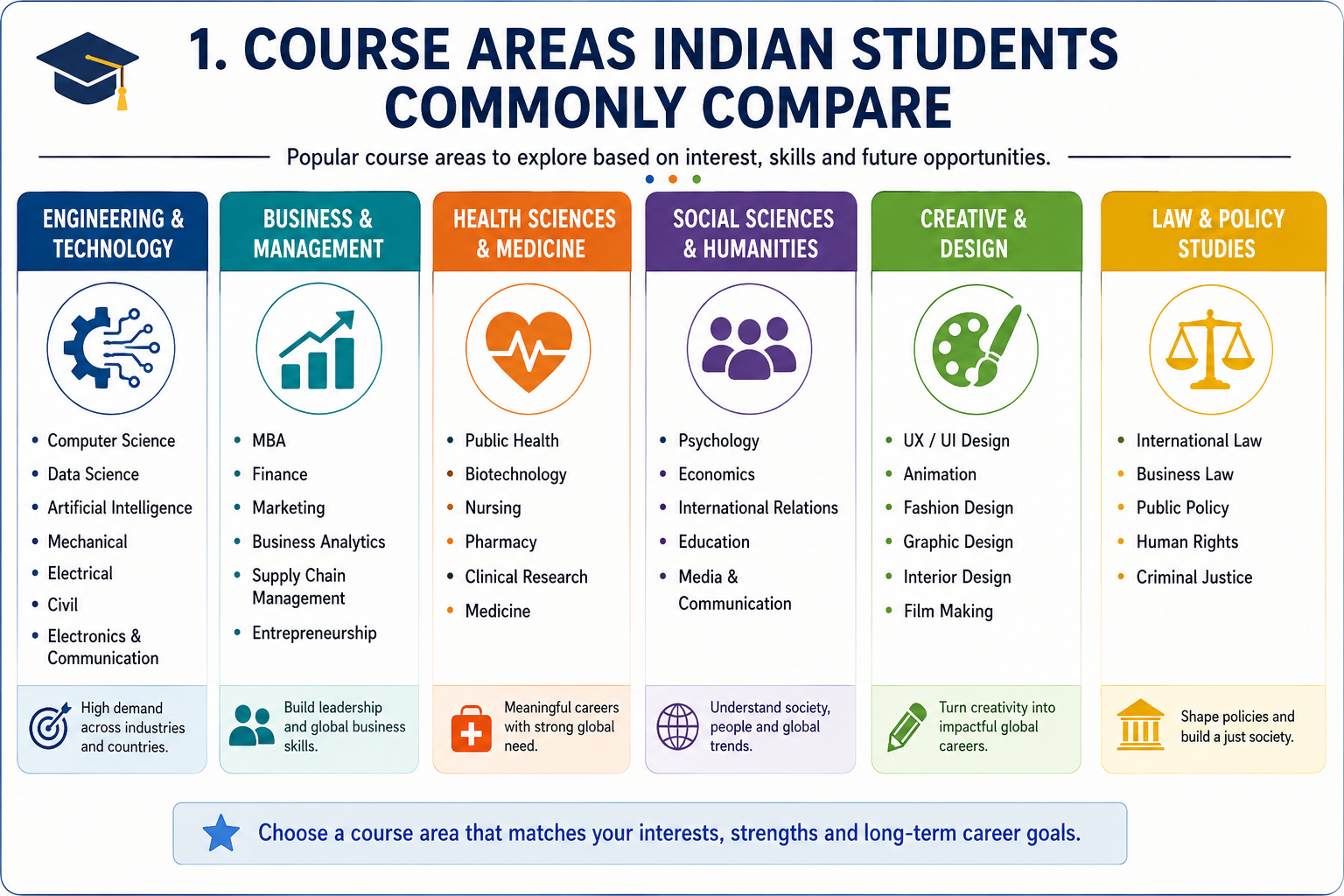
Course Areas Indian Students Commonly Compare
The most ideal course to pursue as an Indian studying abroad might relate to abilities, past research, career objectives, acknowledgement, and costs. The table below is a comparison tool and is not a ranking.
|
Course area |
Compare carefully |
May suit students who enjoy |
Important check |
|
Computer Science, AI & Data |
Math depth, tools, projects and specialisations. |
Logic, programming and statistics. |
Programming prerequisites |
|
Engineering |
Specialisation and accreditation, laboratories. |
Design, systems and applied science. |
Professional pathway |
|
Business, Management & Finance |
Quantitative material, projects and exemptions. |
Decisions and leadership, markets. |
Career relevance |
|
Medicine & Health Sciences |
The clinical placements and licensing. |
Patient care and science. |
Regulator approval |
|
Life Sciences & Biotechnology |
Infrastructure, research topics and industry connections. |
Research and work in laboratories. |
Research progression |
|
Design, Architecture & Creative Arts |
Portfolio, studios and software. |
Imagination and drawing. |
Professional recognition |
|
Tourism and Hospitality |
Some realistic experience and industries exposure |
People, Service, and operations |
Proper structure of the Placement |
|
Social Sciences & Humanities |
Techniques, composition and development paths. |
Person-society communication and research. |
Career pathway |
|
Law |
Jurisdiction, conversion and licensing. |
Analysis, argument and regulation. |
Local practice rules |
|
Environmental Science & Sustainability |
Subject matter, data projects and fieldwork. |
Science, policy and climate solutions. |
Technical depth |
Other factors to look into how to choose course for study abroad to ensure a good salary include the cost of training, entry requirements and potential employment opportunities.
Check out: Top 10 One-Year Master's Courses in the UK with the Best ROI in 2026
Step 3: You need to Check your academic skills and Eligibility
There is no general percentage, age restriction or English score. The eligibility varies among institutions and programmes.
- School history and subjects that are necessary.
- English-language ability
- Work experience
- Lapses and stagnancies in the studies.
- Portfolio or audition
- Interview or Admission test.
- Credentialing or permission by research sponsor or supervisor.
- Financial preparedness, country needs.
In selecting courses to study in the master's program, along with choosing a master's abroad, consider whether or not the university requires a related bachelor's degree, quantitative courses, knowledge of a programming language or work experience.
Step 4: Check Recognition and Accreditation.
It is important to be able to recognise when determining how to choose course for study abroad. Medicine, nursing, psychology, law, teaching and architecture, in particular, are very significant.
- Make sure that the institution is registered.
- Enquire of the programme whether or not it has been professionally accredited.
- Check licensing tests, practice and registration regulations.
- Check recognition in the destination country and, where applicable, in India.
- Even with an academic degree, do not expect that it can authorise you to practise.
Indian students have to consider both the academic and professional usability of how to choose course for study abroad.
Note: Before any deposit is made in regulated fields, specific checks on professional recognition must be cautiously exercised.
Check out: Cost of Studying in Japan for Indian Students: Tuition Fees, Living Expenses & Budget Planning
Step 5: Evaluate Practical Learning and Career Relevance
Learners are more assisted by a programme that allows them to put into practice what they know. Determine whether there is guaranteed, competitive, optional or arranged practical experience.
- Simulations or studios, laboratories.
- Training and projects: consulting projects, industry briefs.
- Field or professional/clinical placements.
- Internships, work-integrated learning or co-ops.
- Portfolio and capstone development.
- Employer engagement and career services.
Such students who study the finest courses outside their country to earn a high salary should think about skills, the quality of the project and their relevance to employers. Earnings are also influenced by experience as well as place, industry factors and the performance of individuals.
The actual exposure makes students realise how to make the correct choice of career upon graduation, as it reveals whether the students like the actual work or not. It is hence a significant assessment in the process of deciding the course to pursue in studying abroad.
Step 6: Compare Country, City and Complete Cost.
The course should be supported by the choice of country. It is not to be used in place of course analysis.
- Style and programme length of teaching.
- Language and cultural environment
- Entry to and location in industry.
- Recognition of institutions and programmes.
- Accommodation and transport, Safety.
- Fees, insurance, visa and mandatory fees.
- Food, utilities, books, flights and set-up.
- Reserve and deposits.
Most high-paying courses overseas may be accompanied by high tuition or high cost of urban living. Parents ought to equate overall financial investment, as opposed to tuition only.
On how to choose course for study abroad, review the master's length and the opportunity cost of the implicit cost of time spent out of work. These aspects ought to continue featuring in how to choose course for study abroad responsibly.
Budgeting Rule: Take indicative ranges to plan and check the actual figure on official pages. Exchange rates vary with respect to the INR conversion.
Check out: Campus France Explained: Complete Step-by-Step Guide for Indian Students 2026
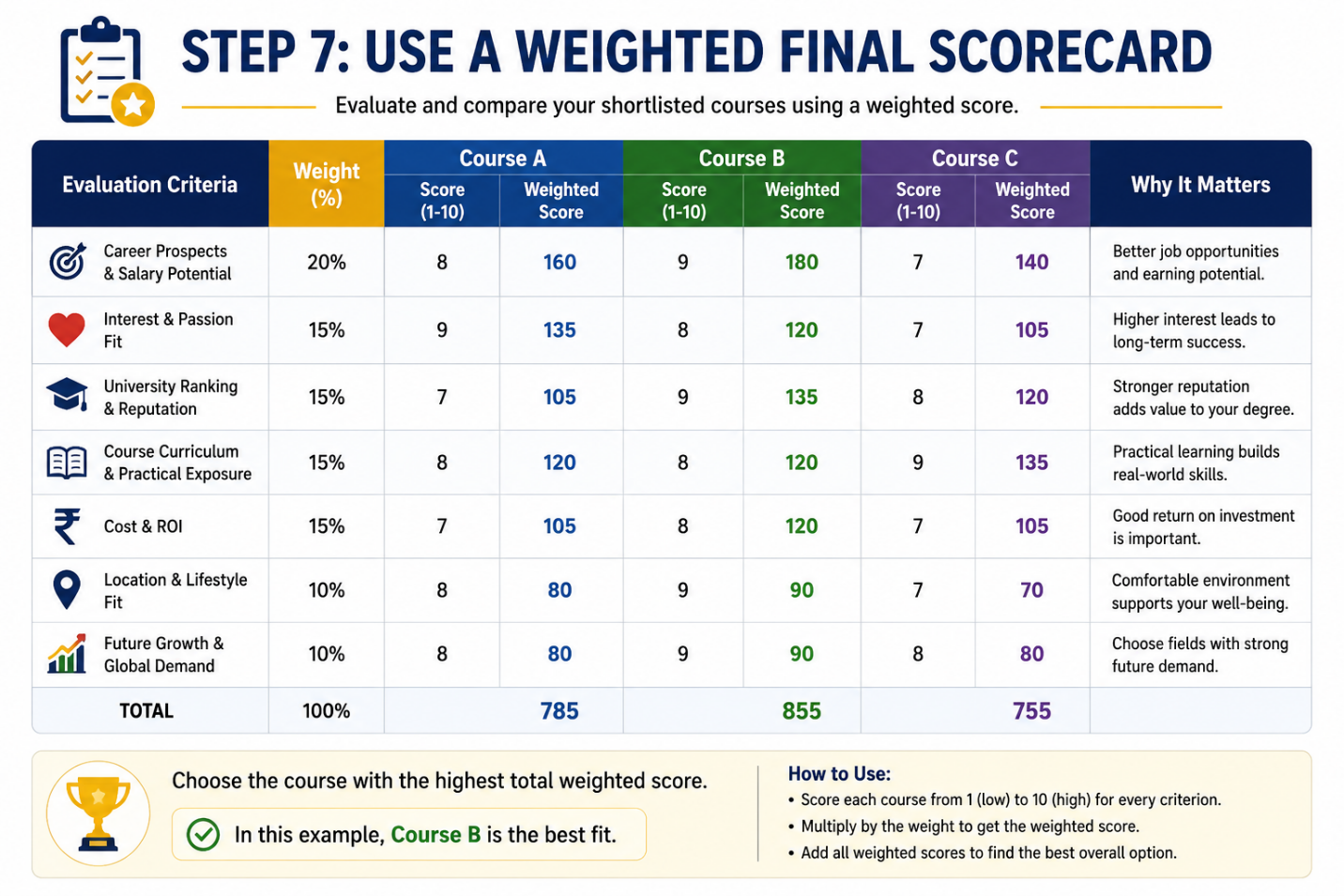
Step 7: Use a Weighted Final Scorecard
The scorecard will simplify the selection of a course to undertake in study abroad. It decreases the number of emotional choices and avoids ranking to take the top of the shortlist. It also transforms the how to choose course for study abroad into a repetitive process.
|
Criterion |
Suggested weight |
Questions to ask |
|
Career alignment |
25% |
Is the target role supported by the programme? |
|
Curriculum fit |
25% |
Are there compulsory modules to deliver the necessary skills? |
|
Recognition |
15% |
Is the institution and programme being recognised well? |
|
Practical learning |
15% |
Are placements, projects or placements worthwhile? |
|
Total cost |
15% |
Is the entire commitment fundable in a responsible manner? |
|
Location and support |
5% |
Does the student fit into the environment? |
Also Read: UK Student Visa Requirements 2026: Complete Eligibility & Document Checklist
Practical Application Timeline
Begin early, though do not think all the students have to heed the schedule. Smaller courses like a portfolio can take more time, research degrees, scholarships, competitions, and loan applications. How to choose course for study abroad and apply to study abroad must not be rushed decisions, as a realistic timeline is crucial.
|
Period before intake |
Expected output |
Priority action |
|
15–12 months |
Initial course criteria |
Career and subject research |
|
12–9 months |
Balanced university list |
Tests and shortlist |
|
9–6 months |
Submitted applications |
Documents and applications |
|
6–3 months |
Confirmed choice |
Offers, funding and deposits |
|
3–0 months |
Travel-ready file |
Visa, accommodation and departure |
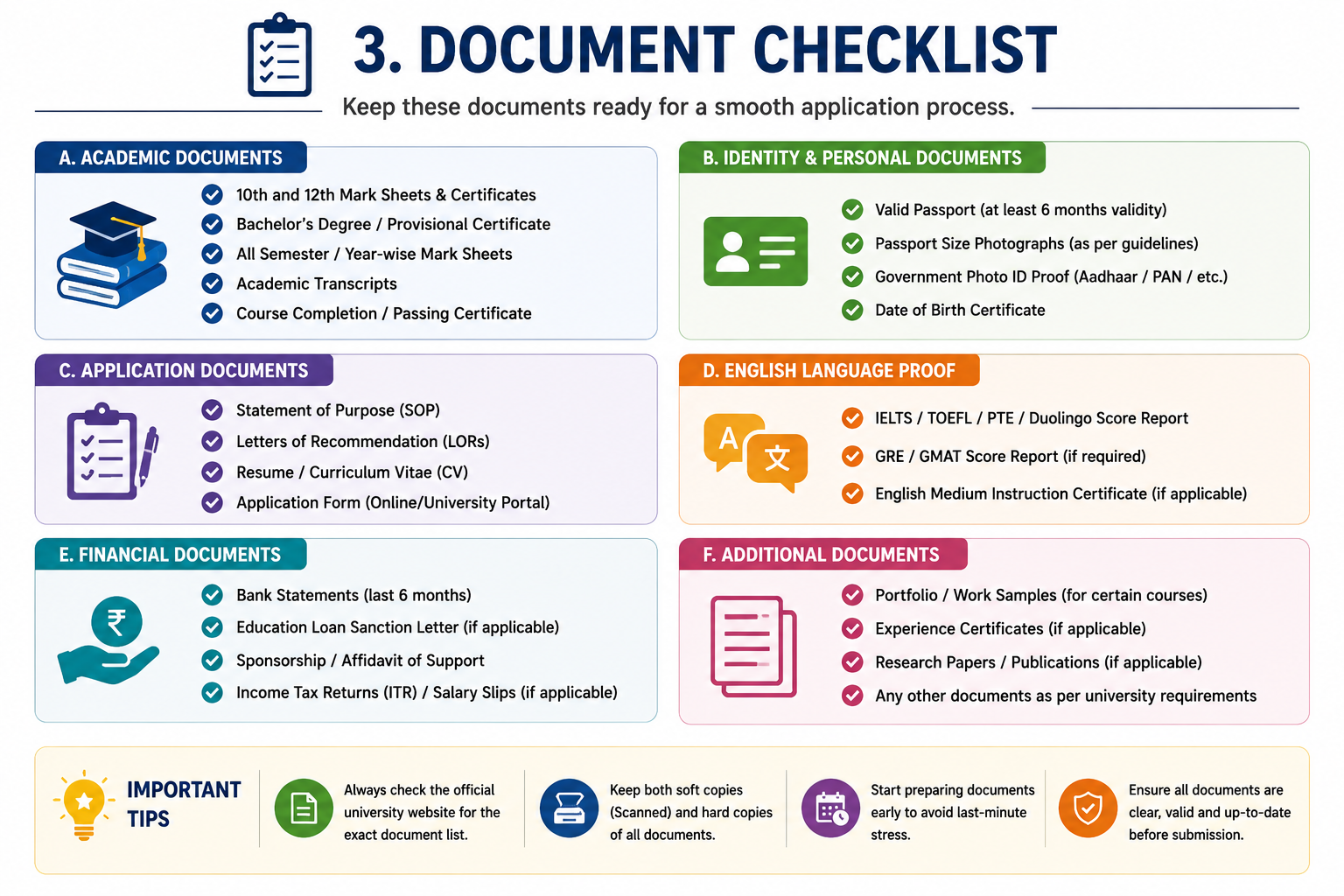
Document Checklist
- Academic records: mark sheet, transcripts, certificates and anticipated grades.
- Representing documents: passport, photos and identification.
- Application papers: SOP, LORs, CV, essay, portfolio or research proposal.
- Test documents: standardised test and English-language scores.
- Financial documents: bank statements, records of sponsorship, loan documents and scholarship documents.
- Visa Paperwork: provide assurance, money trail, medical history, applications, biometrics and evidence.
Education Loans and Scholarships.
It is to encourage a proper course, rather than to encourage an improper course, that a suitable course should be supported by scholarships and loans. Financial assistance is to empower, but not dictate the manner in how to choose course for study abroad.
- Scholarships: check eligibility, distinct applications, deadline, essay, conditions attached to offer letter, value, exclusions and renewal policies.
- Education loans: determine interest rate, processing charges, security, co-applicant, margin, moratorium, term of repayment, amount to be covered, disbursement and prepayment.
- Don’t expect to achieve scholarship or approval of loans.
- Inclusion of funding arrangements in application plan.
Tips for Parent Guidance
The academic worth and monetary commitment must be discussed by parents.
- University/course approval.
- First year/full course cost.
- Loan repayment burden
- Scholarship conditions
- Safety and transport, accommodation.
- Rules about Visa and refund.
- Communication plans and emergency plans.
- Relevance to career and career recognition.

Common Course-Selection Mistakes
- Picking the country without setting the course and career aim.
- Submitting an application without verifying qualifications and preconditions.
- The primary means of decision-making is through rankings.
- Comparison of course titles without studying the required modules.
- Disregarding living, insurance, visa and set-up costs.
- Several countries have a list of the best courses as per good salary in foreign countries and then pick a programme and choose it.
- Ignorance towards expert acceptance in regulated environments.
- Applying a single SOP to all universities.
- Recommendations via social media and not formal websites.
- Only applying to very competitive institutions.
Such errors may also mislead students who are making decisions on how to pursue the correct career upon graduation. An ordered comparison simplifies the decision in terms of explanation and defence.
Professional Advice: Do you Need an Education Consultant?
The student may directly apply via the portals used by the university; thus, a consultant is not required. Professional counselling may be of assistance:
- Eligibility assessment and profile.
- Shortlisting course-wise, country-wise, and university-wise.
- Document and Application support.
- Education-loan counselling and scholarship.
- Visa support and preparing tests.
- Accommodation planning and parent counselling.
- Pre-departure support
Gateway EduConnect provides free video counselling, free home counselling, education-loan, accommodation and test preparation support services to enable students to make informed choices regarding how to choose course for study abroad and undergraduate programmes.
Watch out against organisations that promise admission, scholarships, education loans, jobs or visas. Always check the sources of information with the official university and governmental sources.
FAQs
But what about the issue of what topic I should be taking?
Find two target roles to match up the best things you do and preferred ways of working. Then put it to the test with short projects, internships and mandatory-module reviews.
How to choose course for study abroad as an Indian Student?
No general list. The most suitable courses that should be studied abroad by Indian students would be based on the academic background, aptitude, recognition, cost and career direction.
What are the strategies to use to select courses abroad in master?
Progression of degrees, courses needed, mandatory units, tests and project assignments. Career changers need to ensure that they are accepting of unrelated degrees.
Is it ever worthwhile to choose the best courses overseas to get a high salary?
No. The top foreign courses that provide high wages yet check expenses, acknowledgement, match curriculum and career route incline and demand.
Is it best to pick the course or university first?
Establish programme requirements. Only compare rankings after going through modules, accreditation, teaching approach, cost and career relevance.
Is a consultant able to assure admission or a visa?
No. These decisions are made by Universities, funders and immigration authorities. Confirm all their significant assertions by authoritative sources.
How would you, in the simplest way, learn how to select a course when studying abroad?
Follow a seven-step process: set career objectives, compare course material, identify qualifications, ensure recognition, evaluate pragmatic learning, consider full cost and make the final decision.
Conclusion
The first step towards knowing how to choose course for study abroad is to define an occupation path and the skills required to achieve the goal. Students are then advised to make a comparison of the mandatory courses, evaluation approaches, hands-on education, admissions, accreditation and overall tuition fee among apt programmes. Academic fit, professional recognition or affordability cannot be substituted by rankings and salary expectations, though. Parents ought to look at the whole financial obligation, which consists of tuition and living costs, insurance, travel, deposits and emergency fund. All the fluctuating requirements should be verified on official university, government or regulatory pages and then applied. Mark each alternative using the Course Selection Worksheet and mark the risks and identify workable alternatives. To be guided personally, DM COURSE to have your course-match or course analysis with Gateway EduConnect.
DM COURSE to have a Course-Match Review: Get advice on course fit, country choice, estimated budget, necessary tests, paperwork and follow-up application. Get a copy of the Course Selection Worksheet with your mark.
For more assistance, please visit our study abroad consultancy services and explore our wide range of offerings for students interested in Study in Australia, Study Abroad in Poland, Study in Canada, Study abroad UK, Study in germany, Study in New Zealand, Study Abroad in Ireland, Study Abroad in the USA, Study in Finland, Study Abroad in Italy, and many other countries

Author Bio
Abhinav Jain - Founder, Gateway Educonnect and Director.
B.Tech, MBA, AI and Global Education Specialist.
More than 15 years of professional experience in leading students along international routes based on politics and innovation.