01 Aug 2026 | How to Study Abroad After Graduation 2026: Complete Guide for Indian Students

0
57
Introduction
To study abroad after graduation from India, you should have a clear academic objective, select a master's programme, compare countries, confirm eligibility, prepare documents, fund it and adhere to the formal requirements of the visa. This guide details the entire 2026-27 process in which students typically make decisions. It also includes course options, guide costs, schedules, scholarships, education loans and parent checks. Different countries have different requirements, different universities and different programmes have varying requirements; thus, there is no universal percentage, test score, deadline or budget. Check authoritative course and immigration websites before using or paying application fees.Explore top online programs and expert guidance at Gateway Educonnect Online Courses.
Fees, exchange rates, time frames, visa regulations and proof-of-funds requirements might vary. Cross-examine all the figures on the official source prior to application.
Seven-Step Application Process
Process at a glance
|
Stage |
Priority action |
Result |
|---|---|---|
|
1. Objective |
Career direction, budget, and define subject |
Clear decision criteria |
|
2. Course |
Compare curriculum, assessment and recognition |
Relevant programme shortlist. |
|
3. Country |
Compare overall price, time and regulations |
Appropriate destinations. |
|
4. Eligibility |
Check academics, tests and experience |
Realistic application list. |
|
5. Documents |
SOP, LORs, CV and evidence |
Application-ready file. |
|
6. Proposals |
Compare terms, charges and results |
Knowledgeable final decision. |
|
7. Leave |
Full financing, visa and accommodation |
Travel-ready plan. |
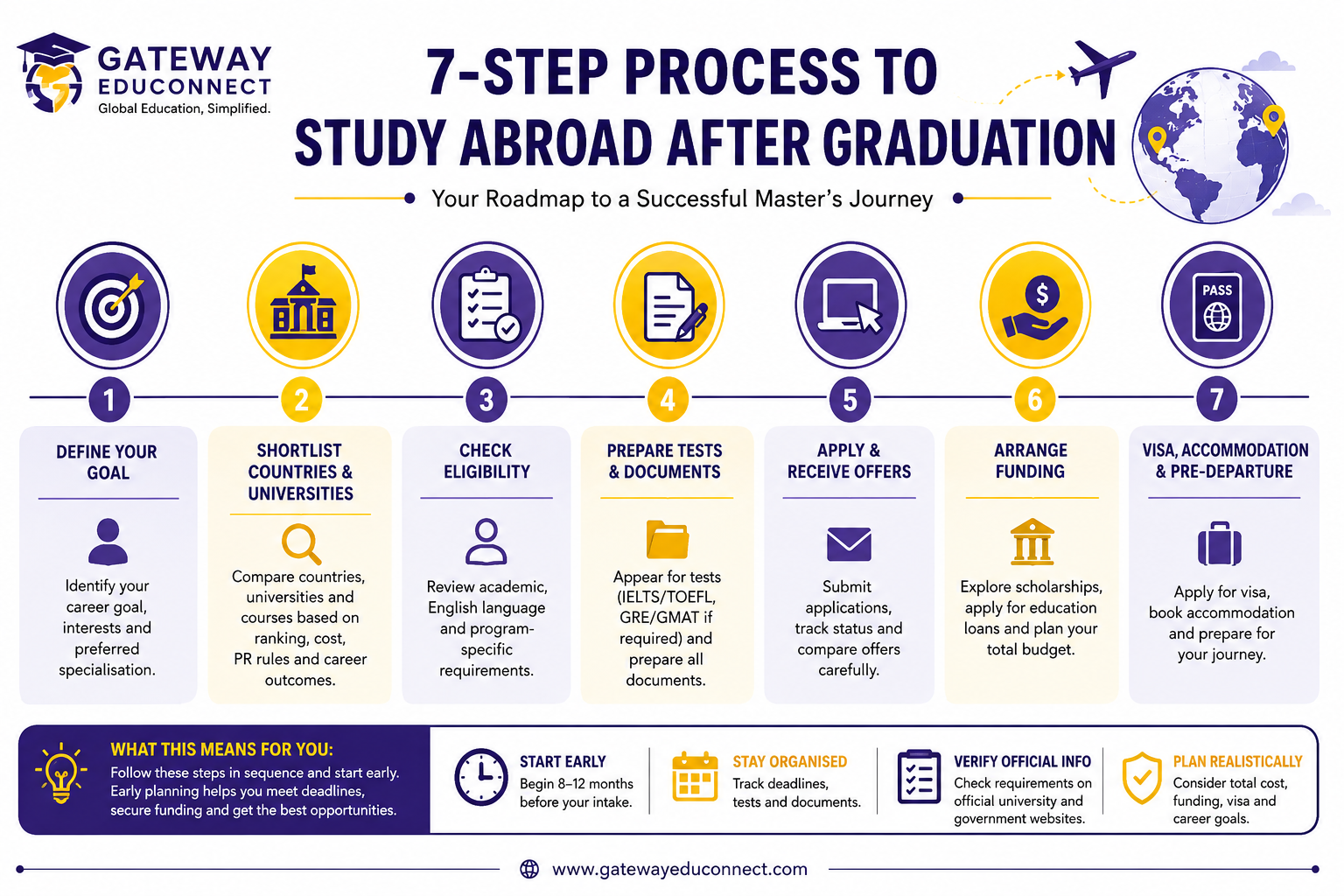
Step 1: Define your Career and Educational Aspirations.
Having a solid strategy to study abroad after graduation from India begins with your desired capability. Link your undergraduate education, projects, and job experience to your future career and graduate studies with a master's degree. Determine the necessity between technical profundity, research training, managerial expertise, career identification or changing careers. Compose a goal statement (one page) of subject, preferred learning style, affordable budget and long-term direction.
It is based on this aim that the best countries for masters after graduation. Destination popularity, rankings or social-media trends must follow programme fit.
What It Means to You: First decide on what outcome you want to achieve academically; and then compare countries and universities to prove it.
Step 2: Choose the Appropriate Master's.
Students exploring the process of applying to a master's in the US should compare the content of modules, modes of assessment, laboratories, projects in industries, placement opportunities and research opportunities. Even similar titles of these courses may result in quite different learning outcomes. Check required subjects, expected portfolio, work experience and how the programme helps you in your desired progress.
Course-selection framework
|
Course area |
What to compare |
Suitable for |
Important check |
|---|---|---|---|
|
Engineering |
Labs, design work, industry projects |
Relevant engineering graduates |
Discipline-specific recognition |
|
AI, Data and Computing |
Programming depth, projects, computing facilities |
Technical graduates and career changers with prerequisites |
Mathematics and coding expectations |
|
Health and Life Sciences |
Clinical exposure, laboratories and research |
Science or healthcare graduates |
Licensing and placement rules |
|
Business, Management and Finance |
Specialisation, analytics and practical consulting |
Graduates seeking commercial or leadership skills |
Professional exemptions where relevant |
|
Environment and Sustainability |
Fieldwork, data and applied projects |
Science, policy and engineering graduates |
Industry and policy relevance |
|
Law, Psychology and Social Sciences |
Research, methods and supervised practice |
Subject specialists or approved converters |
Country-specific professional pathways |
|
Design and Architecture |
Studios, portfolio, software and placements |
Creative or built-environment applicants |
Professional recognition |
|
Hospitality and Tourism |
Industry exposure and operations training |
Applicants seeking service-sector management |
Placement conditions |
To study abroad after graduation from India in controlled areas in India seek professional recognition; the degree might not give a licence to practise.
Read More: Oxford vs Cambridge: Which is Better for Indian Students 2026
Check out: Visa Support for Students: How Expert Guidance Can Increase Your Visa Approval Chances
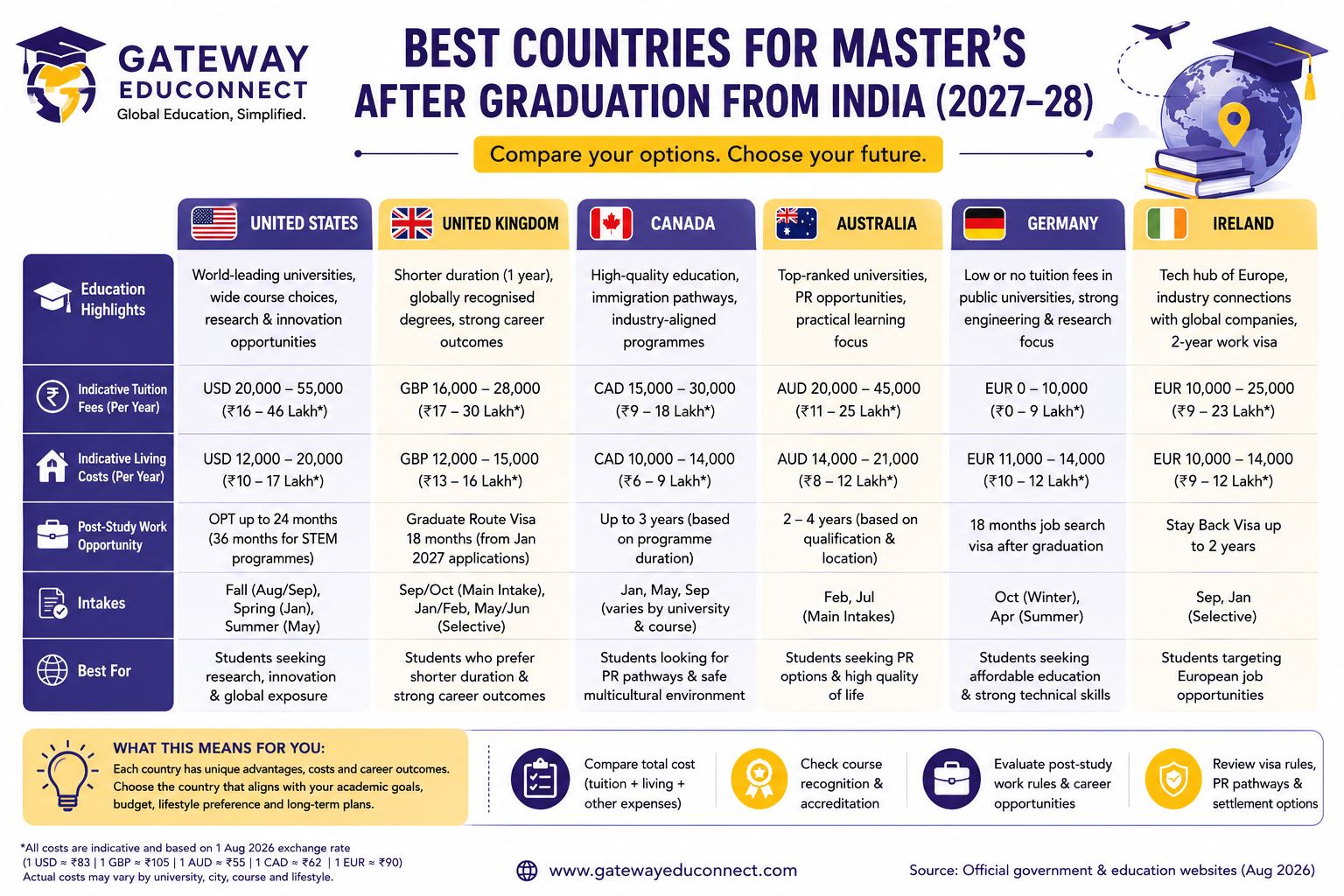
Step 3: Compare Universities and Countries.
When you are study abroad after graduation from India, use the same criteria to determine the best countries for masters after graduation: the quality of the programme, the total cost, course time, the recognition, the language, the location, immigration policies and your own fit. Never base any choice on the fact that at the moment, one country allows impressive post-study options; policies may fluctuate, and jobs can never be assured.
Country comparison questions
|
Decision region |
Questions to be posed. |
|---|---|
|
Academic fit |
Does the programme impart the needed skills and provide the appropriate facilities? |
|
Recognition of selected university |
Does selected university have high recognition, and ranking? |
|
Total cost |
What are the tuition, living, visa, insurance, travel and setup costs? |
|
Duration |
Length of the programme and the impacts of duration on the overall cost? |
|
Rules |
What are the study, work and post-study conditions? |
|
Location |
Is the location appropriate in terms of accommodation, transport, safety and support? |
The most successful countries to pursue a master's in upon graduation are thus personal and not general. Cross-reference official programme web pages and immigration websites and shortlist.
Step 4: You need to Check eligibility
Study abroad after graduation from India might require academic history and required courses, knowledge of the English language, working experience, gaps in studies, backlog, portfolio and interview, research proposal, financial preparedness and country regulations. There are a few universities which admit any number of English tests or waivers; some of them use a specified test but allow a minimum component score. Research degrees might have to be approved by supervisors, such as before application.
Prior to Your Application: See the precise programme page. Other universities might ask to see more documents, or deadlines will be earlier.
Check out: Best Universities in Spain for MBA in 2026: Rankings, Fees & Eligibility
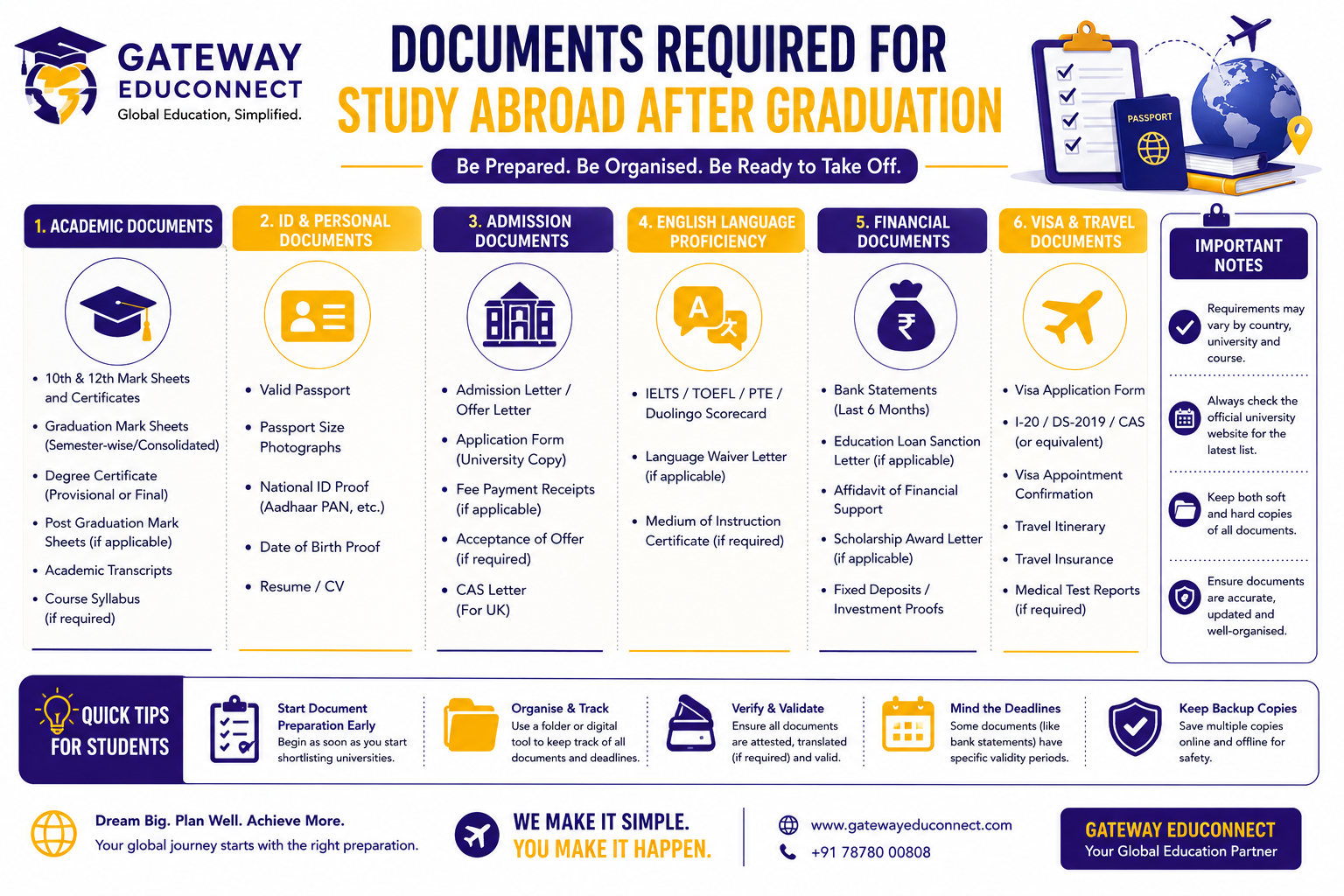
Step 5: Prepare tests and documents
All the documents will have to be in a complete, matching file to understand how to apply for masters abroad from India. Individualise the statement of purpose per programme and also be sure that the dates, grades, employment information and funding information are accurate in forms and evidence.
Document checklist
|
Category |
Typical documents |
|---|---|
|
Academic |
Marksheets, transcripts, degree certificates and evidence of other subjects. |
|
Identity |
Passport, photos and identity records. |
|
Application |
SOP, LORs, CV, essays, portfolio or research proposal. |
|
Tests |
Where necessary, English-language and standardised-test results. |
|
Financial |
Bank statements, sponsorship documentation, loan documents and letters of scholarship. |
|
Visa |
Confirmation of the legitimacy of an offer, documents, money, medical records and biometrics. |
To study abroad after graduation from India, the requirements of the documents differ. Official university and visa checklists.
Step 6: Apply and compare offers
Indian students who study abroad to apply to a master's in other countries do not need to have a consultant; they can apply via the official university websites. Monitor track logins, due dates, references, application fees and lost documents. Make applications to a balance between more ambitious, realistic and less risky options as opposed to exclusively highly competitive institutions.
When following up on offers, check on net tuition once valid awards are gained, deposit and money-back policies, academics, course term, modules, campus, rooms and accommodation and professional accolades. To study abroad after graduation from India, you need to do so responsibly, and the best way would be to select the best overall fit and not the biggest headline scholarship.
Check out: Study Abroad with Low IELTS Score: Options for Indian Students
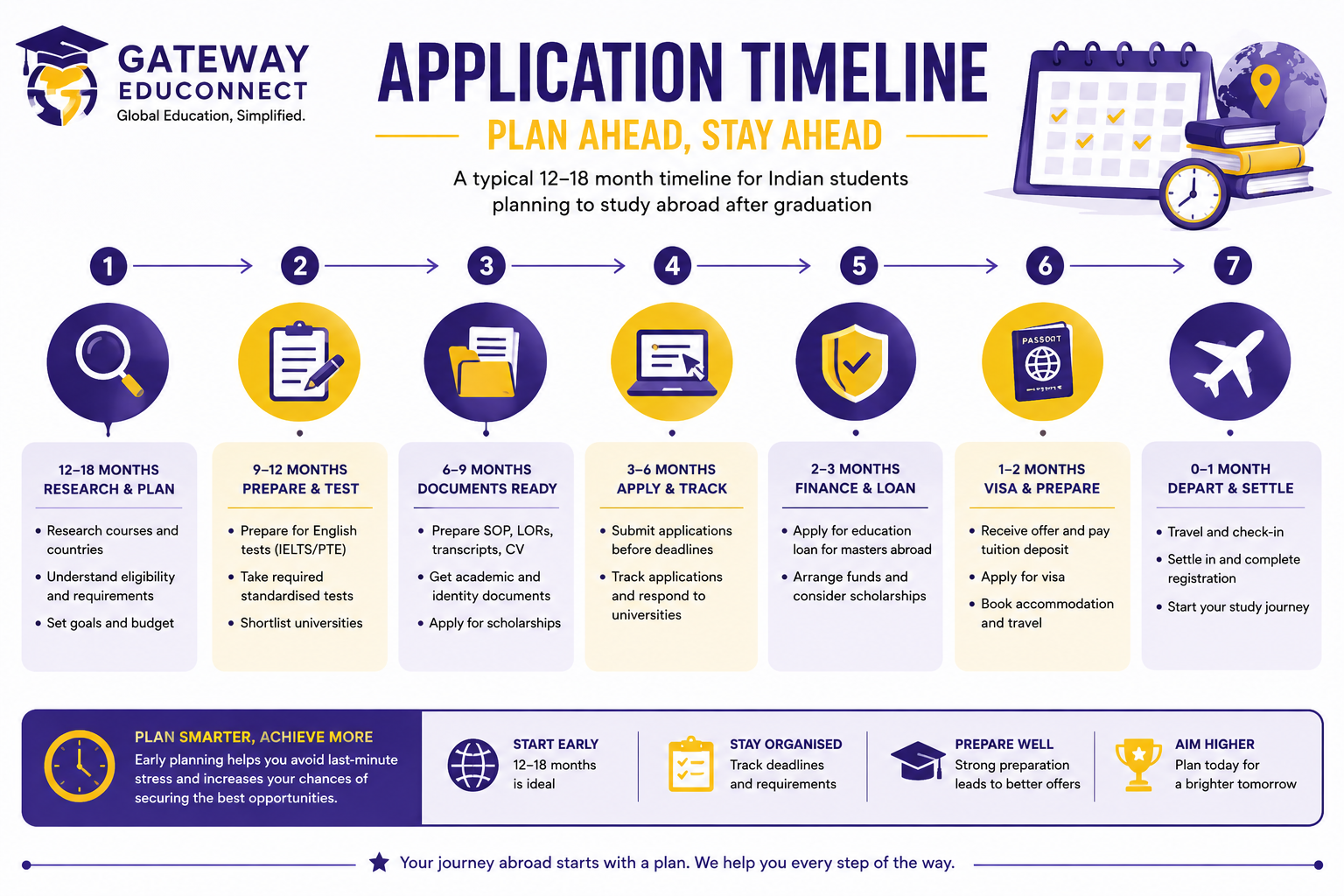
Application timeline for 2026-27
|
Period before intake |
Expected outcome |
Priority action |
|
15-12 months |
Initial shortlist and budget |
Define goal, research courses and plan tests. |
|
12-9 months |
Application-ready documents |
Take exams and finalise SOP, LORs and CV. |
|
9-6 months |
Decisions in progress |
Apply and scholarship applications. |
|
6-4 months |
Final university choice |
Compare rates and validate funding route. |
|
4-2 months |
Visa application submitted |
Make deposits and fulfil visa procedures. |
|
2-0 months |
Arrival plan complete |
Prepare departure, travel and book accommodation. |
The timescales are different to study abroad after graduation from India. More time will be required to process closed intakes, early award, portfolios, supervisor approval, test delays, loan processing and visa appointment.
Step 7: Plan the complete cost
The cost of study abroad after graduation from India is based on city, country, university, , lifestyle, course, duration, scholarship, insurance, accommodation, and exchange rate. Develop a comprehensive budget that includes rent, tuition, food, transport, utilities, visa, tests, health, flights, equipment, books, deposits, emergency fund, and initial set-up. Conversion of INR is for projections and is subject to change.
Budgeting Rule: Parents must compare overall financial commitments, not just tuition.
In several cases, interest rate, processing fee, collateral, co-applicant, margin money, moratorium, repayment period, expenses that are covered, disbursement and prepayment conditions are important terms to compare to find an education loan for masters abroad. Masters loan in foreign countries should also be evaluated against the budget of the entire course, and the ability to pay, rather than just the sanction amount.
Check out: Study Gap and Overseas Education 2026: How Much Gap is Acceptable & How to Explain It
Scholarships and Funding
One must plan his/her finances when study abroad after graduation from India. The usual mode of finance used by most students to fund their education is their personal savings, family support, master's abroad scholarships for Indian students, and an education loan to study abroad after graduation from India.
Scholarships
Before applying, check the following:
- Eligibility requirements (academic ability, economic necessity or alternate programme prerequisites)
- The need to apply separately to a scholarship.
- Dates to submit applications and any supporting papers or essays.
- Value of scholarship and the fees paid.
- Renewal of multi-year programmes.
Most master's scholarships in foreign countries are competitive, with awards to Indian students, and therefore, they need to be applied for early on with all the current information updated on the university or scholarship page.
Education Loan for Masters Abroad
Comparing, in the case of an abroad education loan (master's):
- Interest rates and other processing charges.
- Collateral requirements and co-applicant requirements.
- Moratorium and repayment period.
- Scholarship costs (tuition, housing, transportation, insurance, and so on)
- Timeline on loan processing up to tuition and visa dates.
Although you may be offered scholarships to master's in India, you need to have a realistic budget since the scholarship that could be offered to Indian students is usually a partial payment.
Guidance for Parents
After graduating in India, parents intending to study abroad after graduation from India ought to consider:
- Recognition of universities and courses.
- First year and total course cost.
- Conditions of the education loan for masters abroad.
- Scholarships for masters abroad for Indian students: A list of scholarships to pursue a master's in a foreign country.
- Accommodation, safety and health insurance.
- Conditions of Visa and money-back policy.
- Prospects and returns on investment in the long run.
Parent Tip: Before making a final judgment, there is a need to compare the overall financial outlay of the overall monetary investment and not only the tuition fee.
Check out: 3-Year Degree for Study Abroad: Countries Accepting Indian Students
Common Mistakes to Avoid
- Picking a country prior to course: there is no substitute for programme fit.
- Application without verification: lack of subjects, experience or portfolios will result in rejection.
- Late beginning of finances: Loans, deposit and preparation of proof of funds are time-consuming.
- Being generic everywhere: generic writing undermines the argument in favour of programme fit.
- Having no consideration of cost of living and required costs: tuition is not the only aspect of the budget.
- Basing on social-media assertions: look up regulations on formal sites.
- Late submission of scholarship applications: a number of competition applications do not have long deadlines.
- Application to very selective universities: develop an even shortlist.
- Selection only after completing one's studies: rules may vary and do not guarantee jobs.
- Neglect of professional acceptance: this can restrict the practice in controlled professions in the future.
Are you in Need of a Consultant?
Students are allowed to study abroad after graduation from India, upon successful completion of their course. Assistance can be offered in evaluation, shortlisting, documents, funding, visas, parent counselling and accommodation. Be cautious of promised admission, scholarship, loan/job or visa guarantees.
Gateway EduConnect is able to assist students and their parents through free video and home counselling, loan and accommodation support as well as test preparation support. Insert one of validated Gateway EduConnect students' examples prior to publication.
FAQs
Am I able to study abroad after graduation from India with a study gap?
Yes, most institutions take into account study gaps, yet it is important how the gap is explained and what the students do during the gap. Give correct evidence and programme-specific rules.
What percentage is needed?
Stake never has a common minimum. Depends on the programme, university, background in the subject and grading system; experience, portfolios or interviews are also sometimes considered.
Where are the most preferred countries to pursue a master's on graduation?
Curriculum, budget, length of time, recognition, language, immigration policies and personal agenda are all factors that determine the best countries for masters after graduation. Compare programmes preceding destinations.
What is the way to apply for a master's in foreign countries (India)?
Realising how to apply for masters abroad from India, shortlisting official course pages, checking the eligibility, preparation of tests and documents, application, comparison of offers, financing and finalising visa procedures.
Are scholarships available?
Indian students can take scholarships for masters abroad for Indian students, offered by various companies, but the eligibility, deadlines and the amount of the award vary. Get funds to work early and keep a feasible budget without expectation of success.
At what time do I need to take a loan?
Start an education loan for masters abroad after making a realistic shortlist and budget, but before you have to deposit large sums of money and apply for visas. Compare terms of lenders.
Are the parents interested in sponsoring the course?
Yes, often, as long as there is university and visa evidence. The source, availability and history of funds, as well as the relationship, can be required to be documented.
Am I able to apply without a consultant?
Yes. An adviser is not compulsory. Official university and immigration portals will be available to students, but they have to assess all the requirements and provide consistent evidence.
Conclusion
The particular steps to a successful plan to study abroad after graduation from India are well outlined: set the academic objective, search courses and countries, check their eligibility, prepare good documentation, evaluate the offers, find reasonable funding and take official visa procedures. Review changing fees, payment deadlines, proof-of-funds requirements and terms and conditions of work prior to making payments. Study abroad after graduation from India should be affordable and educationally pertinent in spite of policy changes or scholarship success. To have a personalised guide on eligibility and course options, indicative budgets, tests, documents and next steps in the application, DM MASTERS to course review and request the Master’s Abroad Planning Guide.
Get information on eligibility, course and country choices, estimated budget, necessary tests, documents and the next step to apply. For more assistance, please visit our study abroad consultancy services and explore our wide range of offerings for students interested in Study in Australia, Study Abroad in Poland, Study in Canada, Study abroad UK, Study in germany, Study in New Zealand, Study Abroad in Ireland, Study Abroad in the USA, Study in Finland, Study Abroad in Italy, and many other countries

Author Bio
Abhinav Jain - Founder, Gateway Educonnect and Director.
B.Tech, MBA, AI and Global Education Specialist.
More than 15 years of professional experience in leading students along international routes based on politics and innovation.