27 Nov 2026 | AI Voice Agents for Sub-Agent Networks: Scale Without Hiring

0
9
AI Voice for Education Agents: Scale Your Sub-Agent Network
A practical guide for master agents to centralise student enquiries, take ownership of referrals and increase their calling without proportionately increasing their staff.
AI voice for education agents will enable master agents to deal with increasing student load by automatically qualifying leads, automating follow-ups and structuring counsellor handoffs. As businesses recruit more partners for their telephone calls, they can assess the shared calling infrastructure that can handle routine calls, rather than adding more telecallers.
Expanding a sub-agent network is not just a matter of increasing calling capacity, however. Redundant enquiries, conflicting referrals, lacking qualification, and not communicating with one another can take a toll on the recruitment process.
Master agents can enhance coordination across their recruitment network by integrating artificial intelligence (AI), customer relationship management (CRM) and establishing clear operations. This guide will explain how AI calling contributes to network scalability and the potential costs and benefits of AI calling, as well as regulatory safeguards that businesses should consider before implementing AI calling.
AI voice for education agents Networks: At a Glance
|
Business challenge |
Potential solution |
|
Inconsistent qualification |
Standardised conversation workflows |
|
Increasing enquiry volumes |
Shared AI calling infrastructure |
|
Referral ownership disputes |
Partner-specific attribution |
|
Duplicate student enquiries |
Centralised record matching |
|
Increasing staff workload |
Hybrid AI and human operations |
|
Missed follow-ups |
Assigned responsibilities |
|
Limited performance visibility |
Partner-level reporting |
Why Growing Sub-Agent Networks Need Better Calling Infrastructure
Master agents get student enquiries from various recruitment partners, locations and marketing channels. The more the networks grow, the more difficult it gets to coordinate them.
Common challenges include:
- Contact by multiple partners to the same student.
- Counsellors repeatedly collecting identical information.
- Enquiries that, when appropriate, could not be answered.
- Students with varying qualifications.
- Vague referral and commission attribution.
- Lack of visibility at the partner level on the outcomes of recruitment.
Adding more staff could mean more calls, but will not necessarily solve these operational issues.
AI voice for education agents is an alternative where it can assist with standardised conversations via multiple education recruiters.
Ethical recruitment, student choice, professional governance and accountability are key features underlined in the British Council's Quality Framework for the UK Agent. The concepts are especially applicable to the agent network recruiting students to education providers in the United Kingdom.
Partner network automation should therefore make calling easier and make recruiting more accountable.
How AI Voice for Education Agents Works Across Sub-Agent Networks
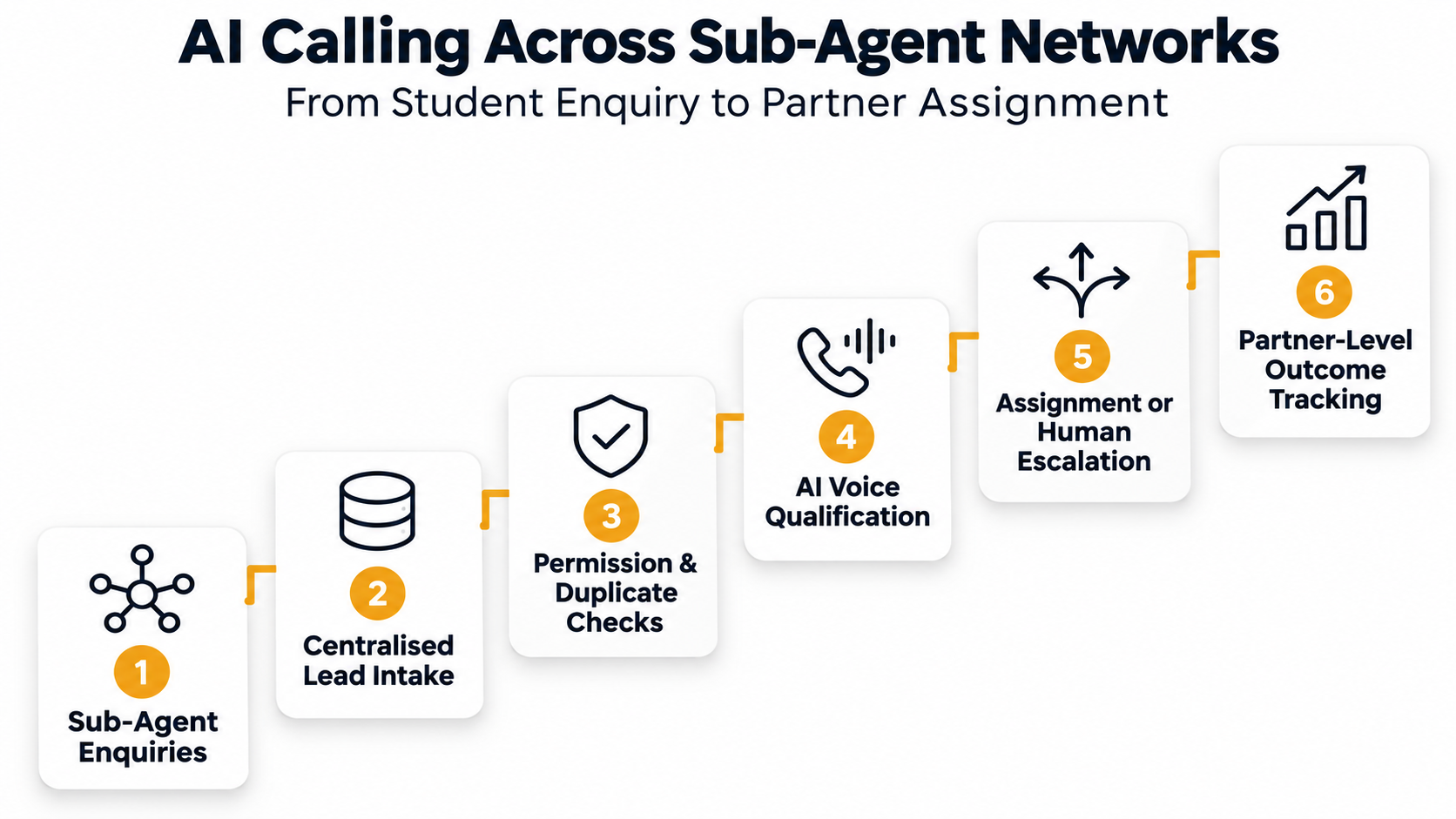
Enables all eligible student enquiries to be brought together within a coordinated operational workflow without losing the original referrals.
Sub-Agents A, B and C → Centralised lead intake → Permission and duplicate checks → AI voice qualification → Routine enquiry assignment or human escalation → Partner-level outcome tracking.
Centralise student enquiries
The first step is to develop uniform sub-agent lead handling procedures. All enquiries should have an originating partner, submission date, contact permissions and an owner assigned.
Automate routine qualification
AI voice for education agents can capture data on desired destinations, desired intakes, academic history and counselling needs using pre-approved conversation flows.
Assign qualified enquiries
Share outcomes of conversations with appropriate partners or counsellor via appropriate integrations. If a person has a complex eligibility question, this should set off the review process using human eyes.
Coordinate student follow-ups
Keep track of past interactions and planned interactions to minimise unnecessary interaction. Gateway EduConnect's Guide to Automated Student Follow-up Calls delves into the details of milestone-based communication.
Networks handling incoming enquiries outside business hours can also explore 24/7 AI enquiry lines for education consultants.
Improving Sub-Agent Lead Handling Without Losing Referral Ownership
AI Voice for education agents should complement rather than compete with the existing recruitment relationship with the partner.
Agreed processes for Duplicate Records, Attribution of Referrals, Commission Disputes, etc. are required for every network.
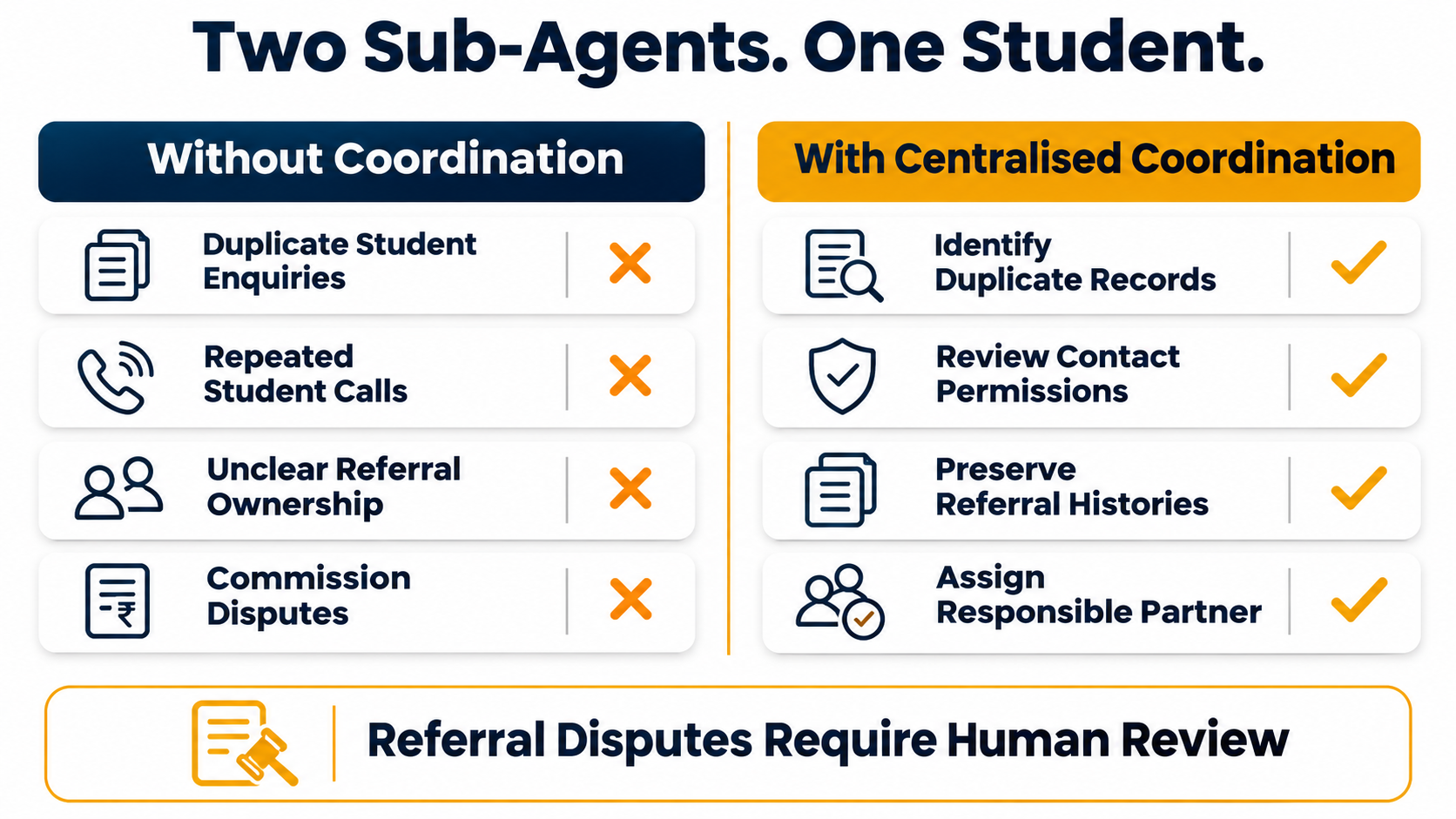
Example: Two Sub-Agents Submit the Same Student
Assume that Sub-Agent A registers a student who is looking to study in the UK at the post-graduation level. Sub-Agent B submits equivalent contact info the next day.
If there is no coordinating sub-agent lead handling, then both parties may call out on their own.
The centralised workflow should identify the possibility of a duplicate, retain both referral history records, review contact permissions and assign responsibility based on approved partner policies.
It is important for AI not to determine entitlement to commission or to replace the students' decision on whom to choose as their representative. Disputed referrals need to be resolved by human effort.
Choosing the Right Calling Model
|
Factor |
Hybrid model |
Centralised AI calling |
Decentralised calling |
|
Qualification standards |
Common standards |
Centrally defined |
Partner-dependent |
|
Calling responsibility |
Shared |
Master agent |
Individual partners |
|
Referral ownership |
Shared visibility |
Central attribution |
Locally managed |
|
Human counselling |
Partner or central specialists |
Assigned counsellors |
Local partners |
|
Duplicate checks |
Synchronised records |
Central record checks |
Partner coordination |
Hybrid partner network automation might be appropriate for companies that want to have a central way of operation but maintain local counselling connections.
What AI Should Handle and What Requires Human Counsellors
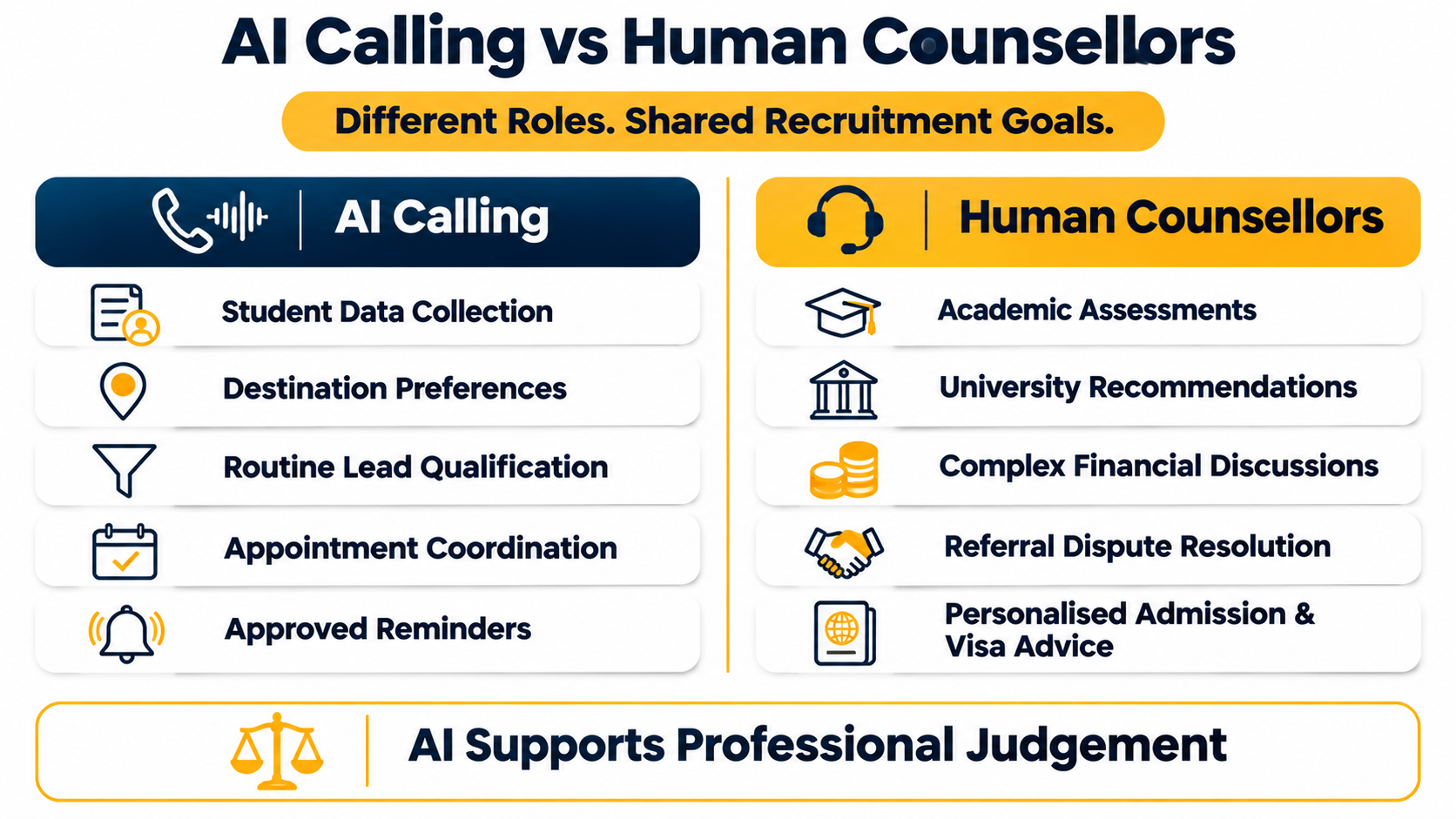
The use of AI voice for education agents works best for repetitive interactions that have specific goals.
Typical tasks might involve gathering student data, discovering destination choices, arranging appointments and providing approved notifications.
Academic assessments, university recommendations, complex financial discussions, and referral disputes and personalised admission or visa advice should be handled by human counsellors, and not replaced by artificial intelligence tools.
Communications with the family should also be sensitive and legal. Check out Gateway EduConnect's AI voice calling scripts for Indian study abroad families to get more specific guidance on engaging parents.
AI is meant to complement, not supplant, professional judgment.
Can AI Voice for Education Agents Reduce Additional Hiring?
The monetary worth of automation relies on calling volume, provider charges, effectiveness of the automation, and the obligations of the staff that will remain following automation.
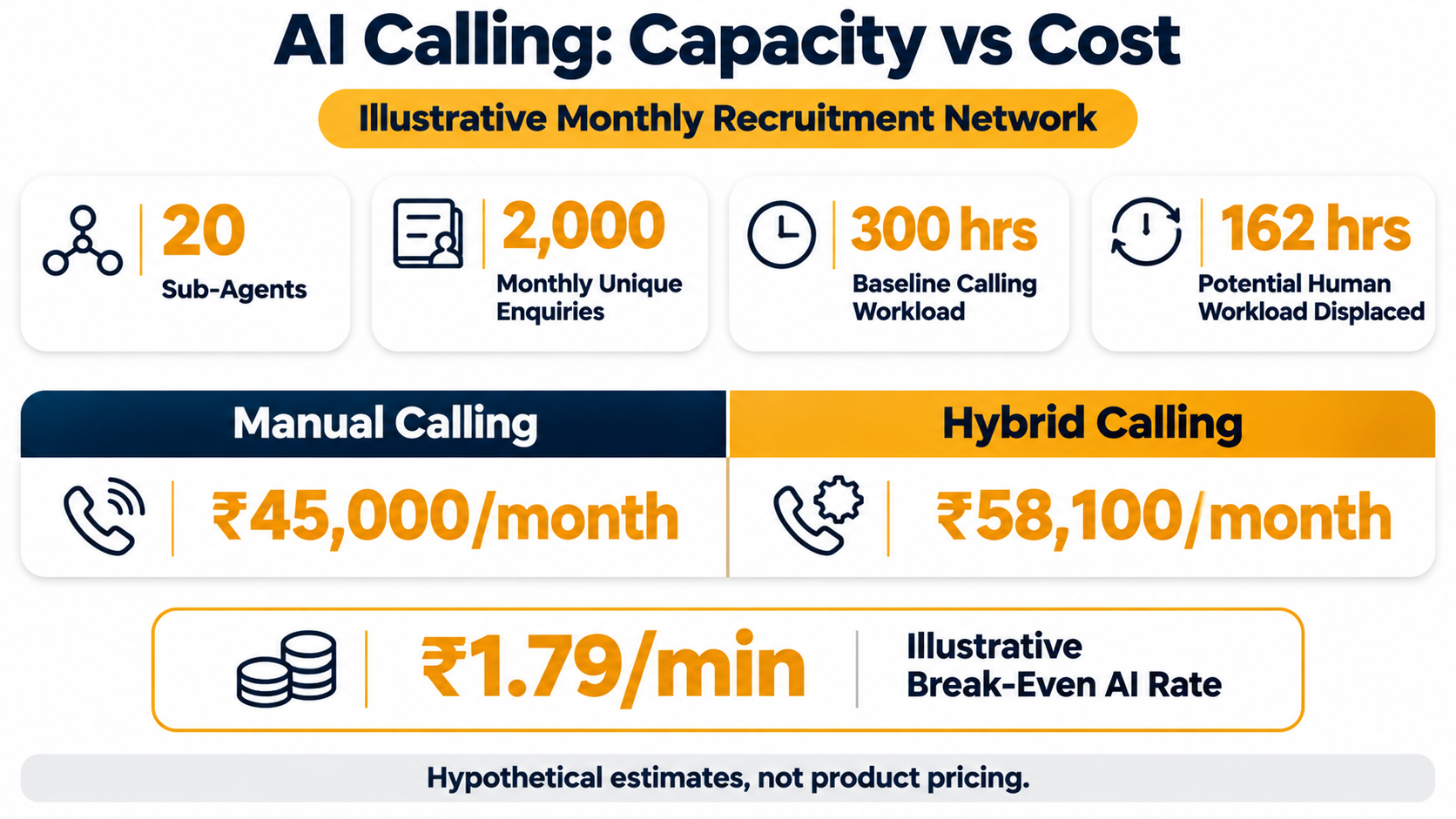
Assume a hypothetical recruitment network that has the following monthly workload.
|
Operating variable |
Illustrative assumption |
|
Unique enquiries per partner |
100 |
|
Sub-agents |
20 |
|
Connected calls per enquiry |
3 |
|
Total unique enquiries |
2,000 |
|
Average call duration |
3 minutes |
|
Total calling hours |
300 hours |
|
Total calling workload |
18,000 minutes |
|
AI-eligible workload |
60% |
|
Human workload potentially displaced |
162 hours |
|
Successful automation of eligible workload |
90% |
|
Remaining human workload |
138 hours |
AI Calling Cost Comparison
Suppose the consultancy has the following costs of running its business.
|
Cost component |
Manual model |
Hybrid model |
|
AI usage at ₹3/minute |
— |
₹32,400 |
|
Human calling at ₹150/hour |
₹45,000 |
₹20,700 |
|
Monthly operating cost |
₹45,000 |
₹58,100 |
|
Additional platform costs |
— |
₹5,000 |
Based on the above assumptions, the hybrid model would result in 162 hours of human calling usage and an extra cost of ₹13,100 per month.
Calculate Your AI Calling Break-Even Rate
The break-even rate determines the maximum amount an AI can be used for, where the potential hybrid model's costs are equal to the manual calling model's costs.
Break-even rate = (₹45,000 − ₹20,700 − ₹5,000) ÷ 10,800 = approximately ₹1.79 per minute.
|
Monthly operating cost comparison |
Estimated cost |
|
Manual calling |
₹45,000 |
|
Hybrid calling at ₹1.79/min |
₹45,032 |
|
Hybrid calling at ₹3/min |
₹58,100 |
Thus, the evaluation of AI voice for education agents should not just be based on advertised calling rates, but also on the number of calls made, the number of counselling outcomes achieved and the cost of a qualified enquiry.
These are estimates and are not Gateway EduConnect pricing. Real calculations should reflect the following: taxes, failed attempts, integration costs, supervision and telephony costs. Another factor that determines payroll savings is whether the human labour can be eliminated or repurposed.
How to Implement AI Voice for Education Agents Across Your Network
Start using recruitment partners and not entire network automation of communication.
With a controlled pilot, companies can find the shortcomings of sub-agents' lead handling before expanding their calling efforts.
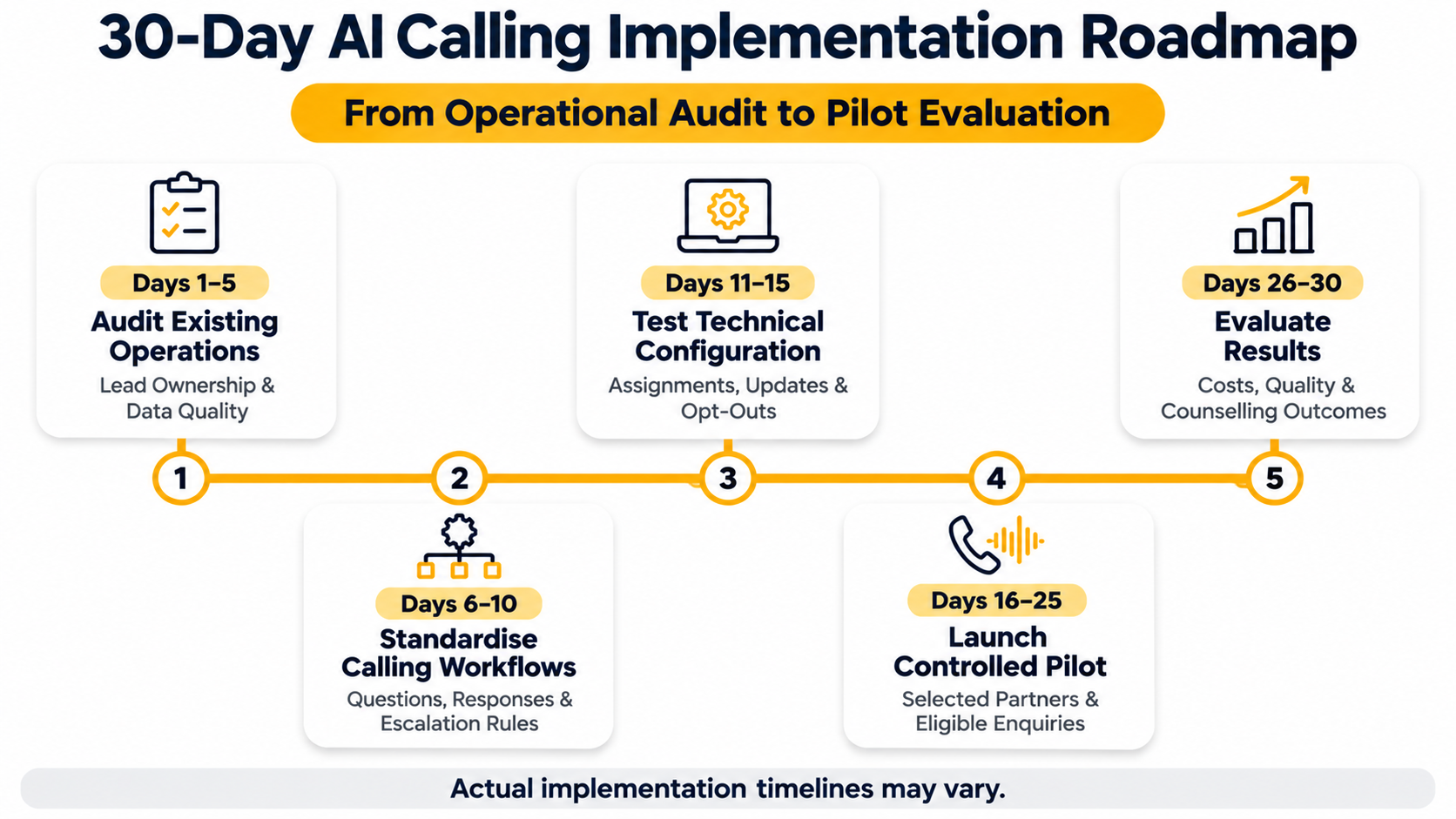
30-Day Implementation Framework
|
Period |
Activity and action |
|
Days 1–5 |
Audit what is already in place: Ensure that lead ownership, data quality, duplicate records and contact permissions are all in order. |
|
Days 6–10 |
Normalise calling processes: Identify qualification questions, approved answers, and escalation rules. |
|
Days 11–15 |
Test technical configuration: Validate outcome updates, failed calls, partner assignment and opt-outs. |
|
Days 16–25 |
Introduce a limited pilot: Pilot approved workflow with selected partner(s) and eligible enquiries. |
|
Days 26–30 |
Compare results of days 26–30: costs, quality of qualification, complaints and counselling outcomes. |
Suggested implementation roadmap. The actual deployment dates will be determined by operability and technical readiness.
Partner network automation expansion should be based on and supported by the pilot's successful qualification accuracy results, effective handoffs, and effective student communication.
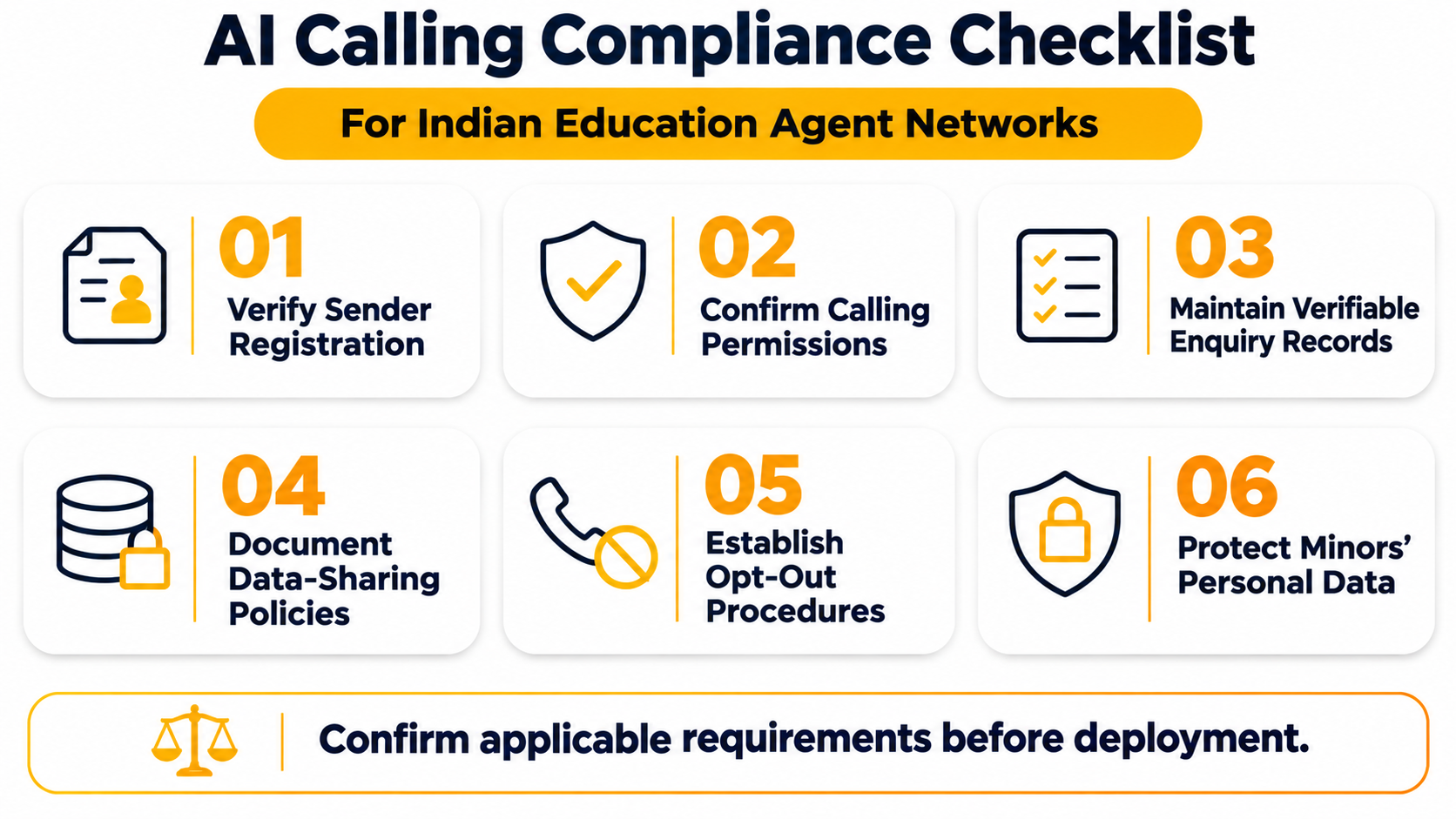
AI Voice for Education Agents: Compliance Requirements in India
Automated calling must be in compliance with relevant telecommunications and data protection regulations.
TRAI Sender Registration and Automated Calling
Sender Guidance of the Telecom Regulatory Authority of India (TRAI) clarifies the guidelines for registration and commercial communications.
The Second Amendment in February 2025 was a new addition that added advance notification requirements for automated dialers and robocalls.
The Third Amendment announcement in September 2026 included further Application-to-Person (A2P) calling rules on automated and artificial voice technologies.
The Seven-Day Enquiry Provision
The September 2026 amendment introduces 7-day time limits for a limited class of commercial communications that are sent in response to a written or digital enquiry, with a requirement for verifiable written or digital enquiry records.
This does not grant permission for all sub-agent/master agents to reach the same student.
To determine the sender relationship, the purpose of the communication and the calling permissions, businesses need to set them up. They must also check the commencement date of the provisions in the official consolidated regulations and amendment notification issued by the TRAI.
A2P Calling Charges
In the November 2026 Fourth Amendment, TRAI has extended the effective dates of Regulation 35A on A2P termination charges to a different date, which is to be notified separately. These charges are not necessarily applicable to all AI calls.
Student Data Protection
The Digital Personal Data Protection Rules, 2025, have commenced in phases, with the key substantive provisions coming into effect from May 2027. The phased implementation of the Act is provided in the separate commencement notification for the DPDP Act.
Prior to implementing AI voice for education agents, it is crucial for master agents to document data-sharing policies, limit access to records, establish opt-out protocols, and implement appropriate age-specific protections.
Buying AI software does not meet regulatory compliance in itself. Get legal and telecommunication advice prior to deployment.
KPIs Every Master Agent Should Track
Evaluation of AI voice for education agents should be based on the actual end results of businesses, not volume of dialing.
|
KPI |
Measurement |
|
Contact rate |
Unique leads reached ÷ unique leads attempted × 100 |
|
First response time |
First attempt time minus enquiry receipt time |
|
Booking rate |
Qualified leads with bookings ÷ qualified leads × 100 |
|
Qualification rate |
Qualified leads ÷ contacted leads × 100 |
|
Attendance rate |
Attended appointments ÷ booked appointments × 100 |
|
Handoff completion rate |
Completed handoffs ÷ requested handoffs × 100 |
|
Duplicate outreach rate |
Leads receiving unintended duplicate outreach ÷ contacted leads × 100 |
|
Cost per qualified enquiry |
Total relevant operating costs ÷ qualified enquiries |
View results by originating partner and intake. Ensure that the same standards are used to judge performance.
How Gateway EduConnect Supports Recruitment Partner Networks
Gateway EduConnect is an education recruitment partner programme that offers application support, application progress tracking via GuaranteeAdmit and recruitment opportunities.
Recruitment businesses need to assess the functionality of calling technology to understand how it can integrate with their current processes when considering AI voice for education agents.
A demonstration should be based around realistic requirements such as handling duplicate enquiries, assigning partners, qualification results and counselling escalation, not just a simple automated conversation.
FAQs
So what does AI voice for education agents mean?
It leverages conversational AI to handle specific student inquiries, gather qualification data, arrange approved follow-up actions and determine conversations that require humans.
Are there multiple sub-agents that can be connected to a single AI calling application?
Yes, if there are sufficient integrations, partner responsibilities, calling permission and controlled data access.
Will AI calling be able to solve duplicate referral issues?
It can help with duplicate identification with reliable records. Proper policies and manual review must be approved to handle referral ownership and commission disputes.
Is it always inexpensive to use AI calling services rather than telecallers?
No, financial feasibility relies on billable minutes, automation success, supplier charges and human labour. Before buying, businesses should work out the break-even rate.
What occurs when AI fails to respond to a student's query?
The workflow should hand off or route the enquiry to a proper human counsellor, including the context of the conversation.
Conclusion: Building the Future of Smarter Education Recruitment
The future of study-abroad recruitment belongs to consultancies that combine technology, operational efficiency and human expertise. AI voice for education agents offers master agents an opportunity to expand calling capacity, strengthen sub-agent coordination and improve student engagement without proportionately increasing their calling teams.
At Gateway EduConnect, we believe technology and meaningful partnerships are the driving forces behind the next generation of global education recruitment. Our commitment is to empower education consultants with the right connections, opportunities and technology-driven solutions to build scalable, efficient and accountable recruitment networks.
Don't just follow the future of education recruitment. Be part of shaping it.
Gateway EduConnect – Connect. Empower. Grow.
Let's build a smarter, stronger and more connected global education ecosystem together.
Connect with Gateway EduConnect to explore AI calling solutions and request a demonstration for your recruitment partner network.
Author Bio
Abhinav Jain - Founder, Gateway Educonnect and Director.
B.Tech, MBA, AI and Global Education Specialist.
More than 15 years of professional experience in leading students along international routes based on politics and innovation.