28 Apr 2026 | Change Course or University Abroad: Rules for International Students Explained

0
96
Introduction: Rules for Students Explained
Going international to study is a life changing option, however, what will one do when he or she discovers that he or she has taken the wrong path or university? International students and parents tend to be worried about this. The positive aspect is that there exists study abroad flexibility, but with certain regulations. One should know the change course abroad rules to prevent visa problems, academic failures, or even monetary waste.
This guide has all the information you will need to change courses or move universities overseas, including visa requirements, costs, and timeframes. This blog will make you make a wise decision whether you have decided to change your course abroad or you are transferring university abroad.
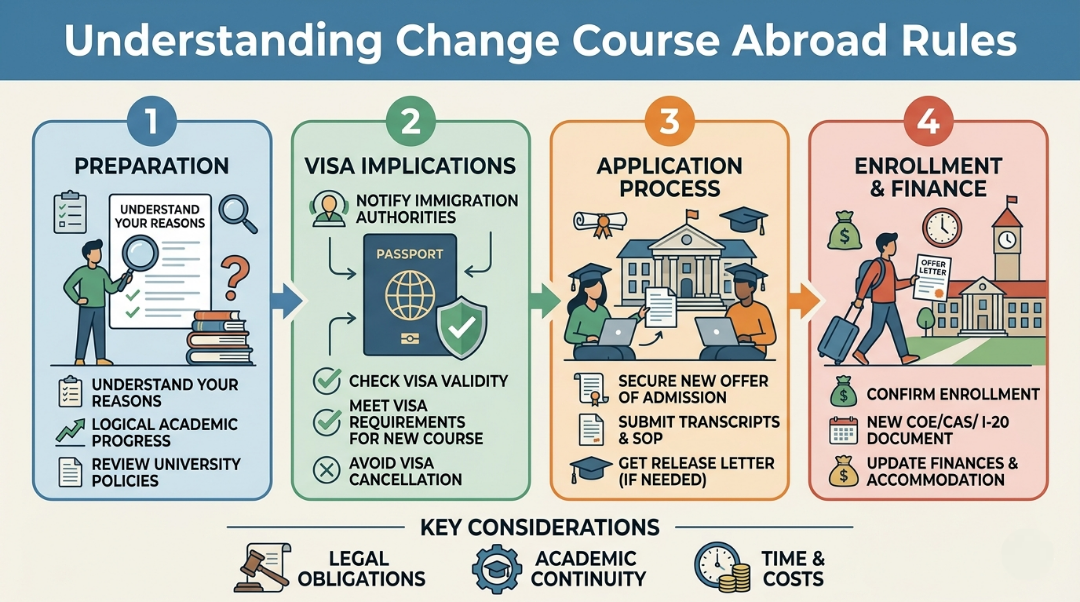
Understanding Change Course Abroad Rules
One should also know before deciding whether or not to change course abroad rules regarding changing courses differ in different countries, universities, and types of visa.
International students are given permission by most countries to change their course/ institution only in some circumstances:
- Students have to be in good enrollment status in the process so that their visa can be kept active and valid.
- The essence of the new course must meet the visa requirement and show reasonable academic progress in your career field.
- In most instances, immigration authorities have to be notified so that you do not face any hassle with your legal responsibility.
To avoid a visa cancellation or problems with immigration in the future, it is important to pay attention to the change course abroad rules.
When Can You Change Your Course Abroad?
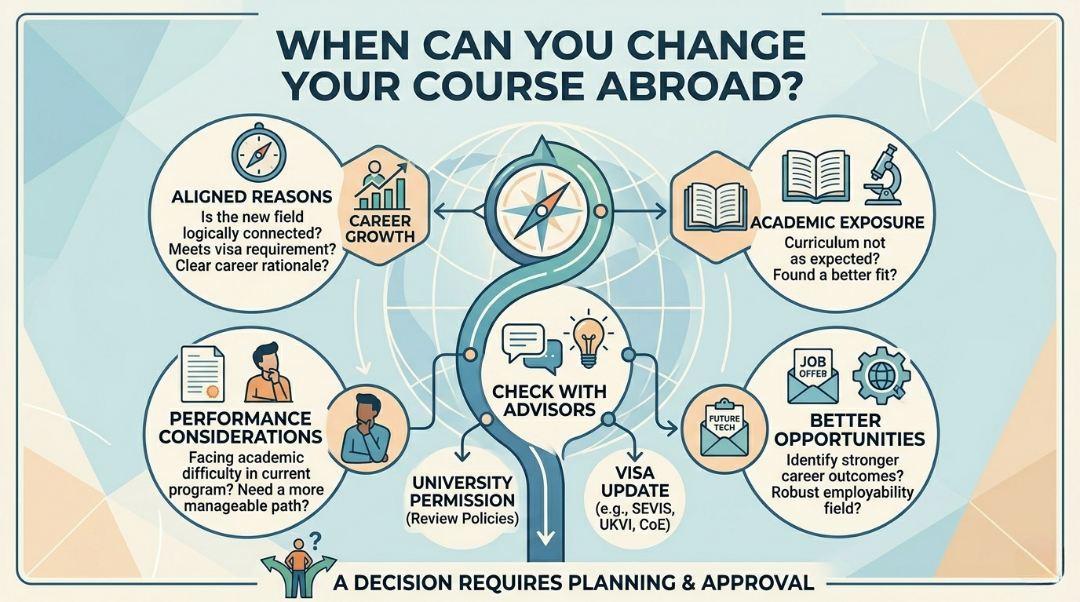
Motives for shifting courses abroad are common.
The following situations allow students to think of a course change abroad:
- After being exposed to the realities of the curriculum and industry opportunities, students understand that the course they had selected does not fit their career objectives.
- It is also not easy because it is due to academic difficulty, so it becomes hard to continue in the current program, and of course, not in an unfamiliar subject.
- It opens and elevates better opportunities in a different field or specialisation that has more robust career outcomes or employability.
- Higher education advocates the idea of performance-based transfer, assisting pupils to transfer into a more effective academic path.
But, overall, most countries anticipate a logical academic development. As an instance, the change of engineering to a business may be accommodated, whereas the completely unrelated change may raise concerns per the change course abroad rules.
Country-Wise Overview of Student Visa Changes
It is essential to comprehend student visa modifications in case of changing courses or a university.
|
Country |
Course Change Policy |
University Transfer Policy |
Visa Update Requirement |
|
Approved with course requirements and university permission. |
The transfer is possible under the condition of admission and adherence to UKVI regulations. |
A new CAS is necessary, and a visa renewal might be needed. |
|
|
A change of course can be made under the permission of the university, and a sound academic cause is required. |
Students may transfer once they have been admitted and upon transfer to SEVIS. |
SEVIS will need to be renewed, and a new I-20 will be needed. |
|
|
Conditional permission was permitted in the early years of research. |
transfer is used in the fulfilment of the release of the provider. |
A new CoE is needed, and the visa should be renewed. |
|
|
Canada |
Permission is provided, provided the student remains in a specified learning institution (DLI). |
It is freely transferred between familiar DLIs. |
IRCC has to be informed of new institutional details. |
|
Germany |
Granted under scholarly legitimate reasons. |
Transfers are limited but dependent on the correspondence of courses. |
It should be duly informed by the immigration office. |
There are strict rules for change course abroad rules, particularly with visa updates.
Can You Transfer to a University Abroad?
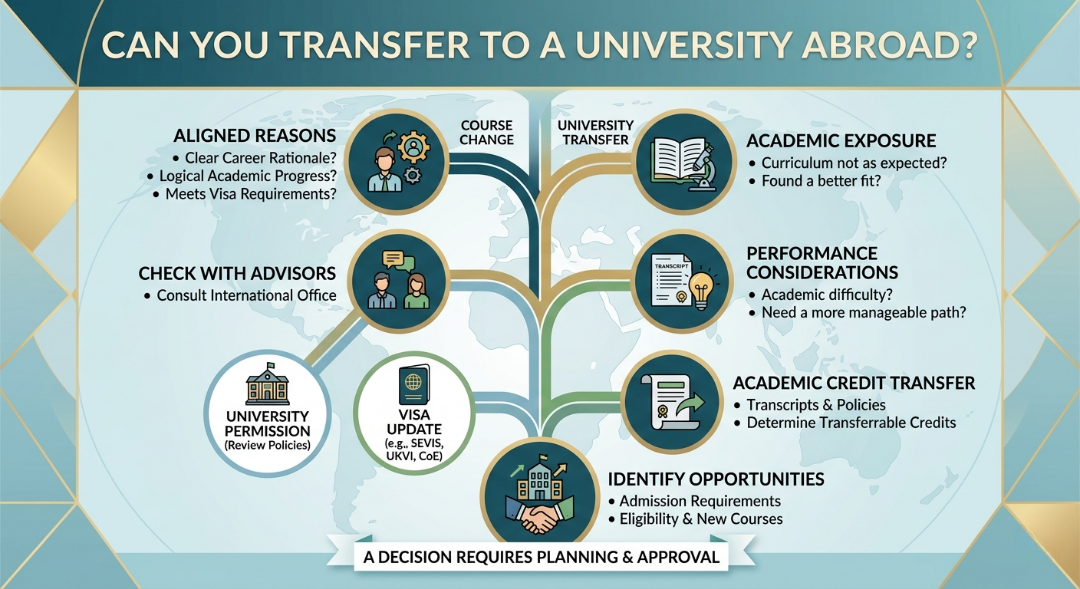
Yes, there are opportunities to transfer to a university in foreign countries, but this matter is based on academic credit, the university's policy, and visa terms.
Important University Transfer Factors
- The new university has a set of admission requirements, such as academic grades, language skills, and eligibility requirements, and they must fit the requirements to be welcomed by the institution.
- Academic transcripts and credit transfer requirements are considered to ascertain the number of credits that have been previously taken that could be transferred.
- Learners should report to immigration officials when necessary to have their visa status modified to reflect the new learning institution.
The problem of transferring to a university in foreign countries is also less problematic with such countries of the world as the USA and Canada, where credit systems can be easily adjusted.
How Student Visa Changes Work
On change course abroad rules or transferring to a foreign university, your visa might require revision.
Important Visa Considerations
- To maintain their status as legal immigrants in the host country, students are forced to report academic changes to immigration officer.
- New Confirmation of Enrollment (CoE/CAS/I-20) can be mandated, and it depends on the country and institution.
- Certain nations have done away with a new visa, particularly when the change is in terms of a different level of education or institution.
Lack of adherence to student visa alteration processes may have grave implications such as a denial of the visa in future.
Step-by-Step Process to Change Course or University Abroad
To change course abroad rules, you need to plan extensively and follow change course abroad regulations.
Step 1: Reason evaluation
Begin by clearly seeing the reason as to why you desire the change. Make sure that your choice should be academically worthwhile and that it must be aligned to your long term career objective both to the universities and the visa authorities.
Step 2: Check with Your University.
See your academic advisor or international student office to become familiar with internal policies. In the Guidance option, many universities provide advice or even an internal course change abroad option.
Step 3: Study and Implement New Choices.
Find out about appropriate courses or institutions which fit your profile. Submit with relevant documents, including transcripts, SOP and English proficiency scores where necessary.
Step 4: Learn Visa Implication.
Thoroughly consider the effects of the change on your visa. Each country has unique student visa regulations, which one has to abide by in order to be in a legal state.
Step 5: Report to Immigration Authorities.
Also, renew your visa by notifying the immigration agency. This will be an important move toward remaining abreast with changes in the course of foreign regulations.
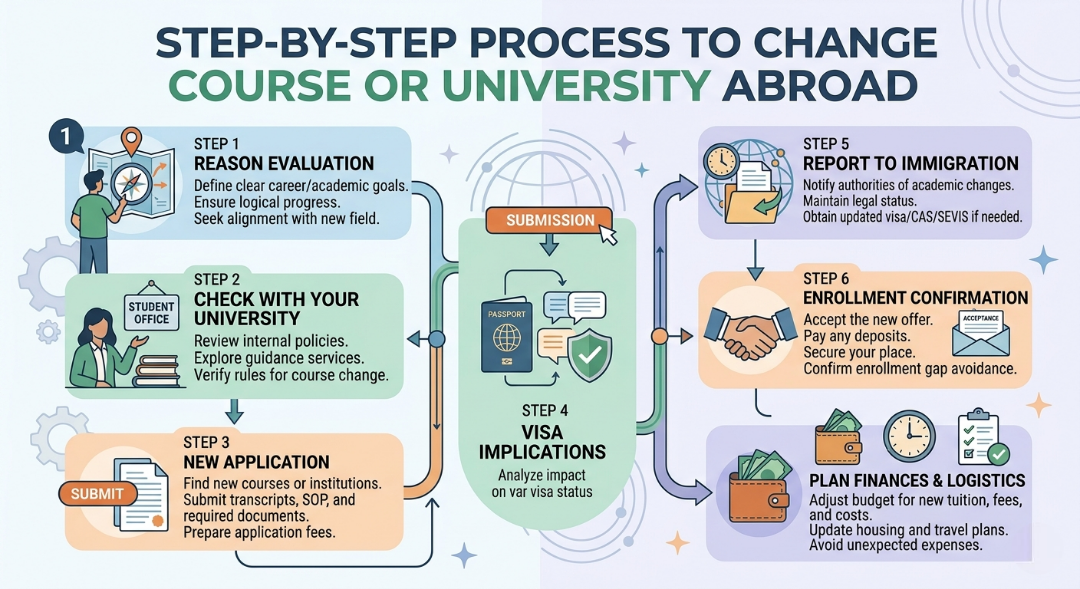
Step 6: Admission and Enrolment confirmation.
Upon acceptance, book your place and go through all the formalities with the new university so that there will not be a gap in enrollment.
Step 7: Spin Financial and Accommodation Plans.
Audit tuition fees, living and accommodation to prevent a big transition without causing a financial strain that may arise unexpectedly.
Expenses to Switch Courses or University.
Typical Costs Include
- Depending on the institution and nation, the application cost of the new university can be between ₹5,000 and ₹15,000.
- Determining visa processing fees can be recurring, particularly when a new visa application is needed, based on the country where the procedure is taking place.
- Differences among tuition fees of courses should also be taken into consideration, whereby some programs will be costlier in comparison to others.
- The accommodation change can bring about relocation costs such as deposits and transportation costs.
The issues of flexibility to study abroad should not become an economic strain with proper planning.
Student/Parent Practical Advice.
In order to make the most out of studying abroad, remember about the following tips:
- It is important to always enquire about the change course abroad rules, better to prevent complications that may not be necessary in the process.
- Select courses that are logically sequenced in an academic way to stand a good chance of the application and visa being good and viable.
- Use all the documents to best your status and take care of changes in your student visa without uncertainties and rejection.
- You should not keep changing, as this can influence your immigration history and subsequent visa claims.
Consult a professional to be guided in order to avoid errors or mistakes that may affect your study abroad experience.
Real Example: A Smart Course Change Abroad
One of the Indian students posted in Canada, pursuing Mechanical Engineering, developed a passion for Data Analytics. The student was able to switch programs in the same university after seeking the advice of consultants and learning about the change course abroad rules.
It was easy to transition due to:
- Student did not experience enrollment voids and continued with academics.
- The new course was in line with the future career aspirations and industry needs.
- The appropriate alterations of student visas were made according to the Canadian immigration regulations.
This brings out the flexibility of study abroad as having the potential to work out favourably when done properly.
Why Expert Guidance Matters
It may be a complicated process to navigate through the change course abroad rules and changes in student visas, particularly among first-time international students.
Gateway Educonnect has worked with 23000+ students in countries such as the USA, the UK, Canada, Australia, Germany, France and Dubai. Having experience of 15+ years, we offer:
- One-on-one counselling to change course abroad rules based on the academic background, interests and long-term career objectives of the particular student.
- University relocation, end-to-end service together with documentation, applications and admission services.
- Full visa and paperwork assistance to coordinate all changes to the student visa in a proper and full-fledged way, without breaking immigration policies.
- Full after-sales services such as education loans, housing aid and test preparation to make their study abroad hassle-free.
- That is why our special platform enables students to apply and get an offer letter within 24 hours .
FAQs: Change Course Abroad Rules
Is it possible, that international students can change course abroad rules?
Yes, they have to abide by change course abroad rules and report to immigration to retain their visa.
Can it be transferred to university in the first year abroad?
Yes, there are a lot of countries where students may have the opportunity to transfer university to other countries, particularly, it is possible to do that in case of academic requirements and credits transfers.
In terms of my visa: Will doing so make a difference in changing my course?
Yes, the changes in student visas could be necessary according to country and a kind of change of courses.
How many times will I have a change course abroad rules?
No set limit, however, a lot of changing and moving can hurt your visa and credibility laws under change course abroad.
What countries are the most flexible in study abroad?
The USA has more flexibility in education than other countries, which explains why it has a higher study abroad flexibility.

Conclusion
It is not impossible to change your course or university in the foreign country but only having a clear idea about change course abroad rules and planning is necessary. There is an increased flexibility in the use of study abroad, but students should ensure that all measures, including decision-making regarding academics and altering student visa requirements, are taken seriously to minimize risks. The career outcomes and satisfaction at large can be enhanced by the planning of the course change abroad or decision to transfer university abroad. Through appropriate guidance, students will be able to make Smart decisions without derailing their international education process. Seeking professional opinion might streamline the whole process, making it safer and smoother in accordance to both students and parents. For more assistance, please visit our study abroad consultancy services and explore our wide range of offerings for students interested in studying in the USA, studying in the UK, studying in Australia, studying in Ireland, and many other countries.
Author Bio
Abhinav Jain - Founder, Gateway Educonnect and Director.
B.Tech, MBA, AI and Global Education Specialist.
More than 15 years of professional experience in leading students along international routes based on politics and innovation.