26 Nov 2026 | AI Calls for Education Fair and Seminar Leads in India

0
6
Education Fair Lead Follow-Up with AI Calling | Gateway EduConnect
Discover how Indian study-abroad consultancies can automate post-event student enquiries, qualify prospects and generate meaningful counselling opportunities through AI calling.
Education fair lead follow-up can be streamlined through artificial intelligence (AI) calling, enabling study-abroad consultancies to contact eligible student enquiries, understand their study preferences and coordinate counselling appointments without manually calling every prospect.
Education fairs, university seminars and spot admission events require significant investment in marketing, venue arrangements and staff resources. However, collecting hundreds of contact details does not guarantee applications or enrolments.
The real challenge begins after the event. Counsellors must identify interested students, manage callbacks and prioritise enquiries while continuing their existing admissions responsibilities.
A structured education fair lead follow-up strategy combining AI calling, organised lead records and human counselling can help consultancies manage concentrated enquiry volumes and evaluate their event investments more effectively.
Why Education Fair Lead Follow-Up Matters for Indian Consultancies
Education fairs have the ability to attract good volumes of potential student visits in a limited amount of time.
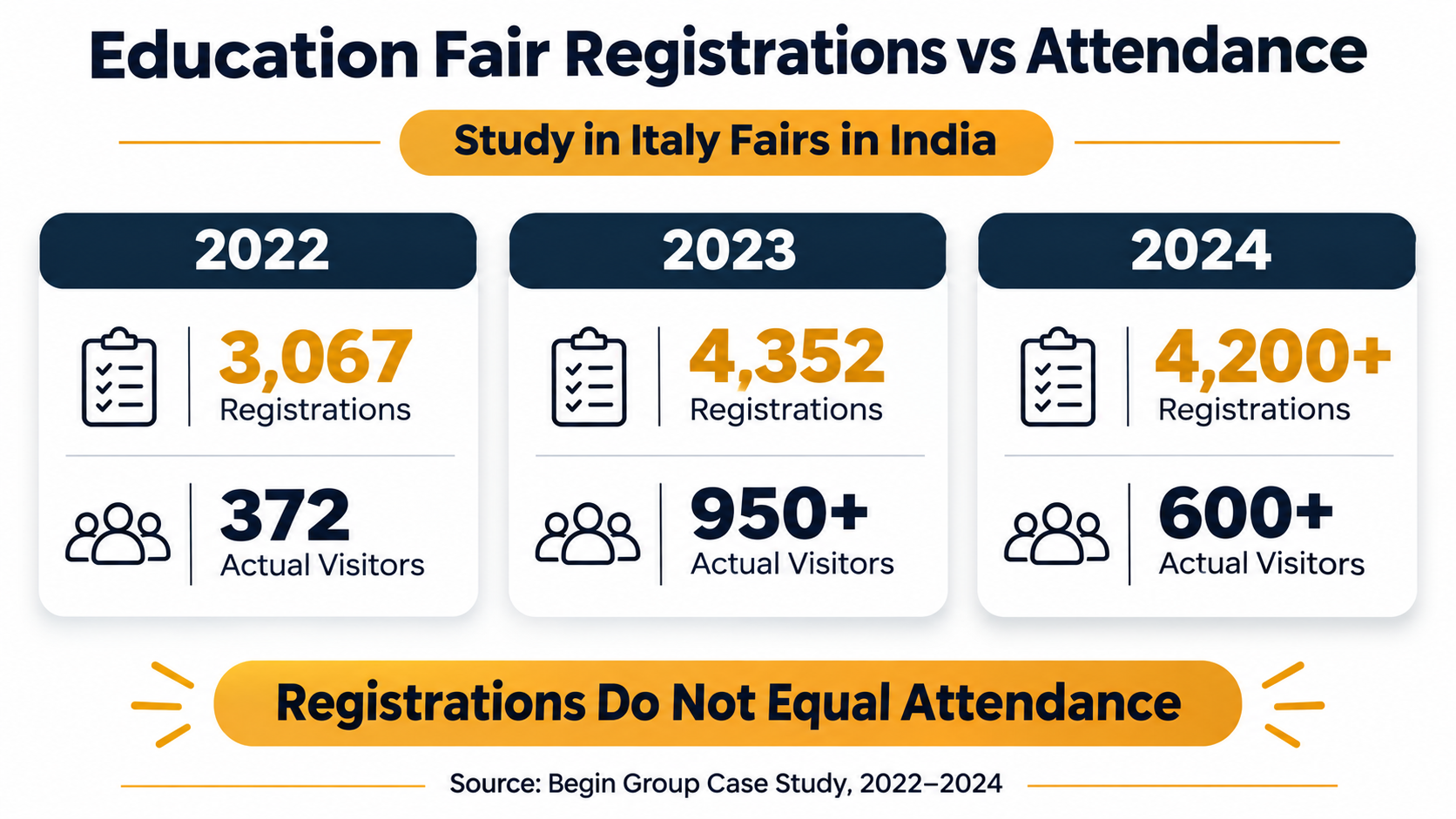
According to a Begin Group case study on Study in Italy fairs that were held in India, the registration and attendance were recorded as follows:
|
Year |
Registrations |
Actual visitors |
|
2022 |
3,067 |
372 |
|
2023 |
4,352 |
950+ |
|
2024 |
4,200+ |
600+ |
Such organiser-reported data help to show the difference between event registrations and attendance. Exhibitors were also provided with prospective student lists to be followed up with in the future.
Not all attendees, however, are willing to apply.
The UCAS advice on maintaining contact following careers fairs focuses on one-on-one meetings, action planning and assisting the student in determining what action to take next.
Indian consultancy post-event issues are common, namely:
- Large volumes of disorganised student enquiries.
- Redundant contacts and calls.
- Late follow-up caused by the unavailability of more staff.
- Challenges in finding admission-ready prospects.
- Lack of information on preferences regarding studies.
- Little transparency of event-created conversions.
The lead follow-up process of an effective education fair should thus place an emphasis on student intent and recruitment results over the volume of calls.
Education Fair vs Seminar vs Spot Admission Event Leads
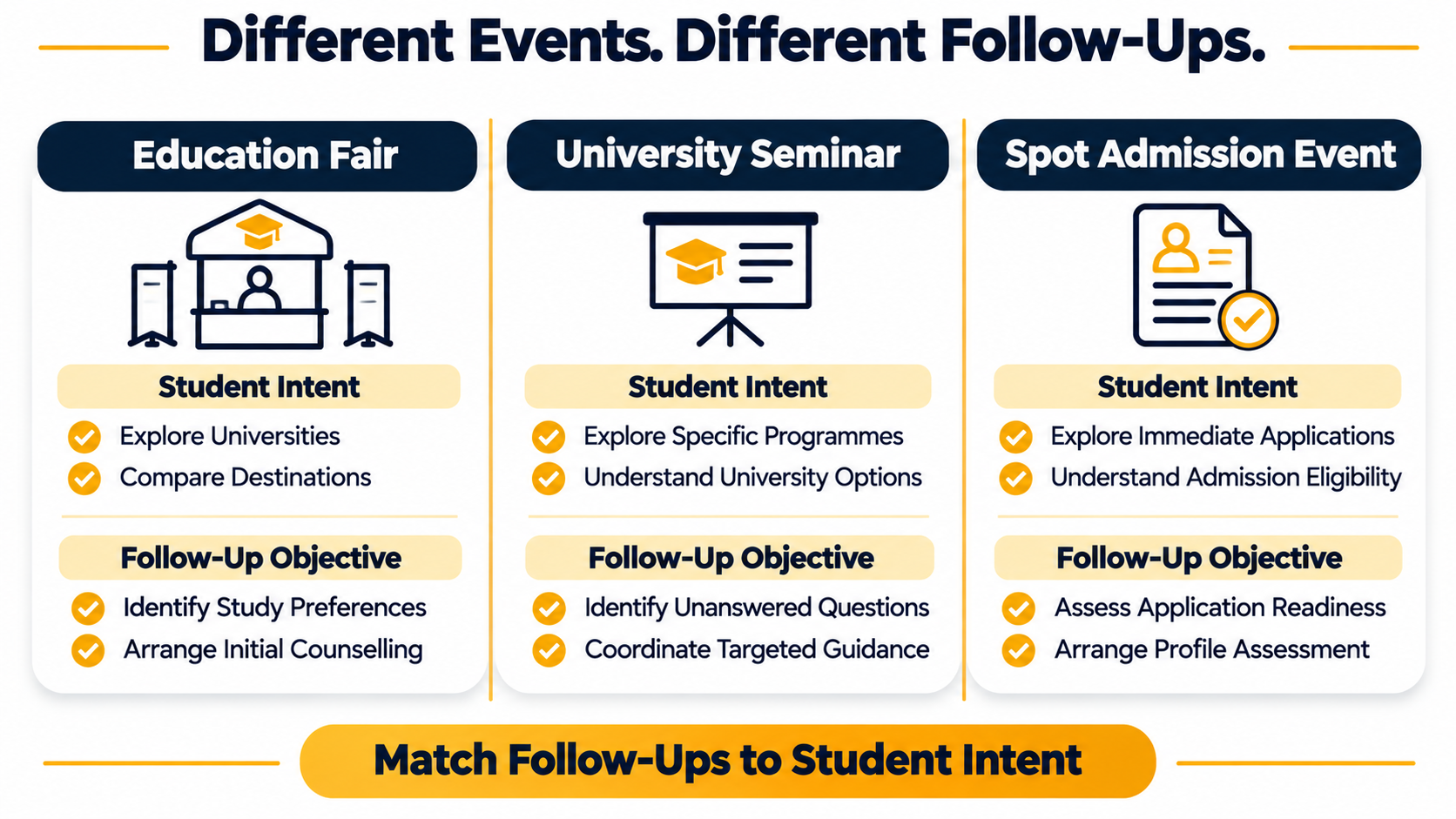
Various education events need different follow-up strategies. A high school student who has visited multiple colleges will likely have different needs compared to a student who is attending a college-specific visitation meeting.
|
Event type |
Recommended calling objective |
Potential student intent |
|
University seminar |
Identify unanswered questions |
Interested in a specific institution or programme |
|
Education fair |
Identify preferences and arrange counselling |
Exploring universities and destinations |
|
Spot admission event |
Arrange academic profile assessment |
Exploring immediate application opportunities |
|
Parent information session |
Coordinate family counselling |
Understanding costs, safety and career prospects |
|
Scholarship seminar |
Identify funding guidance requirements |
Seeking financial assistance |
These categories are recommended baselines, not presuppositions regarding all the attendees.
Appropriate calling of seminar leaders ought to mirror the topic of the event, whereas follow-up for spot admission events ought to identify whether a student is ready to apply and trigger a connection between the student and qualified admission practitioners.
How AI Calling Supports Education Fair Lead Follow-Up?
The automation campaign cannot work well without being based on hanging up the contact numbers in an automated calling platform. Consultancies require workflow coordination among data preparation, qualification and the process of counsellor allocation.
1. Centralise and validate event enquiries
Store all data gathered using registration forms, QR codes and university enquiry desks into a central database.
Important fields include:
- Name of the event and date of enquiry.
- Student contact details.
- Favourite route and pathway.
- Content to be consumed and level.
- Communication permission records.
- Lead and assigned counsellor.
Eliminate duplications and mark contacts whose eligibility is uncertain in terms of communications.
2. Segment students according to their interests
Distinct queries about high-priority, exploratory, unexplored and permission-unverified types.
Emergency counselling should be given priority to students who request it urgently. Unauthorised contacts who have not accepted adequate communication permissions should not be included in automated campaigns until their eligibility is identified.
Segmentation helps to make education fair lead follow-up more relevant to the requirements of individual students.
3. Launch structured AI calling campaigns
The properly designed AI voice agent can determine how interested the students are in studying abroad, their desired intake and the support they need.
According to the Sicada Voice API documentation, technical features such as outbound campaign management, scheduled outbound calls, campaign transcripts, and campaign reports can be performed.
Availability in a particular consultancy package should be established first before it can be implemented.
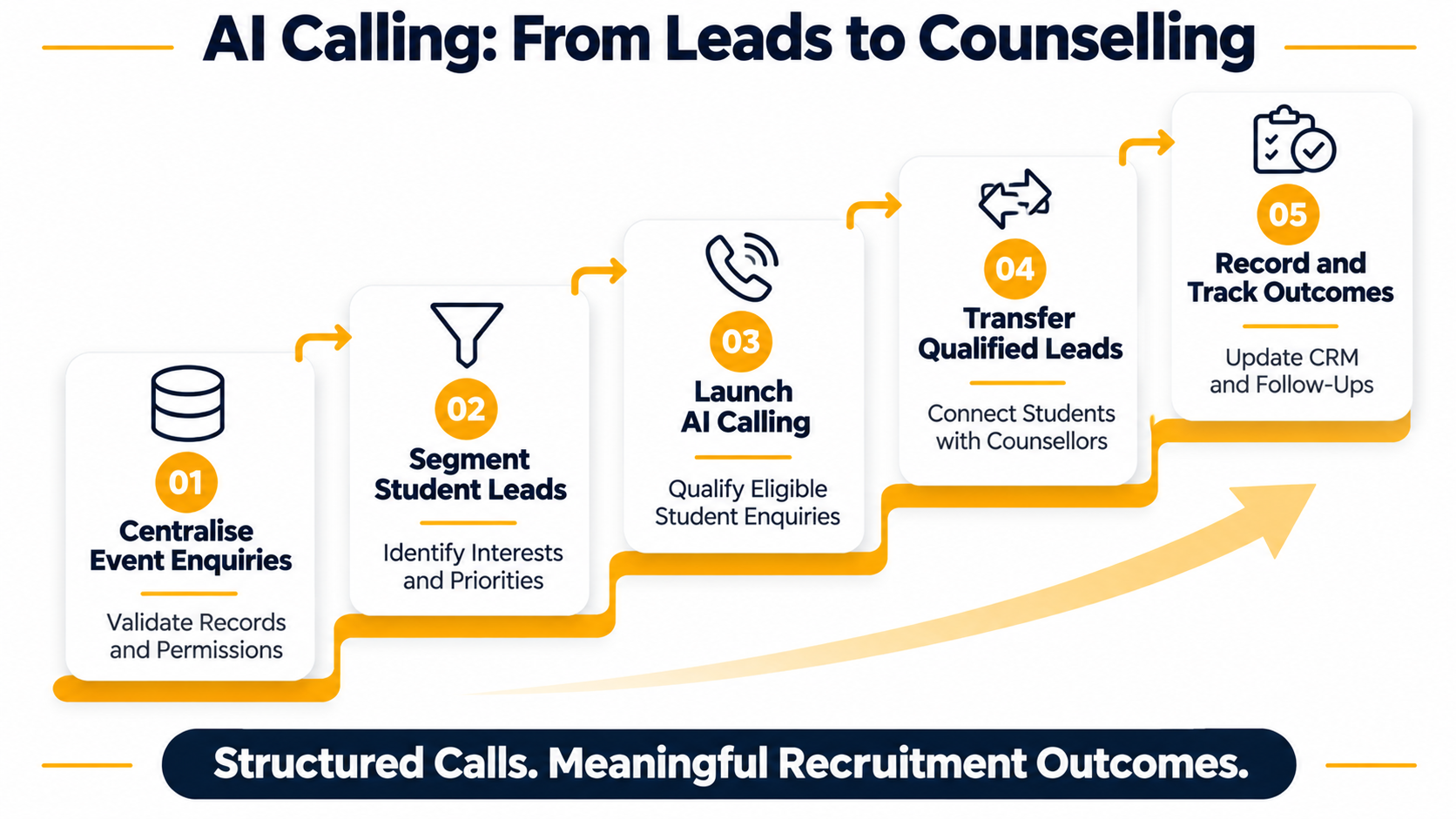
4. Transfer qualified enquiries to human counsellors
Initial information gathering should be done by AI, and not by AI alone, which should assess eligibility for admission.
Depending on the availability of the integrations of different scheduling, interested students may be guided to counsellor callbacks or appointment booking workflows.
Academic testing, university pre-selection, visa advice and complicated financial negotiations should be dealt with by human counsellors.
5. Record call outcomes and monitor progress
Every discussion is to result in some form of outcome:
- Counselling requested.
- Callback scheduled.
- Further information required.
- Unreachable.
- No follow-up desired.
One of the customer relationship management (CRM) systems, like GuaranteeAdmit, comes with documented lead pipelines, student profiles, team jobs, and application tracking services.
The automated integration between the CRM and an AI calling solution should be tested before implementation.
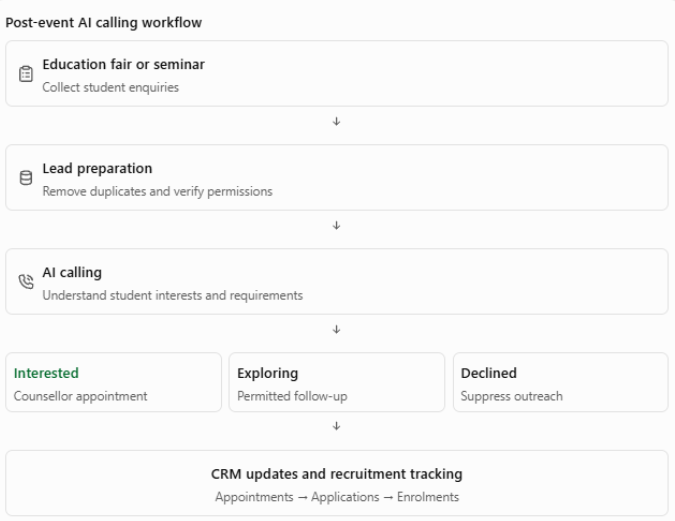
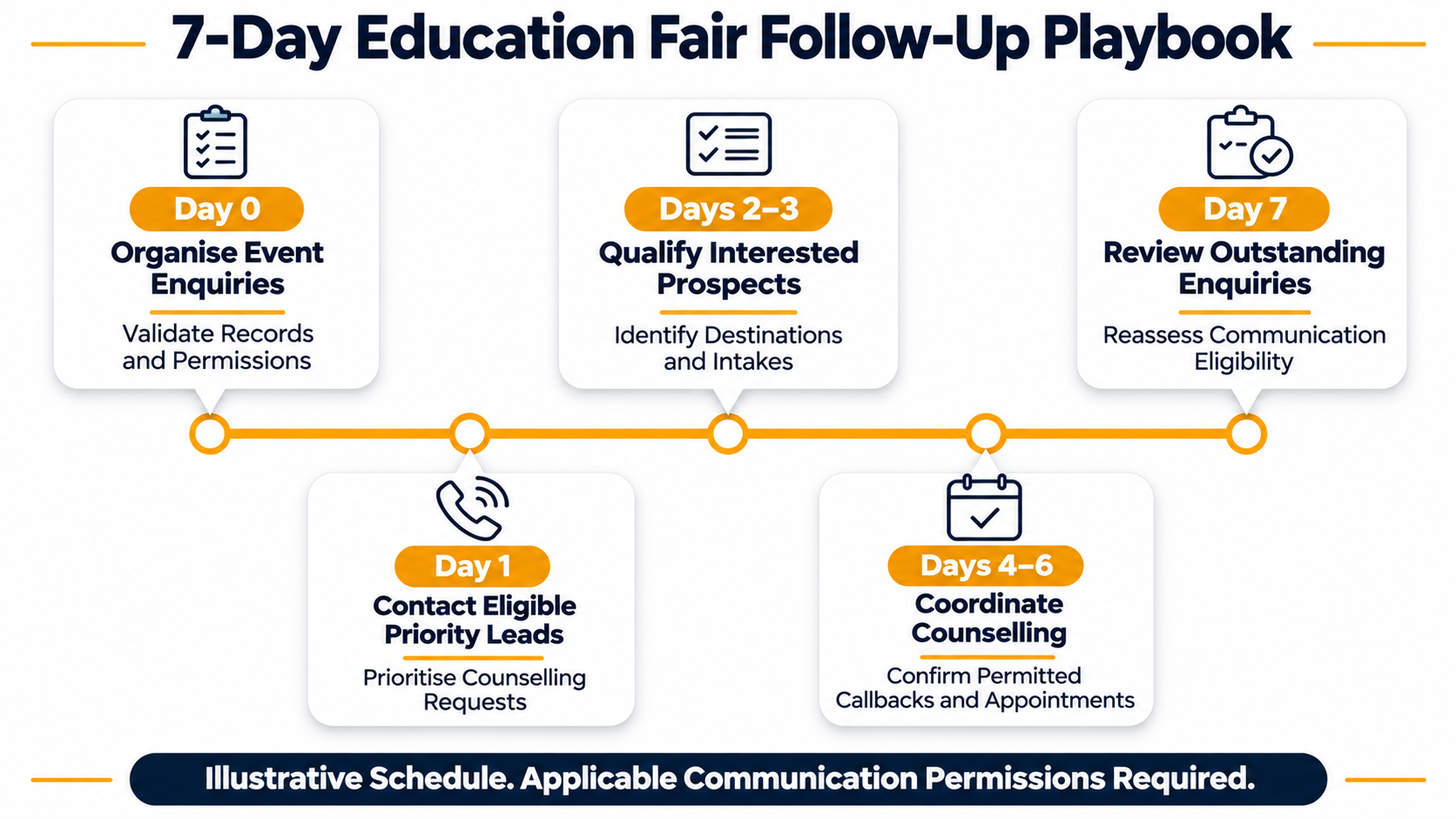
A Seven-Day Education Fair Lead Follow-Up Playbook
A defined follow-up schedule helps consultancies coordinate large enquiry volumes without relying on unstructured calling.
- Day 0: Organise event enquiries
Consolidate records, remove duplicates and validate communication permissions.
- Day 1: Contact eligible high-priority leads
Prioritise students who requested counselling or specific information.
- Days 2–3: Qualify interested prospects
Identify destinations, intended intakes and counselling requirements.
- Days 4–6: Coordinate counselling
Complete permitted callbacks, assign counsellors and confirm available appointments.
- Day 7: Review outstanding enquiries
Update lead statuses and reassess communication eligibility before further outreach.
This education fair lead follow-up schedule represents a graphical operation suggestion, yet not a legal right to follow up with each attendee within seven days. The campaigns should observe relevant telecom demands and the tastes of the recipients.
AI Calling Scripts for Education Fairs, Seminars and Spot Admission Events
Follow-up on education fair leads is affected by the closeness of conversations to the initial queries made by students.
The scripts below are all illustrative, yet assume that proper communication permissions are already in place.
Script 1: Education fair lead qualification
|
AI: Namaste! I am the AI helping the business of [Consultancy Name]. In your study abroad application, you recently requested a study-abroad enquiry at [Event Name]. Does that suit you to talk about where you want to go? Student: I have in mind the UK and Australia. AI: Would you have a counsellor who would assist you in comparing the universities, course choices, and admission criteria? Foreseen result: Recording destination preferences and counselling interest. |
Script 2: Seminar lead calling
|
AI: Hello! I am an IT assistant at [Consultancy Name]. You have just asked me to provide information for our seminar at the university. Do you need additional instructions? Student: I would like to understand the scholarship options. AI: I will take note of your inquiry, and your education counsellor will call you back. Outcome: Programme-specific enquiry to an appropriate counsellor. |
Script 3: Spot admission event follow-up
|
AI: Hello! I am an artificial intelligence assistant at [consultancy name]. You are interested in applying for our spot admission event. Do you want help assessing your academic profile? Student: Yes, I should be helped to be aware of my eligibility. AI: I would be able to take a note on the request to have a callback with the admissions professional in order to review your profile. Our anticipation: Profile assessment request without promising admission documented. |
To discuss such cases with families, the consultancies may create individual workflows with the following Indian study-abroad family AI calling scripts.
TRAI and DPDP Requirements for Education Event Calling
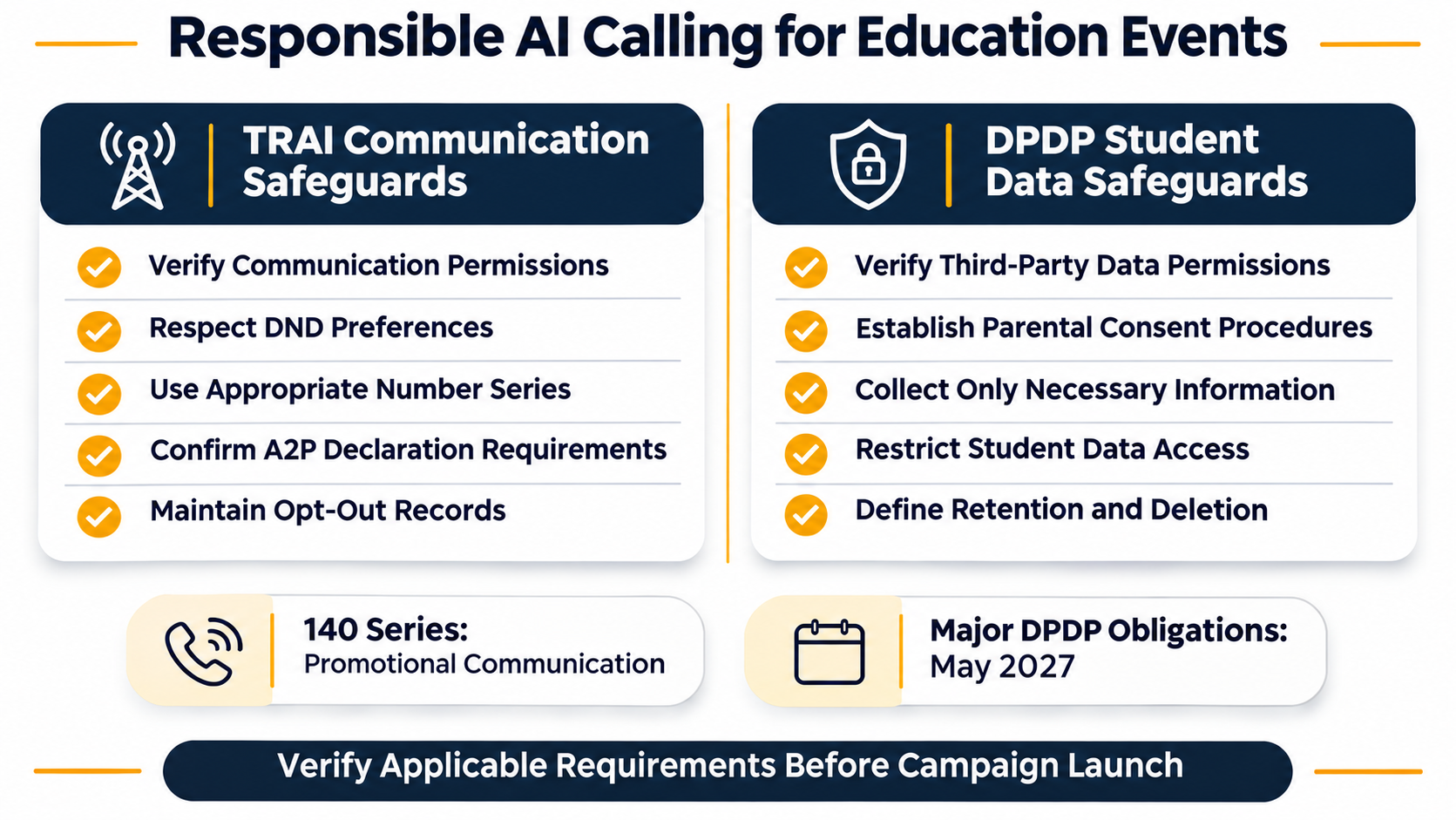
Before automated campaigns are initiated, responsible education fair lead follow-ups must ensure an adequate choice of permission to communicate with students and the protection of student data.
TRAI commercial communication regulations
On 18 September and 4 November 2026, the Telecom Regulatory Authority of India (TRAI) released the Third and Fourth Amendments to its regulations on commercial communication, respectively.
In the official government announcement of September 2026, the updated definition of commercial relationship contains a seven-day grace period for customer enquiries and/or requests that qualify based on verifiable written or digital records.
By registering an education fair, promotion calls would not be automatically authorised.
The consolidated TRAI commercial communication regulations should be checked by consultancies, and the following safeguards are to be established:
- Check enquiries and visit rights.
- Considerable respect for Do Not Disturb (DND) preferences.
- Calls should be made using proper commercial calling number resources.
- Eligibility in specific number series.
- Adhere to appropriate Application-to-Person (A2P) calling declaration requirements.
- Keep an opt-out list among campaigns.
The 140 category will be used in the promotional communication. The telecom provider should be consulted regarding eligibility for other designated number series.
The amendments made in 2026 are gradual in their start-up. Consultancies ought to verify requirements on the day they intend to actually launch their campaign.
DPDP and student data protection
In accordance with the Digital Personal Data Protection Act commencement notification, the major obligations in terms of processing personal data are expected to be enforced in May 2027.
Special attention should be paid when databases of education events include data that belongs to schoolchildren under 18.
Consultancies are to prepare by:
- Checking permissions of third-party event databases.
- Having proper parental consent processes where necessary.
- Gathering information that is needed.
- Determining access to recordings and student files.
- Having proper retention and deletion procedures.
Campaign planning should include data protection as an ingredient and not as a by-product.
How to Measure Education Fair Lead Follow-Up Performance?
The outcomes of recruitment should be the measure of the success of the AI calling campaign rather than the number of calls taken.
|
Performance indicator |
Calculation |
|
Contact rate |
Unique leads reached ÷ unique leads attempted × 100 |
|
Eligible lead rate |
Eligible leads ÷ unique event leads × 100 |
|
Counselling booking rate |
Leads with bookings ÷ unique leads reached × 100 |
|
Qualification rate |
Qualified leads ÷ unique leads reached × 100 |
|
Appointment attendance rate |
Attended appointments ÷ booked appointments × 100 |
|
Enrolment conversion rate |
Enrolled students ÷ unique event leads × 100 |
|
Application conversion rate |
Unique applicants ÷ unique event leads × 100 |
|
Cost per attended appointment |
Attributable campaign cost ÷ attended appointments |
Education Fair Follow-Up Cost Calculator
Use the calculator below to estimate your education fair lead follow-up workload and possible expenditures of the campaign.
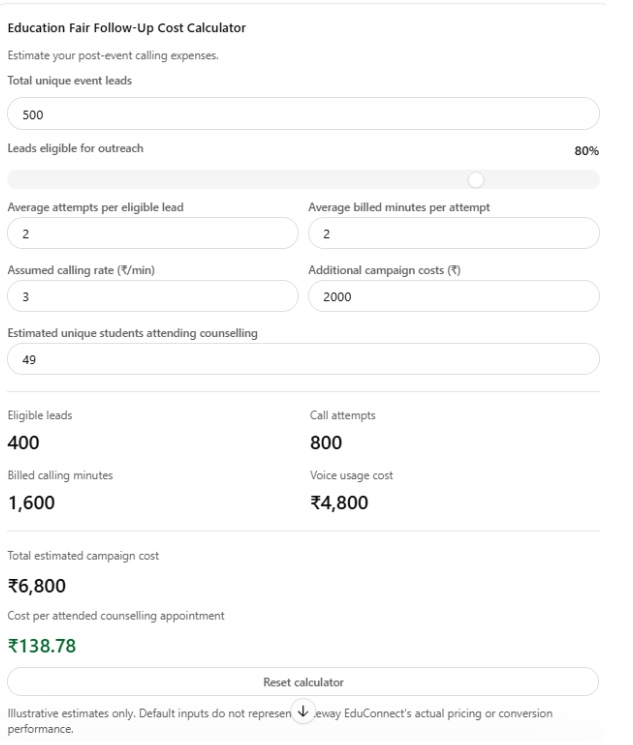
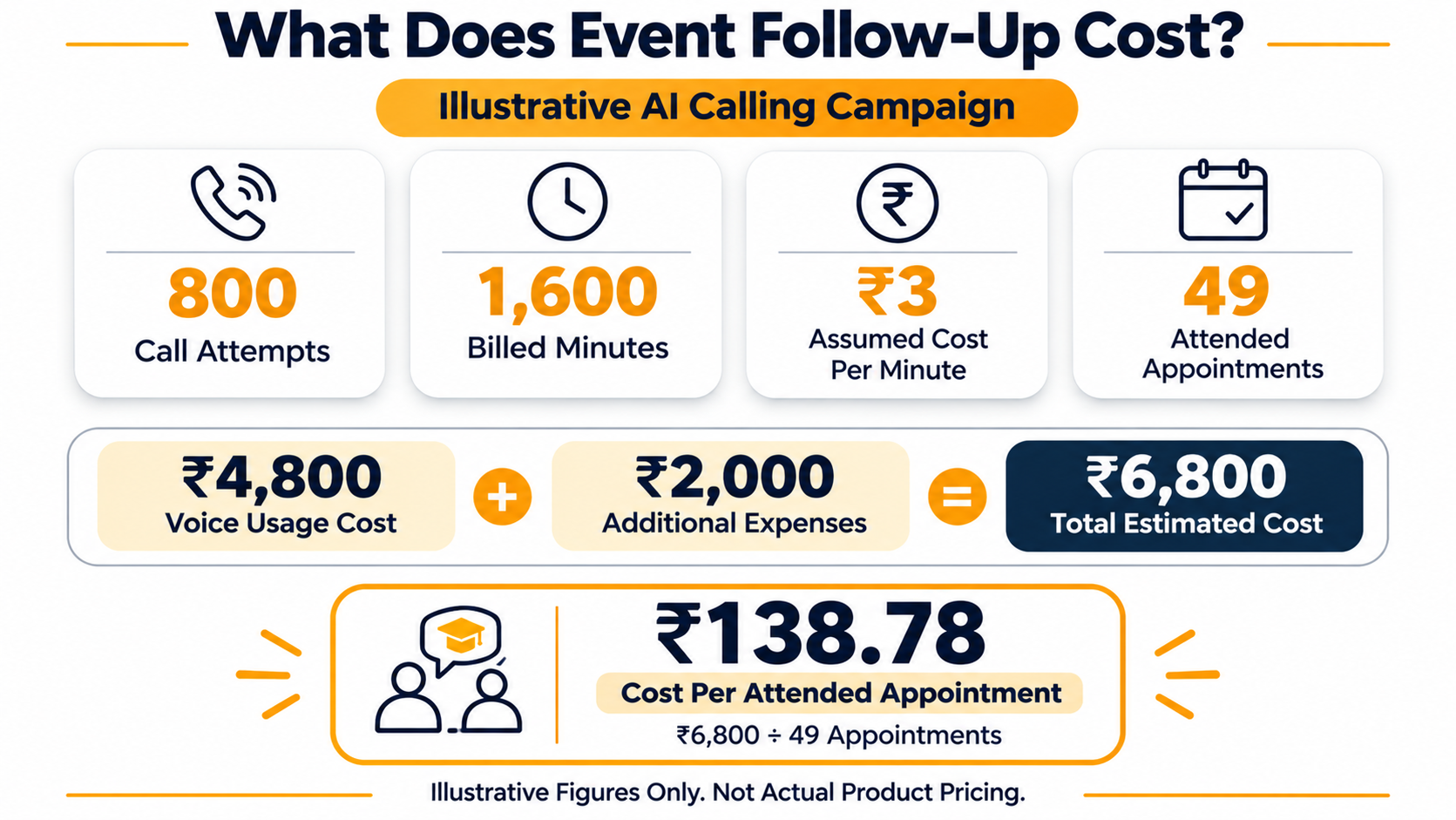
For instance, there would be 400 attempts at 2 attempts per lead and two average billed minutes per attempt, resulting in 1,600 billed minutes.
Voice usage would be ₹4,800 at an assumed rate of ₹3 per minute. Including ₹2,000 in additional expenses and 49 attended appointments, the estimated cost per attended appointment would be ₹138.78.
These are speculative numbers illustrating how the calculation is done, as opposed to the anticipated campaign outcomes.
How to Implement AI Calling Before Your Next Education Fair?
Consultancies should not just start automating their entire database without controlling it in a pilot program.
Prior to the implementation of a campaign:
- Choose one event and a group of qualified enquiries.
- Write event-specific calling scripts.
- Preference of language in tests and interruptions of conversations.
- Establish limits for callbacks and opt-outs.
- Assign counsellor responsibilities.
- Confirm CRM updates and booking.
- Compare the qualification quality and costs to the manual follow-ups.
After the students move to the application stage, automated student follow-up processes can be established individually to handle document submissions, IELTS results and university fee payments.
How Gateway EduConnect Can Support Your Education Fair Lead Follow-Up?
The Gateway EduConnect assists education agents by providing college associations, admissions services and a coordinated application process.
An event-specific demonstration provides an opportunity to test the potential of automated conversations as part of existing recruitment procedures in case a consultancy considers AI calling.
In the demonstration, the owners of the consultancy should evaluate:
- Campaign setup of event leads.
- Student qualification conversations.
- Requirements of language.
- AI-to-counsellor handoff processes.
- Tracking call outcomes and CRM needs.
Integrating the fitting AI calling technology and structured admissions processes will assist the consultancies in creating an easier-to-measure recruitment process but will not eliminate the human touch.
During the demonstration, some specific features, integration and implementation arrangements should be verified.
FAQs
What is the time frame within which the education fair follow-up ought to commence?
Ideally, event data should be prepared on the same day, and priority must be given to high-intent and eligible enquiries within the following working day.
Can AI calling qualify education fair leads?
Yes. An appropriately trained AI agent has the capability of gathering research interests, planned consumption and counselling needs. Qualified human assessment is necessary in making academic eligibility decisions.
What can consultancies do to automate the seminar lead calling?
Gather seminar queries in a single place, obtain permission to send emails, and write event-specific scripts to locate students who need further support.
Is it possible to use AI to assist in follow-up on the spot admission?
AI is able to detect interest in the applications and arrange profile evaluation requests. It is not to be used on its own to ensure admission or scholarly admissions.
Are automated calls possible for all the education fair attendees?
No. Consultancies need to develop the proper communication rights and comply with relevant telecom and data protection regulations.
Conclusion: Building the Future of Smarter Education Recruitment
The future of study-abroad recruitment belongs to consultancies that combine technology, operational efficiency and human expertise. A structured education fair lead follow-up strategy powered by AI calling can help consultancies respond faster, strengthen student engagement and create more meaningful counselling opportunities.
At Gateway EduConnect, we believe technology and meaningful partnerships are the driving forces behind the next generation of global education recruitment. Our commitment is to empower education consultants with the right connections, opportunities and innovative solutions to support sustainable business growth.
Don't just follow the future of education recruitment. Be part of shaping it.
Gateway EduConnect – Connect. Empower. Grow.
Let's build a smarter, stronger and more connected global education ecosystem together.
Book an AI Calling Demo with Gateway EduConnect and discover how technology can support your next education event.
Author Bio
Abhinav Jain - Founder, Gateway Educonnect and Director.
B.Tech, MBA, AI and Global Education Specialist.
More than 15 years of professional experience in leading students along international routes based on politics and innovation.