24 Oct 2026 | F-1 Student Visa Process 2027-28: Complete Guide for Indian Students

0
40
F-1 Student Visa Process 2027–28: Complete Guide for Indian Students
For Indian students aspiring to pursue a master's degree in the United States.
Indian student F1 visa process begins with an offer from any of the U.S. institutions that have been approved to accept international students. Following the issuance of Form I-20, you fill out the DS-160 form, make payments, make an appointment, and finally have a consular interview. In the F1 visa process for Indian students, there must be proof of financial support as well as an explanation of the course that you will be undertaking. This guide is aimed at 2027 28 applicants, and the rules are checked on 24 October 2026.
The charges, screening regulations, as well as appointments may change. Before submitting the student visa application, check the student visa guidelines of the U.S. State Department and verify that it meets current requirements.
Overview: F1 visa process for Indian students
|
Item |
Verified position on 24 October 2026 |
|
Visa application |
DS-160 |
|
Admission document |
Form I-20 from an SEVP-approved institution |
|
Standard application fee |
US$185 |
|
Indian F-1 reciprocity issuance fee |
None |
|
Standard I-901 SEVIS fee |
US$350 |
|
New-student visa issuance |
Up to 365 days before programme start |
|
Indian F-1 visa validity |
Multiple entries, 60 months |
|
New-student entry |
No earlier than 30 days before programme start |
Visa validity is different from the period of authorised stay. These figures are not guaranteed for future intakes.
Who qualifies for an F-1 visa?
This F1 visa process for Indian students who are eligible to study full-time in an approved institution in the U.S. To obtain a master's degree, first obtain acceptance to the university and a valid Form I-20. The F-1 student visa only requires proof of financial preparation, in terms of resources needed to afford studying and living and the ability to obtain temporary student status.
An offer from a university does not assure a visa. The officer can evaluate:
- Your high school or college training and curriculum.
- Scholarship to cover school fees and allowances.
- Your desire to move on your authorised stay.
Check university-specific admissions requirements. State does not have a universal IELTS requirement at the State Department. Gateway EduConnect offers assistance with study abroad, but the visa issuance is the prerogative of U.S. authorities.
How does the F1 visa process for Indian students work?
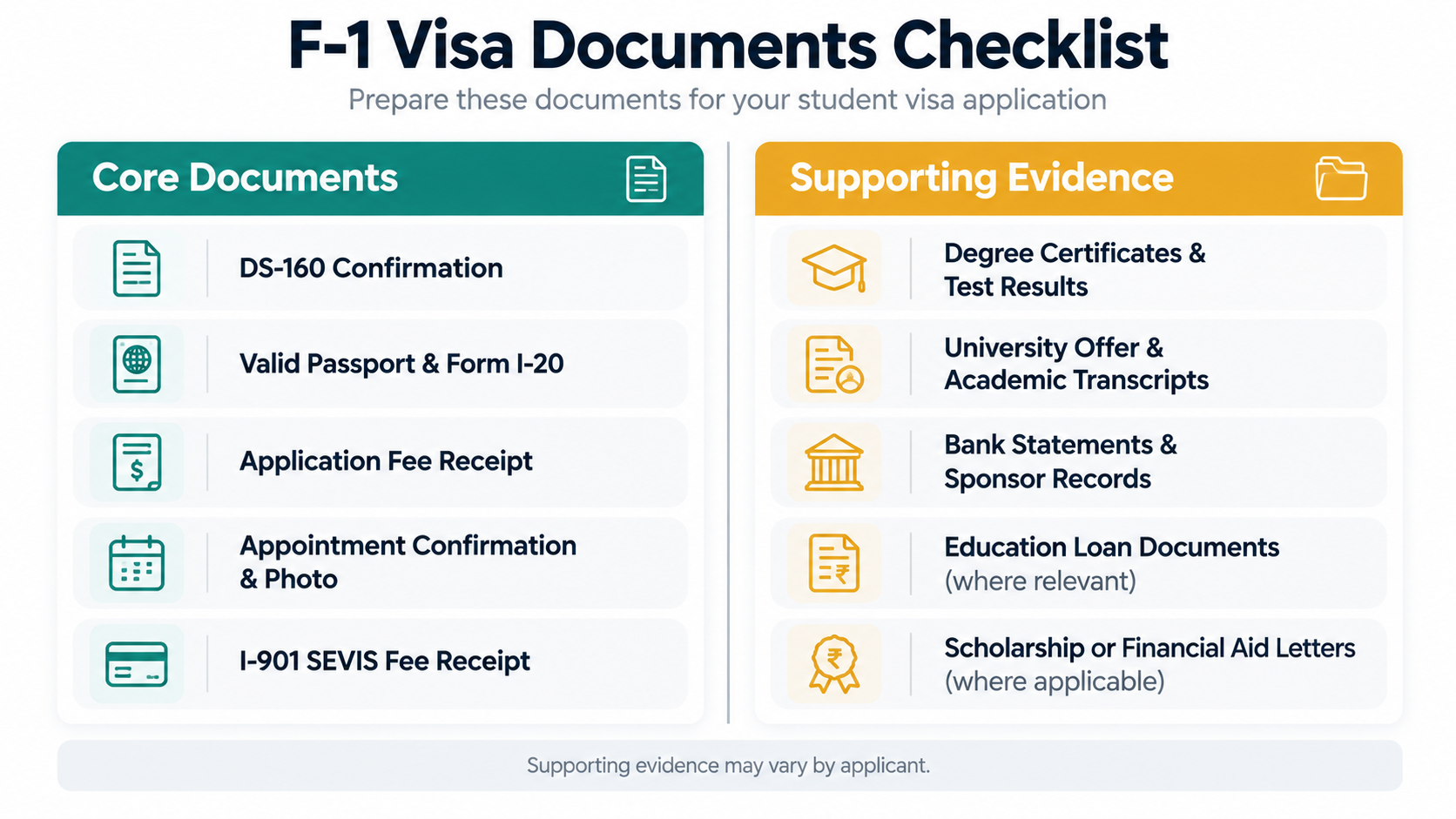
- Receive Form I-20: Get admission and meet the financial documentation requirements of the university. Check:
- Name and SEVIS ID.
- Programme and start date.
Request the school official (DSO) to fix mistakes.
- Pay SEVIS: The payment portal is the official I-901 portal; the receipt must be saved. Correspond your SEVIS number to your I-20. The payment should be made in advance of the interview, though you can make the appointment for an earlier date.
- Fill out impeccable DS-160: Fill out information on complete personal, education, travel and programme at the Consular Electronic Application Center. Save barcode confirmation. In the case of a mistake once submitted, consult the official DS-160 FAQs and act according to the instructions of the consulate, an alternative form will not necessarily refresh an appointment that is already in place.
- Pay and book: Pay the application fee using the registered method. Check the visa information provided by the U.S. Mission in India and ensure:
- The need to have a Visa Application Centre biometric appointment.
- The place of your interviews at a consulate.
- Are there any rescheduling and document rules?
- Interview and decision: Bring your necessary paperwork and supporting materials, respond in a consistent manner and follow the instructions in the passport return or additional processing given by the consulate. The F1 visa process for Indian students is not yet final since an interview has been conducted.
What documents do you need to prepare?
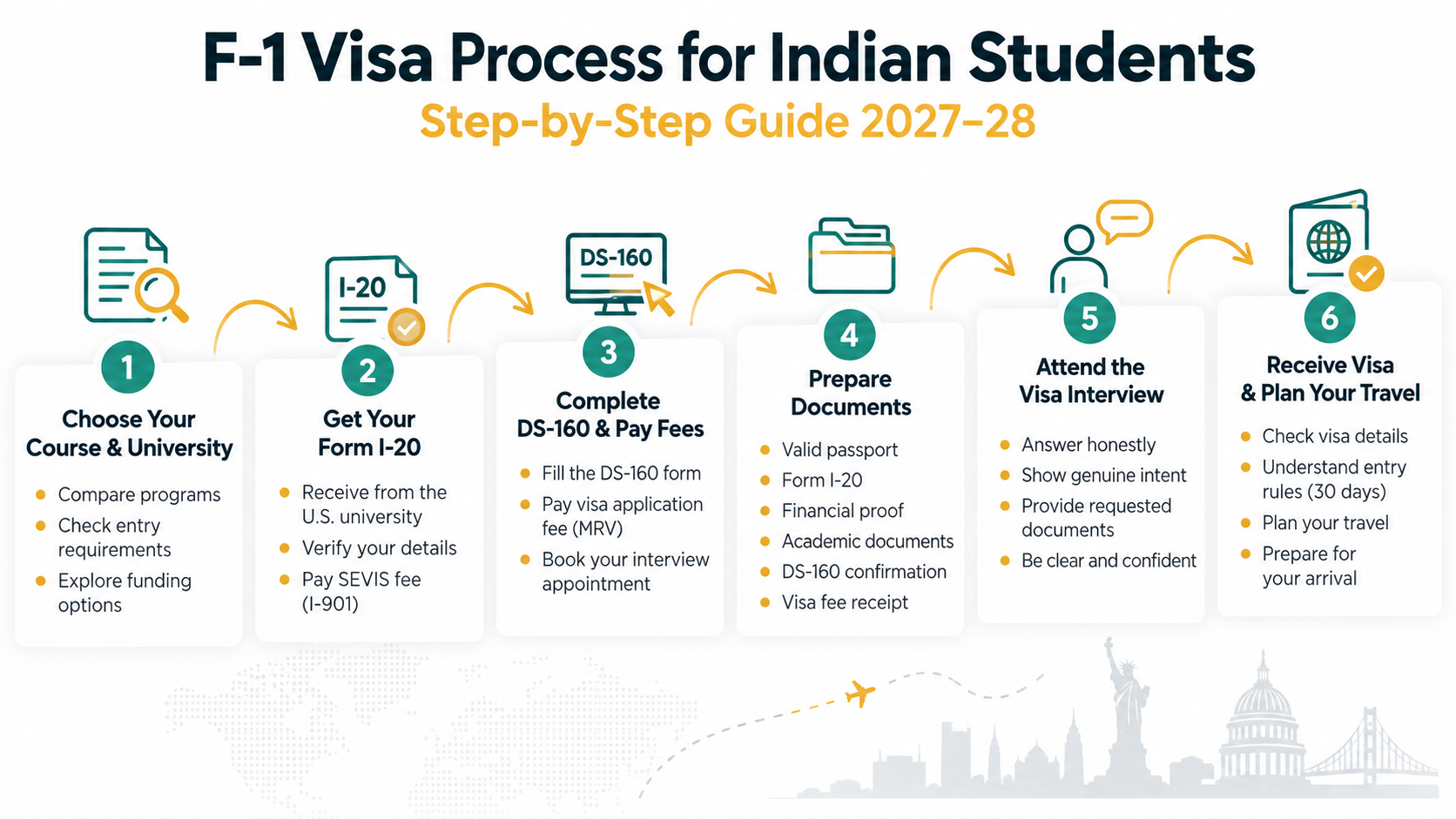
The checklist of documents required to submit a practical F1 visa process for Indian students includes a section dividing simple application documents and those that an officer might want to ask a student to provide.
|
Core documents |
Supporting evidence |
|
DS-160 barcode confirmation |
Degree certificates and applicable test results |
|
Valid passport; signed Form I-20 |
University offer and academic transcripts |
|
Application fee receipt, if required |
Bank statements and sponsor records |
|
Appointment confirmation and photo, as instructed |
Education loan documentation, where relevant |
|
I-901 receipt |
Scholarships or university aid letters |
When names, dates and SEVIS IDs are similar in documents, processing the F1 visa process for Indian students becomes easier. The basic minimum would be dictated by the official student visa document requirements; consular officers might demand some other evidence. Do not think that all the items in the supporting column are mandatory for everyone.
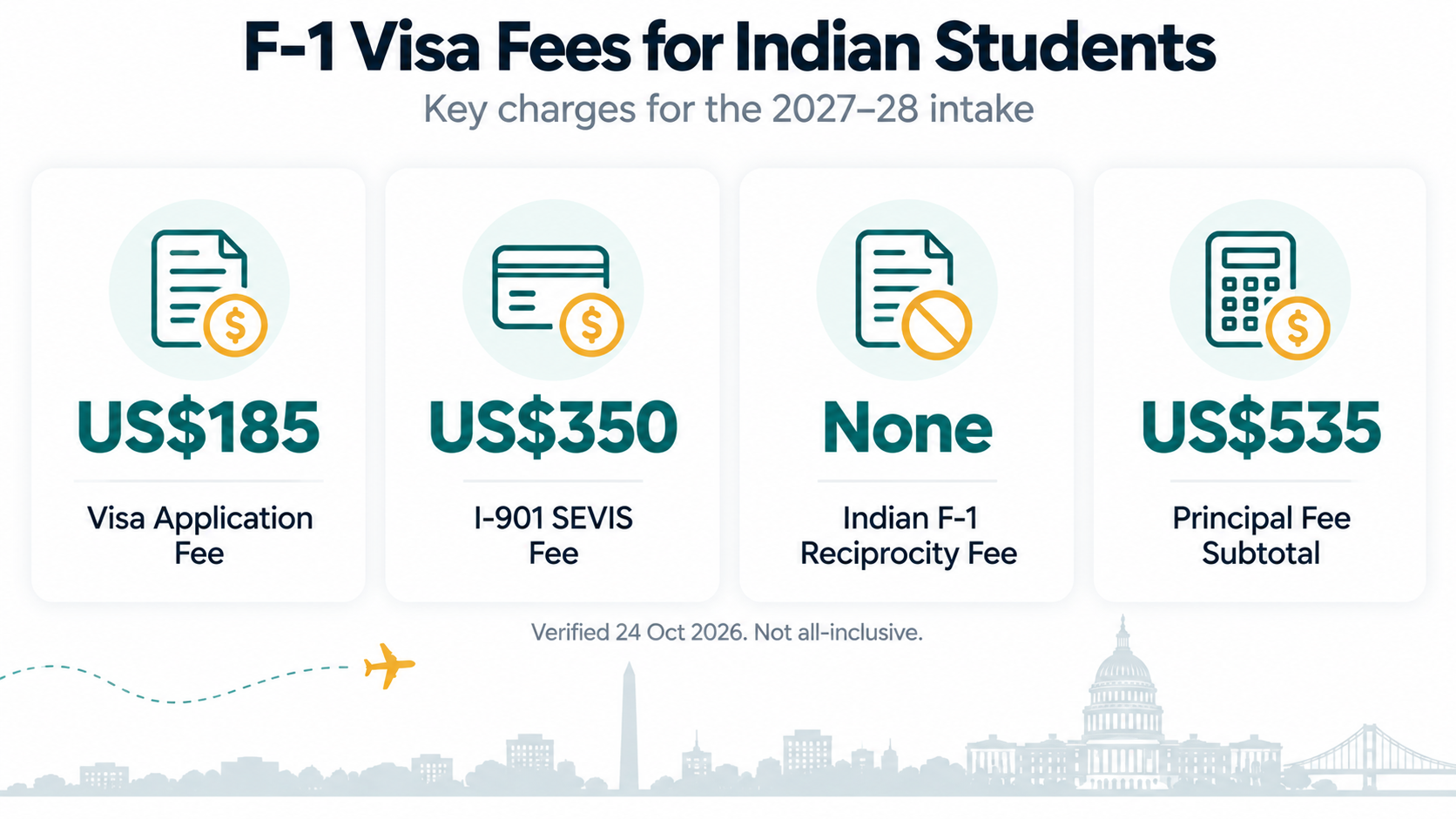
What fees will Indian applicants pay?
|
Verified principal charge |
Amount |
|
I-901 SEVIS fee |
US$350 |
|
F-1 application fee |
US$185 |
|
Indian reciprocity issuance fee |
None |
|
Subtotal of these charges |
US$535 |
F-1 visa procedures for Indian students can incur other expenses, so US $535 is not a certain amount that is comprehensive. Refer to the State Department's fee guidance, ICE's SEVIS instructions and India reciprocity schedule.
The federal law establishes the Visa Integrity Fee, and according to its provisions, its collection modalities and the amount to be paid to the office of Indian F-1 visa applicants were not determined clearly in the official material considered. Do not pay an extra amount when claiming something not official; adhere to existing government payment guidelines.
How much funding must you show?
No nationwide F-1 bank-balance sum that can be guaranteed will definitely get through. Indian students need to have a credible explanation of how the estimated tuition of the institution and living and travelling costs of a student will be met in the F1 visa process for Indian students. Check DHS financial ability instructions and those of your university.
Group according to source of funding:
- Family or parents: Authentic bank statements and income.
- Scholarship or university aid: Formal scholarship or university aid letters.
- Education loan: Approval documents, availability of funds and what is needed by the university.
The Foreign EduLoans service provided by the Gateway assists students to find the best lender. It is a commercial aid program and does not present itself as a governmental organisation nor as a visa-assisting service. Do not make up balances or explanations of the sources of funds.
How do appointments and processing times work in India?
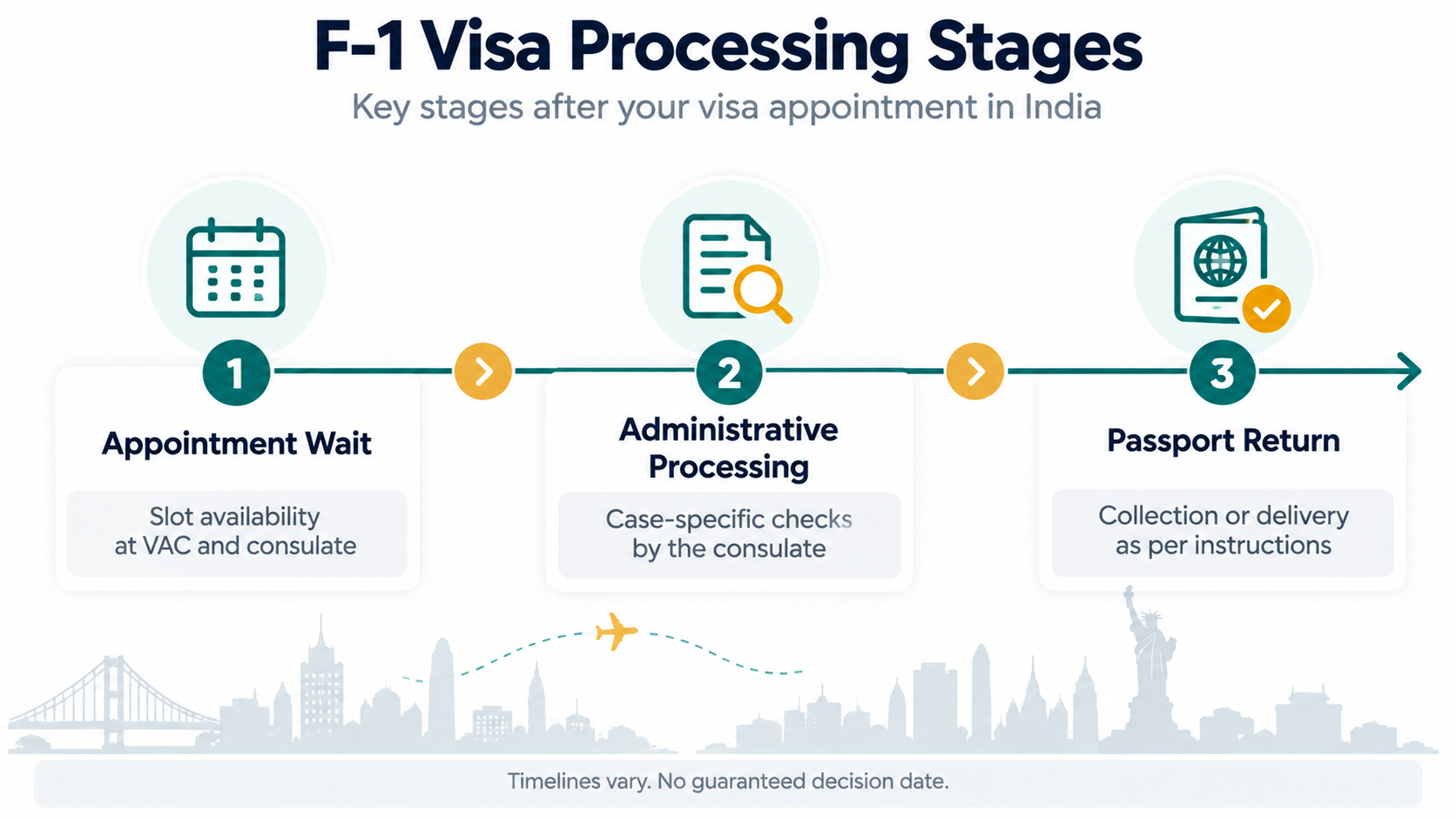
The F1 visa process for Indian students involves three different timelines:
|
Stage |
What it means |
|
Administrative processing |
Other case-specific checks where necessary |
|
Appointment wait |
Wait until an appointment time is available |
|
Passport return |
Delivery/collection after processing |
Do not use the figures for tourist visas, but use the F/M/J category on the State Department Global Visa Wait Times page. Estimates never ensure an appointment and decision.
Gathering A face-to-face interview is usually required of F-1 applicants. Observe the authorised India booking service for any biometric appointment, consular interview, and passport pickup. Perform a live system check of restriction rescheduling as opposed to no more than screenshots or faded-out instructions. There may be delays in administrative processing of cases; consider non-refundable flights before the visa is issued.
What do you do to prepare to interview?
The F1 visa process for Indian students does not entail reading a memorised speech but rather showing eligibility. The F1 visa interview questions that Indian students will find most helpful will be related to the selection of the university and master's programme, past education, who will cover the studies, post-master's programme plans, etc.
Prepare to explain:
- Selection of course: True interests and validated curriculum information.
- Academic history: Previous research, and/or change of subject.
- Funding: Sponsors and truly available funds.
- Applications: A history of previous applications.
Not even a list of questions, practised answers, or agency will guarantee approval.
What happens after refusal or delay?
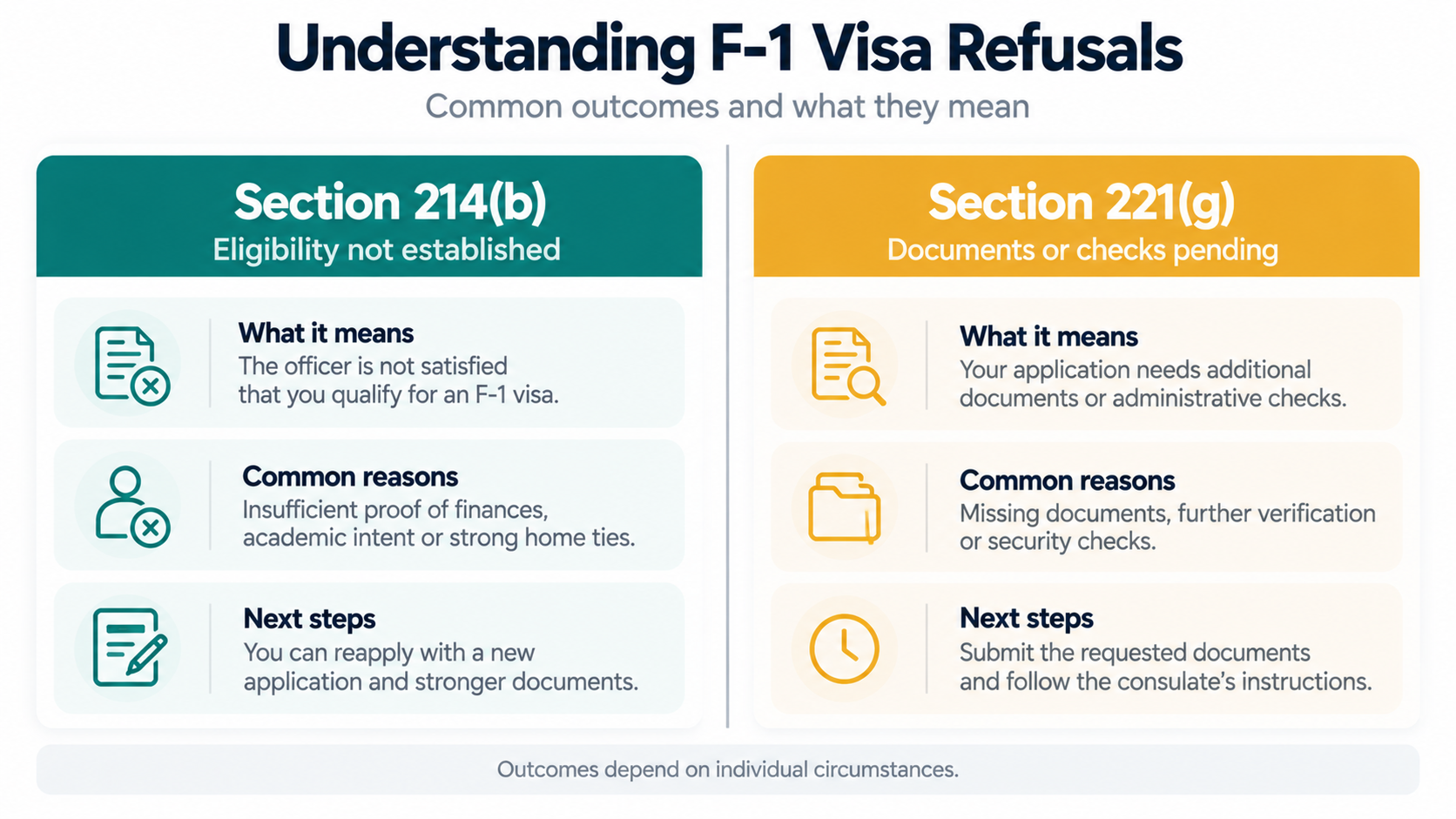
Refusals have different implications:
|
Provision |
What it can mean |
Next step |
|
214(b) |
A new application generally requires a new fee and interview |
|
|
221(g) |
Missing evidence or additional administrative processing |
Follow the consulate's specific notice |
When you are nearing your intake date, call the DSO at your university regarding a new I-20 or deferral. The F-1 visa process for Indian students has been subject to changes, which do not automatically increase the programme starting date in case of a delayed appointment or the I-20 in which the old version is used.
Which 2026 changes matter for 2027–28?
Online-presence screening: F-1 applicants are also screened for online presence by the State Department. There are published guidelines that guide applicants to make their social media pages public/open.
The DHS was looking to replace Duration of Status with fixed admission periods in a separate 2026 rule, but was prevented in September 2026 by a court. The operative position can be shifted by litigation, and therefore it can be prudent not to rely upon it, but to check with the current official guidance. F1 visa process for Indian students is based on a presumed court decision in the future.
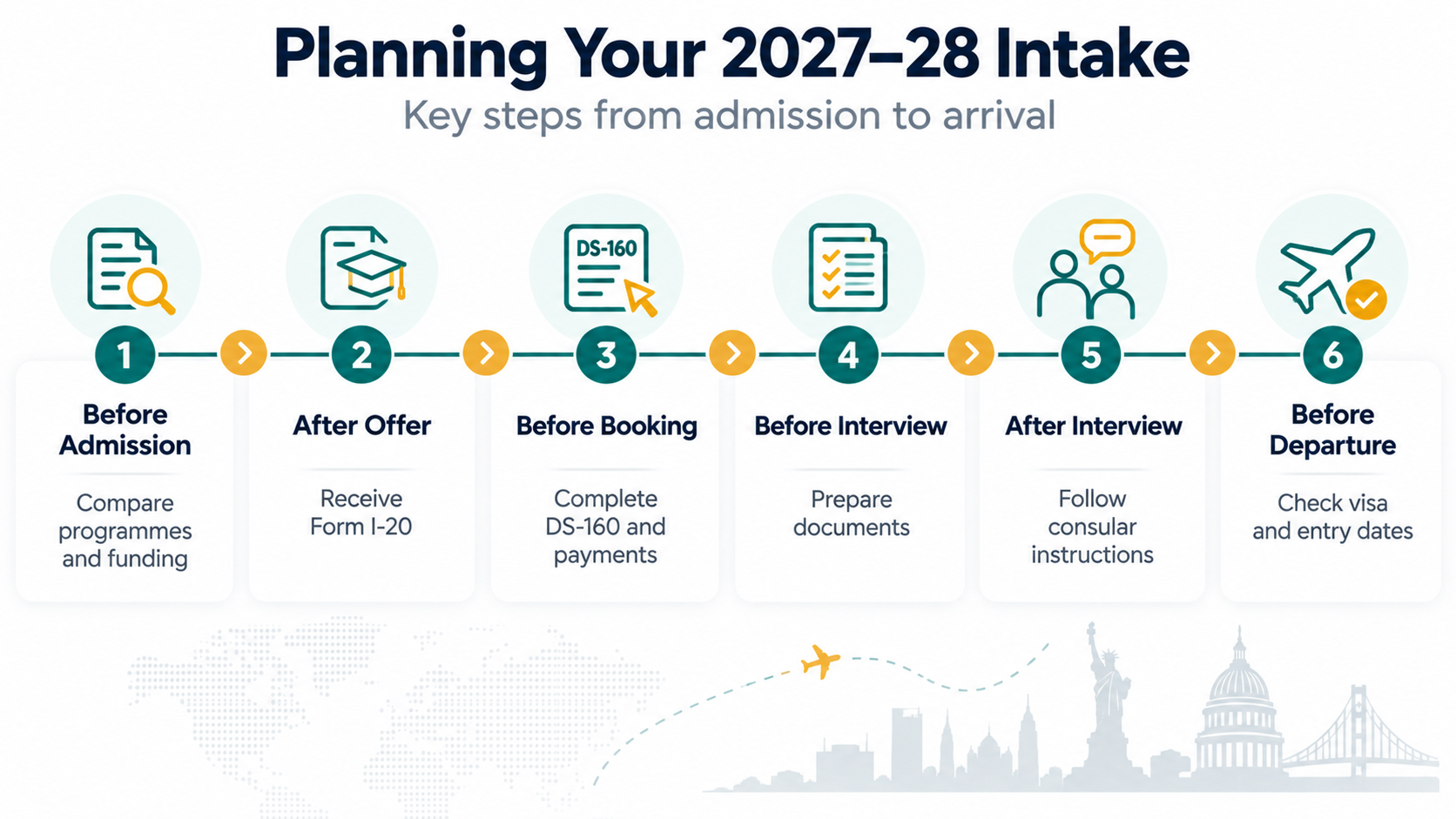
How do you plan your 2027 or 2028 Intake?
Students who are planning to apply to an intake in the future, must plan their application on the basis of dependencies rather than depending on some arbitrary fixed time frame.
|
Planning stage |
What to complete |
|
Before university admission |
Universities, programmes, requirements and funding of admissions. |
|
After receiving an offer |
Full university specifications and receive Forms I-20. |
|
Before booking the interview |
DS-160, instructions and payment requirements to complete check visa. |
|
Before the interview |
Prepare financial documents, school work, and other documentation. |
|
After the interview |
Take the order, passport and university directions. |
|
Before departure |
Check the issuance of the visa, the dates of the programme, and the right to travel. |
Important visa timing rules
As per the U.S. Department of State:
- Issuance of visa: A new F-1 student visa can be issued up to 365 days prior to a programme start date.
- Admission into the USA: New students are usually not allowed to enter the country of study more than 30 days prior to the commencement date of the programme.
- Visa validity: An F-1 visa for an Indian can be 60 months; however, this does not make it a five-year authorisation.
Visit the official Student Visa advice and the India Visa Reciprocity Schedule before laying down your plans of travelling.
The key is to adhere to the real academic schedule of your university and not a standard visa processing schedule.
Top 10 F-1 Visa Mistakes to Avoid
The slightest inconsistencies can make the F1 visa process for Indian students. Watch out for these mistakes when filling out your application.
- Wrong entry details: You should not provide incorrect details as far as your name, passport, SEVIS ID or university is concerned.
- Using obsolete visa data: On the basis of old charges, registration processes or websites that are not official, but use new government guidelines.
- Presenting vague financial information: The assumption that an approved education loan, bank balance or income of the sponsor is enough to indicate the availability of easy and available funds.
- Acting by memory or giving false interview responses: Giving answers that do not reflect your grade, studies, financial records or real study project.
- Software for management: trying to ignore the fact that something has changed in your university intake: not notifying your DSO that, in response to changes in your admission, programme dates or travel, etc.
- Flight reservation prior to visa: Making non-refundable travel plans without the visa.
Mixing up the validity of a visa and immigration status: It is a wrong assumption that a five-year visa will allow an individual to remain in the USA for five years.
What do you do to avoid these errors?
- Before your interview
- Compare with Form I-20, DS-160 and passport information.
- Check your charges and appointment guidelines.
- Prepare authentic academic and financial supporting papers.
- Check the requirements of your visa and update your DSO about any changes.
- To apply, see the U.S. Department of State Student Visa Guide.
These mistakes can be avoided to help increase the accuracy and organisation of your application, though it does not guarantee a visa.
FAQs
Is IELTS mandatory for Indian F-1 visa applicants?
No. The U.S. State Department would not want all F-1 applicants to take IELTS. Certain universities, however, might demand IELTS, TOEFL or other relevant evidence of English proficiency. Ensure you check the admission requirements for your preferred programme.
Is my master's degree in the USA sponsored by my parents?
Yes. Assuming that there are enough funds, you can be sponsored by your parents to study. Additional records can include bank statements, records of income and financial sponsorship.
Am I able to work with an F-1 visa?
Yes. Students who can work on campus have a general limit of 20 hours per week in academic work. On-campus jobs must be properly authorised.
Will Form I-20 ensure that they grant the visa?
No. Form I-20 forms the basis that you are eligible to apply, but a consular officer independently evaluates your visa application, financial position and study plans.
Is it possible to switch universities after getting an F-1 visa?
Yes, but this can be supplemented by other procedures. There are differences based on whether or not you have entered the USA. Use the following official (DSO) at your school before you transfer.
Conclusion
F1 visa process for Indian students process as a preparation exercise when they maintain accuracy in documentation, are conversant with the programme, consider relevant funds and complete the formal procedures of interviews. Assume 202728: treat charges, appointment times, and immigration regulations as a Weakness of Time instead of a Weakness of Being. Confirm individual requirements upon your actual application and travel dates.
Gateway EduConnect provides free video and home counselling, loan and accommodation services and test preparation services to guide students on their plans of studying abroad. Explore with Gateway EduConnect to get ready. This guide also provides the F-1 checklist, which you can use to monitor your documents prior to application.
Author Bio
Abhinav Jain - Founder, Gateway Educonnect and Director.
B.Tech, MBA, AI and Global Education Specialist.
More than 15 years of professional experience in leading students along international routes based on politics and innovation.
Connect: https://www.linkedin.com/in/abhinavedysor/