02 Sep 2026 | France vs Germany for Indian Students 2027-2028: Complete Guide for Indian Students

0
23
Introduction
For Indian students and parents comparing France and Germany for bachelor's, master's and PhD study.
Choosing between France and Germany depends on your programme, university costs, available funds, application requirements and plans after graduation. For students researching France vs Germany study abroad, Germany can offer lower tuition at many state institutions, while France has defined public-university fees for many non-EU students. However, neither destination is automatically cheaper or better for every applicant. A realistic France vs Germany study abroad choice ought to juxtapose the precise university, course, visa necessities and all-inclusive student budget.
France vs Germany Study Abroad: What Is the Quick Comparison?
France vs Germany at a Glance
|
Factor |
Germany |
France |
|
Important exceptions |
Baden-Württemberg and some Bavarian institutions can charge non-EU tuition |
Institutional exemptions and programme-specific fees |
|
Public university tuition |
Generally no tuition for bachelor's and most master's programmes at state institutions |
Published non-EU fees apply, subject to exemptions and exceptions |
|
Current visa financial proof |
€11,904 for 2026 through the blocked-account route |
€877.50 per month from 1 August 2026 |
|
India-specific process |
APS applies to many Indian applicants |
Études en France |
|
Student work |
140 full or 280 half-days annually, with an alternative 20-hour weekly framework |
Up to 964 hours annually |
|
Post-study route |
The qualified graduates are given maximum of 18 months to seek skilled jobs. |
One-year course Job Seeking / Business Enterprise course to qualified graduates. |
What this means: The France vs Germany study abroad comparison has no universal winner. Germany can have a tuition advantage, but course availability, exemptions, visa funds and post-study plans can change the final decision.Ready to turn your study abroad dream into reality? Explore top online programs and expert guidance at Gateway Educonnect Online Courses.
What Does the France vs Germany for Indian Students Cost Comparison Show?
Cost is usually one of the first factors Indian families compare.
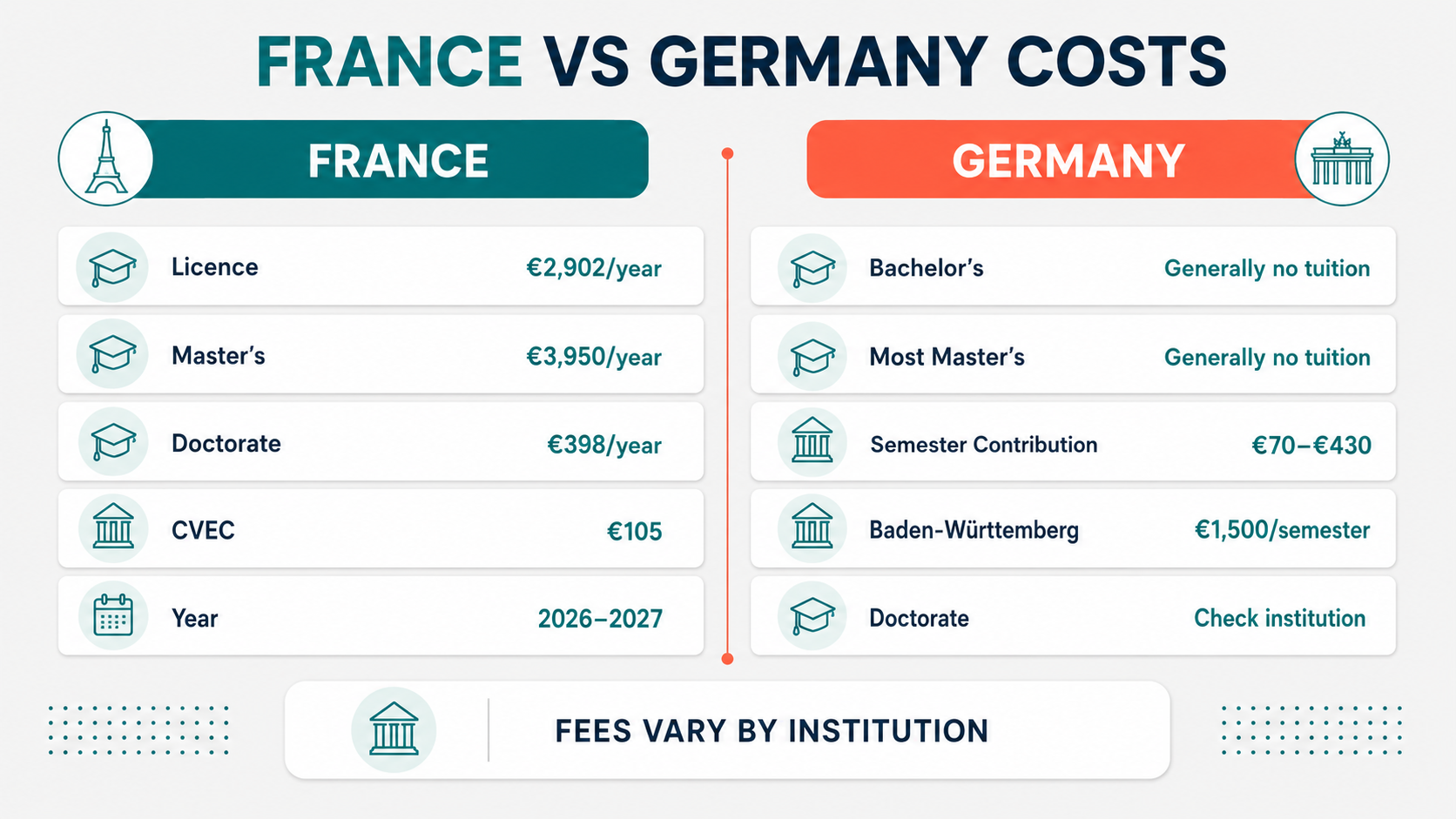
For France vs Germany study abroad, Germany has a significant potential advantage at many state universities. DAAD states that bachelor's programmes and most master's programmes at state higher-education institutions generally do not charge tuition.
Students still normally pay a semester contribution. DAAD currently indicates approximately €70 to €430 per semester, depending on the institution.
Not all international students can have tuition free in Germany. Baden-Wuerttemberg has a charge of non-EU student of €1,500 per semester. Non-EU/EEA students are also allowed to be charged tuition by some Bavarian institutions.
France follows a different fee structure.
Public Higher-Education Cost Comparison
|
Cost |
France |
Germany |
|
Bachelor's/Licence |
€2,902/year for 2026–2027 |
Generally no tuition at state institutions |
|
Master's |
€3,950/year for 2026–2027 |
Generally no tuition for most state master's programmes |
|
Doctorate |
€398/year for 2026–2027 |
Check the individual institution |
|
Other student charge |
CVEC €105 for 2026–2027 |
Semester contribution around €70–€430 |
|
Major regional exception |
Institution/exemption rules vary |
Baden-Württemberg: €1,500/semester for applicable non-EU students |
Source: Campus France official tuition information and DAAD official finance guidance.
For France vs Germany study abroad, these figures make Germany attractive for students prioritising public-university tuition. However, students must check the exact institution before calculating their budget.
How Do Living Costs Compare?
A France vs Germany study abroad budget should separate actual living expenses from visa financial-proof requirements.
Campus France India provides indicative student-budget guidance of around €600 to €800 per month, while also indicating around €1,000 monthly in Paris and €800 elsewhere.
Read this: Campus France India living-cost guidance.
DAAD cites average German student expenditure of €876 per month based on its referenced social-survey data.
These figures are not directly interchangeable. Location, accommodation and individual spending can substantially change a student's actual expenses.
How Much Financial Proof Is Required?
Financial proof is particularly important in the France vs Germany study abroad comparison because the two countries structure the requirement differently.
Visa Funding and Key Charges
|
Requirement |
France |
Germany |
|
Current financial proof |
€877.50/month |
€11,904 for 2026 through blocked account |
|
German monthly equivalent |
Not applicable |
€992 |
|
Student visa fee |
€50 for EEF-country applicants, subject to applicable cases |
€75 for adult applicants |
|
India-specific charge |
Études en France: ₹20,000 |
APS fee may apply separately |
In the case of France, the financial-resource demand was achieved as much as €877.50 per month starting 1 August 2026.
On 1 August 2026, the Études en France fee in India was raised to ₹18,500 to ₹20,000, thus reducing the disparity between the funds students pay in India and in France.
Check out: Campus France India fee update
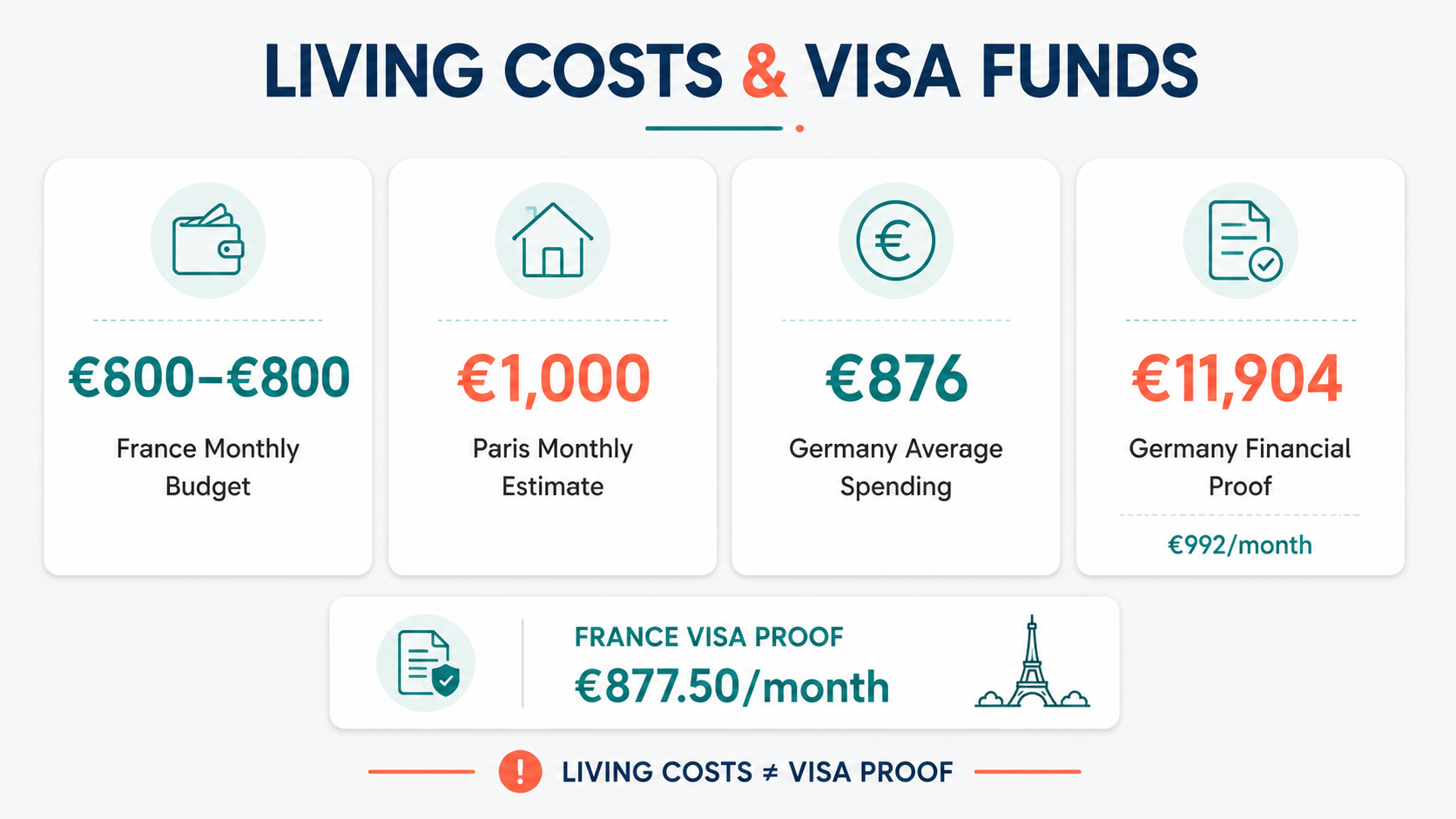
In the case of Germany, the accepted financial-proof amount is in 2026 under the blocked-account route, an amount of €11,904.
Calculation: €11,904 ÷ 12 = €992 per month.
Other recognised methods of demonstrating financing can apply depending on the student's circumstances.
The German Missions in India listed the adult national visa fee at €75 or ₹8,400 on its page dated 27 August 2026. The INR amount can change with the applicable exchange rate.
Read this: Best Universities in Germany for Master's Programs in 2026
For France vs Germany study abroad, remember that financial proof is not the same as your actual annual spending budget.
France vs Germany for Indian Students for Masters: Which Is Better?
Master's students form an important part of the France vs Germany study abroad comparison.
France currently lists a differentiated public master's tuition fee of €3,950 per year for 2026–2027 for applicable non-EU students. Exemptions and institution-specific arrangements can change what an individual student actually pays.
Most of the master's programmes offered in state institutions in Germany are usually free of charge, although exceptions apply. Students are to look at Baden-Wurttemberg and the applicable institutions in Bavaria individually, as well as the individual universities and fee-charging programs.
Neither destination has one universal admission percentage or English-language test score covering every master's programme.
For master's applicants, compare:
- Exact programme curriculum and entry requirements.
- Actual tuition charged by the chosen institution.
- Language requirements for that programme.
- Visa financial-proof requirements.
- Total living budget.
- Post-study immigration options.
A strong France vs Germany study abroad decision therefore compares individual courses rather than national averages alone.
What About Bachelor's and PhD Students?
The France vs Germany study abroad comparison changes depending on study level.
For bachelor's study, France currently lists applicable differentiated Licence tuition at €2,902 per year for 2026–2027. Germany generally has no tuition for bachelor's study at state institutions, subject to the regional and institutional exceptions already explained.
Indian bachelor's applicants considering Germany should pay particular attention to academic eligibility and APS requirements. Entry rules depend on the applicant's qualification and intended pathway.
At PhD level, the comparison becomes more individual. France currently lists €398 per year for 2026–2027 for public doctoral registration. German doctoral programs must be verified in relation to the certain institution or doctoral program.
Learners must not, therefore, just transfer mastery level comparisons to bachelors or doctoral studies.
How Does the Application Process Differ?
The France vs Germany study abroad application journey is different in each country.
France
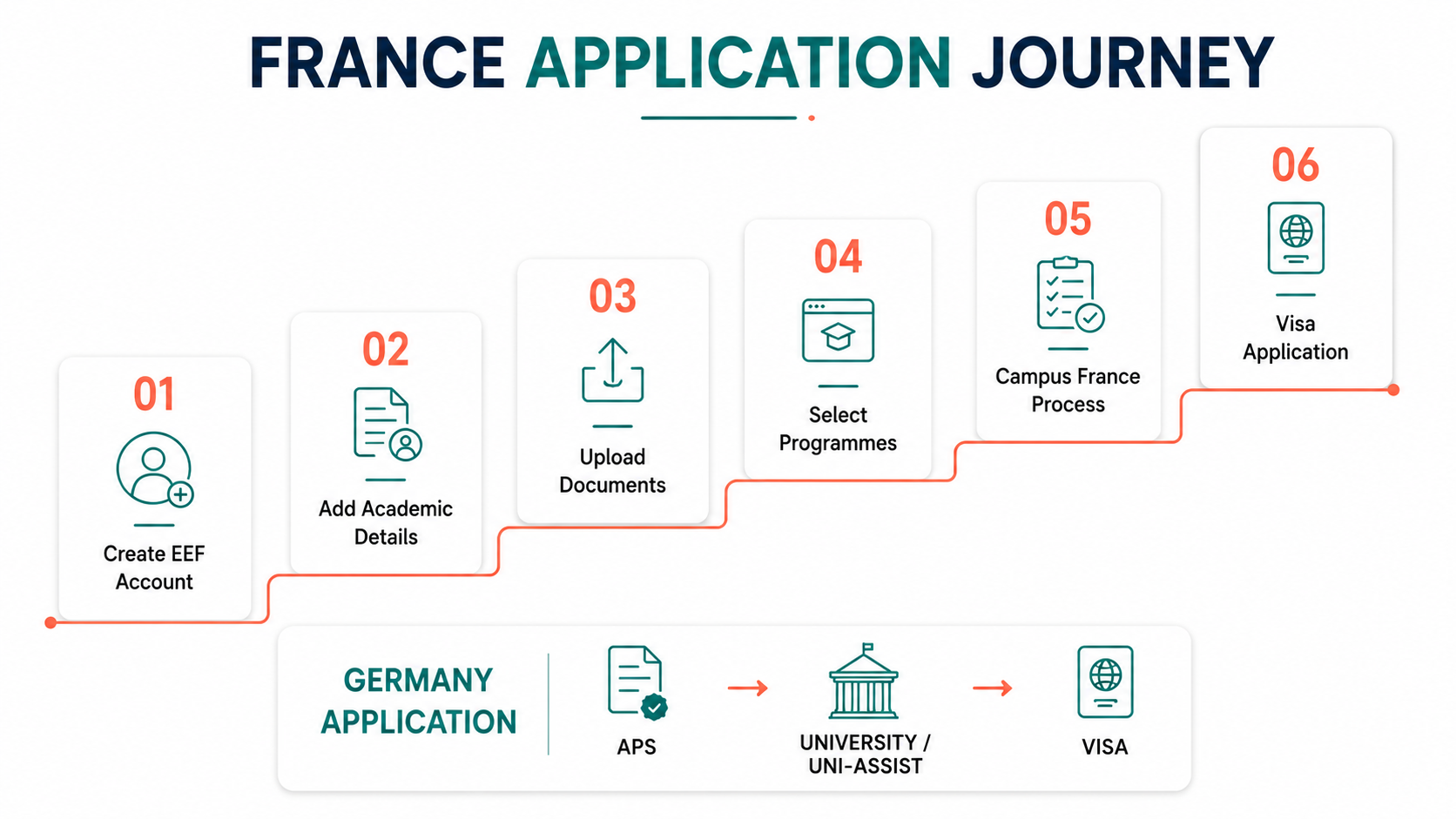
Indian applicants use the Études en France procedure where applicable.
The process can involve:
- Creating an Études en France account.
- Completing personal and academic information.
- Uploading the required documents.
- Selecting and submitting programme applications where applicable.
- Completing the required Campus France process.
- Proceeding with the appropriate visa application.
Check out: Choosing a University Abroad: 10 Mistakes Indian Students Make & How to Avoid Them
Germany
Depending on the university, applications can be done directly to it or via uni-assist.
The usual deadlines may be 15 July and 15 January, respectively, deadlines of winter and summer semester, and are not universal.
Students have to adhere to the deadline provided by their preferred university and the programme.
Do Indian Students Need APS for Germany?
APS is an important difference when evaluating France vs Germany study abroad from India.
APS verification generally applies to relevant Indian academic qualifications, although official exemptions exist.
APS has announced updated criteria for pathways beginning from Winter Semester 2026–2027, including a 70% Class XII minimum within the pathways specified in its notice.
This must not be interpreted as a universal 70% admission requirement for every German university or course.
A verification fee of ₹18,000 can be found on the now-hosted APS individual-procedure leaflet. The leaflet is however dated April 2023. Students who intend to pay in 2027-2028 should ensure that they confirm the existing amount and then pay.
Check out: Studying in Germany The Ultimate Guide for International Students
Can Indian Students Work While Studying?
Work rights are another major France vs Germany study abroad consideration.
Work Rights During Study
|
Country |
Current rule |
|
France |
Up to 964 hours per year for eligible students |
|
Germany |
Up to 140 full or 280 half-days annually |
|
Germany alternative |
Up to 20 hours per week under the applicable framework |
In France, foreign students who have an applicable student status are allowed to work a maximum of 964 hours per year.
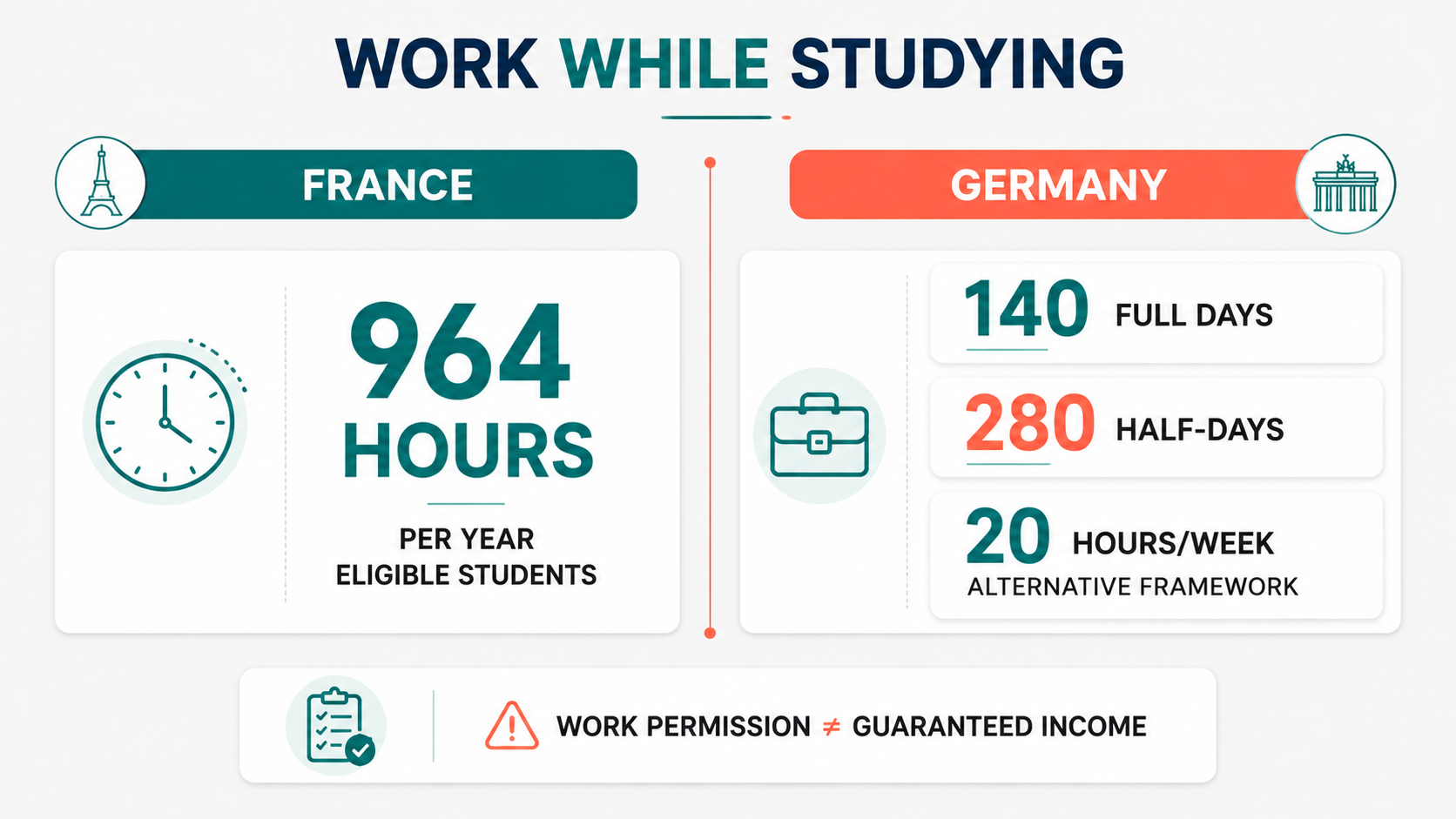
Germany allows qualified third country students to work 140 full days or 280 half days each year. Governmental advice in Germany also has an alternative 20-hours-per-week model.
Learners cannot afford to base their entire financial scheme on anticipated part-time income. The right to work does not mean that one will have a job or a salary.
France vs Germany for Indian Students Post Study Work Visa: What Is the Difference?
Post-study options can materially change a France vs Germany study abroad decision.
Germany permits international graduates that are eligible and successful students in completing a German higher-education degree to receive a residence permit of up to 18 months to find skilled jobs.
The company has a Job Search / Business Creation route, available to eligible graduates in France.
Notably, the official Service-Public guidance of France states that the corresponding residence permit or VLS-TS only lasts a year and is non-renewable. It enables qualified graduates to stay in France as they seek jobs or start a qualifying business.
A separate rule applies when an eligible graduate has already left France. France-Visas states that qualifying graduates can apply to return within four years after obtaining their degree.
The 4-year application window not four years of post-study residence.
Check out: France-Visas Job Search / Business Creation.
Post-Study Comparison
|
Factor |
France |
Germany |
|
Eligible post-study route |
Job Search / Business Creation |
Job-search residence permit |
|
Current duration |
1 year |
Up to 18 months |
|
Renewable in France |
No |
Different residence route applies after qualifying employment |
|
France return rule |
Eligible former graduates can apply within 4 years |
Not directly comparable |
Interpretation: Germany currently provides the longer defined job-search period, while France provides a one-year route for eligible graduates.
What About Health Insurance?
Health coverage also belongs in a complete France vs Germany study abroad budget.
Eligible foreign students in France can register through the official foreign-student health-insurance process.
Germany requires recognised health-insurance coverage. DAAD currently indicates approximately €120 to €130 per month for eligible students under 30 using the reduced statutory student rate.
This is an indicative amount rather than a universal premium.
Read this: DAAD health insurance guidance.
France vs Germany for Indian Students: Which Is Better?
There is no responsible universal answer to France vs Germany study abroad.
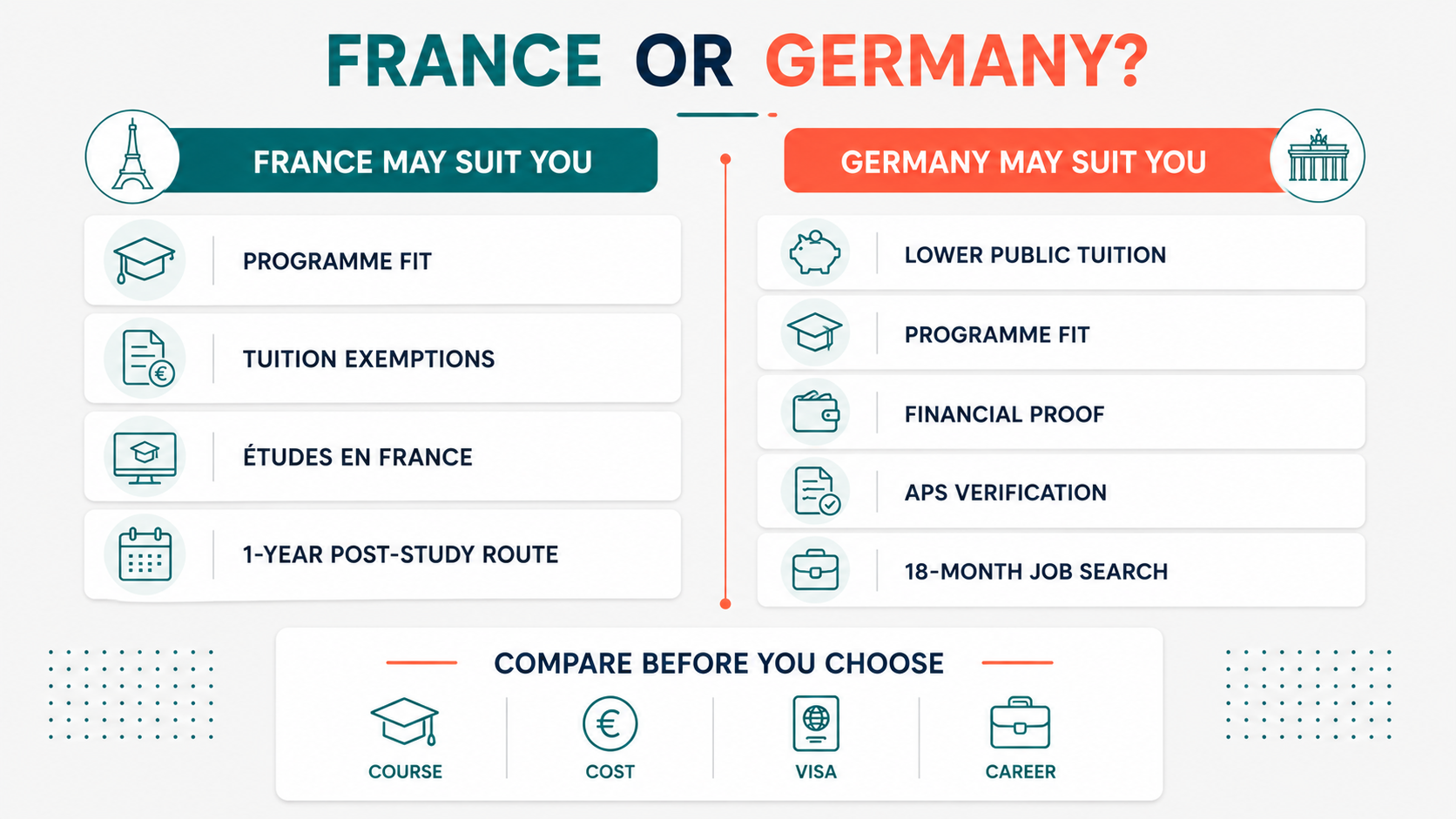
Germany may suit you if you:
- Prioritise lower tuition at many state universities.
- Find a suitable programme outside higher-fee exceptions.
- Can satisfy financial-proof requirements.
- Can complete APS where applicable.
- Value the defined 18-month post-study job-search period.
France may suit you if you:
- Find a programme strongly aligned with your academic goals.
- Qualify for favourable tuition arrangements or exemptions.
- Are comfortable using the Études en France process.
- Meet the conditions for France's one-year post-study route.
The answer to France vs Germany for Indian Students which is better for Indian students should therefore come from the student's actual programme shortlist and budget, not a blanket country ranking.
What Common Mistakes Should Indian Students Avoid?
When planning France vs Germany study abroad, avoid these mistakes:
- Assuming every German public university is completely tuition-free.
- Treating 2026–2027 French fees as confirmed 2027–2028 fees.
- Treating Germany's 2026 blocked-account figure as confirmed for 2027.
- Confusing visa financial proof with actual monthly living expenses.
- Ignoring APS when preparing a German application from India.
- Assuming one English-test score applies to every programme.
- Treating common application dates as universal deadlines.
- Depending entirely on part-time employment to finance studies.
- Calling France's four-year return window a four-year post-study visa.
- Comparing countries without checking the actual university and programme.
FAQs
Is Germany cheaper than France for Indian students?
For France vs Germany study abroad, Germany can have lower public-university tuition, although important regional and programme exceptions apply.
Is France or Germany better for master's students?
For France vs Germany for Indian Students for masters, compare programme fit, tuition, admission requirements, budget and post-study options.
Do Indian students need APS for Germany?
APS generally applies to relevant Indian applicants to Germany, although official exemptions exist for certain cases.
Is it possible to have working Indian students during their studies?
Yes. In France, students have 964 hours per year. Anntoie, Germany has 140 full or 280 half-days a year.
What are post study options in France and Germany?
In the case of France vs Germany post study work visa to Indian students, the range of eligible path in France is as long as one year whereas Germany will be up to 18 months.
Are 2027–2028 fees confirmed?
Not all. Several France vs Germany study abroad cost figures currently apply to 2026 or 2026–2027 and require rechecking.
Conclusion
France vs Germany study abroad option ought to be supported on your real course, university expenses, your financial potential and post study objectives. Germany now presents a significant tuition benefit, at a large number of state institutions, and at most of the regional level, as well as programme level, exceptions. France has printed non-EU tuition price in 2026-2027 and offers organised Études en France route to Indian candidates. The two destinations also allow qualified learners to work and offer post study route, but the regulations and the time vary. To have a sound France vs Germany study abroad choice to make in 2027-2028, shortlist programmes first, take the entire budget and re-remind all the shifting fees and visa necessities first and then apply. Allow Gateway Educonnect to show you the way. Free Consultation of the book, please visit our study abroad consultancy services and explore our wide range of offerings for students interested in Study in Australia, Study Abroad in Poland, Study in Canada, Study abroad UK, Study in germany, Study in New Zealand, Study Abroad in Ireland, Study Abroad in the USA, Study in Finland, Study Abroad in Italy, and many other countries

Author Bio
Abhinav Jain - Founder, Gateway Educonnect and Director.
B.Tech, MBA, AI and Global Education Specialist.
More than 15 years of professional experience in leading students along international routes based on politics and innovation.