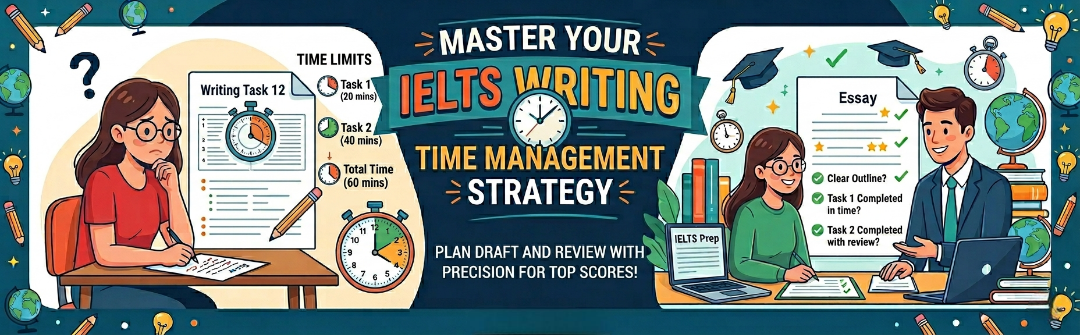
01 Jun 2026 | IELTS Time Management Strategy 2026: Complete Section-Wise Plan

0
92
Introduction: IELTS Time Management Strategy 2026
The process of training to take the IELTS test is not all about enhancing your English proficiency. Completing all the sections within the stipulated time is one of the biggest problems students encounter. Even students who are well prepared will fail to manage time well during the test, thus losing marks. For this reason, it is necessary to include a great IELTS time management strategy in 2026.
Regardless of whether you are ready to study in the United States, Canada, the United Kingdom, Australia, Germany, or Dubai, your IELTS score is a significant factor in admission to universities and in obtaining a visa. The intelligent use of time in IELTS would help you become more accurate, less stressed, and get the most out of it.
This is an all-inclusive guide that will not only instruct you on a part-by-part approach to IELTS, some tips and tricks on how to save some time on practice and what professional advice you can follow to ensure you approach each and every question in the test without any fear.
Understanding the IELTS Time Management Strategy in 2026
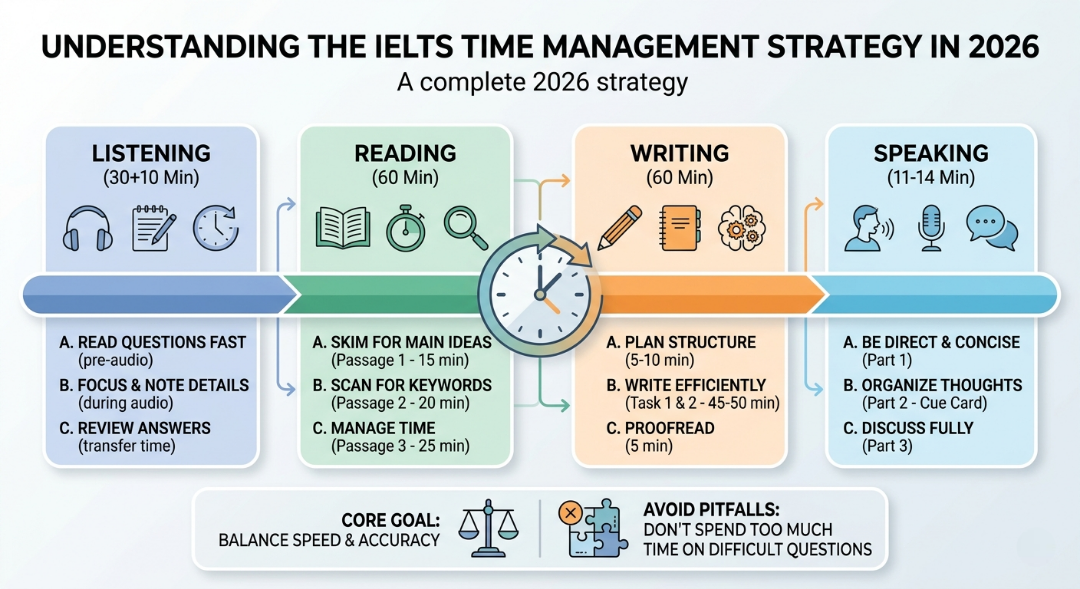
Students have to know the official IELTS examination time before estimating their effective time management plan.
|
IELTS Section |
Total Duration |
Time Management Focus |
Common Challenge |
|
Listening |
30 Minutes + 10 Minutes Transfer Time |
Find keywords quickly, track what is being said in audio, and examine responses during the time to transfer. |
Loss of focus- missed answers. |
|
Reading |
60 Minutes |
Make time appropriately in each of the three passages, and do not spend much time on a single question. |
Answer all questions promptly. |
|
Writing |
60 Minutes |
Tasks 1 and 2 are about balance and time to plan and proofread. |
Task 2: Time constraint. |
|
Speaking |
11–14 Minutes |
Be confident in your responses, arrange ideas efficiently, and remain fluent in the discussion. |
Hesitation, and Nervousness |
The biggest error which the students commit to themselves is that, they end up consuming too much time in the challenging issues when in the first stage of reading the test. The most successful IELTS section strategy is that which attempts to compromise about the speed and accuracy.
Check out: Best Free IELTS Apps in 2026 for Band 7+ Preparation
The Importance of Time Management in IELTS.
An effective plan in time management in IELTS is vital as time limits exist in all types of the exam, and even the well-prepared students can lose points due to his or her inability to manage the time properly. Proper planning will help the students get all its tasks done at a leisurely pace, growing accuracy and eradicating exam stress.
- It assists students to have a go at all questions on a real IELTS exam timing.
- It enhances concentration and helps to pull oneself together during challenging parts.
- It enables the students to contemplate pace and accuracy in Reading and Writing activities.
- It assists in preventing haphazard errors arising due to a rush at the end.
- It facilitates an enhanced performance through clever IELTS part preparation planning.
- It stimulates students to use practical time-saving clues for IELTS in their practice and exams.
- It enhances amicability in IELTS time management strategy in the real test setting.
By regularly practising and using the correct approach, students can score higher in their band and play more confidently on exam day.
IELTS Listening Time Management Strategy
The listening section requires strong concentration, quick learning, and keen decision-making, since one is only allowed to listen to the audio once.
Suggested listening approach
|
Stage |
Focus Area |
Time Strategy |
|
Before Audio Starts |
Read Questions |
Quickly identify keywords and predict possible answers |
|
During Audio |
Listen Carefully |
Focus on synonyms, numbers, and important details |
|
After Audio |
Check Answers |
Use transfer time to review spelling and grammar |
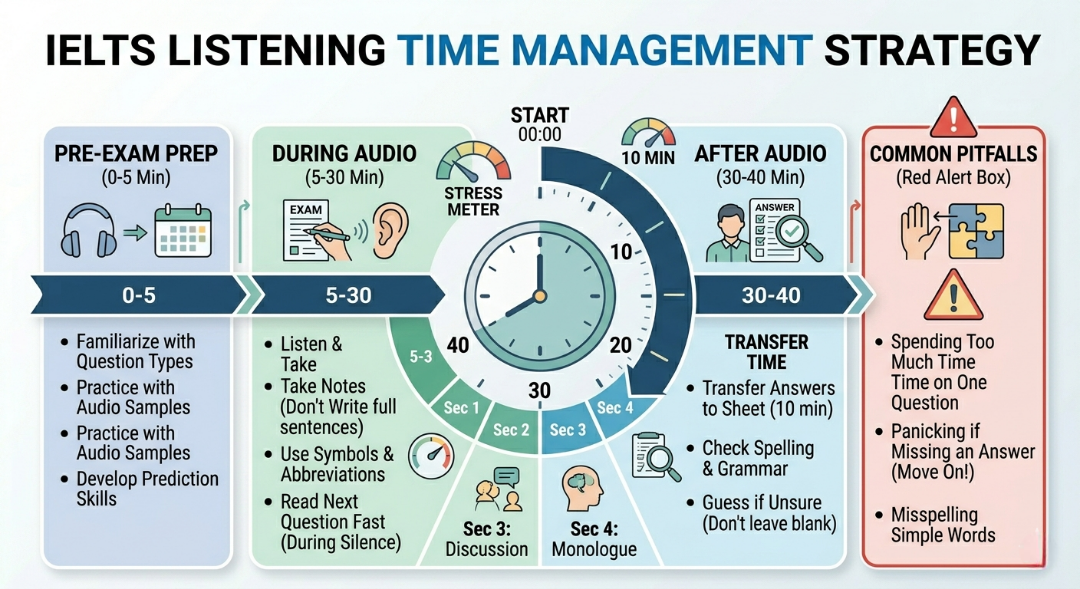
Effective Listening Strategies
- Children have to read inquiries quickly before the recording.
- Highlight words and concentrate on key details.
- Continue listening even when one of the answers has been missed.
- Note what words were used in the audio as synonyms and paraphrases.
- Do not get panic and remain in track during the recording.
Time-Saving Tips for IELTS Listening
- Practice Listening exams in timed conditions of official IELTS exam.
- Take notes and improve your ability to create it
- Have a steady approach to IELTS sections when doing mock tests.
- Listen to news, podcast and interviews
Regular training and astute practice may increase how confident you are in time management in IELTS Listening tasks and lead to a better band score.
Time Management Strategy of IELTS Reading.
Reading section is among the most time conscious aspects of the exam, and most of the students find it hard to go through all questions with limited time. The smart IELTS time management strategy will assist students to become speedy, accurate, and confident when working with the long passages.
Recommended Time Distribution
|
Reading Passage |
Recommended Time |
|
Passage 1 |
15 Minutes |
|
Passage 2 |
20 Minutes |
|
Passage 3 |
25 Minutes |
This strategy enables the student to take up extra time on the challenging passages and not be rushing towards the end.
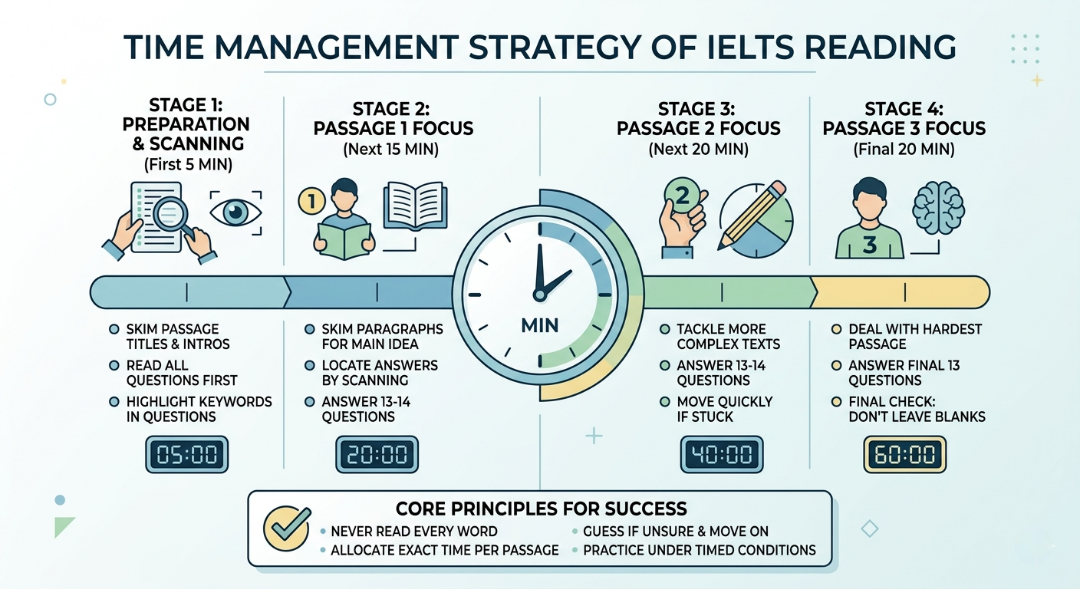
Effective Reading Strategies
- Reading Use skimming strategies to grasp the general meaning in a short time.
- Use scanning techniques to find keywords and key information.
- Reading every word is not necessary; focus on the keywords of the questions and synonyms.
- Bypass tough questions for now and come back to them later.
- Do not take excessive time on a paragraph or response.
Time-Saving Tips for IELTS Reading
- Practice Reading tests in official conditions of IELTS exams.
- Enhance vocabulary skills concerning common IELTS issues.
- Adhere to a regular IELTS part plan when doing mock tests.
- Check errors to enhance accuracy and speed.
Check Out: STEM vs non‑STEM courses – which one fits you?
IELTS Strategy of Writing Time Management
Writing is among the most demanding components of the exam as the students have to think, formulate ideas, and write correct answers within constrained time. An IELTS time management strategy will enable students to do both assignments and avoid the last-minute run around.
Recommended Time Split
|
Writing Task |
Recommended Time |
|
Task 1 |
20 Minutes |
|
Task 2 |
40 Minutes |
Task 2 gets more marks and so students need to devote more time to articulating good arguments and examples.
Task 1 Strategy
- Take 2-3 minutes to familiarise yourself with the chart, graph or diagram.
- Determine the major trends and important bits of data that require writing before writing.
- Be clear, well structured, and concise in your response.
Task 2 Strategy
- Create writing structure within 5 minutes.
- Use this structure: introduction, main body, and conclusion.
- Pay attention to conciseness and logical structure as opposed to writing a very long answer.
Tips about Saving Time in the IELTS writing.
- Write practice essays in the conditions of a real IELTS exam timing practice.
- Do not use too complex words that can result in something being wrong.
- Allow the final 5 minutes to correct grammar and spelling.
- Employ a regular IELTS section approach in the mock tests.
Timed drills and planned training will go a long way towards building your confidence in managing time during IELTS Writing activities and helping you achieve a better band score.
IELTS Speaking Strategy of Time Management.
The Speaking section can be less than the other sections of the exam, but students most commonly fail to gain marks by being nervous and hesitating and lacking time management. An intelligent IELTS time management strategy can make students respond with confidence, are fluent, and also plan their ideas well at the test.
Part 1: Introduction and Interview (45 Minutes)
- Provide brief, nonverbal, and direct responses.
- One-word answers and explanations of simple questions should be avoided.
- Pay attention to articulating and feeling confident.
Part 2: Cue Card Round (3-4 Minutes)
- Take advantage of the 1-minute preparation time.
- reason why use keywords, not full sentences.
- Use a straightforward start, body, and conclusion when talking.
Part 3: Round of discussion (4-5 Minutes)
- Include comprehensive answers, including examples and views.
- Be fluent despite minor grammatical errors.
- Enhance flow and unity by using connecting words.
IELTS Speaking Time-saving Tips.
- Every day IELTS practice on everyday topics of speaking.
- Write the answers to enhance pronunciation and fluency.
- Do not have memorised answers to use on the test.
- Use a systematic IELTS section plan to guide your response.
Taking practice of speaking and gaining confidence through practice may dramatically increase your IELTS time management strategy and overall Speaking band score.
Check out: Course Comparison: Humanities v/s Social Sciences
Common Time Management Mistakes in IELTS
The reason is that many students are unable to reach their target band score as they usually concentrate on English proficiency and neglect the need to implement a reasonable IELTS time management strategy. By avoiding the pitfalls, students can learn to speed up, be more accurate and more confident in the exam.
- Wasting a lot of time on the hard Reading questions rather than proceeding.
- Having extremely long Introduction and Conclusion in the Writing section.
- Panicking upon not getting answers in Listening and forgetting about the following questions.
- Failure to practice under official IELTS examination time.
- Lack of concern with proofreading time in Writing tasks.
- Attempting to read the words rather than employing skimming and scanning.
- Not adhering to an appropriate IELTS section strategy when taking mock tests.
- Do not practice time-saving tips to use during IELTS practice before the test.
By tracking down these errors at the initial stage, students will be able to further their time IELTS time management strategy and approach test day with greater confidence.
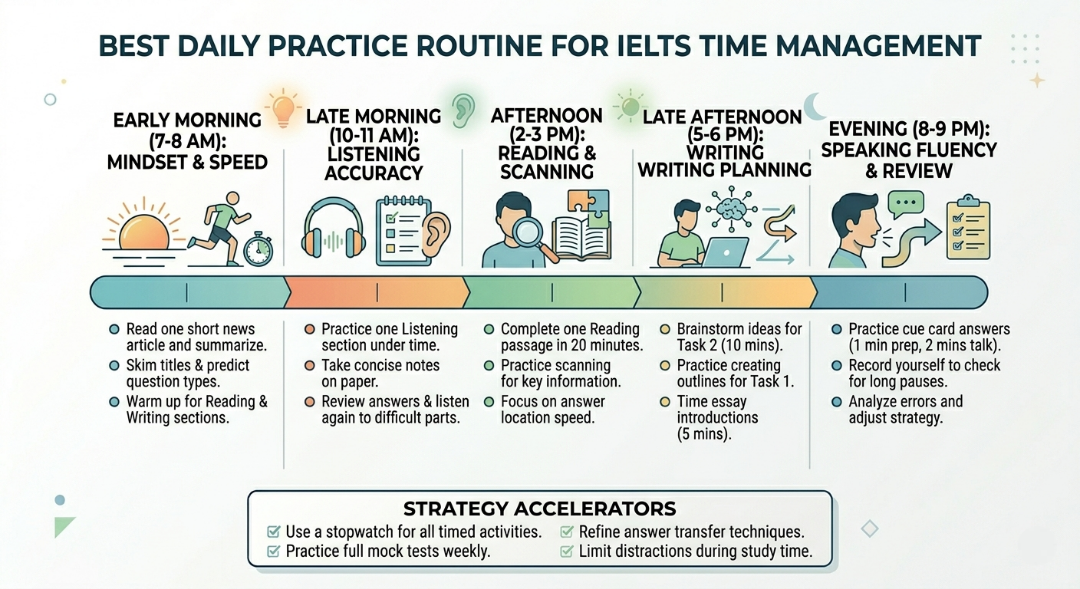
Best Daily Practice Routine for IELTS Time Management
The daily timetable helps students develop a good IELTS time management strategy and improve their performance in actual exams.
|
Time of Day |
Practice Focus |
Key Activities. |
|
Morning |
Reading Practice |
Complete one Reading passage using the timer, work on scanning and skimming and keep all the mistakes noted. |
|
Afternoon |
Writing Practice |
Complete Task 1 or Task 2 under official IELTS examination time and allow some time to go through proofreading. |
|
Evening |
Listening & Speaking |
Practice listening with headphones, record speaking answers, and implement tips to save time on the IELTS. |
|
Weekly |
Full Mock Test |
Do one complete IELTS mock test to refine your strategy in the IELTS section and confidence in dealing with time in IELTS. |
A regular practice routine can help students develop speed, accuracy, and overall band performance.
An Overview of How Gateway Educonnect Benefits IELTS Aspirants.
With professional advice and trial training, students will develop a powerful IELTS time management strategy with the help of Gateway Educonnect.
- One-on-one IELTS training towards desired band scores.
- Specialists support strategies of each IELTS section.
- IELTS tested mock tests with ideal time-saving tips.
- Advice on formal IELTS time.
- Scholarship, visa, loan and housing support.
- Assistance to study abroad in USA, UK, Canada, Australia, Germany, France, and Dubai.
- Over 15 years’ experience with 23, 000+ students who have been guided successfully.
Through student oriented mentorship, Gateway Educonnect enables students to build confidence and excel in time management in IELTS.
FAQs
Which is the fastest IELTS time management?
The optimal IELTS time management strategy would be strict timing in practice in all sections, paying attention to questions that will be less difficult to respond to at the beginning and not wasting too much time on a single task. Speed and confidence can also be enhanced by regular mock tests.
What can I do better to manage time in IELTS Reading?
The key steps to manage time better in IELTS Reading are: first, scan and skim all passages, allocate appropriate time to each passage, and proceed to the next if a question requires more time.
What are the most productive time saving hints of IELTS Writing?
It is common knowledge that some of the valuable time-saving tips for IELTS Writing are that one has to plan their response first, one has to adhere to an acceptable structure and leave the remaining few minutes to correct any grammar and spelling mistakes.
So why is it important to know IELTS exam timing?
Knowing the time of IELTS exams enables students to do all parts with ease. It is also effective in enhancing concentration, minimizing panic, and having sufficient time to look at answers multiple times.
Is it possible to use professional advice to enhance IELTS performance?
Yes, professional advice can assist students in becoming more accurate and better at time management to achieve higher band scores and in learning to create their IELTS section plan.
🌍 Looking for flexible learning opportunities from leading international institutions? Browse the latest programs at Gateway Educonnect Online Courses.
Conclusion
Not only proficiency in English, but also the ability to approach time management in a smart, practical way are key to mastering the IELTS exam. An organised IELTS time management strategy enables a student to remain composed, take on all challenges in stride, and thereby be better placed to achieve a higher band score. Knowing how the exam is structured, training on the actual timing of the IELTS exam, and using effective time-saving IELTS tips will help students work more effectively in Listening, Reading, Writing, and Speaking.
The keys to success are consistency, mock tests and preparation in sections. When you are planning to study abroad to such countries as Canada, the UK, Australia, or the USA, there is advice on how to help you prepare, so expert guidance will help you focus on your preparation efforts.
Are you already prepared to achieve your dream IELTS score and study abroad? Get in touch with Gateway Educonnect today to receive personal counselling, professional advice, and comprehensive care for your international education experience. For more assistance, please visit our study abroad consultancy services and explore our wide range of offerings for students interested in studying in the USA, studying in the UK, studying in Canada, studying in Australia, studying in Ireland, and many other countries.

Author Bio
Abhinav Jain - Founder, Gateway Educonnect and Director.
B.Tech, MBA, AI and Global Education Specialist.
More than 15 years of professional experience in leading students along international routes based on politics and innovation.