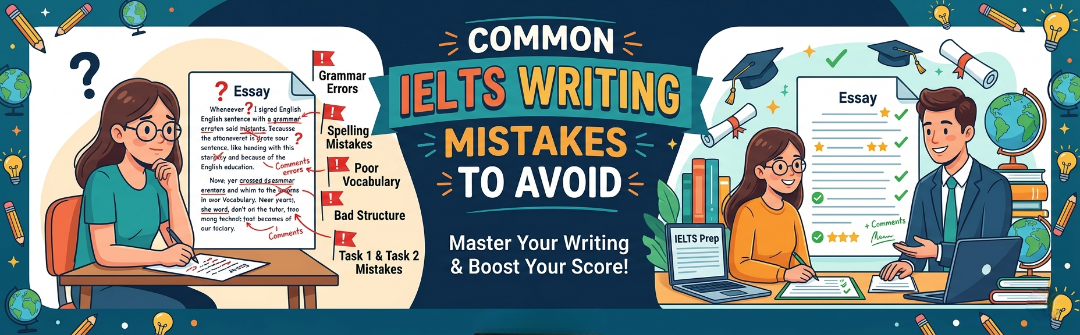
01 Jun 2026 | IELTS Writing Mistakes That Keep Students Stuck at Band 6

0
64
Introduction: IELTS Writing Mistakes That Keep Students Stuck at Band 6
Scheduling the IELTS exam can be disheartening, particularly as students are repeatedly getting the same Band 6 score in writing, despite practicing the exam. This is the challenge many Indian students, who wish to pursue their education abroad in places such as the UK, Canada, Australia, the USA, Germany, or Dubai encounter. It is not always a matter of vocabulary and grammar. Rather, minor yet repetitive IELTS writing mistakes prevent students from advancing to Band 7 or beyond.
These errors are significant to understand, as IELTS Writing has a direct effect on university admissions, scholarships, and visa prospects. Over the past 15+ years, our professionals have helped 23,000+ students at Gateway Educonnect achieve their goal of international education. In this blog, we are going to dissect the most frequent problems that students encounter, how to correct them, and provide actual strategies that will enable you to improve your score with confidence.
Reasons Why Students Keep at Band 6 in IELTS Writing.
The majority of the students think that the more essays they write, the higher they will score. Nevertheless, repeated practice solely supplies bad habits, unless there is an effort to work on fundamental weakness points.
Repeating IELTS writing mistakes when it comes to structure, response to the task, grammar and coherence are the largest factors that cause students to stay stuck.
🌍 Looking for flexible learning opportunities from leading international institutions? Browse the latest programs at Gateway Educonnect Online Courses.
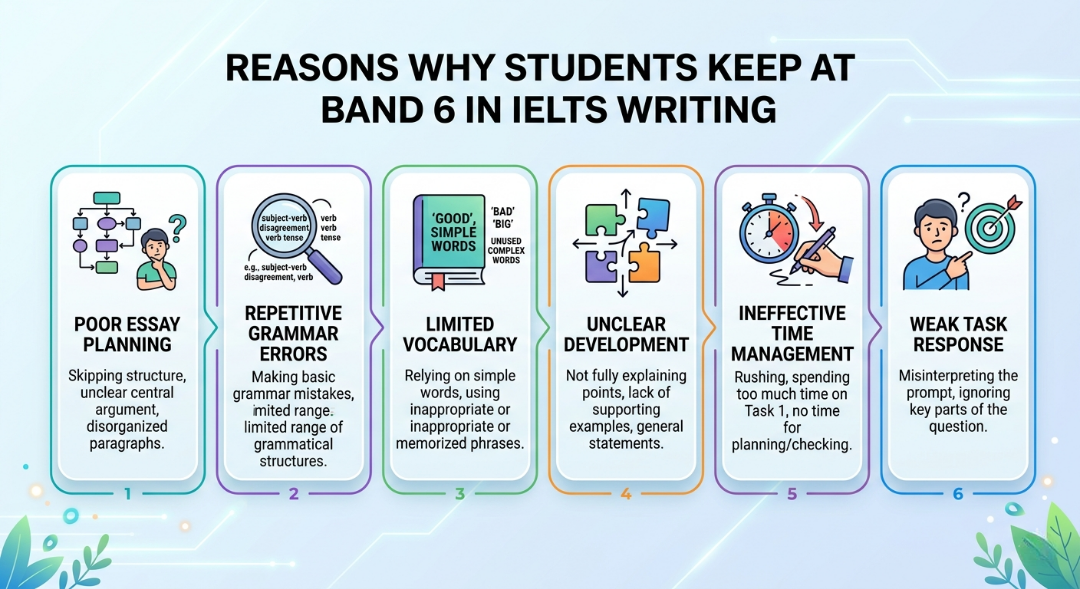
Some typical patterns that the examiners observe are as follows:
- Students respond to the question, not to the full extent of the requirements.
- Essays tend to be missing a logical sequence and structure of paragraphs.
- When ideas are good, grammar errors diminish their clarity.
- Words are unnaturally made to sound sophisticated.
- Task 2 essays are usually too general in nature with no examples or explanations.
Learning about the following IELTS writing mistakes would be the initial, but not the obvious, step towards improvement.
Check Out: STEM vs non‑STEM courses – which one fits you?
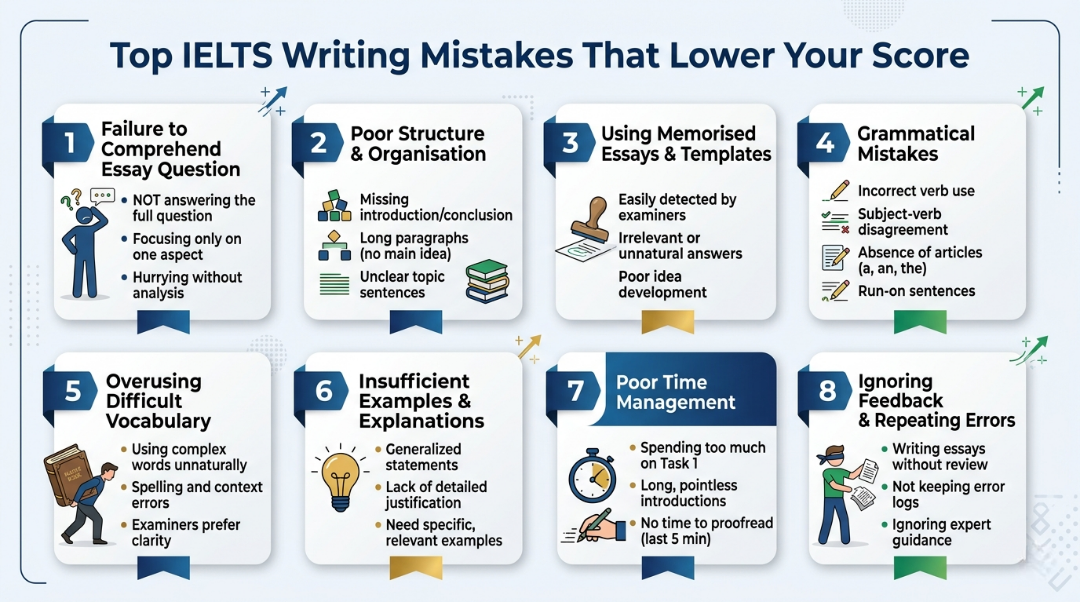
Top IELTS Writing Mistakes That Lower Your Score
Simple but repeater mistakes lead many students to lose marks in IELTS Writing. The positive news is that these problems can be corrected by the appropriate approach and constant training.
1. Failure to comprehend the Essay Question.
Answering the question is one of the most typical IELTS writing mistakes. When a task requires it, students tend to start writing too quickly and fail to comprehend what it requires them to do.
Example: Where is the hotel located?
- Discuss both views and give your opinion.
- Discuss reasons and remedies.
- Compare advantages and disadvantages.
Nevertheless, a good number of students would focus on one aspect of the question, which reduces the Task Response score.
Why This Happens
- Exam time is when students become panic-stricken, and they hurry to write.
- Essay templates are over-reliied upon by many.
- Some do not find the key instructions keywords appropriately.
- Answers are in a hurry and unclear due to poor time management.
How to Avoid It
- Take time to analyse the question before you write (3-5 minutes).
- Circle keywords and indicate the typology of the essay.
- Before beginning the essay, make up your mind and your central argument.
This is among the best IELTS writing band 7 tips since no good grammar could improve an answer, which is not complete.
2. Poor Structure and Organisation of Essays.
The commonest challenge that causes students to be stuck at Band 6 of IELTS Writing is poor organisation of the essay. Examiners are fond of clear, logical and easily followed essays. Most students earn marks due to very long paragraphs, the incorporation of several thoughts into a single sentence, or the absence of clear topic sentences. Quick alternations between ideas also have an impact on coherence and make essays tough nuts to crack. These are typical task 2 writing errors that lower overall writing scores.
A well-organised IELTS essay ought to contain:
- A clear introduction with the main idea.
- One-point and two body paragraphs with descriptions.
- A brief conclusion to conclude the argument.
Each paragraph ought to have one main idea. Clear organisation enhances readability and enables the students to argue more effectively.
3. Using Memorised Essays and Templates
Most students have to rely on memorised essays at coaching centres or the Internet. Nevertheless, it is among the most common IELTS writing mistakes that may reduce your mark.
Memorised information can be quite easy to detect by examiners and can result in:
- Answers to irrelevant questions, which may not be completely satisfactory to the essay question.
- Absence of natural vocabulary and poor syntactic structure in the essay.
- Poor performance on tasks because of poor idea development.
- Problem with being able to cope with unrelated issues during IELTS.
Improved Strategy to enhance IELTS Writing.
- Master versatile essay patterns rather than repeating verbatim solutions.
- Practice creating ideas on usual IELTS subjects frequently.
- Clear and natural language, rather than imposed complex words.
- To learn how to develop a strong argument, review Band 7 sample essays.
To really enhance IELTS writing, focus more on the essay's logic rather than copying prewritten essays.
4. Grammatical Mistakes that decrease clarity.
Correct grammar is significant to IELTS writing marks. Students commit the same Common IELTS writing mistakes over and over again, which can reduce their clarity and overall performance.
Some of the common grammar errors are:
- Mistakes in the correct use of verbs that reduce grammatical correctness in IELTS writing assignments.
- Misalignment of verbs with the subject that undermines the meaning and comprehension of the sentences.
- Absence of articles such as a, an, and the in the sentences of academic writing.
- Wrong punctuation that causes ideas not to be easily understood by the examiners.
- Sentences that run on and render the essay to have a disorganised look.
What To Do To improve IELTS Writing grammar.
- Reconsider grammar errors following each practice essay to prevent the occurrence of similar errors.
- Concentrate on composing simple and precise sentences rather than too complicated sentences.
- Write very short grammatically correct paragraphs every day to enhance the fluency of the sentences.
Among the most effective strategies to develop IELTS writing is initially to rectify common IELTS writing mistakes in grammar and subsequently to meet advanced vocabulary.
Check out: Computer-Based IELTS Tips 2026: How to Score Faster in the Digital Exam
5. Overusing Difficult Vocabulary
Students commonly think that difficult words automatically increase the IELTS scores. Nevertheless, one of the frequent IELTS writing mistakes that may reduce the marks is a wrong or unnatural use of vocabulary.
Examiners mainly evaluate:
- Clearly written throughout the essay.
- Relevant and sound language that is fluent.
Some Vocabulary Errors
- The use of words that one does not necessarily know how to use or spell correctly.
- Incorporation of complicated phrases in an unnatural manner to become more scholarly in writing.
- Using memorised and enhanced vocabulary that does not appropriately match the subject.
More Advised Strategy to improve IELTS Writing.
- Vocabulary to use - this is vocabulary you can put to use, and you can do so in other essay topics naturally, with confidence.
- Use words that are understandable and naturally spoken rather than imposing some alien and complex words.
Easy, natural writing is always much better than forced complexity. This is among the most effective IELTS writing band 7 tips students should follow.
6. Insufficiently Clear Examples and Explanations.
One flaw that is widespread with Band 6 essays is lack of development of ideas. Students give generalized statements without justifying their claims.
One weak instance
Technology has got a positive impact on education.
This is too broad of a sentence and does not explain or give an example that can be used to substantiate the thought.
One strong instance
Technology enables international students to use the online learning resources (Coursera, edX) and make the learning process more adaptable and reachable.
Some drawings can help make your essay more attractive and these can be applied to enhance the ratings of task achievement.
To prevent the following task 2 writing errors, always:
- Be able to articulate your ideas rather than compose brief statements that are too general and will lack detail.
- Make sure that you use at least one example that is relevant in every body paragraph to make your explanation more powerful.
- Make sure that your examples show well as to why you are making the main argument, not that you are putting extra details that cannot be covered in the main argument.
7. Poor Time Management During the Exam
Students end up losing marks due to IELTS writing mistakes, and time constraints, as they are unable to complete both assignments well.
Tips on Time mismanagement.
- Devoting excess time to Task 1 and hurrying up with the more crucial Task 2 essay.
- avoiding meaningful insight and time wastage by writing long introductions to exams.
- Missing the step of setting time aside to proofread grammar, spelling and punctuation errors at the final point.
Recommended Timing Strategy
- Task 1: Take approximately 20 minutes to do the report/letter writing task with care.
- Task 2: It will require at least 40 minutes since it is worth more points in IELTS Writing.
- Final Checking: Leave the last 5 minutes to vocabulary, punctuation errors, and proofreading grammar.
Some strategies to save your time
- Write briefly in a plan before you compose to make your writing more structured and organised in terms of ideas.
- It is unnecessary to rewrite sentences three times, as doing so wastes time on the IELTS exam.
- Practice essays with time constraints more often to be able to write faster.
Proper time management will reduce stress and minimise typical IELTS writing mistakes caused by time constraints.
8. Ignoring Feedback and Repeating the Same Errors
Lots of students find themselves in Band 6 due to the recurring IELTS writing mistakes writing without reading into them. The only way in which you can actually get a better score in terms of writing more essays is by paying attention to your weak points all the time.
What Prospective Learners Do (But are successful in IELTS) that achieve success differently.
- Read through corrected essays and spot common errors in grammar, vocabulary and structure.
- Keep a notebook of mistakes that happen most of the time to prevent repeating the same mistake in writing.
- Get expert help now and then to improve performance as a writer.
Active analysers commonly overcome their drawbacks and minimise the IELTS writing mistakes associated with them, making a successful improvement.
Check Out: IELTS One Skill Retake 2026: Everything International Students Need to Know
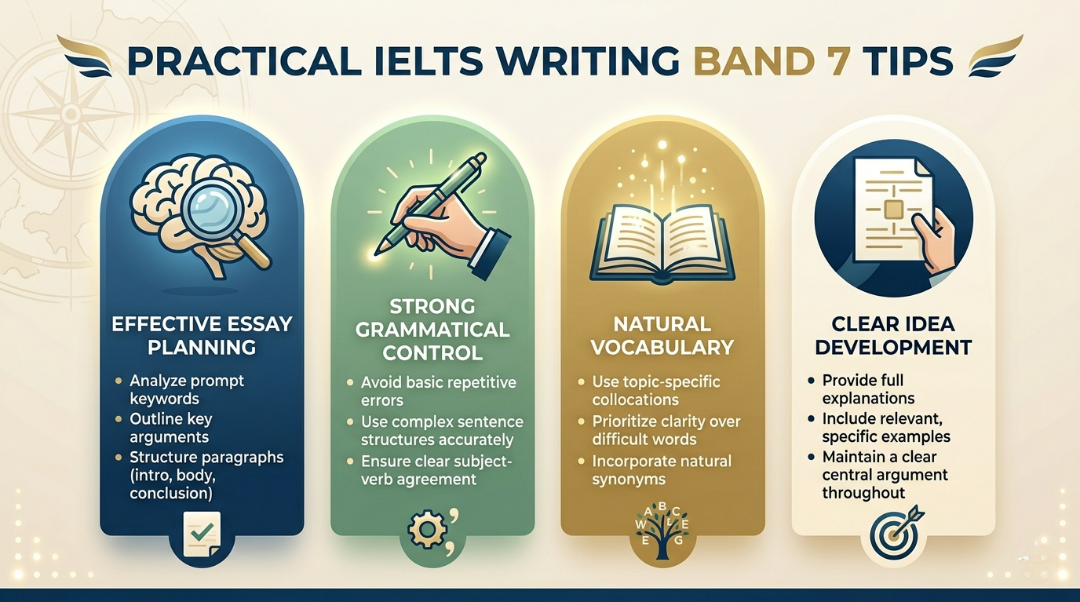
Practical IELTS Writing Band 7 Tips
To improve your IELTS Writing score, you need to exercise and get constructive criticism as well as effective preparations. Students who hope to achieve Band 7 are supposed to work on establishing solid writing habits, as opposed to memorising essays.
Effective Writing Habits
- Regularly write one Task 2 essay every two days under the conditions of a timed IELTS exam.
- Practice Task 1 summarises and reports data to enhance the use of data interpretation and organisation.
- Examine Band 7 sample essays critically to learn about structure, coherence and use of vocabularies.
Referring to the usual routine will help eradicate widespread IELT errors in writing over time and enhance his writing fluency.
Target Feedback to practice, rather than practice.
When students practice without going over past errors, they repeat the same errors.
Development Strategies
- Recognise common IELTS writing mistakes and emphasise correcting them in the same direction.
- Keep a record of grammar/vocabulary mistakes to revise and improve on.
Feedback-enabled students tend to learn more quickly than blind students.
Develop Reading English Skills.
Quality English reading material on a regular basis can play a great role in the enhancement of the IELTS Writing.
Reading Helps Improve
- Academic writing (Structure of sentence and grammatical correctness).
- Uses of vocabulary and expression in various topics of IELTS essays.
- Capabilities to develop ideas and logically explain them, as needed in Task 2 essays.
Recommended Reading Sources
- BBC News to write clearly and formally.
- The Guardian to share your opinion and enhance your vocabulary.
- National Geographic to develop ideas and writing techniques.
- IELTS sample essays on learning the expectations of examiners and high-scoring patterns.
- These practices slow down the Common IELTS writing mistakes and assist student to develop sound academic writing instinctively.
Check out: Course Comparison: Humanities v/s Social Sciences
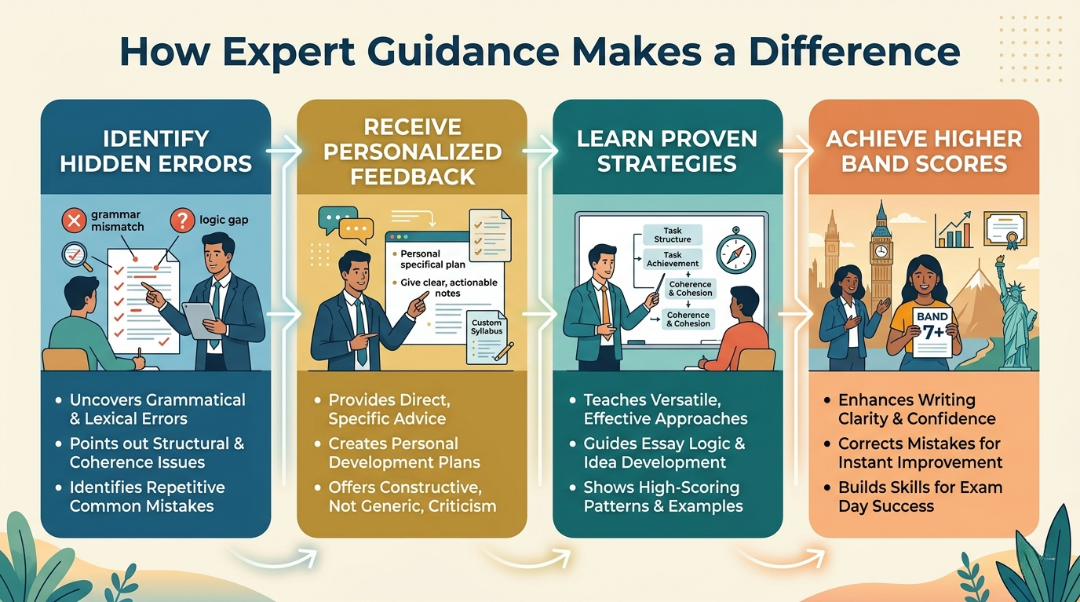
How Expert Guidance Makes a Difference?
Most students perform the same IELTS writing mistakes due to lack of proper feedback or strategy in making the attempts.
The value of Professional Advice.
- Teachers indicate grammar, coherence, and vocabulary errors as some of the mistakes that students tend to miss when they write on their own as they prepare to study.
- The effect of professional feedback is an improvement in steering the structure of the essay, the development of ideas and a general writing clarity.
- Personalised plans to get rid of the multifarious repetitive Common IELTS errors and to improve band scores are being offered by trainers.
- Mimic tests and elaborate assessments enable students to take tests in the actual IELTS examinations with confidence.
Having support and practising IELTS writing helps students eliminate IELTS writing mistakes and attain higher IELTS band scores.
Conclusion
To score higher in your IELTS Writing, it is not necessary to use complicated words or memorise your essay. The majority of students are just at the level of Band 6 due to recurrent IELTS writing mistakes of grammatical, structural, cohesive and task responsive nature. Through such errors, when learner is aware of such errors and implements the appropriate strategies, he will be able to pick up slowly on his or her performance in writing and also get a better score in these bands.
Regular practice, good time management, thorough review, and good reading skills are all important for writing improvement. The students are not supposed to sound complicated, but they should concentrate on clarity, logicality and natural language.
At Gateway Educonnect, we have professionals who advise students and provide personalised assistance, IELTS preparation schemes, and counselling for studying abroad. By knowing the right path and being committed, it is a lot easier to attain your desired IELTS score with a lot less stress. For more assistance, please visit our study abroad consultancy services and explore our wide range of offerings for students interested in studying in the USA, studying in the UK, studying in Canada, studying in Australia, studying in Ireland, and many other countries.
FAQs
How can it be the quickest way to enhance IELTS Writing skills?
The most effective method of improving IELTS writing is regular and timed practice with detailed feedback analysis, grammar and reading quality English material daily.
What is the reason why most of the students reach the Band 6 of IELTS Writing?
There are common IELTS writing mistakes that many students make again and again due to a lack of correction or advice from their expert regarding grammar, essay structure, responding to the task, and coherence.
Are grammar mistakes an important factor in IELTS Writing scores?
Yes! When repeating grammar mistakes, you can lose your Grammatical Range and Accuracy score quite easily and you will find it difficult to achieve higher bands in IELTS Writing.
Does coaching have the potential to minimise typical IELTS writing mistakes?
Yes, professional advice helps pupils identify previously unnoticed flaws, avoid common IELTS writing mistakes, and improve overall writing outcomes more quickly.
Task 2: On IELTS Writing exam, how critical is it?
Task 2 attracts more marks than Task 1, so it is important not to commit errors on Task 2 writing when you are targeting to attain Band 7 or more.

Author Bio
Abhinav Jain - Founder, Gateway Educonnect and Director.
B.Tech, MBA, AI and Global Education Specialist.
More than 15 years of professional experience in leading students along international routes based on politics and innovation.