21 Sep 2026 | Eligibility for Ireland Universities 2027-28: Complete Guide for Indian Students

0
15
Introduction
For Indian students planning a Master’s degree in Ireland for the 2027-28 intake.
Indian applicants do not have one national percentage that makes them eligible for every Irish Master’s programme. For Ireland university eligibility Indian students, the correct approach is to check three layers: the university’s India-specific academic rule, the individual programme requirement, and the English-language requirement. Official pages already show different percentage mappings and treatment of 3-year degrees.
That is why Ireland university eligibility Indian students cannot be reduced to “you need 60%”. Your Bachelor’s degree, awarding institution, programme, academic background and English evidence all matter.
Accuracy note: Admission rules, English requirements and application dates can change. Some 2027-28 details are still pending. Verify the live university and programme pages before applying.
Ireland University Eligibility Indian Students: A-Glance
|
Eligibility area |
What you should check |
|
Bachelor’s qualification |
Whether your Indian degree is accepted |
|
Academic result |
The Irish classification required and its India-specific equivalent |
|
Degree duration |
Whether a 3-year degree is accepted and under what conditions |
|
Subject background |
Whether the Master’s requires a related discipline or prior subjects |
|
English |
Accepted test or exemption route and exact score |
|
Documents |
Core academic documents plus programme-specific additions |
|
Timing |
Live 2027 opening date and programme deadline |
What this means: the criteria are programme-specific. A student can meet one university’s threshold and fall short of another university’s requirement for a similar course.
What Academic Qualification do Indian Students need for a Master’s in Ireland?
The first part of Ireland university eligibility Indian students should check is the level and type of the Bachelor’s qualification.
QQI’s NARIC Ireland foreign-qualification guidance compares foreign qualifications with Irish awards, but its comparability statements are advisory. The education provider makes the final admission or recognition decision.
Trinity College Dublin’s India entry requirements state that postgraduate applicants normally need at least a 2.1 honours degree from an Irish university or an equivalent result from another country. Individual courses can require higher standards, tests or interviews.
This matters because Ireland university admission requirements start with the programme. You must first know whether the course asks for a 2H2, 2H1, first-class equivalent or another standard before interpreting an Indian percentage.
What is the Minimum Percentage to Study in Ireland for a Master’s?
There is no verified national minimum percentage to study in Ireland for all Indian Master’s applicants. Official university pages use different thresholds.
Current academic-equivalency examples
|
University |
Published guidance for Indian postgraduate applicants |
|
University of Galway |
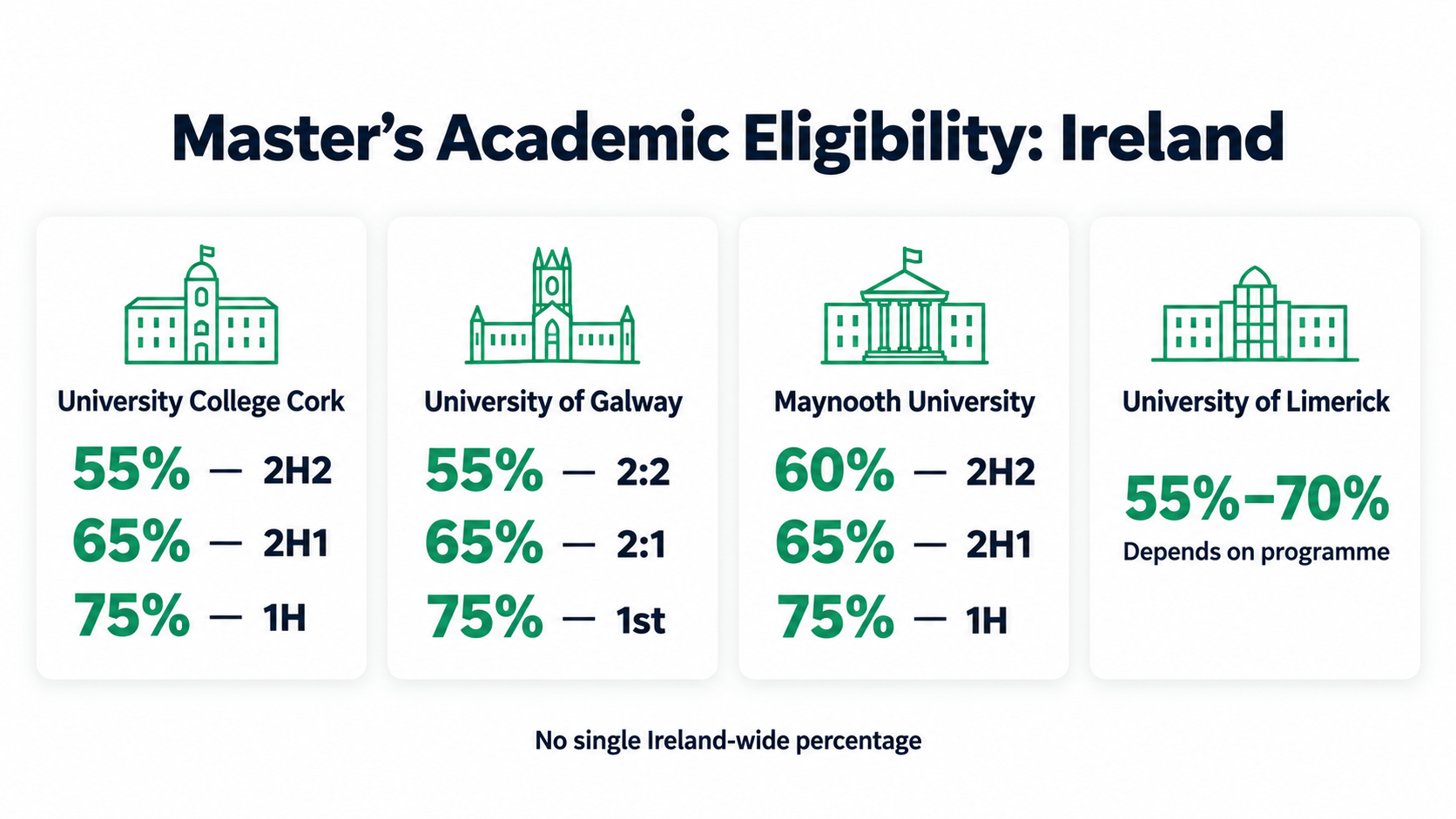
Standard mapping: 2:2 55%; 2:1 65%; 1st 75% |
|
University College Cork |
2H2: 55%; 2H1: 65%; 1H: 75% |
|
Maynooth University |
2H2: 60%; 2H1: 65%; 1H: 75%, with lower thresholds for specified universities |
|
Trinity College Dublin |
A minimum 2.1 honours degree or equivalent, there is no single Indian percentage listed on its India page. |
|
University of Limerick |
Depending on programme, normally 55% to 70. |
Official sources: UCC India postgraduate requirements, University of Galway India requirements, Maynooth India postgraduate requirements, University of Limerick international postgraduate requirements and Trinity India requirements.
What this means: a generic “60% for Ireland” rule is not supported by these official sources. Use the minimum percentage to study in Ireland only in the context of the specific university and course.
For Ireland university eligibility Indian students, first identify the Irish classification required by the programme, then check the university’s India-specific conversion where one is published.
University of Galway gives lower percentage equivalents for applicants from Delhi, Mumbai, Pune, Calcutta and Anna University, and institutions in the top 100 of the 2025 NIRF ranking. Its page dates that NIRF reference to 1 October 2025. Maynooth also publishes lower thresholds for applicants from Delhi, Mumbai, Pune and Calcutta universities.
This shows why Ireland universities eligibility for Indian students cannot be inferred from another institution’s policy.
Check out: Cost of Studying in Ireland 2027-28: Complete Guide for Indian Students
Are 3-year Indian Bachelor’s Degrees Accepted?
Sometimes, but there is no universal rule. This is a critical check for Ireland university eligibility Indian students with a 3-year BA, BSc or BCom.
Maynooth states that a 3-year Bachelor’s may be accepted where the final year includes a research project, capstone, thesis, dissertation or internship. Certain 3-year degrees without such a component may be considered for specific business programmes at a 75% minimum.
UCC states that for a 3-year Bachelor’s degree, the standard of the awarding institution will be considered. University of Limerick accepts a 3-year honours Bachelor’s degree in a relevant discipline and normally requires first-division results between 55% and 70%, depending on the programme.
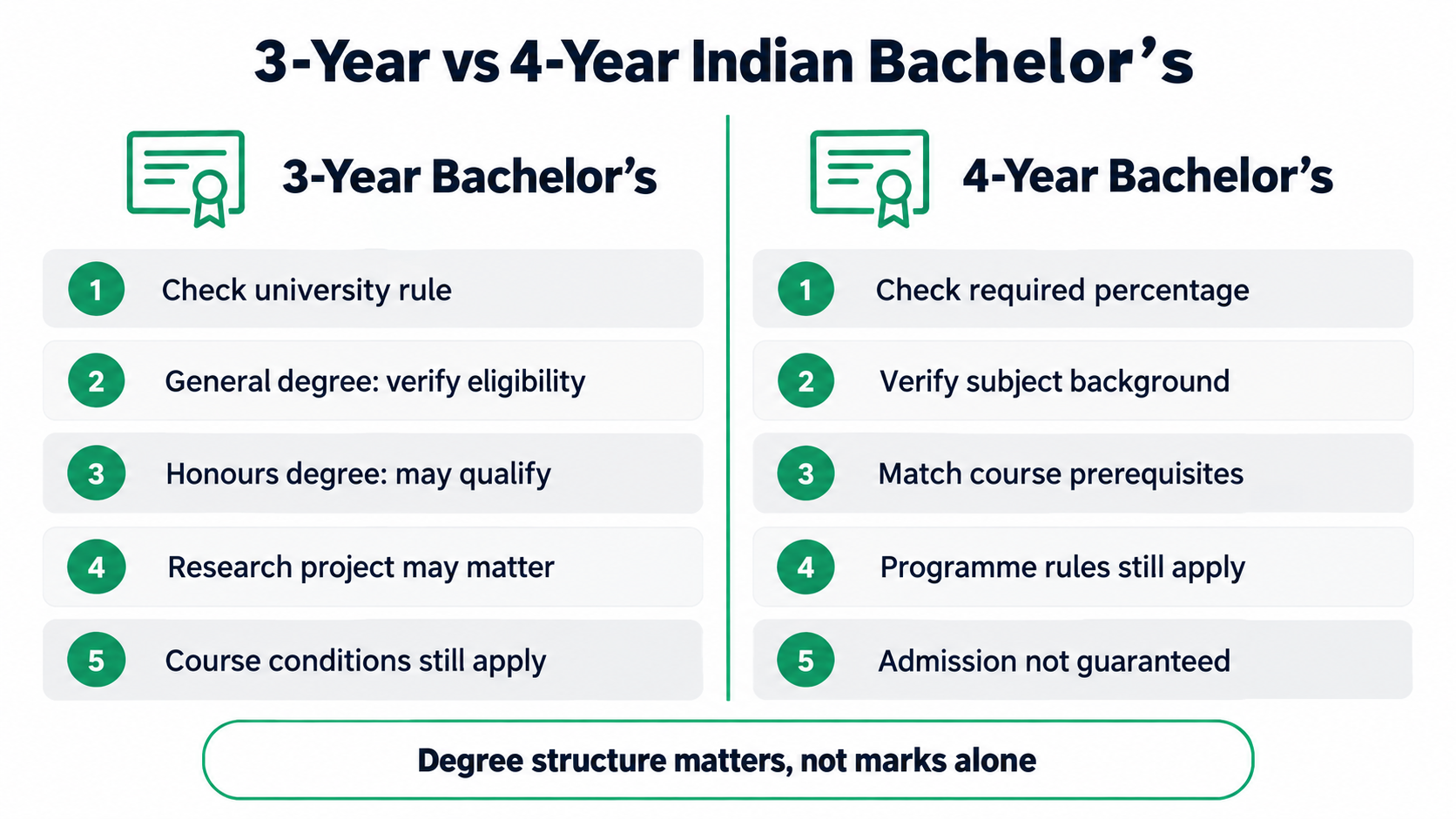
3-year versus 4-year degree check
|
Qualification |
What to verify |
|
3-year general Bachelor’s |
Do not assume automatic eligibility; check the university’s India rule |
|
3-year honours Bachelor’s |
Some universities publish routes for qualifying honours degrees |
|
4-year Bachelor’s |
Check the required percentage and subject background |
|
Degree close to the threshold |
Verify the course requirement before paying an application fee |
What this means: academic percentage is only one part of Ireland university eligibility Indian students. Degree structure and subject relevance can be equally important.
Check out: Diploma Courses Abroad After 12th for Indian Students: Best Countries and Colleges
Does your Bachelor’s Need to be in a Related subject?
For many programmes, yes. Ireland university admission requirements can include a relevant academic discipline, prior modules, work experience or an interview.
University of Limerick’s India guidance requires a relevant discipline and notes that some programmes may require an interview or work experience. Course pages can add CV, reference or portfolio requirements.
Before applying, check:
- whether your Bachelor’s field is accepted;
- whether mathematics, statistics, programming or another subject is required;
- whether work experience is compulsory;
- whether an interview or portfolio is required;
- whether the programme sets a higher threshold than the university’s general guidance.
For Ireland university eligibility Indian students, marks alone are not enough. UL also states that not every applicant who meets minimum grades will receive a place.
What English-Language Requirements Apply?
English proficiency is another core part of Ireland university eligibility Indian students must verify at course level.
Trinity’s current English-language requirements give IELTS Academic 6.5 overall with 6.0 in each band for standard Band B. University of Galway’s English requirements also give a general IELTS requirement of 6.5 overall with no component below 6.0, while noting that some programmes require higher scores.
On the current page of Maynooth, there is 2026/2027, IELTS 6.5 and no lower band than 6.0 that states that the requirements are reviewed within a year. DCU reports that its English page is undergoing update and outlines a number of requirements (particularly entry 2027).
Current English-language examples
|
University |
Important caution |
Published example |
|
University of Galway |
There are courses that are more expensive to pass. |
IELTS 6.5 average, 6.0 each, mostly. |
|
Trinity College Dublin |
Check required band of the programme. |
IELTS 6.5 overall, 6.0 each for Band B |
|
Maynooth University |
Page is for 2026/27 |
Duolingo 120/110, PTE 63/59; IELTS 6.5/6.0; |
|
Dublin City University |
Page says it is being updated |
Requirements vary by faculty |
One national English score cannot be used to check the Ireland university eligibility Indian students. In case of the academic eligibility of Indian students at Ireland university, rules of shelf course level English prevail.
Can Indian students use MOI or Class XII English instead of IELTS?
Do not assume an Indian Medium of Instruction certificate automatically provides an English-test waiver.
Maynooth’s Bachelor’s English exemption list names Ireland, the UK, USA, Australia, New Zealand, Nigeria and Canada; India is not listed.
University of Galway publishes a separate route for specified Indian Standard XII English qualifications, with conditions and verification requirements.
For Ireland university eligibility Indian students, use the exact English policy published by the university and course. Do not apply one university’s waiver rule to another.
What Documents are Required for Ireland University Admission?
The documents required for Ireland university admission vary, but academic records and qualification evidence are core.
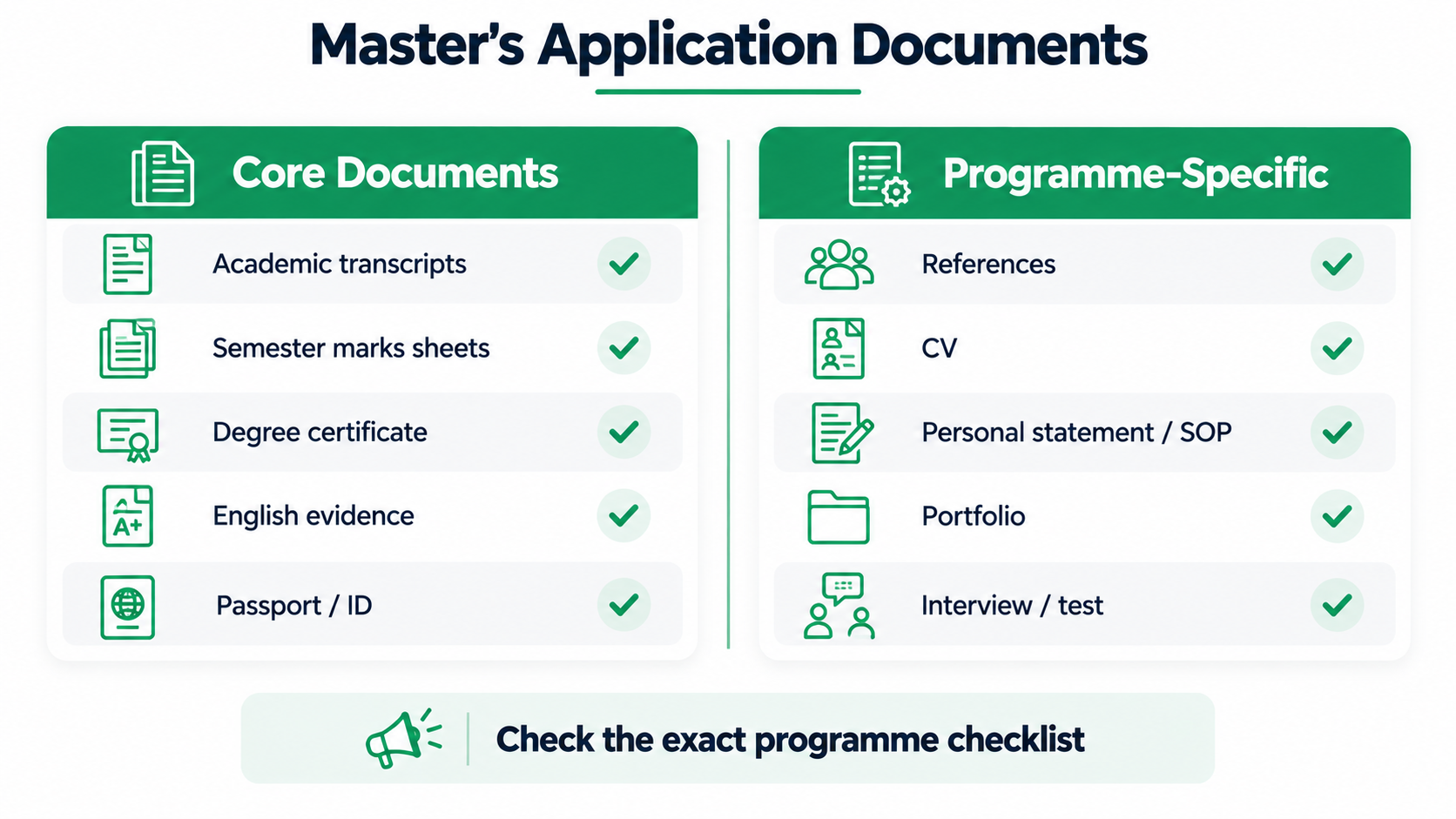
Trinity’s international postgraduate entry guidance lists academic transcripts, certified degree certificates, English-language evidence and two academic references among its application materials. UL requires full transcripts or marks sheets for every semester from Indian applicants and states that a consolidated marks sheet alone is insufficient.
Master’s application document checklist
|
Document |
How to treat it |
|
Academic transcripts/semester marks sheets |
Core evidence; follow university format rules |
|
Degree certificate |
Common proof of completed qualification |
|
English-language evidence |
Required unless an accepted exemption applies |
|
Passport/identity document |
Common application document |
|
References |
Number and type vary |
|
CV |
Programme-specific |
|
Personal statement/SOP |
Programme-specific |
|
Portfolio/interview/test evidence |
Only when required |
What this means: the documents required for Ireland university admission should be checked after selecting the exact programme. A generic checklist can otherwise create missing or unnecessary uploads.
Students reviewing Ireland universities eligibility for Indian students should distinguish between documents needed at application and conditions completed later.
Check out: Study Abroad with Low IELTS Score: Options for Indian Students
When should Indian Students Apply for 2027-28?
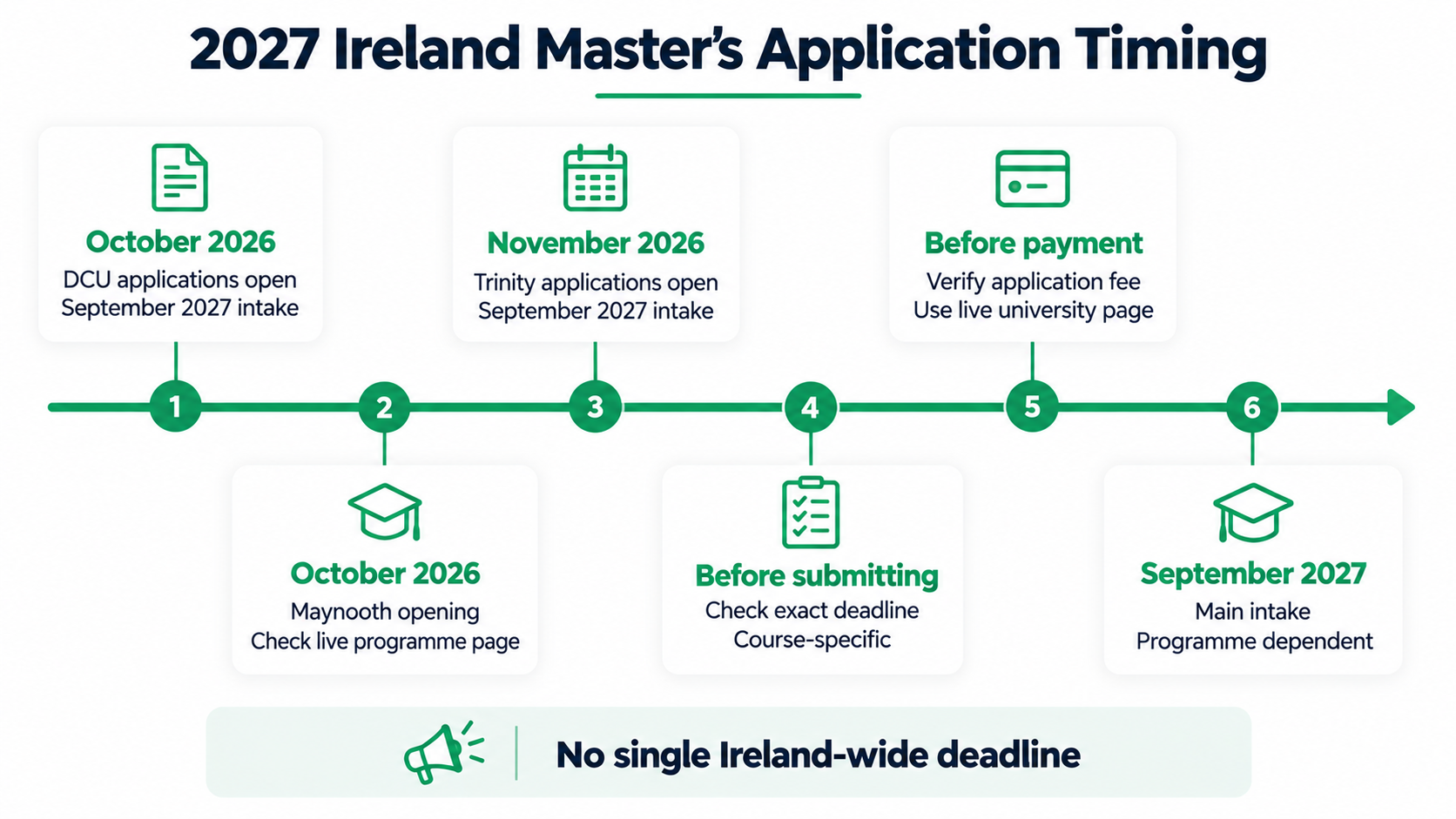
Parts of the 2027 cycle already appear on official pages, although there does not yet exist a single calendar of deadlines across the country of Ireland. The study of Ireland university eligibility Indian students needs to thus, distinguish between eligibility and timing.
As an example, currently Trinity indicate that it is accepting in November 2026 applications to join in September 2027; DCU indicate that it is accepting applications to join in September 2027 in October 2026. Maynooth also explains that in October, September 2027 postgraduate applications are open.
Before submitting:
- open the university’s postgraduate application page;
- open the exact programme page;
- confirm the 2027 intake;
- note the actual closing date;
- check whether the course can close when places fill;
- verify any application fee immediately before payment.
Do not turn one university’s date into a national deadline. A proper Ireland university eligibility Indian students check must include the live application timing.
How should Indian Students check Eligibility Step by step?
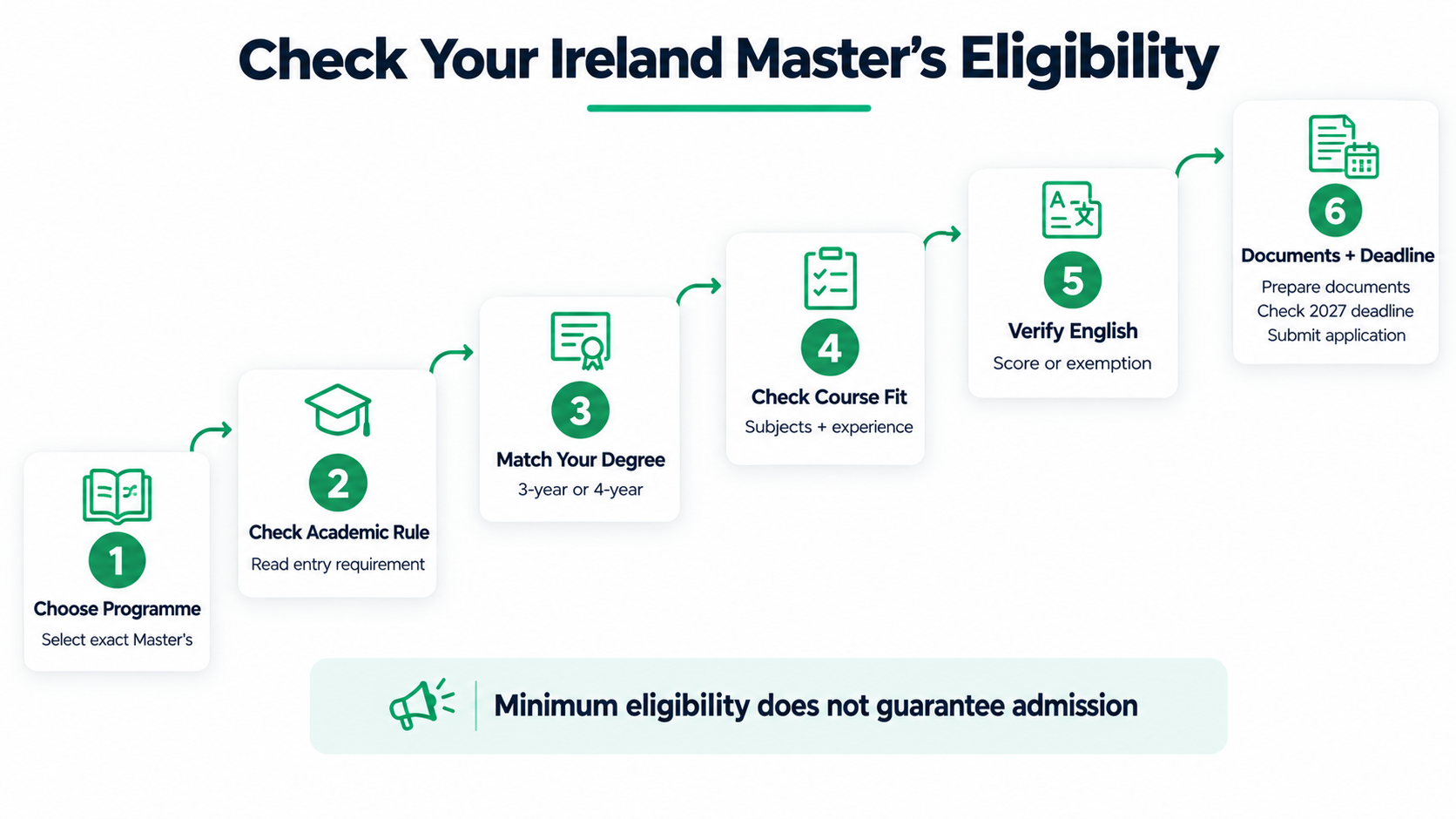
For Ireland university eligibility Indian students, use this order:
- Choose the exact Master’s programme
- Look through its academic requirement
- Make the necessary Irish classification equal to the India specific equivalent
- Make sure your 3 or 4 year degree is accepted
- Check prerequisites, subjects, and work-experience rules
- Check existing English requirement or exemption that has been approved
- Make the necessary documents to apply to the university of Ireland
- Confirm live 2027 opening and deadline and submit
This sequence reflects Ireland university admission requirements better than relying on one percentage or generic checklist.
For related reading, see Gateway EduConnect’s Ireland eligibility guide and guide to universities in Ireland for Indian students. These are internal Gateway EduConnect resources; verify changing admission requirements on the official university pages linked throughout this article.
Check out: Top Best Countries to Take into Account for Studying in Europe
Common Mistakes Indian Applicants should avoid
- Treating 60% as a universal minimum percentage to study in Ireland.
- Assuming every 3-year Indian Bachelor’s degree is accepted.
- Ignoring the individual programme requirement.
- Assuming MOI automatically replaces an approved English test.
- Treating a 2026/27 English requirement as automatically valid for 2027-28.
- Uploading only a consolidated marks sheet where full semester marks sheets are required.
- Assuming minimum eligibility guarantees admission.
- Using a generic deadline instead of the live programme deadline.
FAQs
What percentage do Indian students need for a Master’s in Ireland?
For Ireland university eligibility Indian students, there is no single national minimum percentage to study in Ireland. Current official requirements differ by university and programme. Identify the programme’s required Irish classification first, then check the institution’s India-specific equivalent.
What are the main Ireland university admission requirements for Indian students?
The main Ireland university admission requirements include an accepted Bachelor’s qualification, the programme’s academic standard, relevant prerequisites and acceptable English evidence. Some courses add references, a CV, statement, portfolio, interview or work experience.
Are 3-year Indian degrees accepted for Master’s programmes?
They can be. Maynooth, UCC and UL publish different approaches to 3-year Indian qualifications, which is why Ireland universities eligibility for Indian students must be checked institution by institution.
What are the documents required for Ireland university admission?
The documents required for Ireland university admission commonly include transcripts, degree evidence, English evidence where needed and identification. Other items depend on the programme.
Does meeting the eligibility requirement guarantee admission?
No. Published minimums do not guarantee an offer. Competition, capacity and additional criteria can still affect the outcome. University of Galway and UL both make clear that meeting stated entry criteria does not automatically guarantee a place.
Conclusion
For Ireland university eligibility Indian students planning a Master’s in 2027-28, there is no safe shortcut based on one percentage. Start with the programme, check its required degree classification, then compare your qualification with the university’s India-specific guidance. Next, confirm degree duration, subject background, English evidence and application documents.
The key point for Ireland universities eligibility for Indian students is that criteria differ across institutions, and some 2027-28 details are still being updated. Recheck the live official page before submission, especially English requirements and deadlines.
Get the Ireland Cost Planner from Gateway EduConnect to organise tuition, living expenses and funding before you apply. Speak with Gateway EduConnect for free video or home counselling and support with your study abroad consultancy services and explore our wide range of offerings for students interested in Study in Australia, Study Abroad in Poland, Study in Canada, Study abroad UK, Study in germany, Study Abroad in Ireland, Study Abroad in the USA, Study in Finland, Study Abroad in Italy, and many other countries

Author Bio
Abhinav Jain - Founder, Gateway Educonnect and Director.
B.Tech, MBA, AI and Global Education Specialist.
More than 15 years of professional experience in leading students along international routes based on politics and innovation.