
18 Nov 2026 | New Zealand vs Australia for Indian Students 2027-28: Complete Guide for Indian Students

0
11
New Zealand vs Australia for Indian Students 2027–28: Complete Master's Guide
Before deciding where to study, compare master programmes, tuition fees and living costs, scholarships, visa requirements and career prospects.
Which is best, New Zealand or Australia: the choice of Indian students who want to pursue a master's degree. Neither is necessarily better. It is a matter of your programme, your overall budget and your professional objectives and family conditions.
The comparison is especially significant to students who intend to New Zealand vs Australia study abroad in 2027-28 due to the recent shifts in immigration policy. Australia has added some more restrictive requirements to dependent visa schemes, and New Zealand has amended the working conditions of master's students.
This guide will compare approved fees in universities, scholarships, student visas, employment prospects and post-graduation options and, in doing so, assist you in making an informed choice.
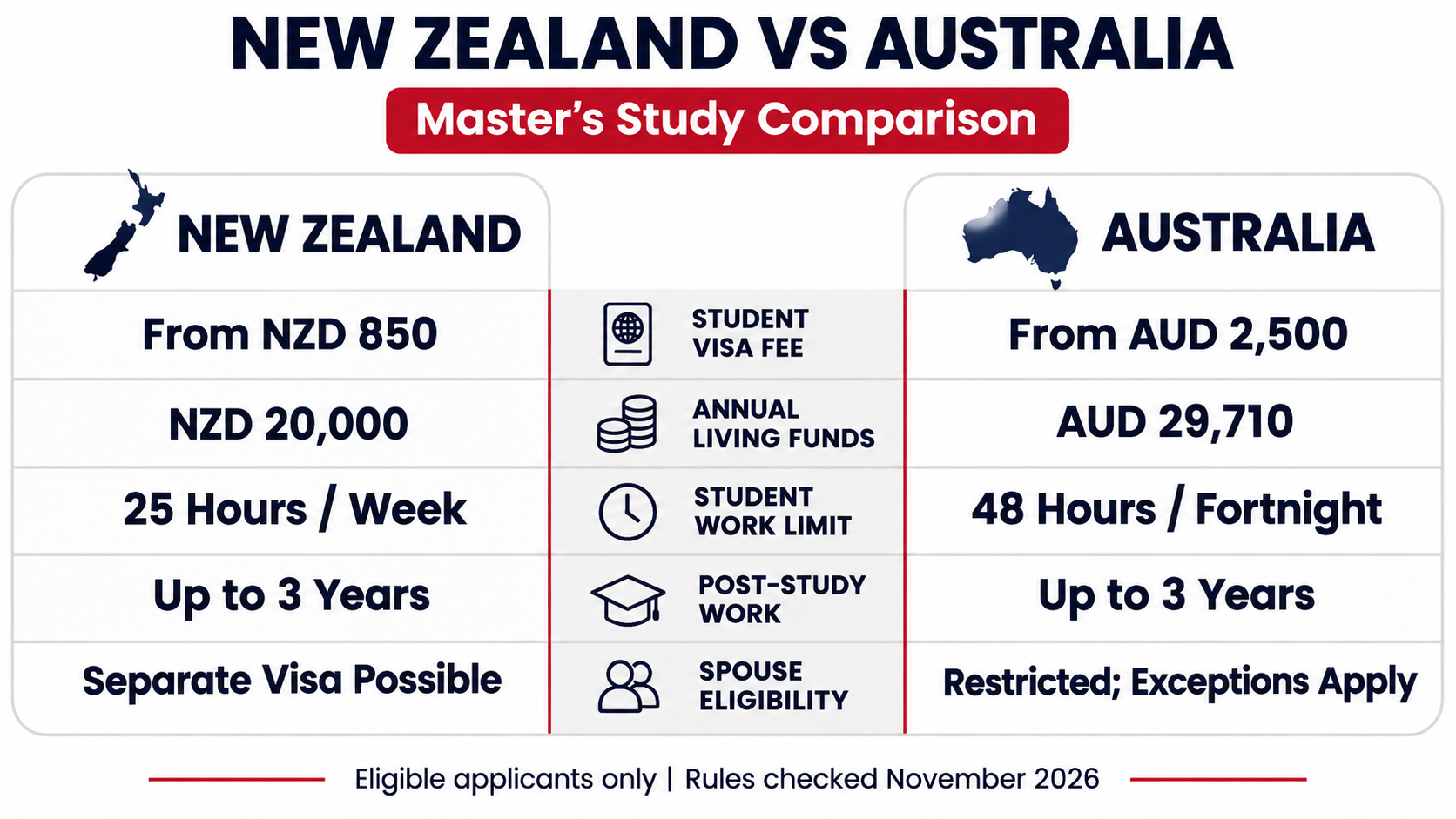
New Zealand vs Australia Study Abroad: Quick Comparison
Before choosing a university, understand the main financial and immigration differences.
|
Factor |
New Zealand |
Australia |
|
Master's duration |
Varies, commonly 1–2 years |
Varies, commonly 1–2 years |
|
Student visa fee |
From NZD 850 |
From AUD 2,500 |
|
Minimum living funds |
NZD 20,000 yearly |
AUD 29,710 for 12 months |
|
Work during classes |
Up to 25 hours weekly |
48 hours fortnightly |
|
Research master's work |
25 hours weekly for new visa applications |
No hourly limit for eligible students |
|
Post-study work |
3 years for eligible master's graduates |
3 years for eligible Indian master's graduates |
|
Spouse eligibility |
Separate partner work visa possible |
Restricted for most new student applicants |
|
Permanent residency |
Skilled residence pathways |
Skilled migration pathways |
These are current rules, not guaranteed 2027–28 entitlements.
Sources: Immigration New Zealand and Australian Student Visa.
Key takeaway: Your total qualification cost, course suitability and immigration eligibility matter more than a single advertised benefit.
Which Country Is Better for a Master's Degree?
Academic suitability should be the starting point of a New Zealand vs Australia study abroad comparison.
Both destinations offer postgraduate programmes in:
- Information technology and artificial intelligence.
- Business, Management and Finance.
- Data Analytics and Sciences.
- Engineering and Technology
- Medical and medical sciences.
Nonetheless, programme structures vary.
The University of Auckland's Master of Information Technology is based on various credit-based pathways based on previous qualifications.
On the same note, the Monash University's Master of Information Technology provides postgraduates with a condition of entry that is based on academic history.
Before applying, compare:
- Subject modules and specialisations.
- Credit and qualification period.
- Research or industrial project opportunities.
- Previous qualification requirements
- Total tuition and career pertinence.
A shorter course need not be superior when it fails to impart the knowledge or experience which your desired career demands.
New Zealand vs Australia Cost Comparison for Indian Students
The overall New Zealand vs Australia study abroad budget must cover tuition, accommodation, food, transport, insurance and immigration expenses.
How Much Are Master's Tuition Fees in 2027?
The following figures are published international tuition examples, not national averages.
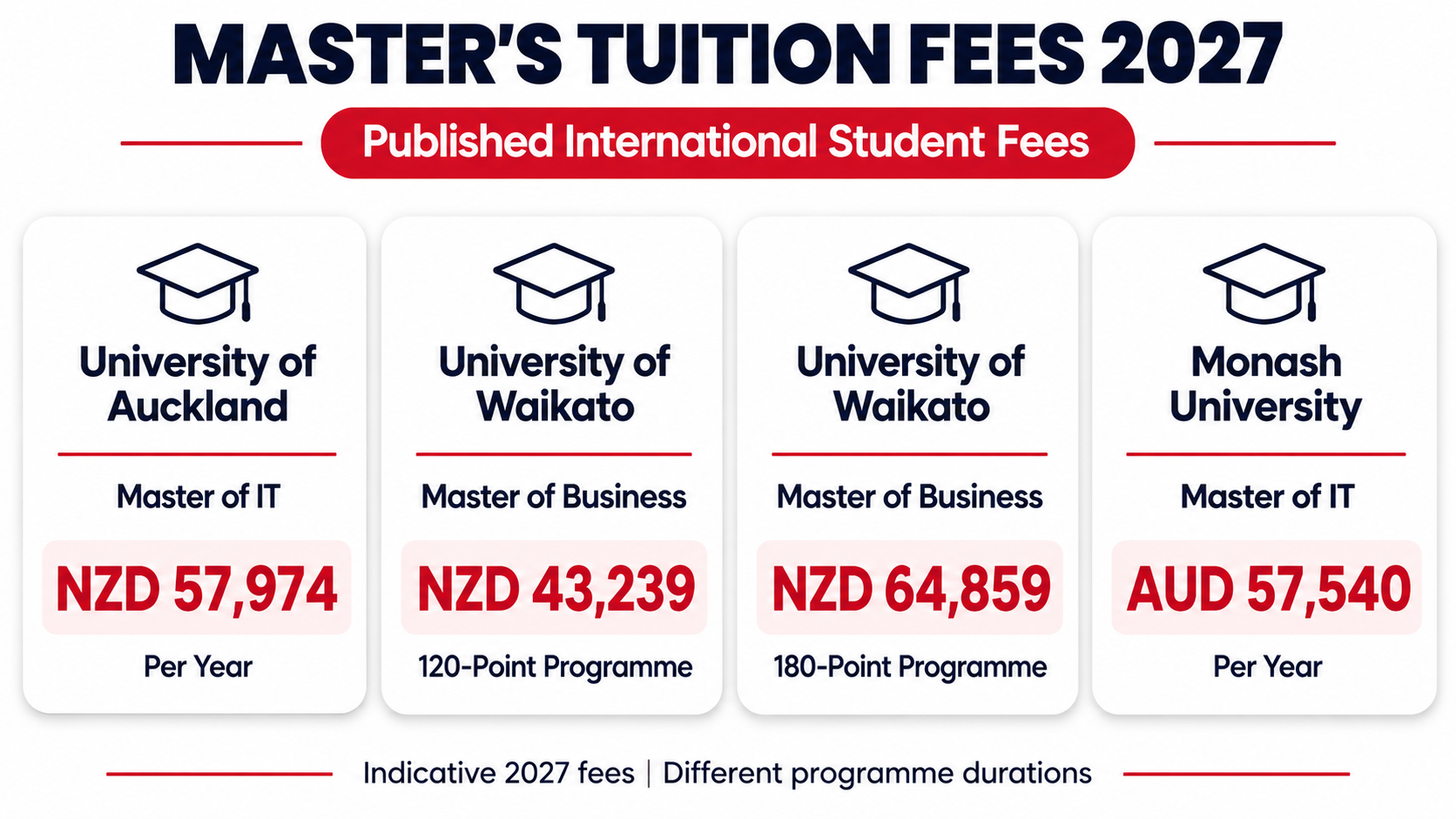
|
University and programme |
Country |
Published 2027 tuition |
|
Waikato, Master of Business (120 points) |
New Zealand |
NZD 43,239 |
|
Auckland, Master of Information Technology |
New Zealand |
NZD 57,974 annually |
|
Monash, Master of Information Technology |
Australia |
AUD 57,540 annually |
|
Waikato, Master of Business (180 points) |
New Zealand |
NZD 64,859 |
What About Living Expenses?
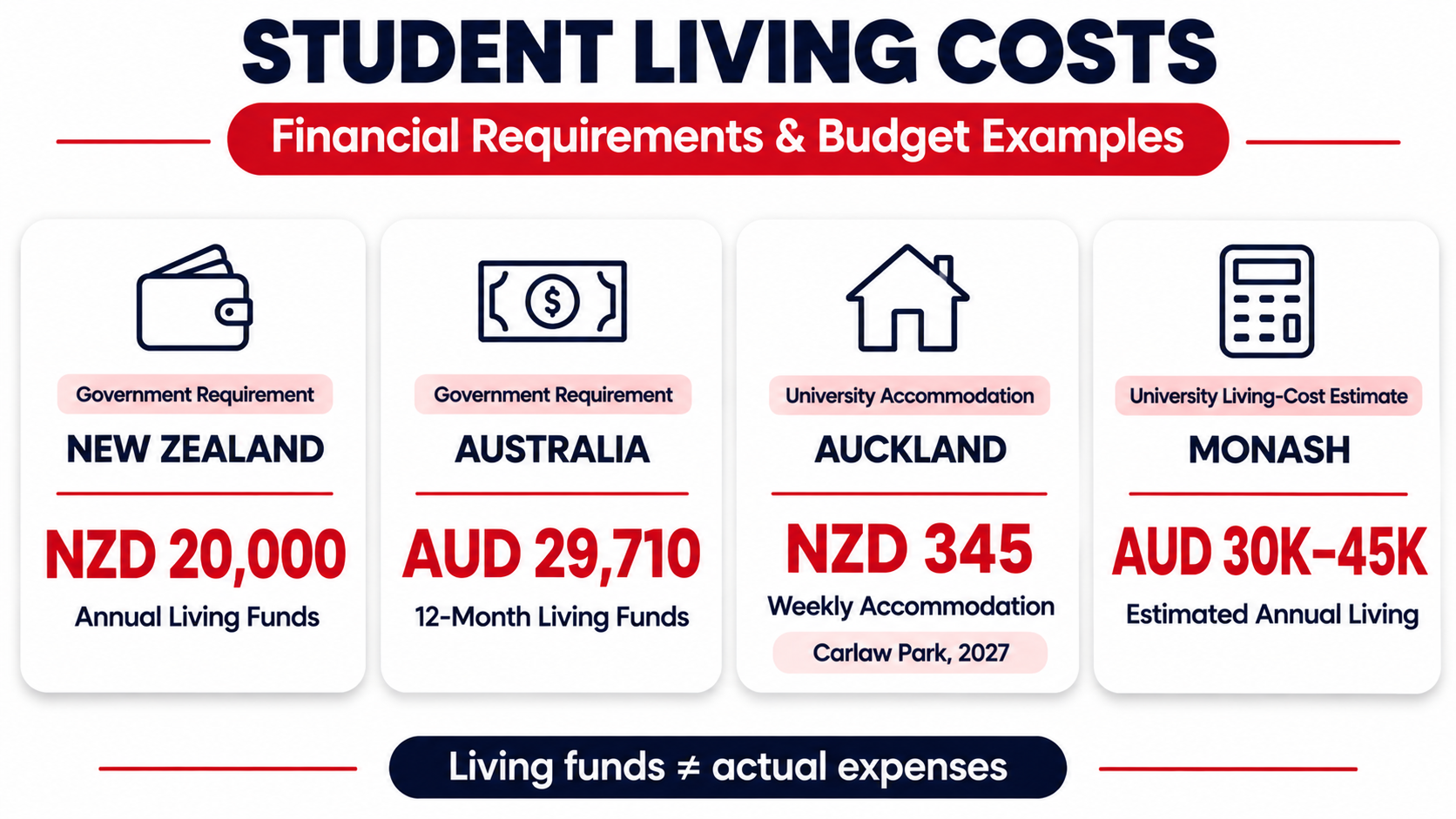
Government financial-capacity thresholds are different from actual living costs.
New Zealand requires eligible tertiary students to demonstrate NZD 20,000 yearly for living expenses. Australia's published individual financial-capacity figure is AUD 29,710 for 12 months.
For a practical accommodation example, Auckland's Carlaw Park Student Village lists NZD 345 weekly for a 52-week contract in 2027.
Accommodation calculation: NZD 345 × 52 = NZD 17,940 annually, excluding additional personal expenditure.
Meanwhile, Monash University's budgeting guide estimates AUD 30,000–45,000 in annual living expenses for a single international student.
How Should You Calculate Your Total Budget?
In the case of New Zealand vs Australia study abroad, the formula is:
Complete programme fee and cost of living throughout the course + insurance + visa and transportation - available scholarships.
As an illustration, the NZD 43,239 published tuition plus NZD 20,000 in annual living costs totalled by Waikato will yield NZD 63,239 without visa fees, insurance and travel.
The illustration of this is for planning, not the actual amount of attendance cost that the university is certain to incur.
Students in need of funding should consider the Gateway EduConnect's education loan assistance service, an information service which is a commercial service and not a government funding programme.
What Scholarships Are Available for Indian Students?
Scholarships can significantly change the New Zealand vs Australia study abroad cost comparison.
The three opportunities that can be identified are:
1. University of Waikato, New Zealand
Vice-Chancellor's International Excellence Scholarship for India provides a scholarship of NZD 15000 to eligible Indian students toward tuition.
It is applicable to eligible postgraduate study and includes trimester-specific application deadlines.
2. Deakin University, Australia
The Deakin Vice-Chancellor's International Scholarship will provide applicants who are successful with a tuition reduction of 50% or 100%.
The applicants should meet academic and course entry requirements, which include the scholarship's published achievement requirements.
3. Australian Research Training Program.
The Research Training Program is a program that aids qualified research master's and doctoral students via participating universities.
It is not a general scholarship for taught master's programmes.
Scholarship is competitive. Before budgeting an award, verify the current application round, the nationality that is eligible, the programme and the closing date.
What Are the Admission and Student Visa Requirements?
When evaluating New Zealand vs Australia study abroad, distinguish university admission rules from government visa requirements.
Academic and English Requirements
Universities evaluate candidates by using past qualifications, grades, and programme-related criteria.
Other postgraduate programmes (masters) specify a minimum overall test score of 6.5 with components. Other institutions might accept other approved tests of English or qualifying exemptions.
In the case of Australia, English requirements under the Student visa are not similar to university admission limits. The New Zealand universities also test applicants who have adequate English to complete their programmes.
Documents Indian Students Should Prepare
- Passport and school transcripts.
- University offer and degree certificates.
- Admitted evidence in English, where appropriate.
- Tuition and financial records.
- Insurance and health evidence.
- Authentic student and character history/writing, where necessary.
In the case of New Zealand, consider the Fee Paying Student Visa.
In the case of Australia, students usually require a Confirmation of Enrolment prior to making their Student visa application.
Fulfilment of admission requirements does not give an assurance of visa grant.
Can Indian Students Work Part-Time While Studying?
In planning New Zealand vs Australia study abroad, it is an important factor, which is part-time employment but it is not guaranteed.
Current conditions include:
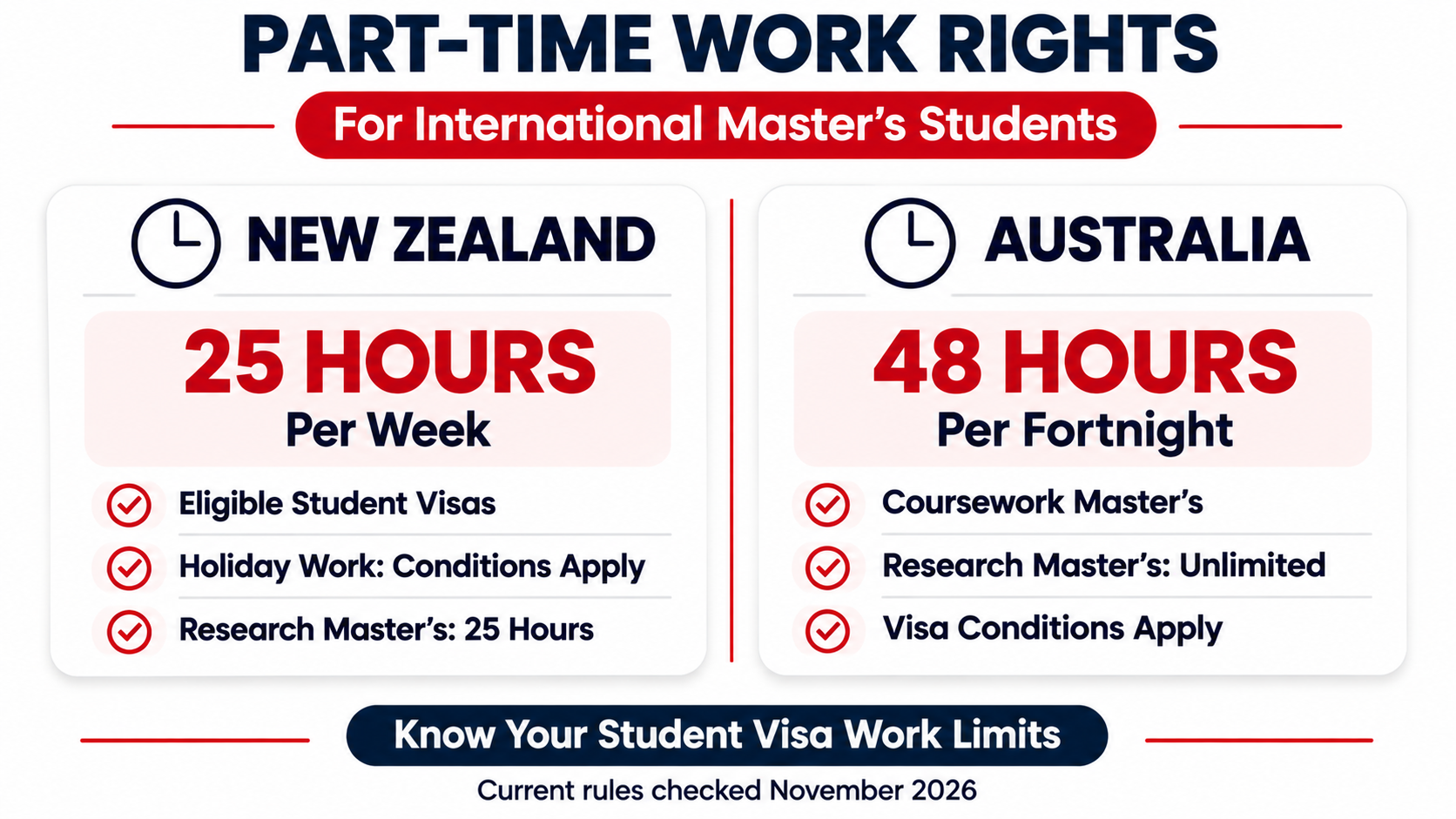
- New Zealand: Master's students who are eligible can work up to 25 hours per week, and full-time on approved holidays.
- Australia: They are eligible coursework master's students have an approximate 48-hour fortnightly limit when classes are in session.
- Master of research: Australia has no restrictions on the number of work hours for eligible students. In October 2026, New Zealand terminated the unlimited in-study work rights on new applications for the research-master visa.
The students should abide by their respective visa terms.
This alteration in policy can be explained by the New Zealand student visa changes.
Do not think part-time income is going to be able to pay for tuition or housing.
New Zealand vs Australia Post-Study Work Visa: What Happens After Graduation?
Post-graduation opportunities strongly influence New Zealand vs Australia study abroad decisions.
New Zealand
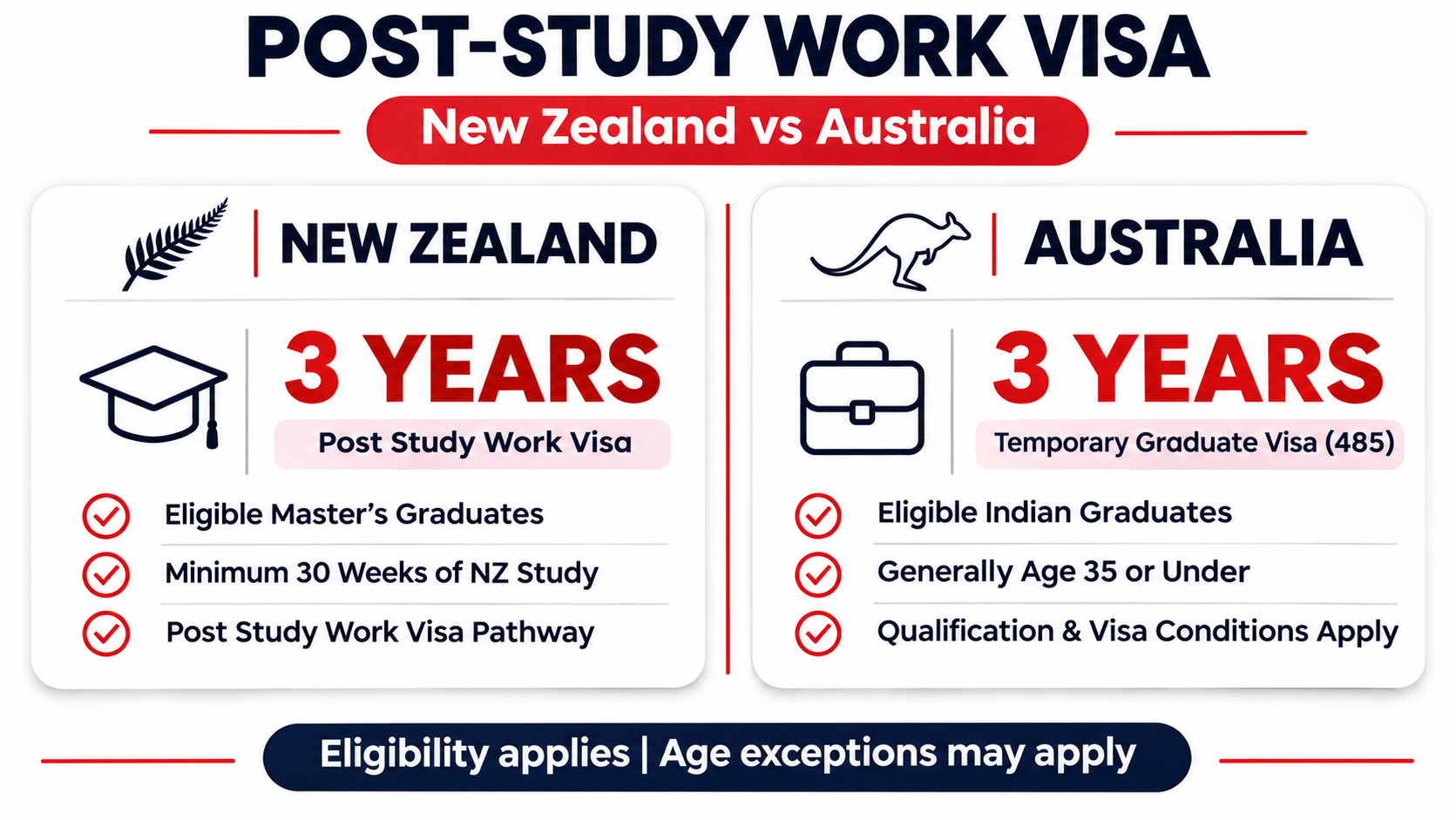
New Zealand: The three-year post-study work visa may be awarded to eligible master's graduates who complete 30 weeks of full-time study in New Zealand.
Students should also fulfil the relevant completion, application and immigration requirements.
Read the official Post Study Work Visa requirements.
Australia
Indian nationals who are eligible and successfully complete a qualifying course of study, master's degrees (extended or research degrees) can be granted three years of a temporary graduate visa through the provisions of the Australia India Economic Cooperation and Trade Agreement.
subclass 485 eligibility rules of Australia are, however, significant.
Applicants generally must:
- Possess or have been granted a valid visa.
- Be aged 35 or under, unless an exception applies
- Have a qualification that is CRICOS-registered.
- Meet requirements in English, health, character and application.
Qualified master's students of research can receive an age exception to apply at the age of less than 50.
Who does it include in terms of post-study work rights? Within these qualifying master's, the two have three years each. None of them ensures a job or permanent status.
Which Country Offers Better Job Opportunities?
The opportunities are an important aspect of the research on New Zealand vs Australia study abroad employment opportunities.
The 2025 International Graduate Outcomes Survey conducted in Australia indicated:
Of the international postgraduate coursework graduates who are available to work full-time, 52.2% are employed on a full-time basis.
71.8% of international postgraduate research graduates were available to work full-time.
The measurements of these results were realised about four to six months after graduation. These are not India-specific and cannot be directly compared with the earlier year of surveys due to changes in methodology.
Similar New Zealand figures were not set to compare to the same figures in the recent past reliably.
Investigate prior to selecting a programme:
- Job openings in your desired job.
- Professional registration requirements
- The appropriate work experience requirements.
- University career support
- Eligibility of visa post-graduation.
Work entitlement enables qualified graduates to apply for work. Not guaranteed recruitment.
Can Indian Master's Students Bring Their Spouse?
Using family planning can alter the outcome of a comparison in the New Zealand vs Australia study abroad.
New Zealand: If the student has an eligible level 9 master's degree, they are allowed to support a separate Partner of a Student Work Visa.
The partner should have a satisfactory relationship and meet financial and other visa requirements. The visa eligibility of children should be approached differently.
Australia: Most new Student visa applicants since 2 October 2026 are not allowed to add partners or dependent children, unless there is an exemption. There are a few exceptions: some doctoral, sponsored and scholarship.
According to the new regulations, family members are generally not allowed to be subsequent entrants on a student visa.
View the exemptions for family members of Review Australia.
New Zealand might present extra closer consideration to an Indian coursework master applicant who may want to relocate with a spouse, given that there is a requirement.
Is Permanent Residency Easier in New Zealand or Australia?
New Zealand vs Australia study abroad does not necessarily lead to permanent residency.
New Zealand has routes such as the Skilled Migrant Category, which comes in a six-point framework, as well as skilled employment and other conditions.
Australia possesses skilled migration routes such as the Skilled Independent visa (subclass 189). Its points-tested route normally involves 65 points and an invitation.
These are various systems. Their numerical thresholds should not be compared, as they do not determine which country offers easier residency.
Work, skills, and personal qualifications are more important than the nation itself.
When Should Indian Students Apply for 2027–28?
Students intending for New Zealand vs Australia study abroad are supposed to adhere to programme-specific deadlines.
For example:
New Zealand: The Master of Information Technology at Auckland starts with Semester 1 on 1 March 2027 and has a programme closing date of 8 December 2026. Its overall direction to postgraduate applicants suggests that international students should submit their applications before 1 December 2026 to allow time to obtain a visa.
Australia: According to Master of Business at Deakin, the direct applications closing date (Trimester 1) is 7 February 2027.
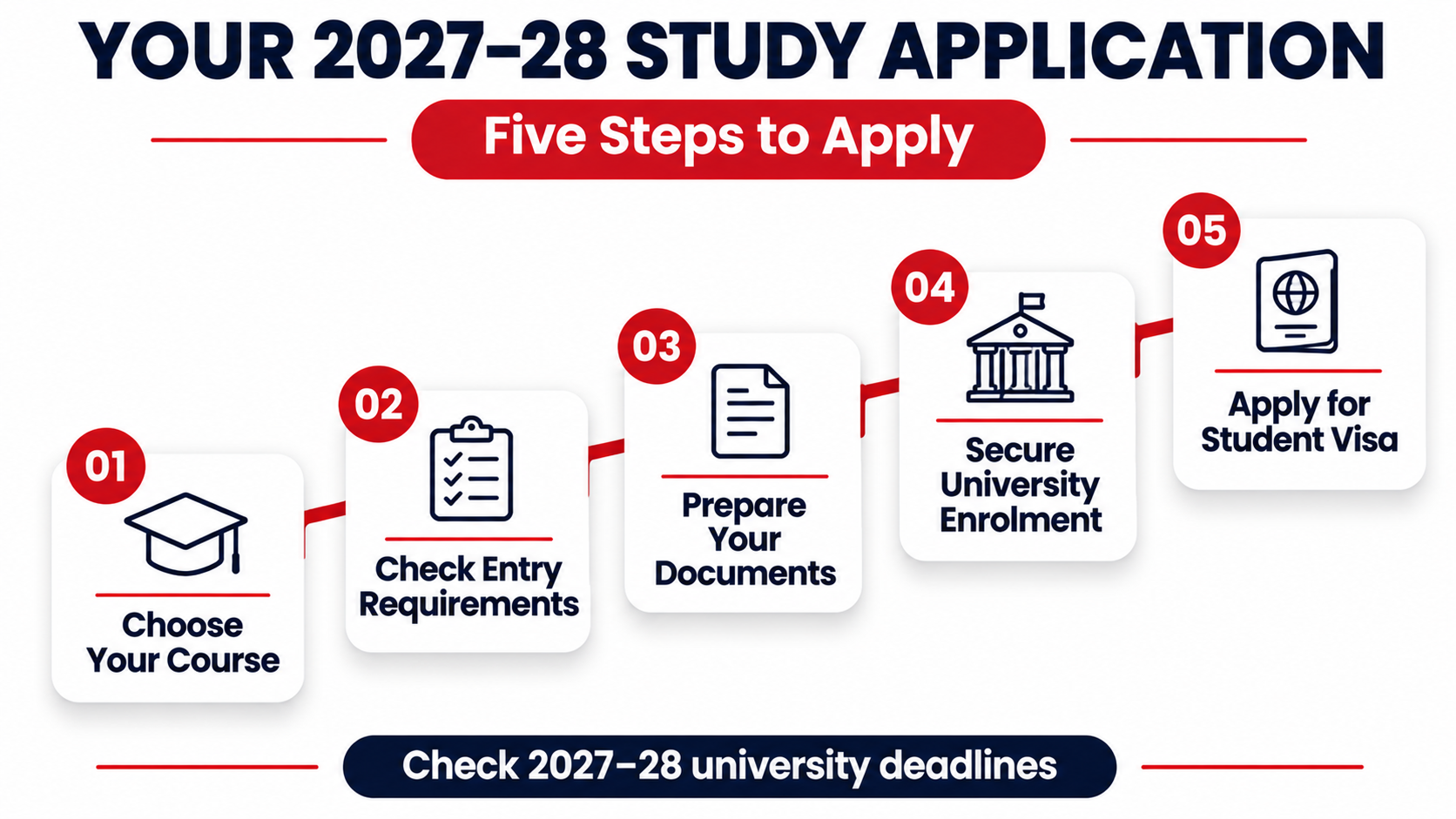
Applicants should:
- Choose courses and check the requirements.
- Check scholastic grants and application terms.
- Get financial and academic proof.
- Obtain enrolment documents.
- Submit the appropriate visa application.
Check 2028 intake dates as they become publicized by universities.
New Zealand or Australia: Which Is Better for Indian Students?
The correct New Zealand vs Australia study abroad decision is one that will be based on what matters most to you.
|
Student priority |
Better approach |
|
Research master's |
Compare supervisors, funding and research work conditions |
|
Permanent residency |
Assess occupation-specific eligibility; neither guarantees PR |
|
Lowest overall cost |
Compare full course fees, duration and living costs; neither country wins universally |
|
Post-study work |
Both offer eligible Indian master's graduates three-year options |
|
Relocating with spouse |
Examine New Zealand's eligible partner pathway and Australian restrictions |
Select New Zealand when its programme, the budget or the requirements of the eligible partners are better suited to your needs. Select Australia where the particular university it provides, research opportunities or career setting is more in line with your plans.
Do not use advertised work rights as a basis to select either destination.
FAQs
Are Indian students cheaper in New Zealand than Australia?
Not necessarily. The cost comparison of New Zealand vs Australia study abroad would have to take into account the entire qualification, living costs and available scholarships.
What is the maximum duration of the post-study work visa in which country?
Indians graduates with master's degrees who are eligible can be entitled to three years in any of the countries under visa requirements.
Would students be able to work during their master's?
Yes, as it is allowed by the visa conditions. New Zealand tends to permit 25 hours per week, and Australian coursework master's tend to have 48 hours per fortnight.
Is it possible to bring spouses to the married students?
New Zealand has a partner work visa to support eligible students. Most new Student visa applications have limited family inclusion in Australia.
Will a master's degree make me a permanent resident?
No. Each country has its own migration eligibility conditions.
Conclusion
Academic suitability, overall expenses, family needs, and realistic career prospects must be the basis of the decision in selecting New Zealand vs Australia study abroad.
New Zealand can be one of the places that may be prioritised on the list of students who can use the partner visa schemes. Australia might suit you better when a specific master's course, scholarship or research placement better fits your purposes.
Neither of the destinations promises employment, scholarships, nor permanent residence.
Get to know the overall programme cost prior to application, ensure your visa eligibility and choose a course that is applicable to your career aspirations.
Get the NZ vs Australia Comparison
Compare master's programmes, scholarship eligibility, tuition fees and application charges at Gateway EduConnect.
Author Bio
Abhinav Jain - Founder, Gateway Educonnect and Director.
B.Tech, MBA, AI and Global Education Specialist.
More than 15 years of professional experience in leading students along international routes based on politics and innovation.
Connect: https://www.linkedin.com/in/abhinavedysor/


