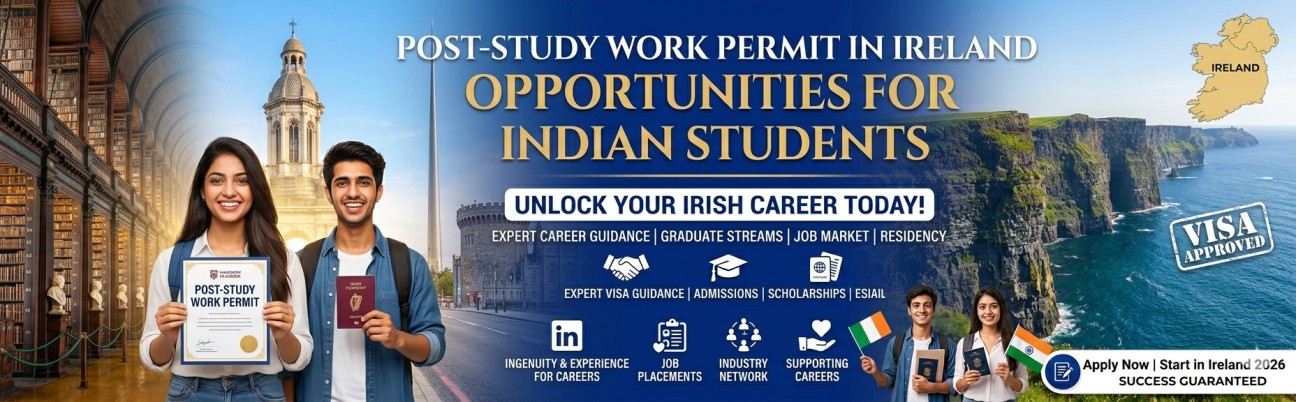
01 Apr 2026 | Post-Study Work Permit in Ireland: Opportunities for Indian Students

0
112
Post-Study Work Permit in Ireland for Indian Students: Complete 2026 Guide
Ireland has emerged as one of the most promising destinations for Indian students who seek not only a good education but also promising career prospects after graduation. Over the past 15 years of my leadership of students at Gateway Educonnect, I have witnessed firsthand the change in career outcomes among Indian students in Ireland, driven by proper planning and the Post-study work permit.
The Higher Education Authority of Ireland (HEA) states that the number of international students in the country has steadily increased over recent years, and the number of Indian students is among those that have increased at the highest rate. Furthermore, according to IDA Ireland, over 1,800 multinational corporations operate in Ireland, particularly in technology, pharmaceuticals, and financial services. Such economic power renders the post-study work permit in Ireland for Indian students very precious.
What is the Post-Study Work Permit in Ireland?
The Third-Level Graduate Programme in post-study work permit in Ireland for Indian students. It enables qualified graduates to stay in Ireland upon completing their studies to seek jobs on the spot.
The stay-back visa in Ireland is a Stamp 1G license that permits graduates to obtain legal residence and work rights without employer sponsorship. In practice, this is a structured job search permit that gives students time to find a job and be transferred to long-term work permits.
Through my advisory experience, I have realised that a student who understands the technicalities of the Ireland stay-back visa before deciding on their course is in a better position to succeed in the long term.
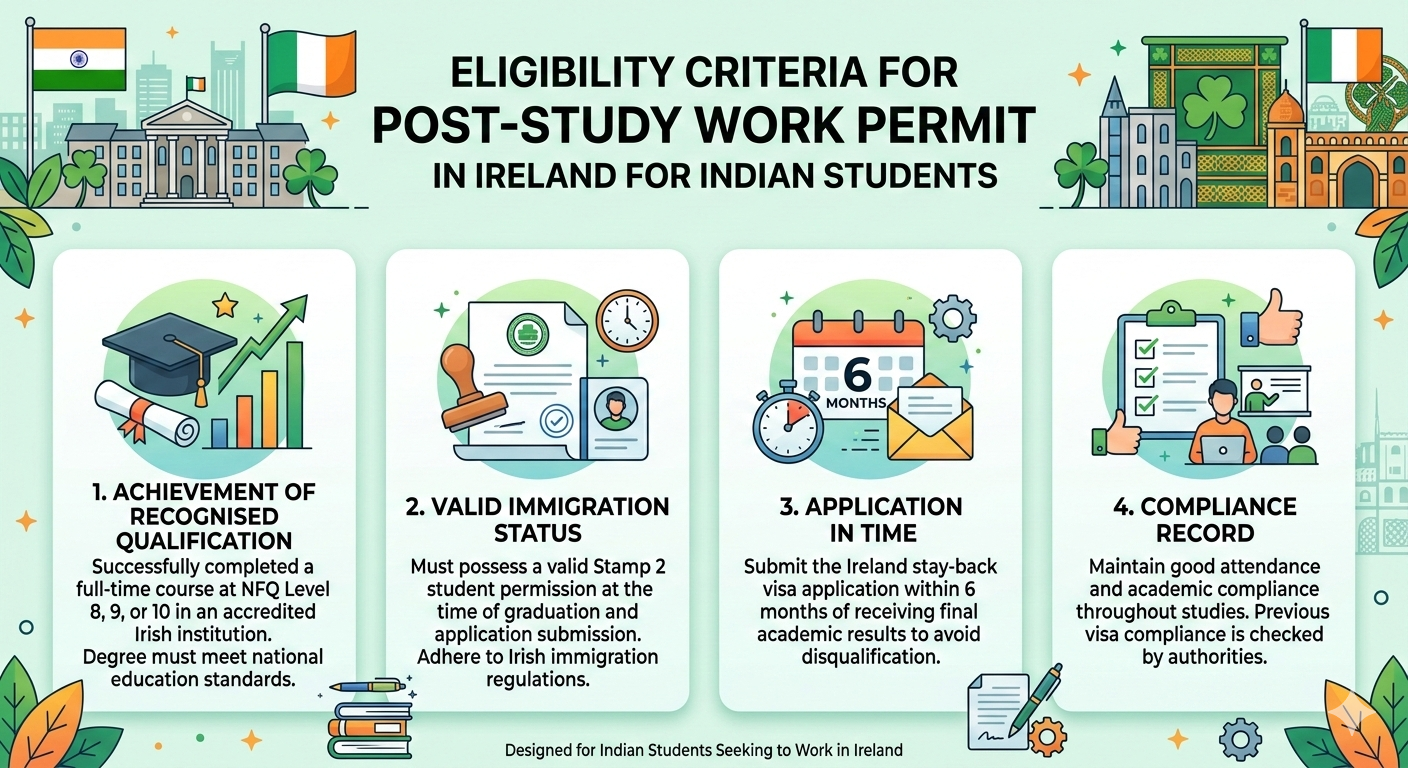
Eligibility Criteria for Post-Study Work Permit in Ireland for Indian Students
In order to apply for the post-study work permit in Ireland for Indian students, the candidates should not fail to meet certain requirements:
- Achievement of Recognised Qualification: The student should have successfully completed a full-time course at NFQ Level 8, 9, or 10 in an accredited institution in Ireland, and the degree must meet the national education standards.
- Valid Immigration Status: The applicants must have a valid Stamp 2 student permission at the time of graduation and when submitting their applications, in line with Irish immigration regulations.
- Application in Time: An application for the Ireland stay-back visa should be submitted within 6 months of receiving the final academic results, to avoid disqualification.
- Compliance Record: Students should maintain good attendance and academic compliance throughout their studies, as previous visa compliance is checked by immigration authorities.
I continuously encourage my students to start preparing their documentation in advance of the final result being announced, to ensure a smooth sailing experience for post-study work permit in Ireland for Indian students.
PSW Duration in Ireland
The PSW duration is a crucial factor to consider when choosing a study level.
- Bachelor's Degree (Level 8): Graduates are entitled to a 12-month stay-back period, which should give them ample time to secure relevant jobs.
- Master's Degree (Level 9): The graduate will have a maximum of 24 months' stay-back, which will greatly enhance the flexibility of job search and interaction with employers.
- Doctoral Degree (Level 10): PhD graduates are also eligible to receive up to 24 months of the scheme, which helps graduate professionals in research-related jobs.
The PSW is very strictly controlled, and extensions of the stipulated time are not usually allowed. Personally, students who complete master's programs are the ones who gain the most, as the duration of PSW is longer and the job prospects are high.
Application Process for Ireland Stay Back Visa
The Ireland stay back visa procedure is well-organised but simple:
- Confirmation of Graduation: Before the application is initiated, the student must ensure that he or she has confirmation of degree completion at his or her university.
- Online Registration: Applicants are registered via the Irish Immigration Service Delivery (ISD) and make an appointment if necessary.
- IRP Registration Fee: To register as an Irish resident, one must pay a fee of about EUR300.
- Stamp 1G Permission: After permission, graduates achieve Stamp 1G status, which allows them to work full-time and find long-term employment.
Indian students in Ireland are provided with a Post-study work permit, which becomes valid upon issuance of Stamp 1 G.
Work Rights Ireland During PSW Period
The key strength of the post-study work permit in Ireland for Indian students is its explicit work rights framework:
- Full-Time Employment: During the PSW period, graduates may work up to 40 hours per week without needing another employment permit.
- Availability of Talent Positions: Students are eligible to seek positions on the Ireland Critical Skills Occupation List, enhancing their long-term sponsorship opportunities.
- Self-Employment Flexibility: Certain types of entrepreneurial activities are permitted, provided the legal requirements are met.
- Transition to Employment Permit: May switch to a Critical Skills or General Employment Permit when they find a suitable job opportunity.
The transparency of Ireland's work rights policies renders the post-study work permit in Ireland for Indian students one of the best-structured policies in Europe.
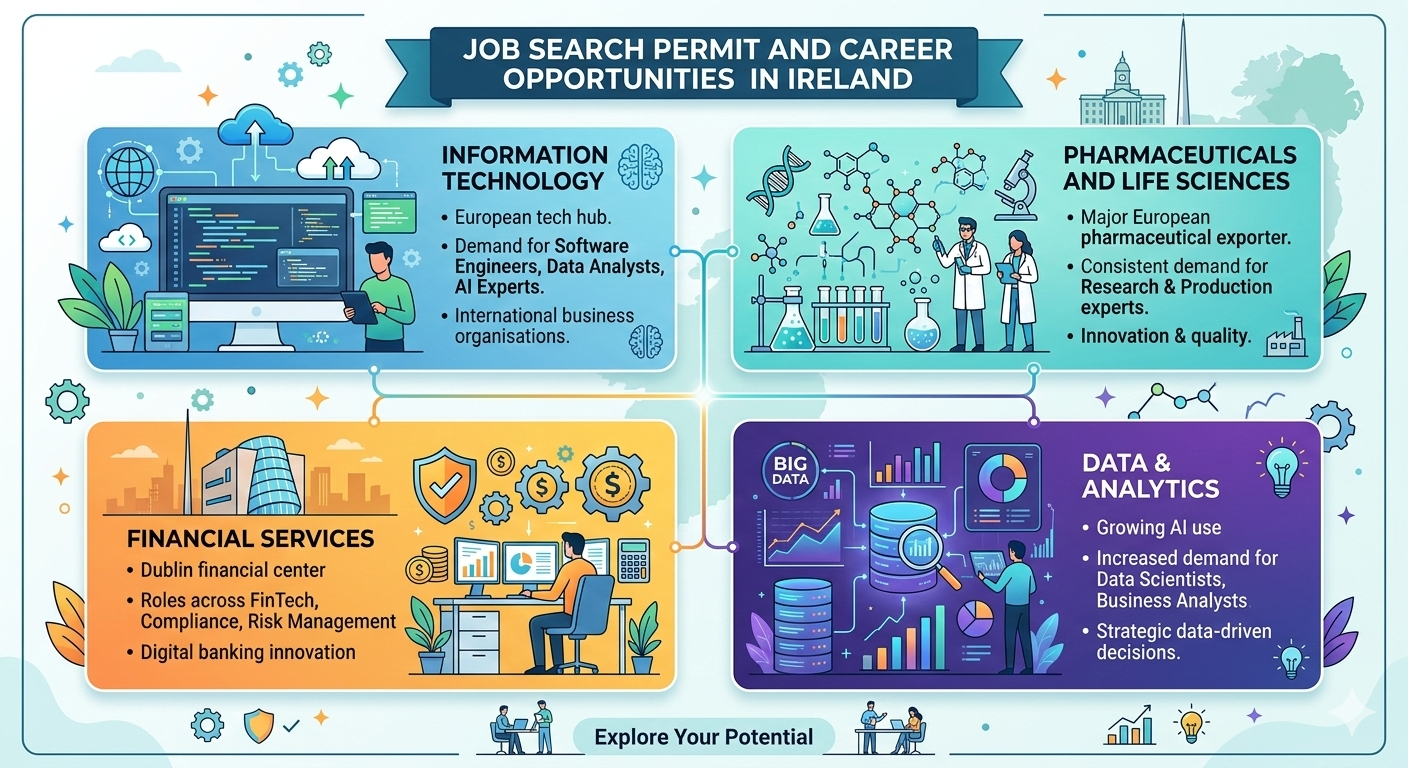
Job Search Permit and Career Opportunities
The Post study work permit for Indian students based in Ireland works effectively as an organised job-search permit window.
Graduates are employed in such sectors as:
- Information Technology: Ireland has become the European hub of technology, with international business organisations actively seeking software engineers, data analysts, and AI experts.
- Pharmaceuticals and Life Sciences: Ireland is a major European pharmaceutical exporter, generating consistent demand for research and production experts.
- Financial Services: Dublin offers roles across fintech, compliance, and risk management.
- Data & Analytics: The growing use of AI across industries has increased demand for data scientists and business analysts.
I remember one of my students from Gujarat who graduated with a Master of Data Analytics and landed a job within 7 months during the job search permit phase. His Critical Skills Permit application, which was based on his Ireland stay-back visa, was a smooth process due to the early networking.
Cost Overview
|
Expense Category |
Approximate Cost |
|
IRP Registration |
€300 |
|
Living Expenses (Annual) |
€10,000–€15,000 |
|
Employment Permit (Later Stage) |
Varies by permit type |
Effective budgeting throughout the PSW period is a measure to ensure that students do not have to cope with employment issues and concentrate on their finances.
Advantages of Post-Study Work Permit in Ireland for Indian Students
The Indian students in Ireland have several long-term advantages under the Post-study work permit:
- Good Economic climate: Ireland has always been one of the rapidly developing economies in Europe, which favours the employment of graduates.
- Clear Immigration Framework: The Ireland stay back visa system has clear eligibility and timelines, which eliminate doubts.
- Robust Work Rights Ireland Policy: Graduates get the right to full-time employment within the period of PSW.
- Unambiguous PR Pathway: Employment at the job search permit stage creates possibilities of long-term residency.
- English-Speaking Nation: Ireland provides an English-speaking setting which facilitates the process of workplace integration among the Indian graduates.
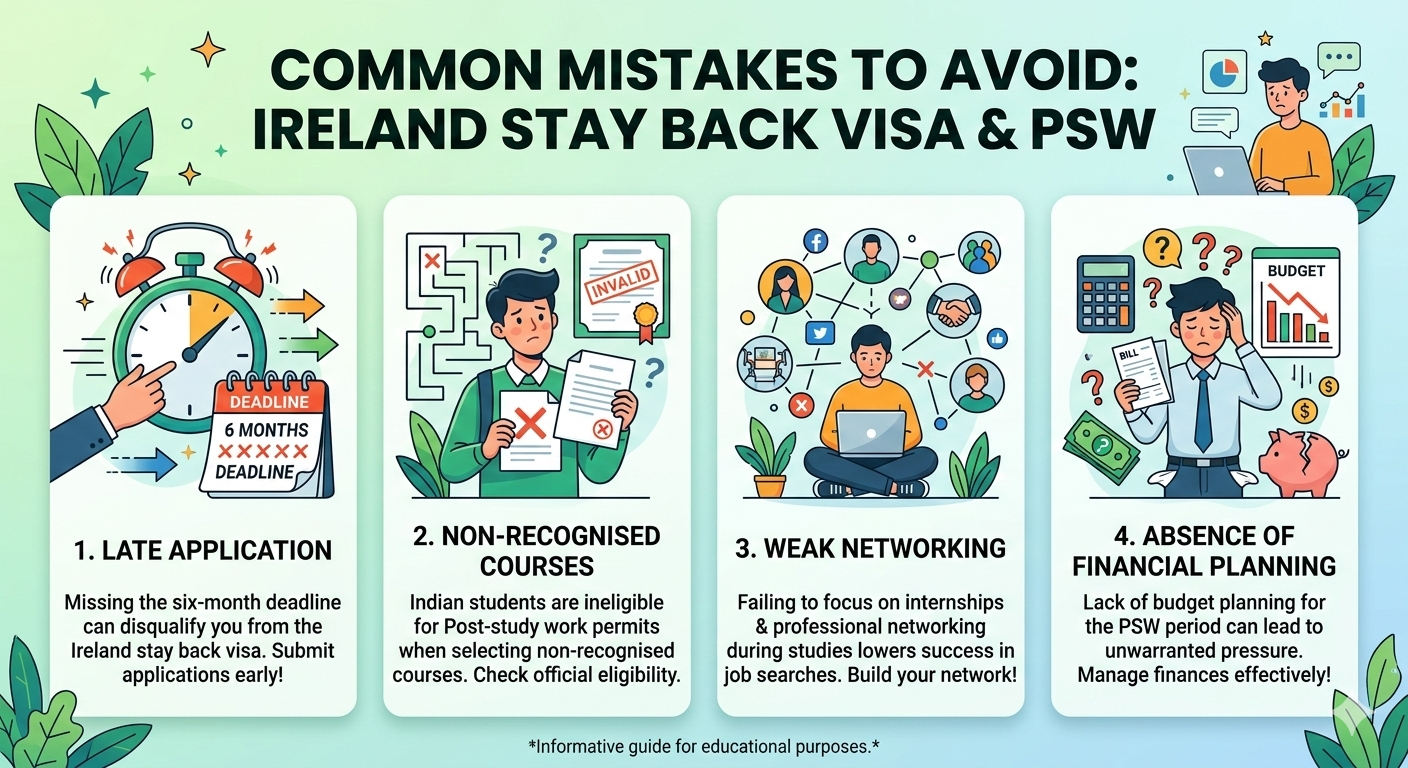
Common Mistakes to Avoid
- Late Application: The deficiency of six months can disqualify the applicants from the Ireland stay back visa.
- Selection of non-recognised courses: Indian students wishing to have the Post-study work permit in Ireland would be ineligible to do so when they select non-recognised courses.
- Weak Networking: It is not necessary to focus on internships and professional networking when studying because it lowers the rates of success in job search permits.
- Absence of Financial Planning: The absence of planning of budgets within the duration of the PSW can lead to unwarranted pressure.
Conclusion
The post-study work permit in Ireland for Indian students is not only a stay-back, but a guided career-building avenue. Having a specific PSW length, well-defined work rights in Ireland, and an effective job search permit system, Ireland can be considered to have one of the most transparent post-study systems in Europe.
Having more than 15 years of experience in leading students across the world, I am convinced that the success of the Post-study work permit of Indian students in Ireland is in effective course choice, discipline in complying with the rules and regulations and active networking. The Ireland stay back visa, when utilised well, may form the basis of a successful international career.
For more assistance please visit us study abroad consultancy, and avail of our wide range of services for students on destinations like study in USA, study in UK, study in Canada, study in Australia, study in ireland and many more country.
FAQs
Post-study work permit in Ireland among Indian students?
It enables Indian graduates to remain in Ireland once they have done the relevant degrees with the intention of seeking employment and also experience.
SIAD The duration of PSW in Ireland is what?
PSW is 12 months in case of bachelor's alumni, and up to 24 months in case of master's and doctoral alumni.
What is the stay-back visa of Ireland?
An Ireland stay back visa is issued under the permission of the Third Level Graduate Programme under the stamp 1G.
What are the work rights that Ireland offers during PSW?
The Work Rights Ireland permit full-time employment without an immediate employer-sponsored permit.
Is PR brought about by the job search permit?
Yes, the attendance of eligible jobs at the phase of job search permits may result in long-term residency routes.
Author Bio
Abhinav Jain - Founder, Gateway Educonnect, and Director.
B.Tech, MBA, AI and Global Education Specialist.
More than 15 years of professional experience in leading students along international routes based on politics and innovation.