
24 Apr 2026 | How to Shortlist Universities Abroad for Indian Students (Step-by-Step Guide)

0
92
Introduction: Shortlist Universities Abroad
Going to an overseas university is a life changing choice and it may seem daunting to decide on the right university. The global institutions available to Indian students and parents are in the thousands and consequently, they struggle to reduce the universities in the foreign countries. A well-planned approach will save time and, moreover, will increase the possibility of admission and ensure an increased ROI.
This step-by-step guide has made the entire process of shortlist universities abroad easy. At the very first stages of planning your study abroad or if you are already ready to do it, this blog will help you make sound decisions as to the most suitable choice of universities and an effective college selection abroad experience.
The Significance of Shortlisting by Universities.
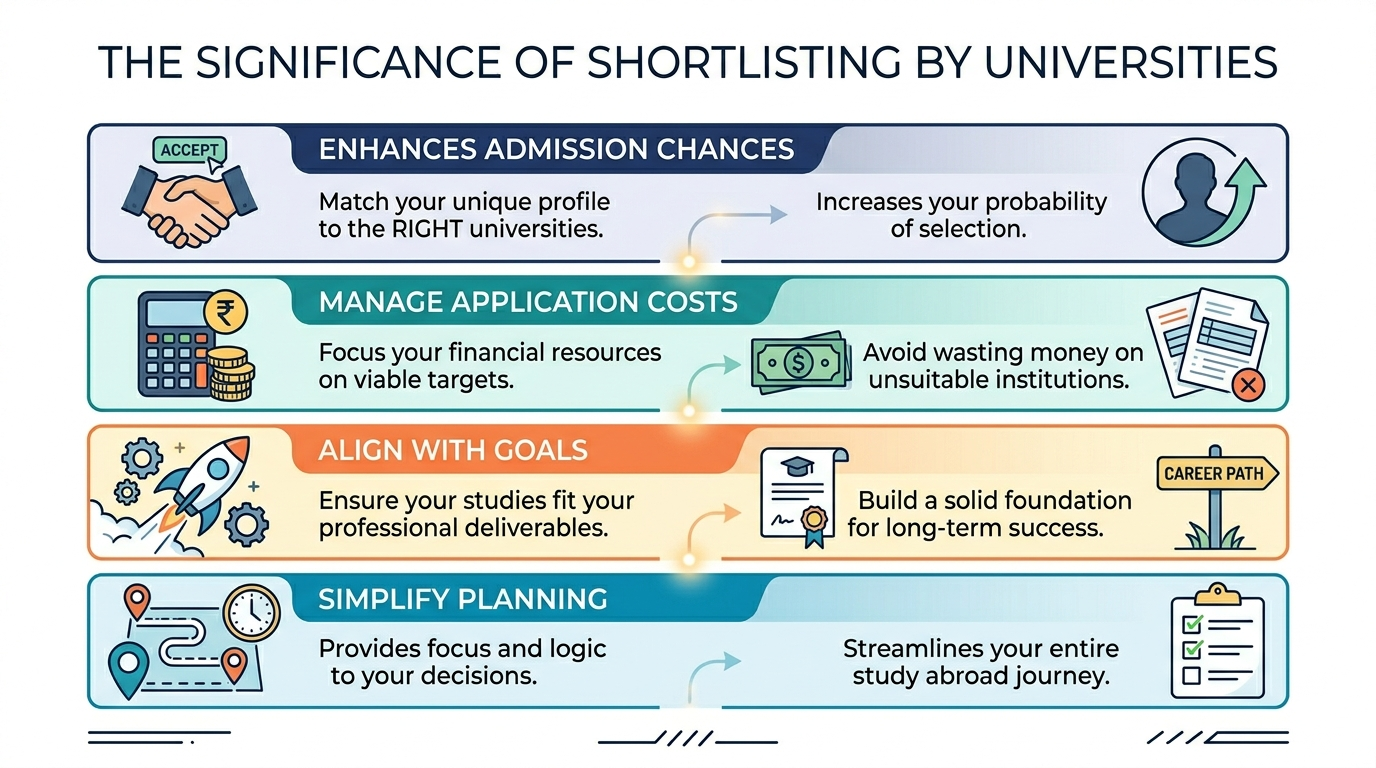
The reason why it is essential to take this step should be known to you prior to shortlist universities abroad:
- Planned shortlist enhances your chances of being accepted since you match the appropriate universities with your profile.
- It will help you to manage the cost of applications as it will avoid unnecessary applications in the wrong institutions.
- It ensures that it aligns with your academic endeavours and career deliverables, which is crucial to success in the long term.
- It makes planning your entire study abroad simple as it gives you some form of clarity and a logical way to your decisions.
Shortlist Universities Abroad: Step-by-Step Guide
1. Decide your Career Goals and Major plans.
Begin by learning what you desire to learn and why.
- Select a major that would correspond with your career objectives in the long term to ensure that your degree will be relevant to your future career.
- High-demand research industries in your desired destination to enhance your employability after receiving your graduation.
- Do not follow the route simply due to fads or the influence of peers, since it might not be in your interest and capacities.
This is what constitutes a good university short-listing guide.
2. Choose the appropriate country.
The various nations have different benefits.
|
Country |
Key Benefits |
Average Tuition (INR/year) |
|
Top-ranked universities, flexibility |
20–40 lakhs |
|
|
Shorter courses, strong ROI |
15–30 lakhs |
|
|
Affordable PR opportunities |
12–25 lakhs |
|
|
Australia |
High employability rates |
18–35 lakhs |
|
Germany |
Low or no tuition fees |
0–10 lakhs |
- In order to do better, choose the country that will be the most appropriate to your academic goals and financial possibilities, as well as to your future profession.
- Consider immigration and the opportunities of the post-study work and make the final decision.
- Evaluate language requirements and cultural environment to create a comfortable learning experience among students.
The selection of the appropriate country will help you to shortlist universities abroad easily.
3. Evaluate Academic Requirements
Each of the universities has different requirements for eligibility.
- Eligible with minimum academic qualification such as your 10th, 12th or graduation grades.
- Rewrite entrance examinations like IELTS, TOEFL, GRE or GMAT as required by your favourite universities.
- Make sure that you have the right profile in general and other activities as well that may be expected in a university.
This is an extremely significant move towards realistic best university selection.
4. Classify Universities (Safe, Moderate, Ambitious)
A clever way of reducing the number of universities on the list in foreign countries is by classifying them:
- Safe universities are those in which your academic profile is above the acceptance requirements, and thus you are more likely to be accepted.
- The ones that your profile is very close to the requirements of their eligibility are the moderate universities.
- Aspiring universities are highly competitive institutions that are hard, but not impossible, to be admitted to.
This is a moderate approach that will increase your likelihood of success in a college of your choice in a foreign nation.
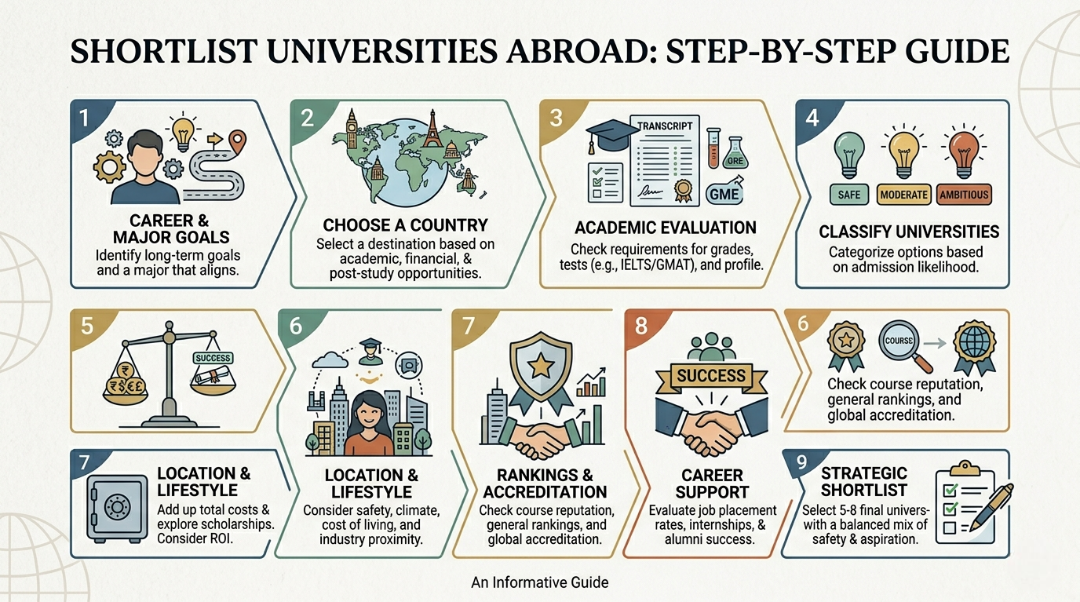
5. Take into account the budget and ROI.
One of the key aspects in the study abroad planning is cost.
- Add up all the costs, such as tuition fees, cost of living, and cost of travelling, to avoid experiencing financial strain in the future.
- Get scholarships, grants or assistantships that can reduce your overall cost significantly.
- Think about the job opportunities and how much you will receive as a reward for your investment based on the employment prospects and the amount of remuneration.
The benefit of a shortlist universities abroad would never be more expensive than its payoff in the future.
6. University Rankings and Accreditation Check.
Rankings are merely a guideline, and they must not be considered in isolation.
- See, to be aware of the reputation of the university, such international lists as QS or Times Higher Education.
- Check course-specific rankings, as some universities are high in certain areas and not in the general ranking.
- Make sure that the university is accredited and is recognised around the world in order to retain the worth of your degree.
This assists in informed choices of the best universities.
7. Talk about Location and Lifestyle Factors.
Student life is dependent on where you are.
- Think about climate, safety, and cost of living to have a comfortable and safe stay in foreign countries.
- Proximity to industries and internship opportunities; this can be improved by checking.
- Assess cultural fit and student support services to make sure that you are able to adjust to a new environment with ease.
These are just a few of the things that are not taken into account when choosing a college in a foreign country, yet they are very critical.
👉Read More: UK vs Australia for international students
8. Analyse Placement and Career Support
Education is not the only thing you are pursuing, but career development.
- Measuring the rate of employment of graduates will help ascertain the success ratio of students who have completed the course.
- Search for internship and co-operative programs so as to get practical work experience during the study.
- Better career opportunities. There are career opportunities available upon graduation, and one way to learn about these opportunities is to read alumni success stories.
This will ensure that you can succeed long-term in your venture to shortlist universities abroad.
9. Shortlist 5–8 Universities Strategically
By now, you should have a list that is narrowed down.
- Do not offer to too many universities unless there is a good case to do so, as it is costlier and time-consuming, and it can not necessarily be a sure gain.
- Make sure that your categories of shortlist are diverse with safe, moderate and ambitious universities.
- Have backup plans available to you in case of unforeseen events.
It is at this point that your shortlist universities abroad guide comes into play.
👉Read More: IELTS score needed for scholarships
10. Seek Expert Guidance
Some of the students have an issue with shortlist universities abroad that are not in their country due to a lack of clarity.
- Use the services of competent counsellors who would analyse your profile and suggest to you appropriate universities.
- To get professional guidance and get rid of the pitfalls to improve your chances of admission.
- Get assistance with applications, documentation and getting a visa to make the journey smooth.
Gateway Educonnect offers professional services related to: and has over 23,000 students who have been placed successfully over the past 15+ years.
- The profile analysis that causes you to be familiar with your strengths and opportunities.
- Selecting a university depending on your profession and studies.
- Application support to submit error-free.
- Visa advice to make the last step of your study abroad easier.
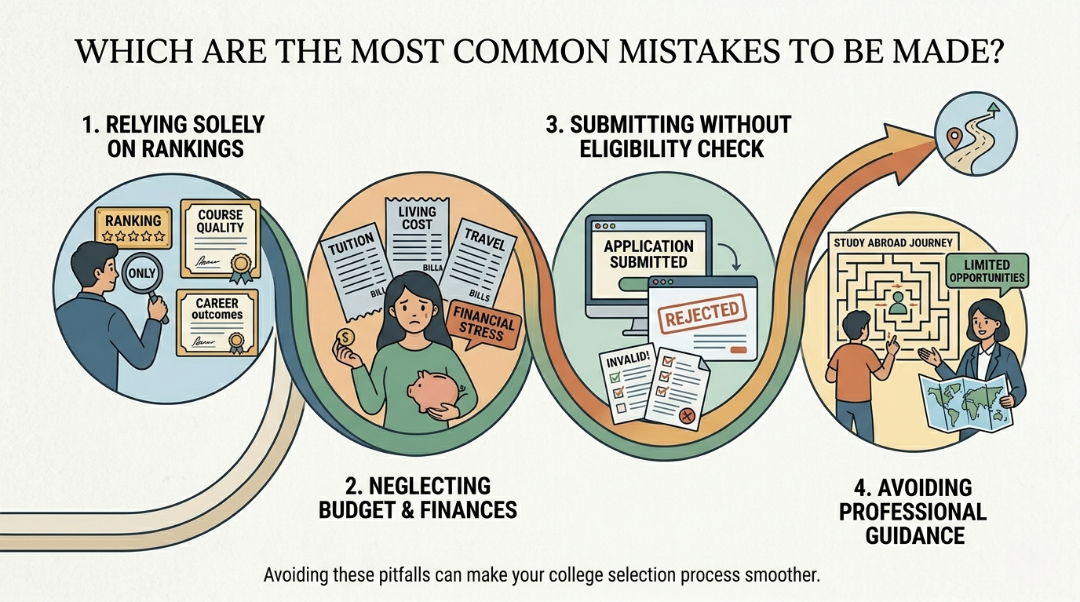
Which are the Most Common Mistakes to be made?
Some of the major pitfalls to be wary of and to be avoided in planning your study abroad trip are:
- Choosing universities based on the ranking in isolation from consideration of the quality of courses and career outcomes.
- Failing to plan your budget and finances can lead to stress in your studies in a foreign country.
- Application submission without the information on their eligibility requirements results in unnecessary rejection.
- Not seeking the advice of a professional where needed, and this may limit your opportunities.
These are some of the mistakes that can be avoided to make college selection in a foreign nation an easy process.
Reasons to Use Gateway Educonnect?
Gateway Educonnect is a good partner to Indian students:
- Students assisted: 23,000+, a fine record of successful study abroad experience.
- Experience: Over 15 years of experience in counselling students on educational opportunities in the world.
- To offer a wide global opportunity, Gateway Educonnect is a company which helps students in the most favourable study destinations such as the USA, UK, Canada, Australia, Germany, France and Dubai.
- The one- click apply facility enables students to start their university applications within only 100 seconds and thereby, the process becomes quick, easy and painless.
- Quickly offered letters within 24 hours assist in minimising wait and doubt.
- These advantages enable one to visit and shortlist universities abroad.

👉Read More: Study in Italy without IELTS
FAQs
1. What do I do to shortlist universities abroad?
The initial move towards an effective method of shortlist universities abroad will be to determine your course, country of interest and your financial ability. Shop and compare universities, then make good decisions based on eligibility, ranking and career results.
2. What is important in college choice in foreign countries?
When making a decision on which college to attend in a foreign country, one should consider such factors as the quality of courses provided, tuition fee, location and employment prospects upon completion of the course. These will guarantee that your decision is both career and education-oriented.
3. How many universities do I have to shortlist?
It is advised that you should have 5-8 shortlisted universities with regard to safety, moderation and ambitions. This will enhance your opportunity and assist in selecting the best universities.
4. Am I able to shortlist overseas universities on my own?
It is possible to do it yourself, but professional advice could make your university shortlisting guide easier and minimise errors. Professionals are useful in matching your profile with the universities.
5. What is the time to begin planning to study abroad?
It is best to start your study abroad planning at least 10–12 months before your intake. Early planning will enable you to have enough time to research and shortlist universities abroad with confidence.
Conclusion
One of the most crucial actions during your study abroad will be to shortlist the appropriate university. By applying to international universities, you not only increase your chances of being accepted but also increase your academic and career opportunities. With the help of a systematic shortlist universities abroad guide, where you have to take into account such aspects as budget, course quality, and prospects after graduation, you will be able to make informed choices.
It can also be made easy and simplified with expert assistance in case you get lost along the way. Gateway Educonnect and its long-standing experience and student-centric approach can guide you in making the process of planning your study abroad an easy one, and help you realise your vision of studying abroad with a clear and confident vision. For more assistance, please visit our study abroad consultancy services and explore our wide range of offerings for students interested in studying in the USA, studying in the UK, studying in Australia, studying in Ireland, and many other countries.

Author Bio
Abhinav Jain - Founder, Gateway Educonnect and Director.
B.Tech, MBA, AI and Global Education Specialist.
More than 15 years of professional experience in leading students along international routes based on politics and innovation.