24 Apr 2026 | Tier 1 vs Tier 2 Universities Abroad: Which is Better for Indian Students

0
127
Introduction: Tier 1 vs Tier 2 Universities Abroad
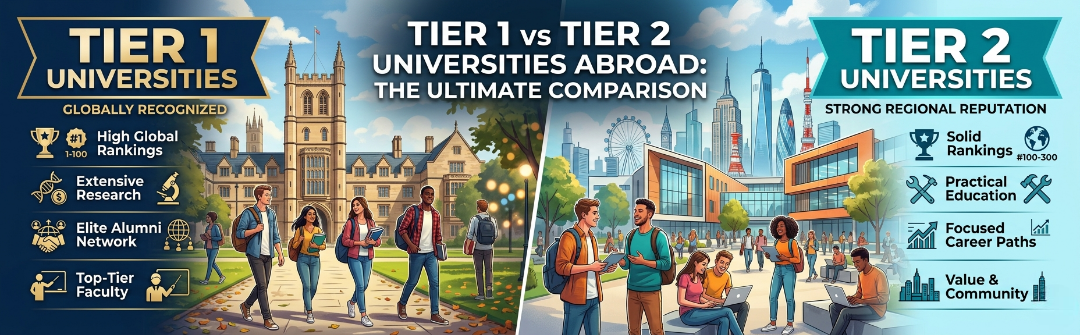
Indian students and their parents make one of the most crucial decisions when they decide on the correct university to attend in a foreign country. Tier 1 vs tier 2 universities abroad and it may be so confusing with all the choices they offer. Tier 1 universities are known by the global ranking and prestige, whereas Tier 2 universities are increasingly popular because of their affordability and applicability to a career.
However, they are not the only different decisions to make. Additional aspects, including budget, course relevancy, career goals and return on investment, are also paramount. Students can make better decisions by being made aware of the significance of ranking universities and the comparison of the top and average universities of other countries.
The guide will simplify the procedure of making decisions by offering clear insights, illustrative cases and recommendations backed by knowledgeable individuals. Be it prestige or practicality, this study abroad decision guide can help you make the right decision.
Understanding Tier 1 vs Tier 2 Universities Abroad
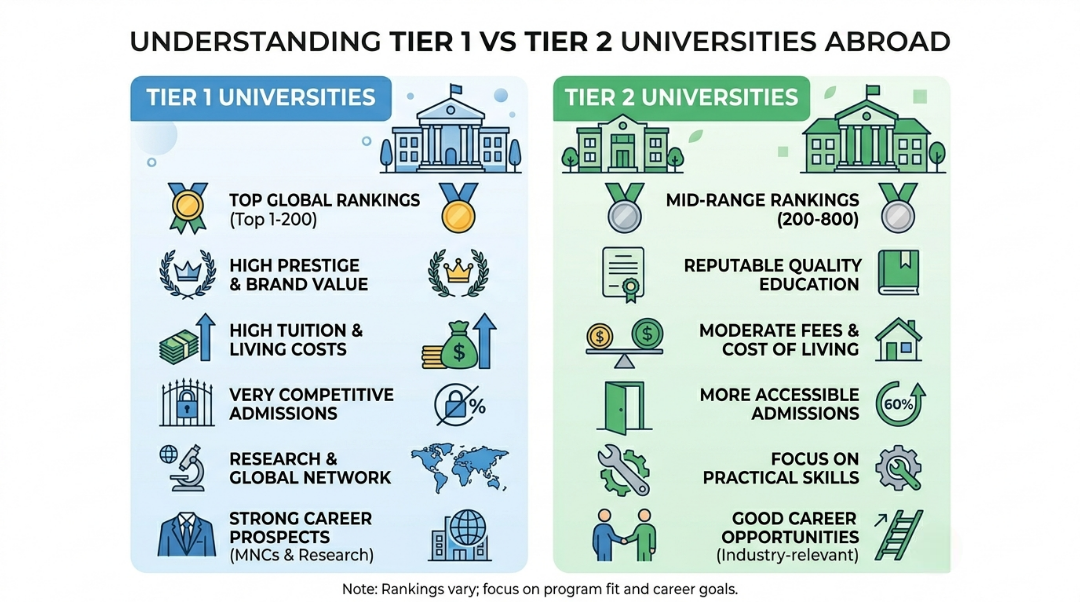
In the comparison between the Tier 1 vs tier 2 universities abroad, the classification is largely based on the international rankings, popularity, research, and the awareness of the employers.
Tier 1 Universities
- These are ranked universities throughout the world and are normally ranked among the top 100-200 in the global ranking, thus, make them prestigious.
- They are the ones who are reputed to be highly research productive, resource advanced and those that are internationally scholarly acclaimed.
- The Ivy League and Russell Group universities in the United States, and Russell Group universities in the United Kingdom are one such example.
Tier 2 Universities
- These universities are listed as normally ranked between 200 and 800 around the world, and yet provide a reasonable quality of education.
- Rather, they could be slightly less noticeable on the global scene and provide lots of educational opportunities and career possibilities.
- The majority of these universities are attended by foreign students due to their low price and the convenience of accessibility to the facilities.
You must be conversant with the best vs mediocre universities elsewhere and then make up your mind.
Key Differences: Tier 1 vs Tier 2 Universities Abroad
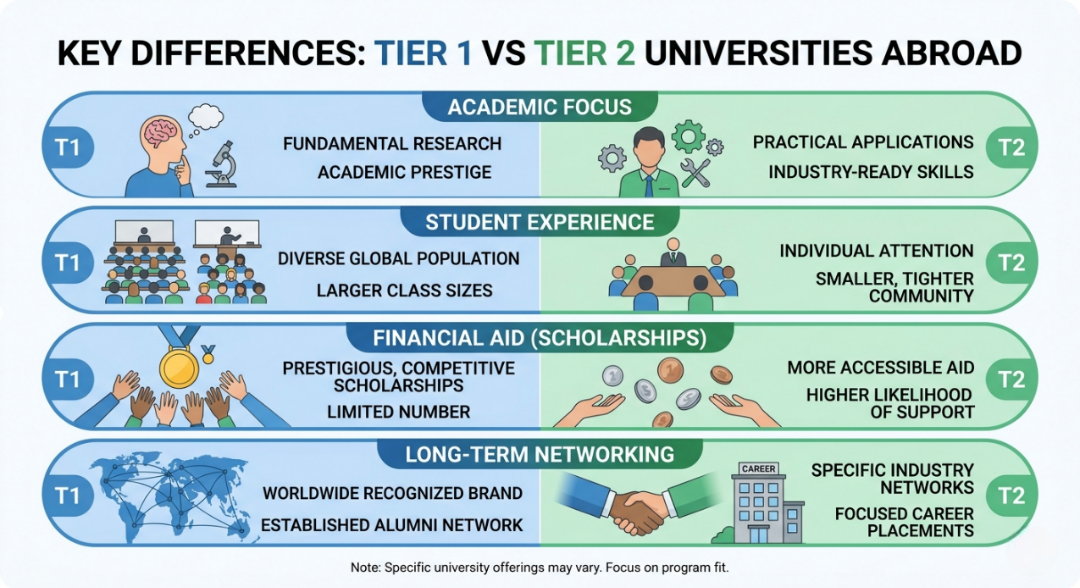
The next is a lively parallel which would allow you to go between these two choices:
|
Factor |
Tier 1 Universities |
Tier 2 Universities |
|
Ranking |
The tier 1 universities are the most reputable ones, always, and are usually reputed to be of good academic standards. |
Tier 2 Universities are mid-range in the world ranking, but the academic levels and reputation of the Universities are good. |
|
Fees |
The tuition fees in tier 1 universities are high since they are global, well-developed in terms of infrastructure, and have research facilities. |
Tier 2 universities generally cost a lot less in terms of tuition and thus are accessible to most Indian students. |
|
Admission |
Tier 1 Universities are quite competitive when it comes to release entry and demand good academic performance, i.e. high scores gained in the test and profile. |
Tier 2 universities also possess rather lax admissions requirements, in such a way that students with mixed academic environments can apply. |
|
ROI |
The good long-term returns on investment can be realised through tier 1 universities since they will provide higher benefits in terms of salary and global job opportunities. |
The institutions which have a moderate payoff on investment in lower price and moderate career returns are the tier 2 universities. |
|
Class Size |
Tier 1 universities have bigger and more varied classes that are open to international students, exhibiting diversity. |
Tier 2 universities are also impacted by small class sizes that could lead to more individual attention from the faculty. |
|
Scholarships |
The scholarships appear very prestigious at Tier 1 universities, but are few and highly competitive to acquire. |
Tier 2 universities have scholarships that are more likely to be available to international students. |
This comparison implies the motivation for why the study abroad decision guide cannot solely be based on rankings.
Why Should we Care About University Rankings?
The ranking of the Tier 1 vs tier 2 universities abroad is generally overrated. Rankings are an information source on quality, and should not be the only consideration.
When Rankings Matter
- Rankings are influential when the career path you seek involves a research focus, and your location can significantly impact your opportunity.
- They are pessimistic when you want to work in competitive and fast-paced companies in the world, and want to attract the best university graduates.
- Rankings also matter when brand recognition is an important part of your professional integrity.
Rankings are not so important.
- The importance of rankings is less likely when you are looking into skills-based jobs where practical experience is more important than the prestige of a particular institution.
- They will not be so judgmental once you expect to gain work experience and build up your profile by taking part in internships and projects.
- The cost-effective students could put up a consideration on cost over and above the rankings and still achieve a good performance in the career.
The significance of knowing university ranking will help you to have a balanced expectation and reality.
👉Read More: UK vs Australia for international students
Comparison of Cost
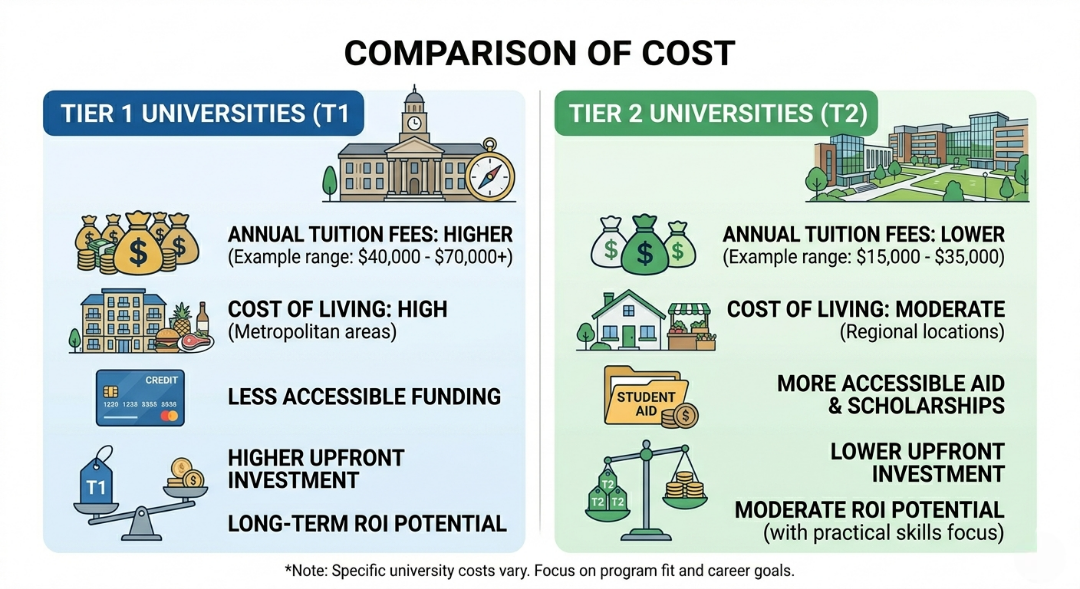
One of the biggest differences in Tier 1 vs tier 2 universities abroad is cost.
Tier 1 Universities
- Depending on the course and country, the tuition fees may be ₹25-50 lakhs annually.
- An additional cost of 10-20 lakhs annually can also be on the major city living cost, and this would cause the total cost to be tremendous.
Tier 2 Universities
- The cost of tuition fees is either less expensive, 12–30 lakhs/year on average.
- And the last one is that the cost of living is very moderate, which makes their residence a possible choice for a variety of Indian families.
This disparity has a grave consequence on decision-making by most Indian families. This is when the powerful study abroad choice guide will really be essential.
Outcomes of Careers: Does the Tier Really Count?
The popular myth related to the Tier 1 vs tier 2 universities abroad argument is that only the top universities are able to assure success.
Reality Check:
- It is true that employers now worry more about the applied skills, internships and job experience than the rank of the university.
- In the majority of cases, tier 2 university students acquire a high-paying job with the help of active networking and exposure to industries.
- Like that, career development typically depends on individualism, flexibility and lifelong learning as compared to a college or university name.
That is why it is necessary to comprehend the top and average universities in other countries in a much bigger picture.
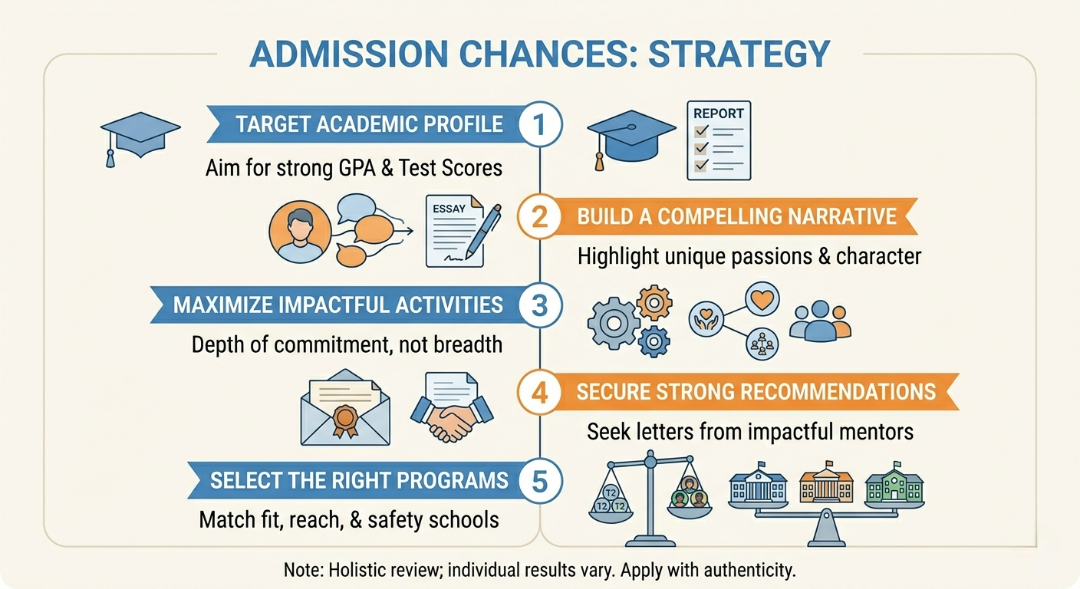
Admission Chances: Strategy
The level of competition is so high that it can be competitive enough to get into Tier 1 vs tier 2 universities abroad.
Tier 1 Admission Requirements
- Sometimes, for honourable students, that is, though, admirable grades, good after-school achievements are often demanded.
- A well written Statement of Purpose (SOP), and effective Letters of Recommendation (LORs) are very important in enhancing your application.
- Most universities also include in the entry requirements; in most cases competitive test scores.
Tier 2 Admission Advantages
- Admission requirements are quite lenient, and a greater number of students can easily apply successfully.
- Universities frequently will give faster admissions, lessening confusion and anxiety.
- The rate of acceptance increase will put you on the brink of admission to the program of your choice.
A smart study abroad guide will probably propose applying to both levels.
In Which Reasons do you Want to Choose Tier 1 Universities?
Choose Tier 1 if:
- Your school performance is good, and your grades are high, and on the other hand, competitive amongst the test scores, to give you a chance as a candidate in highly competitive universities.
- You desire research, academia, or speciality career tracks, and reputation, or the institute can be a key determinant in establishing opportunities.
- You have the economic capacity, scholarships or any other source of funding to comfortably afford the cost of increased tuition fees and cost of living.
- You put great emphasis on brand awareness worldwide, network and long-term career gain factors in competitive industries.
Such cases evidently depict the ranking importance of the university, in particular when prestige and international visibility are critical in your career objectives.
In case Tier 2 Universities are a Better Alternative.
Choose Tier 2 if:
- You are moderately academically partnered yet desire to gain entry to good international education and powerful employment opportunities.
- You are seeking an affordable alternative with the right balance between the quality of education and cost.
- You like quicker admission cycles and a less competitive application procedure to obtain your seat without unjustified delays.
- You are more concerned with acquiring relevant competencies, work experience and employability, rather than just being overly concerned with the reputation of the university.
This is the point where the best vs average university knowledge abroad comes to the rescue, since not ranking but basing decision-making on the long-term results comes in.
👉Read More: Study in Italy without IELTS
University Choice Tips for Indian Students.
The following are a few tips of actionable university selection:
- The course curriculum should never be hurried and you should always take a time to think over before making sure that the course curriculum best suits your career interests and objectives.
- Check post-study jobs in the country since they are critical in making long term career plans.
- Take into account the overall price, such as tuition fees, cost of living and other hidden expenses, such as insurance.
- See what internship programs and industry links the university provides to become more employable.
- Look at the success stories of alumni as a way of realising the practical career results and prospects upon graduation.
This will assist in making a better choice with these tips for selecting a university.
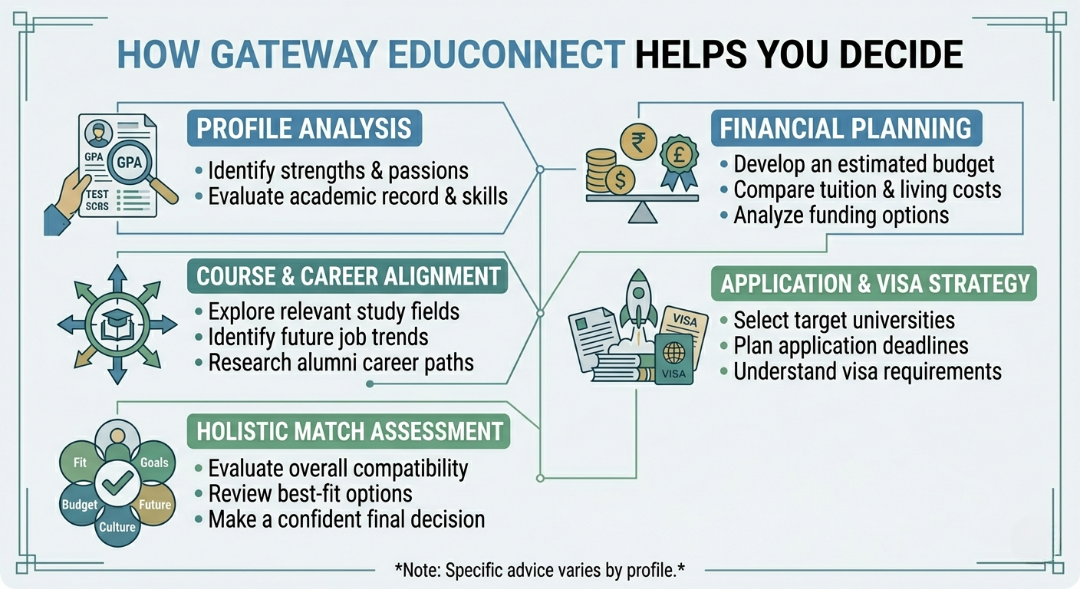
How Gateway Educonnect Helps You Decide
Gateway Educonnect has over 15 years of experience in guiding, having guided 23,000 students and succeeded in assisting them in making decisions on whether to go to Tier 1 vs tier 2 universities abroad.
What Do You Think Our Differences Are?
- Apply to your college by taking just 100 seconds using our one-click apply system.
- Our quick and efficient admission process enables students to obtain offer letters immediately, within 24 hours.
- The prime motifs of our services include the United States, the United Kingdom, Canada, Australia, Germany, France and Dubai.
We provide:
- One-on-one counselling to help you select the right university according to your profile and goals.
- Cashless convenient means of accommodation in a new country, with loans and a place to stay.
- Test recommendations that can help you increase your chances of attending the best colleges.
FAQs
1. Do Tier 1 universities necessarily have a high superiority over Tier 2 overseas?
No, choices are preferable based on your financial capacities, objectives and academic experiences. The choice of the Tier 1 vs tier 2 universities abroad must be tailored.
2. What is the level of satisfaction with rankings in the selection of a university?
The rank factor of the university is important, but it has to be weighed with other aspects such as cost, ROI and career objectives.
3. Are Tier 2 universities well-prepared in terms of career?
Yes, many of the students of the tier 2 universities do so due to the internships, networking, and cultivation of skills.
4. What appears to be the best decision guide among the Indian students on study abroad?
An effective guide towards the choice to study in a foreign land takes into consideration the budget, the career purposes, the country and the reputation of the university.
5. Which country to go to or not to go? Top vs average universities?
Comparison of top versus average foreign countries universities: do not just look at prestige, but ROI, quality courses and employment.
👉Read More: IELTS score needed for scholarships
Conclusion
Finally, it’s a matter of choice and personal choice which university to attend, on Tier 1 vs tier 2 universities abroad, your financial ability, and the future of the chosen career. The benefits of Tier 1 universities in regard to international recognition and academic affiliation and network with other universities are negated by the affordability, access and good career opportunities of Tier 2 universities. In either case, success may be realised upon the appropriate decision.
Instead of merely listening to the rankings, it is better to evaluate the true values of the university ratings and compare such aspects as ROI, course quality and employment prospects. Queried comparisons between the best and mediocre universities overseas with a pragmatic head will assist you in making a well-rounded conclusion. Perhaps you are not aware of where to begin; expert guidance can perform wonders. Over 23,000 students have been helped to overcome this process successfully with the help of Gateway Educonnect.
Become a part of the new learning at gateway Educonnect. Enjoy a free consultation and make your dream of studying abroad come true.For more assistance, please visit our study abroad consultancy services and explore our wide range of offerings for students interested in studying in the USA, studying in the UK, studying in Australia, studying in Ireland, and many other countries.
Author Bio
Abhinav Jain - Founder, Gateway Educonnect and Director.
B.Tech, MBA, AI and Global Education Specialist.
More than 15 years of professional experience in leading students along international routes based on politics and innovation.