
12 Jul 2023 | Working in Morocco: A Comprehensive Guide for All Job Seekers out there

0
1406
Introduction
A handy resource for Indian professionals and foreign job seekers looking to work in Morocco.
Opportunities for working in Morocco can be found in the sphere of services, manufacturing, the auto industry, outsourcing, tourism, logistics and digital industries. However, foreign workers cannot afford to see the process as a mere identification of a vacancy and travelling. Such factors as employer authorisation, entry regulations, residence, language expectations and sector need are all important.
When the Indian candidate is thinking of working in Morocco, first have a valid employer in mind, go through the legal process and compare the job package before moving out.
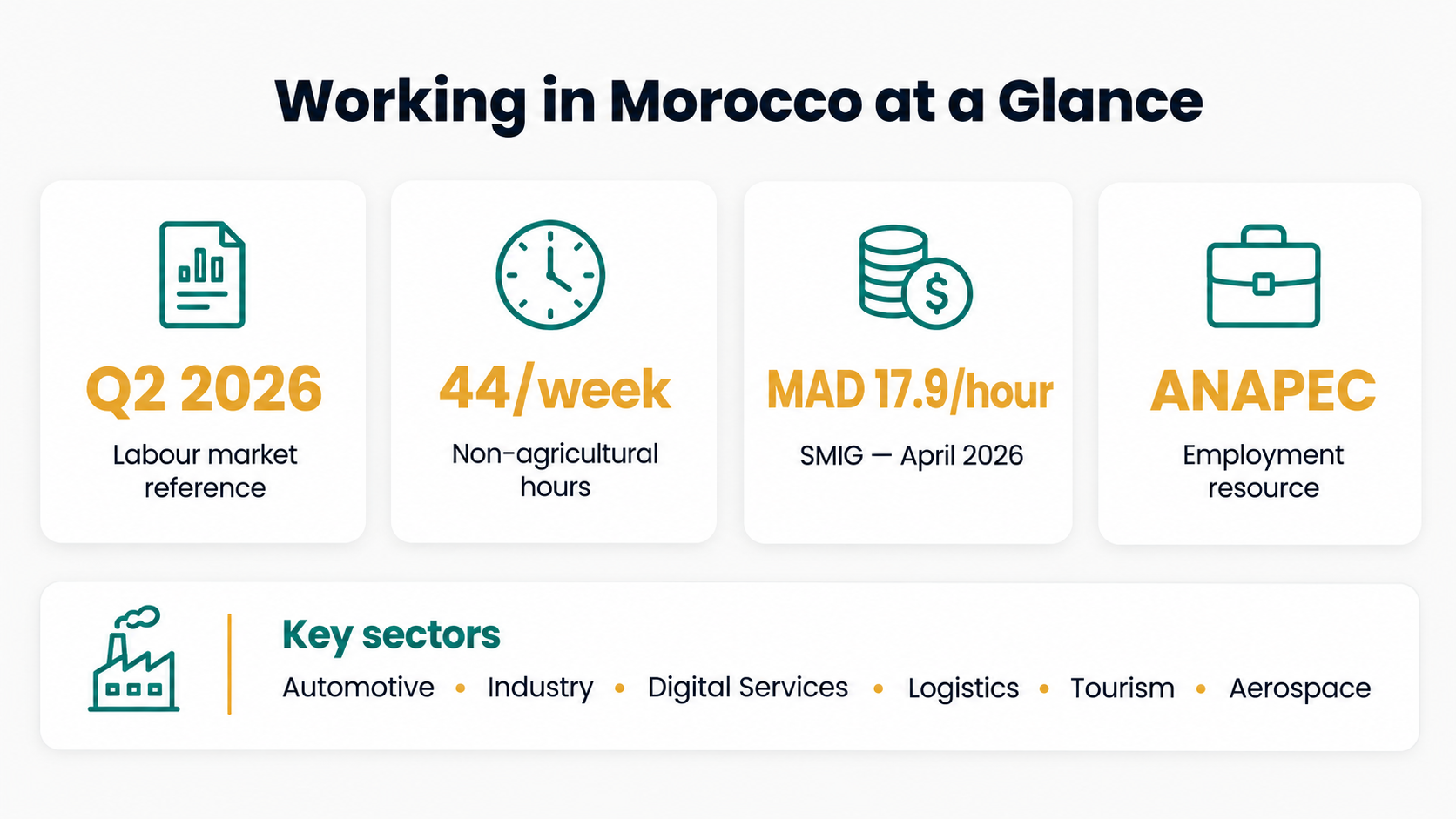
Working in Morocco at a Glance
|
Factor |
Current guidance |
|
Most recent reference of the labour market |
HCP Q2 2026. |
|
Foreign employment |
Employer permission as required under the Labour Code. |
|
Non-agricultural |
Hours: 44/week or 2,288/year. |
|
Minimum wage reference |
SMIG at MAD 17.9/hour in April 2026. |
|
Employment resource |
ANAPEC |
|
Recording industries |
Automotive, industry, digital services, logistics, tourism and aerospace. |
This implies something: The Moroccan job market is not a homogeneous one. The future will be based on qualifications and occupation, employer, locality, languages and the company's ability to hire a foreign employee legally.
Read More: Criteria for Indian Students to Receive a Scholarship for Studying overseas?
What will the Job Market be like in the year 2026 in Morocco?
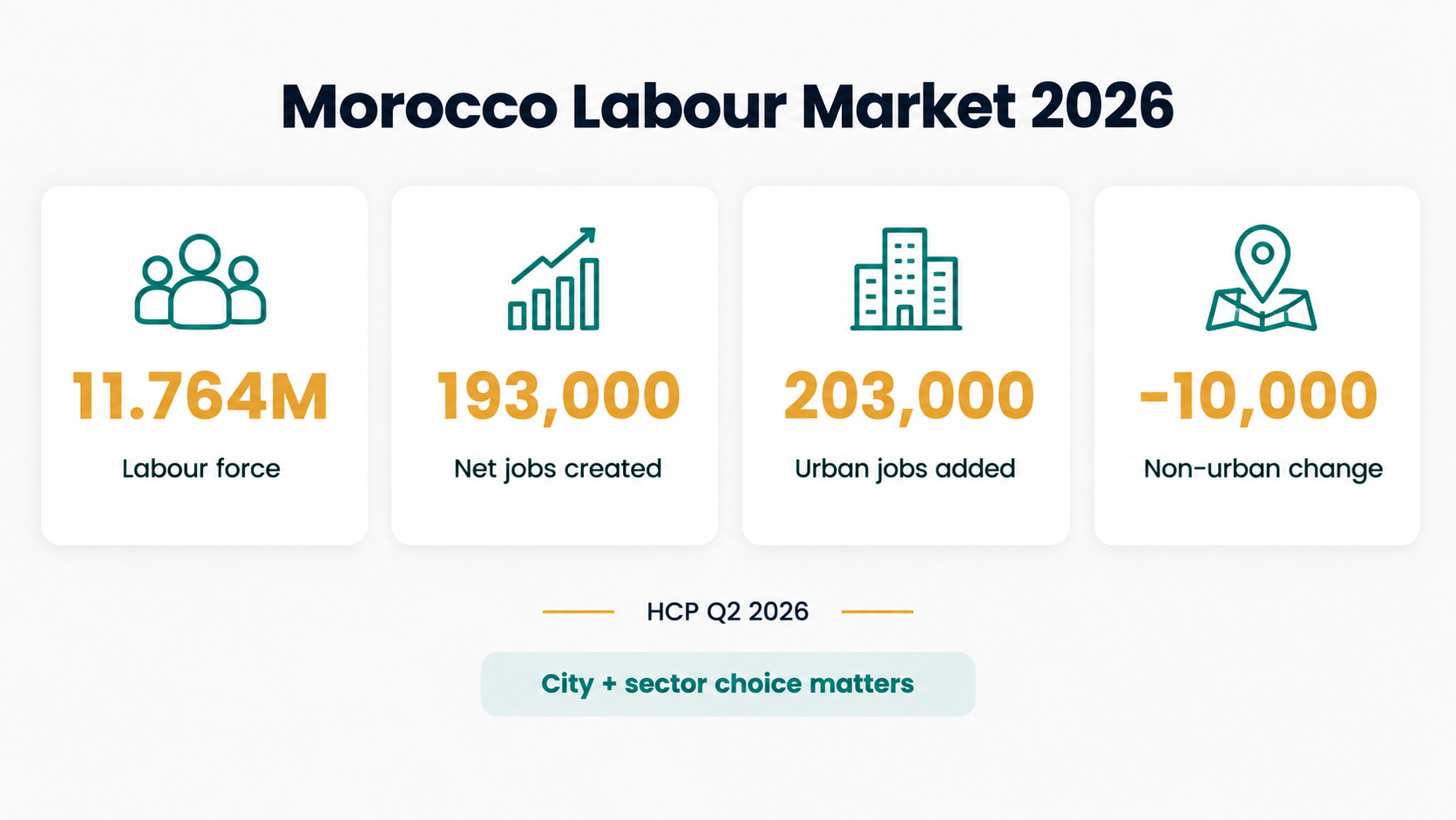
In the most recent High Commission for Planning Q2 2026 labour-market release in Morocco, the labour force has been estimated at 11.764 million individuals. The newer 2026 series indicators in their new survey are also not directly comparable with older indicators, HCP cautions, without restated series.
To put the research into perspective, the HCP's annual employment results for 2025 declare that Morocco registered the creation of 193,000 net jobs in 2024-25, with urban localities attaining the addition of 203,000 positions and unincorporated regions registering the subtraction of 10,000. This supports the importance of the city and sector choice in the evaluation of job opportunities in Morocco.
Should you be yet to decide whether you will take the first step with education for a global career, or with immediate employment, using the guide to studying abroad in India, Gateway EduConnect can give you the opportunity to weigh the arguments.
What Sectors have Sources of Jobs in Morocco?
Sectors where there has been proven activity should attract the attention of professionals who are interested in working in Morocco, rather than random applications.
Manufacturing and aerospace, Automotive.
According to the Ministry of Industry and Commerce National Industry Barometer of Morocco, over one million industrial jobs are projected in 2024, and over 250,000 of these jobs will be in the automobile industry. The Casablanca-Settat Regional Investment Centre's sector overview also recognises the automotive sector, aerospace sector, logistics sector, finance sector, renewable energy and service outsourcing as some of the key sectors in the region.
Such industries may apply to the engineering, production, quality and technical profiles. Sector size is not an indication that all employers hire internationally.
Online, Information Technology and ODS.
A Moroccan government update of 2026 claimed that the outsourcing industry had over 148,500 workers and had in excess of 1,200 foreign firms. Morocco's Digital Morocco 2030 update also prioritises key strategies such as digital skills, qualified employment, innovation and the development of digital services.
It would therefore be an advantage to IT, business-process outsourcing and technology operations, since it could serve as an avenue for exploration to work in Morocco when one is abroad, especially with specialised or multilingual candidates.
Tourism, Logistics and Renewable energy.
Tourism is still incorporated in the national development strategy of Morocco. Casablanca-Settat includes logistics and tourism as the official sector, and its regional investment authority mentions renewable energy as an activity of interest as well. The approvals of the April 2026 National Investment Commission in Morocco involved the tourism industry, renewable energy, automotive and aerospace, among others.
Consider these areas for research, rather than employment assurances.
Foreigners in Morocco: Are they required to have a work permit?
This is the most important legal matter when working in Morocco.
Article 516 of the official Moroccan Labour Code provides that, in the case where an employer wants to hire a foreign worker, they have to seek approval from the government office that oversees unions. This is authorised in the form of a visa on the employment contract. Article 517 insists that the contract of the foreign worker should be based on the form.
That is why it cannot be considered that a Moroccan work visa is a single document which gives an opportunity to be there, work and live.
|
Stage |
What it covers |
|
Employment authorisation |
Employer's legal authorisation to hire the foreign worker |
|
Entry permission |
Permission to enter Morocco |
|
Residence status |
Residence documentation as needed. |
In the official eVisa information of Morocco, Indian citizens are under category A. Nonetheless, Access Maroc's official eVisa conditions clearly state that the eVisa is issued either on a tourism or business basis, and its holder cannot apply for a residence permit. An eVisa should not be made out to be a work permit in Morocco.
Prior to taking up a job, ask the employer about the kind of employment authorisation and residence procedures it will be undertaking and the kind of documents you need to present.
What Does ANAPEC Do?
ANAPEC is the public employment agency in Morocco and is introduced to the official procedure for foreign workers. A list of attestation processes for the activity of a foreign employee is included in the Moroccan system. Examples of supporting documents displayed on the portal are an employer request, qualification/diploma, resume and job description.
The nature of the requirements may be case-dependent. Whoever intends for working in Morocco is advised to enquire with the employer on which ANAPEC steps need to be adhered to and not to follow a sample of an old checklist created on an unofficial site.
Which Hours Does it Work?
The normal working time in the non-agricultural activities of Morocco under the Labour Code is 2,288 hours annually or 44 hours per week. It does not set up a standard Monday-Friday, 9-5 progression.
Ensure that your contract has your weekly hours, day of rest, overtime, leave and schedule requirements before working in Morocco. Also, do not expect that all the workplace in the private sector automatically observes the reduced Ramadan work timings; no general guideline was found in support of this assertion in the reviewed discourse.
What Is the minimum wage?
As per Moroccan government's April 2026 wage update, based on the renewed wage package applied in April 2026, had increased by maximum MAD 17.9 per hour in the non-agricultural segment, consisting of the SMIG, and was approximately 3,400 net monthly. The Agricultural SMAG was reported to be MAD 2,400/month in April 2026.
These are not average professional wages; they are minimum wage references.
Consider a comparison of gross salary, deductions, insurance, housing, transport, bonuses and relocation support, whether you choose for working in Morocco. The salary offered by itself is not a sufficient concept to estimate whether an offer is more valuable or not.
Do You Require French, Arabic or English?
There is no single language rule for all employers in Morocco. Article 5 of the Moroccan Constitution is an acknowledgement of Arabic and Amazigh as official languages. Language in the workplace, however, is based on the company, occupation and customers.
In many other areas of work, the use of French is involved, and in international business, technology and outsourcing, English may be relevant. But it would be deceitful to assume that with English only one can get any job in Morocco as a foreigner.
Read each vacancy thoroughly, and specify your language skills.
How Should International Candidates Search for Jobs?
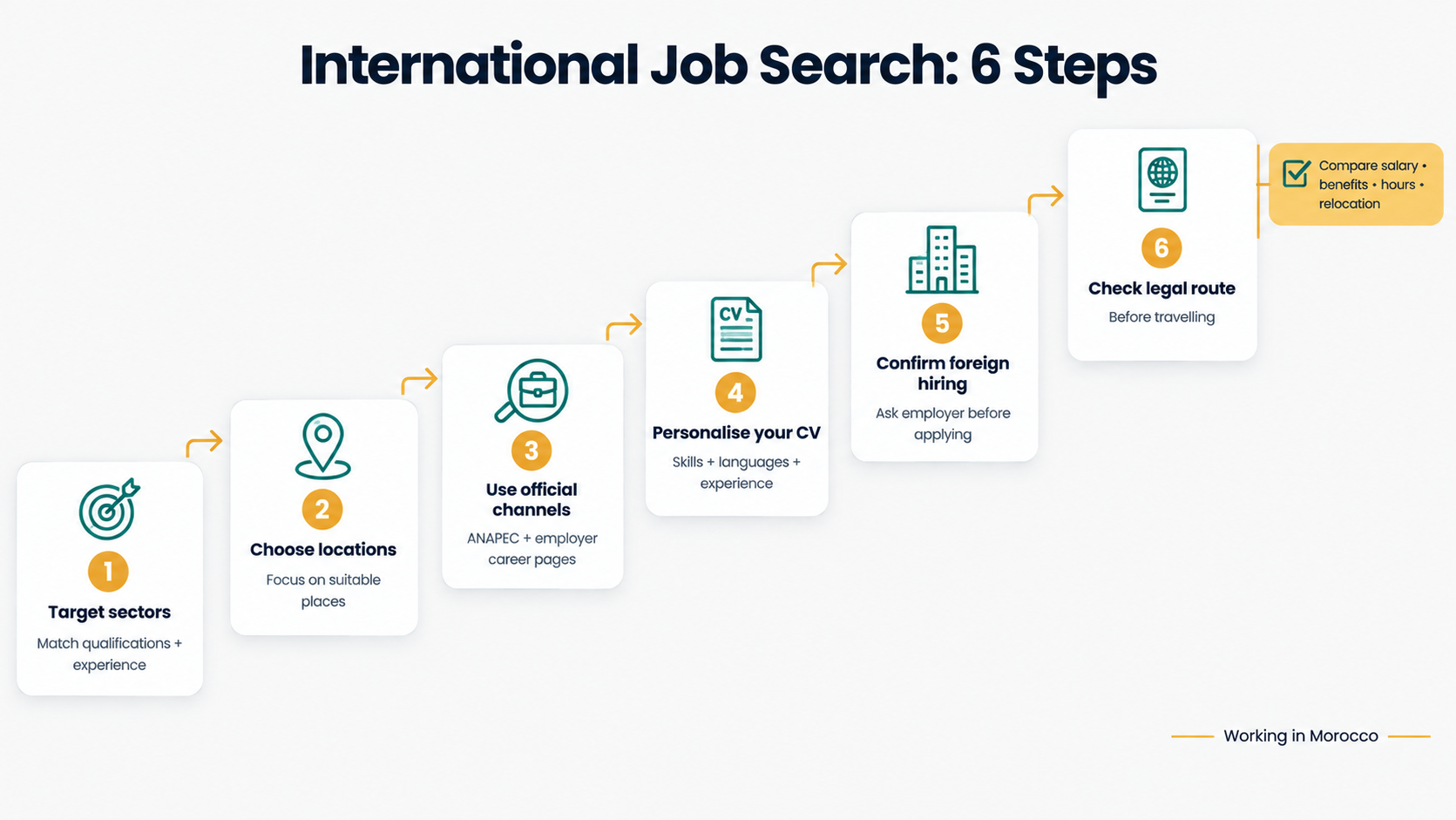
Be systematic:
- Select target areas that will suit your qualifications and experience.
- Focus on places of interest and not just a city based on lifestyle.
- Apply to official and direct channels, such as ANAPEC and employer career pages.
- Personalise your CV based on technical skills, languages and quantifiable experience.
- Inquire and confirm with the employer regarding hiring foreigners at the outset and their ability to complete the process.
- Legal route: Before travelling, check the legal route.
- Compare all the offers, like salary, benefits, hours and relocation terms.
Graduates who are yet to get the necessary skills to dive into the employment world overseas can use Gateway EduConnect's study-abroad counselling resources to determine whether further studies will prove to be more effective.
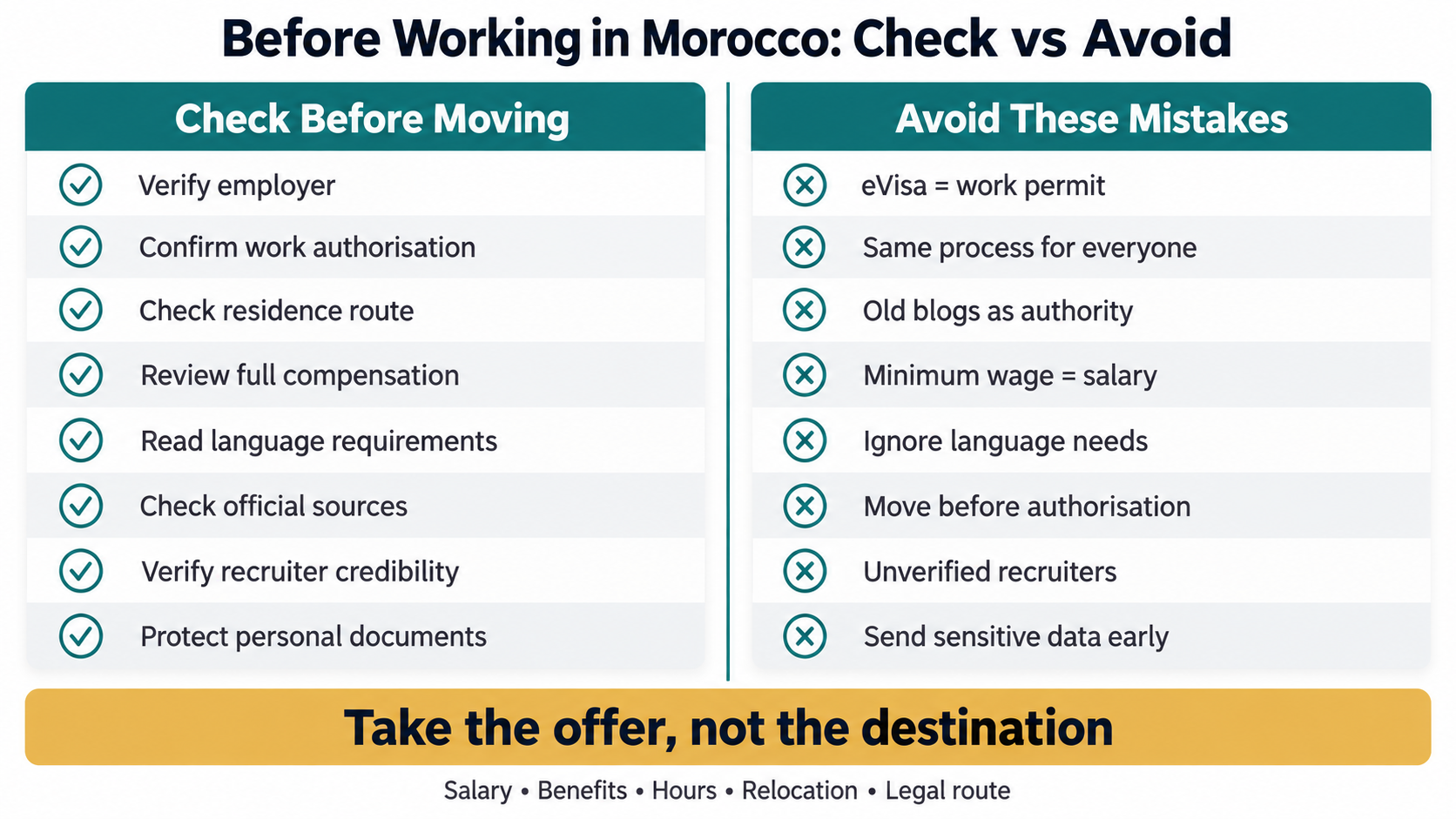
Common Mistakes to Avoid When Working in Morocco
Taking an eVisa as employment permission.
- Treating an eVisa as employment permission.
- Supposing that all foreign employees use the same procedure.
- Relies on the old blogs as the ultimate authority concerning employment law.
- Consideration of minimum wage as an average professional salary.
- Omission of language requirement in vacancies.
- The authorisation is ensured by relocating prior to the employer.
- Home page: Do not pay recruiting agencies without verifying them or send sensitive information prematurely.
FAQs
Is it possible to have Indian citizens work in Morocco?
Yes, as long as there are no employment authorisation and residence requirements. The Labour Code requires that employers hiring foreigners in Morocco obtain an authorisation.
Do you mean a Morocco eVisa is a work visa?
No. According to Access Maroc, its eVisa cannot be used to apply to be a resident; it is for tourism or business. Employment authorisation is separate.
What is the process of obtaining a work permit in Morocco?
This should begin with a real employer. The employer has to decide which labour authority process has to be applied; in various cases, ANAPEC can also be included in the process.
Which jobs can foreigners get?
No official list exists which is used by foreigners. The sectors that are documented are automotive, manufacturing, digital services, outsourcing, logistics, tourism, aerospace and renewable energy. Real recruitment is based on the employer and job position.
Is a career in Moroccan work abroad a good opportunity?
Whether the role, employer, payment, language requirements and legal route suit your career or not is a question that can be answered. Take the offer, not the destination, into consideration.
Conclusion
Working in Morocco is a viable choice for people entering the workforce who follow legal procedures and demonstrate their suitability in the target field. Better chances can be found by aligning relevant skills with employers in industries that have a registered presence, rather than moving initially in the hope that they could subsequently get employment. Prior to relocation, cross-check the employer, get to know the employment-authorisation process, examine the entire compensation package and ensure up-to-date entry and residence requirements with official Moroccan sources.
For additional help, check out our study abroad consultancy services and the many options available to students who want to study in the USA, study in the UK, study in Canada, study in Australia, study in Ireland and many other countries.

Author Bio
Abhinav Jain - Founder, Gateway Educonnect and Director.
B.Tech, MBA, AI and Global Education Specialist.
More than 15 years of professional experience in leading students along international routes based on politics and innovation.


