27 Nov 2026 | AI-to-Counsellor Handoff: Rules for When a Human Takes Over

0
12
AI to Human Handoff in Counselling: 8 Rules for Study Abroad Consultants
A practical guide to escalation rules, warm transfers and accountable human intervention for study-abroad consultancies.
AI to human handoff in counselling should occur whenever a student enquiry requires personalised professional judgement, reliable information beyond the AI agent's approved knowledge or direct human assistance. Consultancies must establish clear escalation rules to determine when automation should stop and a counsellor should take over.
AI calling agents can manage routine enquiries, collect preliminary information and coordinate appointments. However, complex academic profiles, previous visa refusals and significant financial decisions require appropriate human oversight.
An effective AI to human handoff in counselling is not simply about transferring calls. It is about connecting students with suitable professionals, preserving conversation context and ensuring that every unresolved enquiry has an accountable owner.
What Is AI to Human Handoff in Counselling?
AI to human handoff in counselling is the transfer of a student or parent query from an AI agent to a human counsellor.
Depending on the technology and its set-up, the occurrence may be through:
- Live call transfer: This involves connecting the caller to an available counsellor.
- Scheduled callback: Arranging a person at a specific time.
- Task-based escalation: Delegate an unresolved enquiry to a specific team member.
The documentation of AI-to-human handoff, provided by Twilio, shows how active conversations, including additional relevant context and AI-generated summaries, can be transferred to people with the help of configured systems.
In the case of study-abroad consultancies, this means the counsellor can access the relevant information they need before moving on with a student discussion, as long as the platform has the necessary functionality.
Where Should AI Calling Stop and Human Counselling Begin?
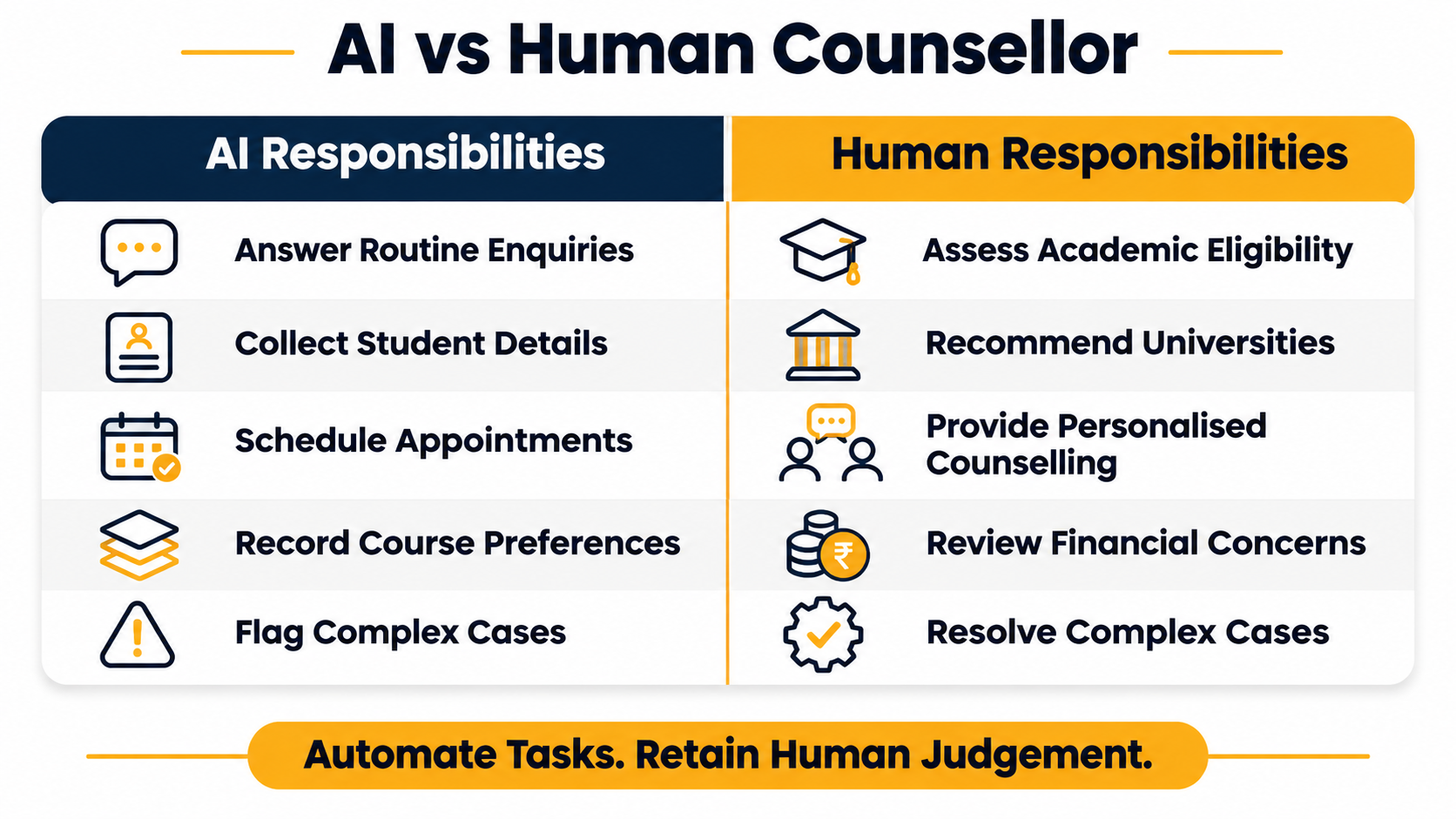
Before applying AI to human handoff in counselling, consultancy owners are advised to establish three tiers of automation.
|
Enquiry category |
Human responsibility |
AI responsibility |
|
Initial qualification |
Assess individual suitability |
Collect academic background, destination and course preferences |
|
Routine enquiries |
Handle exceptions |
Answer approved FAQs and share general intake information |
|
Appointment requests |
Conduct counselling |
Capture preferences or schedule supported appointments |
|
Financial enquiries |
Review individual affordability and funding concerns |
Share verified published information |
|
University shortlisting |
Recommend appropriate institutions |
Record student requirements |
|
Complaints |
Investigate and resolve |
Acknowledge and escalate |
|
Visa complications |
Arrange appropriate specialist guidance |
Identify concerns and flag the case |
Foreseeable activities based on information should be left to AI. Individualised advice and resultant choices must remain with the provider of counsellors.
A consultancy should also include these limits in its automated strategy for following up with students via calls.
8 Escalation Rules for AI to Human Handoff in Counselling
The escalation rules below are proposed policies for education consultancies and are not legal requirements.
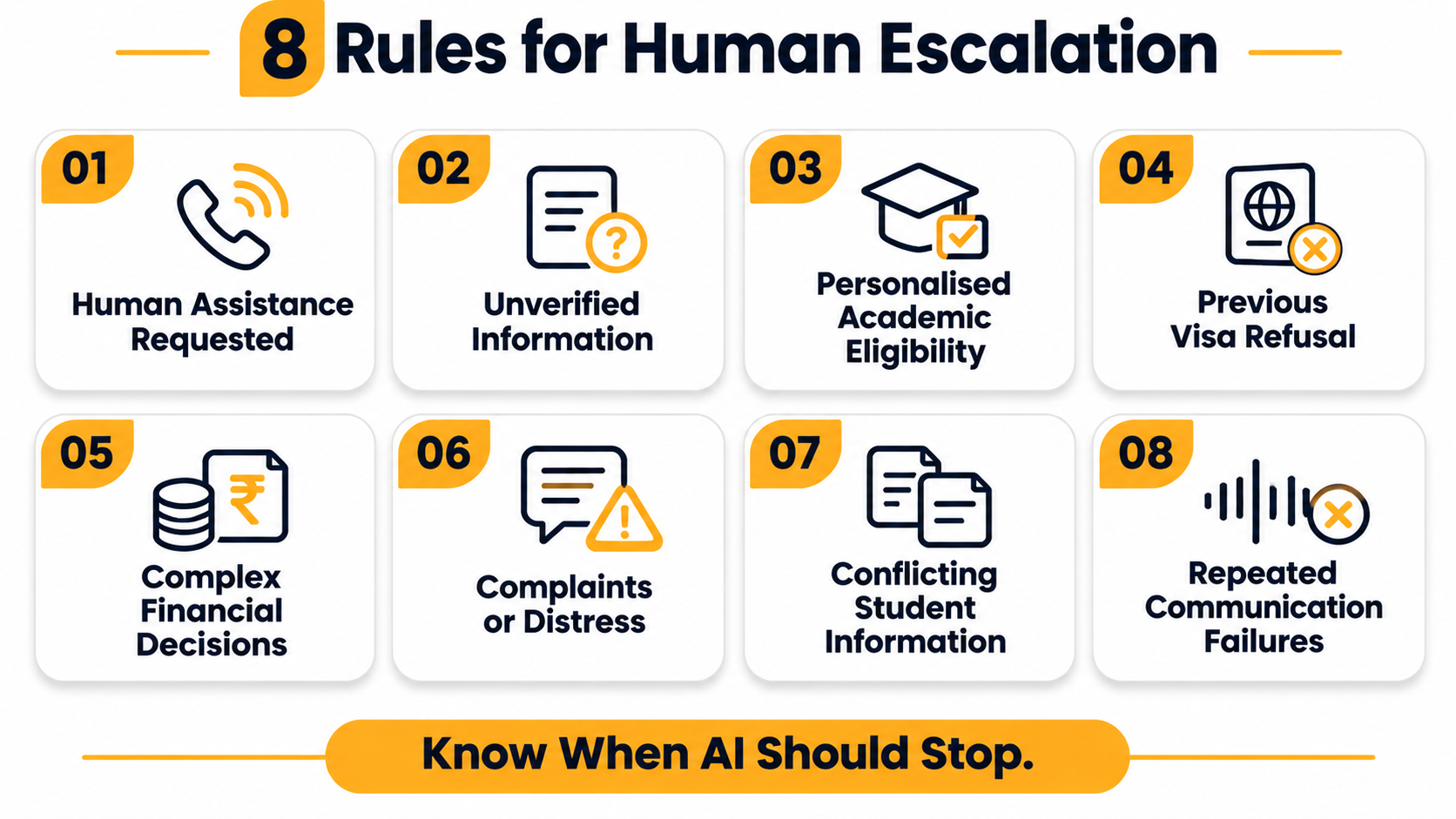
1. The Student or Parent requests Human Assistance.
Escalation should be triggered by an explicit request to meet with a counsellor.
The AI agent ought to provide a live transfer or call-back option rather than repeatedly trying to resume the automated dialogue.
2. AI is unable to validate information.
University terms of entry, scholarships, fees, and application time limits can vary.
When an AI agent cannot confirm information in its approved knowledge base, it should admit the limitation and direct the enquiry to a counsellor.
3. Individualised Academic Eligibility Is needed.
Depending on academic requirements, subject combinations, English language proficiency, and personal university needs, these factors may influence admission suitability.
AI can capture such information, but a qualified counsellor should review individual suggestions.
The student sponsor advice by the UK Home Office defines recruitment-agent management responsibilities under the Agent Quality Framework for UK student sponsors.
Although these obligations do not address particular AI handoff laws, they affirm the need to uphold responsible recruitment practices.
4. Student Has Been Previously Refused a Visa.
A history of visa rejections or complex immigration backgrounds needs to be evaluated individually.
AI is not supposed to predict visa approval or guarantee results, but it can recognise the issue. This should extend to a counsellor who can make necessary arrangements for appropriate, qualified immigration advice.
5. The Conversation Involves Significant Financial Decisions
Professional verification may be necessary for education loans, scholarship eligibility, and affordability evaluations.
Human intervention is especially necessary when financial expectations conflict between the student and the parents.
This rule can be implemented with suitable Indian study-abroad family AI calling scripts within consultancies.
6. The Caller Shows Discontent or Distress.
Human beings must attend to grievances regarding delays in receiving applications, payments, or past counselling.
The AI can recognise the concern and record the necessary information, and an authorised representative can review it and resolve the problem.
7. Student Data Is Partial or contradictory.
Mismatched qualifications, unaccounted gaps in academics, and inconsistencies in application history require further investigation.
The AI agent must flag inconsistencies instead of deeming the data unreliable.
8. Repeated Communication Failures Occur
Automated conversations can be affected by accents, language switching, background noise, and ambiguous responses.
Consultancies ought to set a limit on unsuccessful clarification attempts. The AI must provide human help once that limit is reached.
Build an AI to Human Handoff in Counselling Decision Matrix
Escalation rules can be used in practice when the triggers are prioritised, with an owner and completion criterion assigned to each.
|
Escalation trigger |
Assigned owner |
Priority |
Completion condition |
|
Unverified information |
Destination counsellor |
Medium |
Accurate information provided |
|
Explicit human request |
Available counsellor |
High |
Human contact established |
|
Previous visa refusal |
Senior counsellor or specialist |
High |
Appropriate review arranged |
|
Academic eligibility |
Academic counsellor |
Medium |
Individual assessment completed |
|
Financial concerns |
Relevant finance adviser |
Medium or high |
Concern reviewed |
|
Communication failure |
Suitable human counsellor |
Medium |
Communication restored |
|
Conflicting information |
Application team |
Medium |
Discrepancy investigated |
|
Complaint or distress |
Operations manager or designated staff |
High |
Appropriate action initiated |
The proposed matrix can be tailored to the size of the consultancy, counsellor availability, and the complexity of the enquiry.
Warm Transfer vs Cold Transfer: Which Is Better?
When implementing AI to human handoff in counselling process, it is crucial to select the appropriate transfer method.
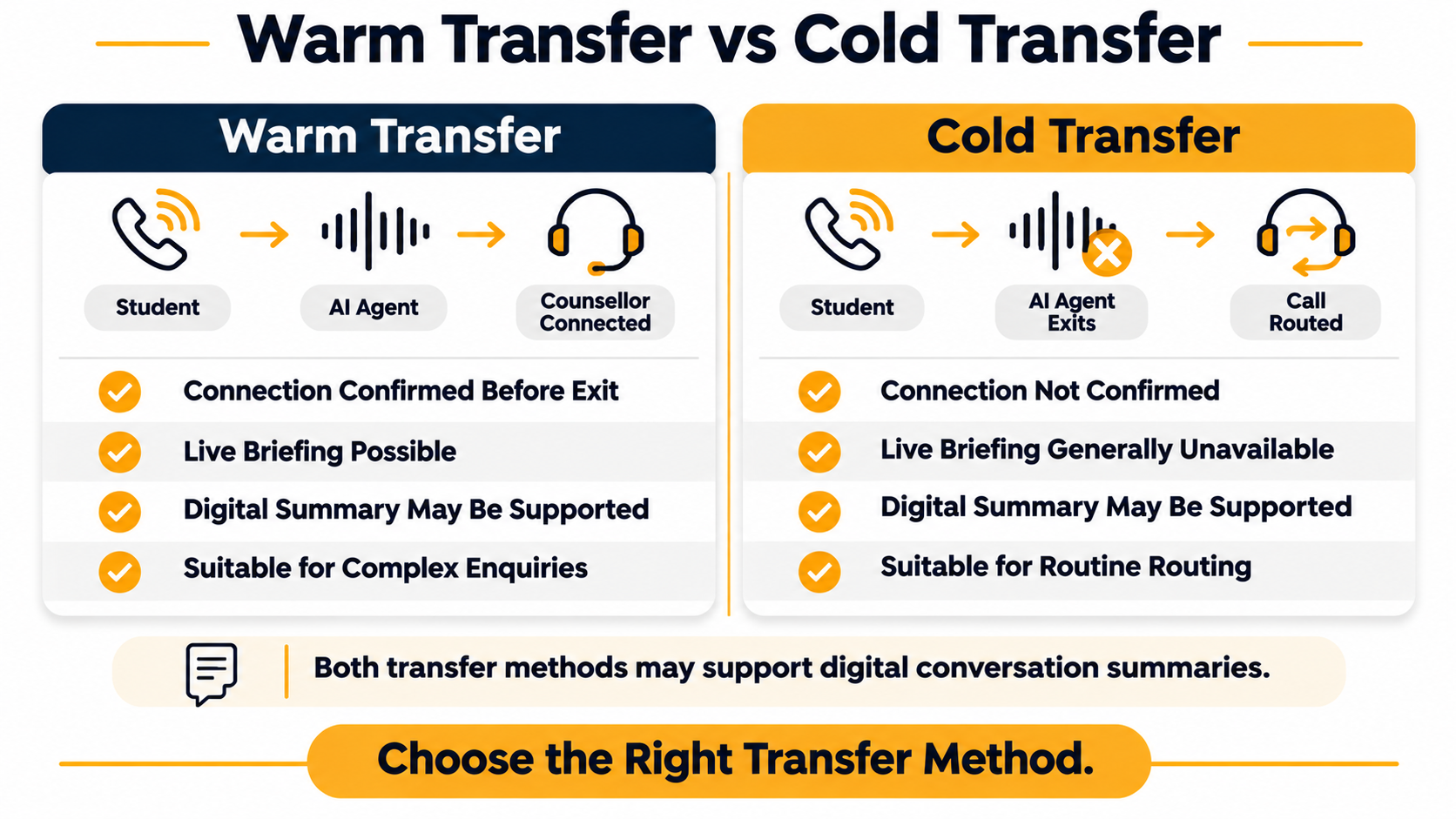
A warm transfer means connecting with the agent receiving the call before the sending agent leaves. Where supported, the receiving counsellor can also receive a briefing.
A cold transfer forwards the call without the calling agent remaining connected, ensuring the called agent has responded.
Google Cloud's call transfer documentation explains the operational differences between these mechanisms.
|
Comparison |
Cold transfer |
Warm transfer |
|
Live briefing |
Generally unavailable |
Possible |
|
Connection confirmation |
Not confirmed by originating agent |
Receiving agent can be connected before completion |
|
Digital conversation summary |
May also be supported |
May be supported |
|
Implementation |
Generally simpler |
Requires additional coordination |
|
Suitable use |
Routine departmental routing |
Complex student enquiries |
Warm transfer is usually ideal for sensitive enquiries, provided the required technology and available counsellors are available in the consultancy.
How to Implement AI to Human Handoff in Counselling?
A good handoff requires a standard operating procedure (SOP) rather than a one-off call-transfer feature.
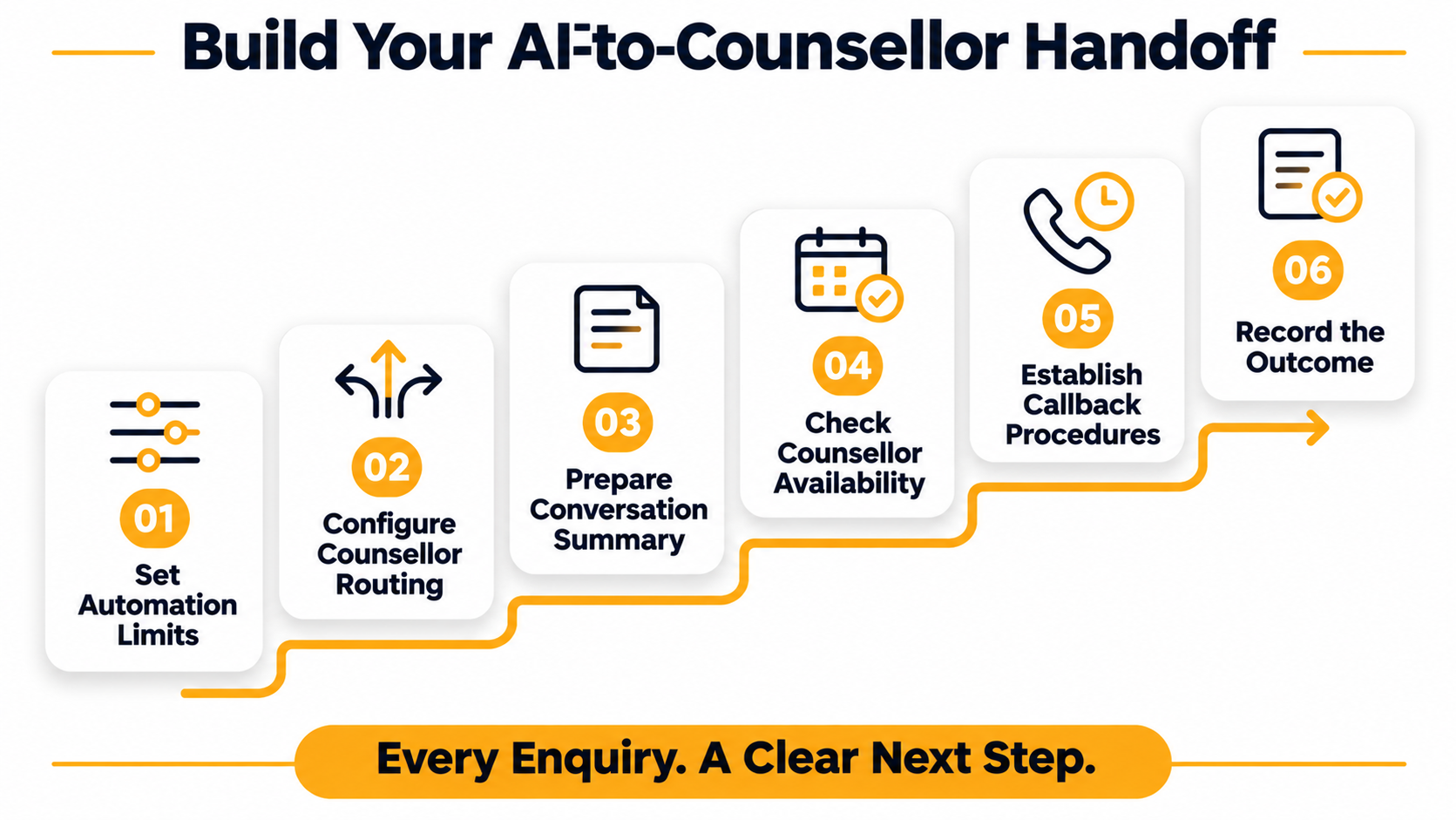
Step 1: Set Automation Limits.
Define approved AI responsibilities, exceptions, and forced escalation requirements.
Step 2: Counsellor Routing configuration.
Allocate inquiries based on study destination, programme level, language interest, application stage, and field of professional specialisation.
Step 3: Get the Conversation Summary Ready.
Provide appropriate information to the counsellor to whom it is sent, including:
- The student's name and contact information.
- Favourite location, meal and consumption.
- Relevant academic background.
- Reason for escalation.
- Questions that remain unanswered and the next steps to be undertaken.
Step 4: Check Counsellor Availability
Confirm with the receiving counsellor the option of making the warm transfer where supported.
Step 5: Forge Callback Procedures.
If the counsellor is unable to respond, provide an appropriate reply and assign the task to complete it.
Step 6: Record the Outcome
Record the handoff status, responsible counsellor, and pending action in the customer relationship management (CRM) system or enquiry register.
Recommended workflow: Student enquiry → Intent identification → Escalation decision → Counsellor assignment → Live transfer or callback → Outcome recorded.
What Happens When No Counsellor Is Available?
Failure to transfer should not necessarily result in a lost student enquiry.
Achieving an effective AI to human handoff in counselling workflow must provide alternative routing and callback processes.
The documentation in Google Cloud on transferring virtual agents shows how fallback routes can be configured to deal with transfer failures.
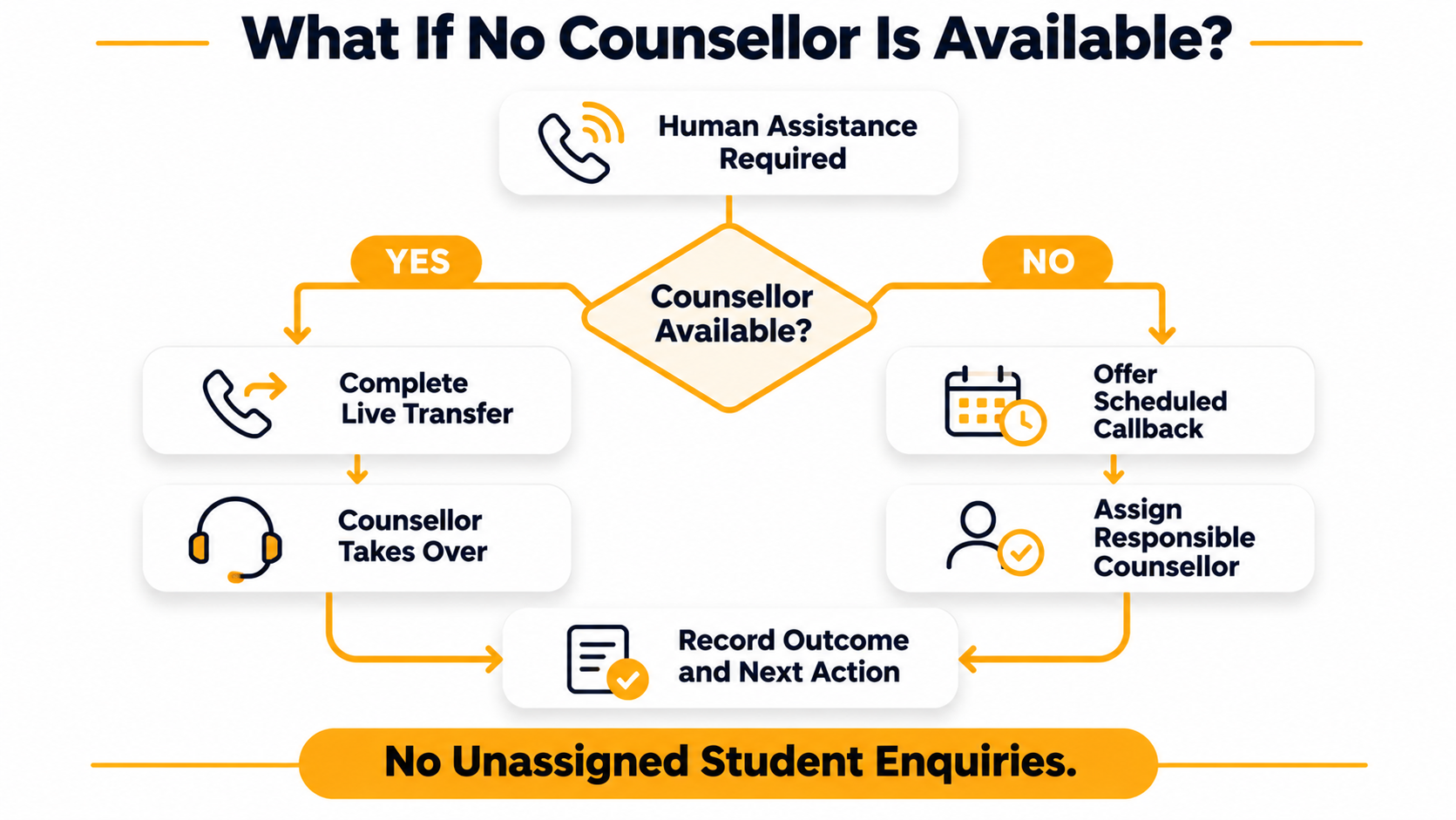
To achieve this, the consultancies should put in place mechanisms to:
- Referral to another appropriate counsellor.
- Provide a scheduled callback if immediate help is unavailable.
- Voice membership of non-full handoff.
- Monitor overdue callbacks.
- Find out about frequent routing failures.
The processes are most specific in consultancies with a 24/7 on-call AI enquiry line, where leads come in at night and on weekends.
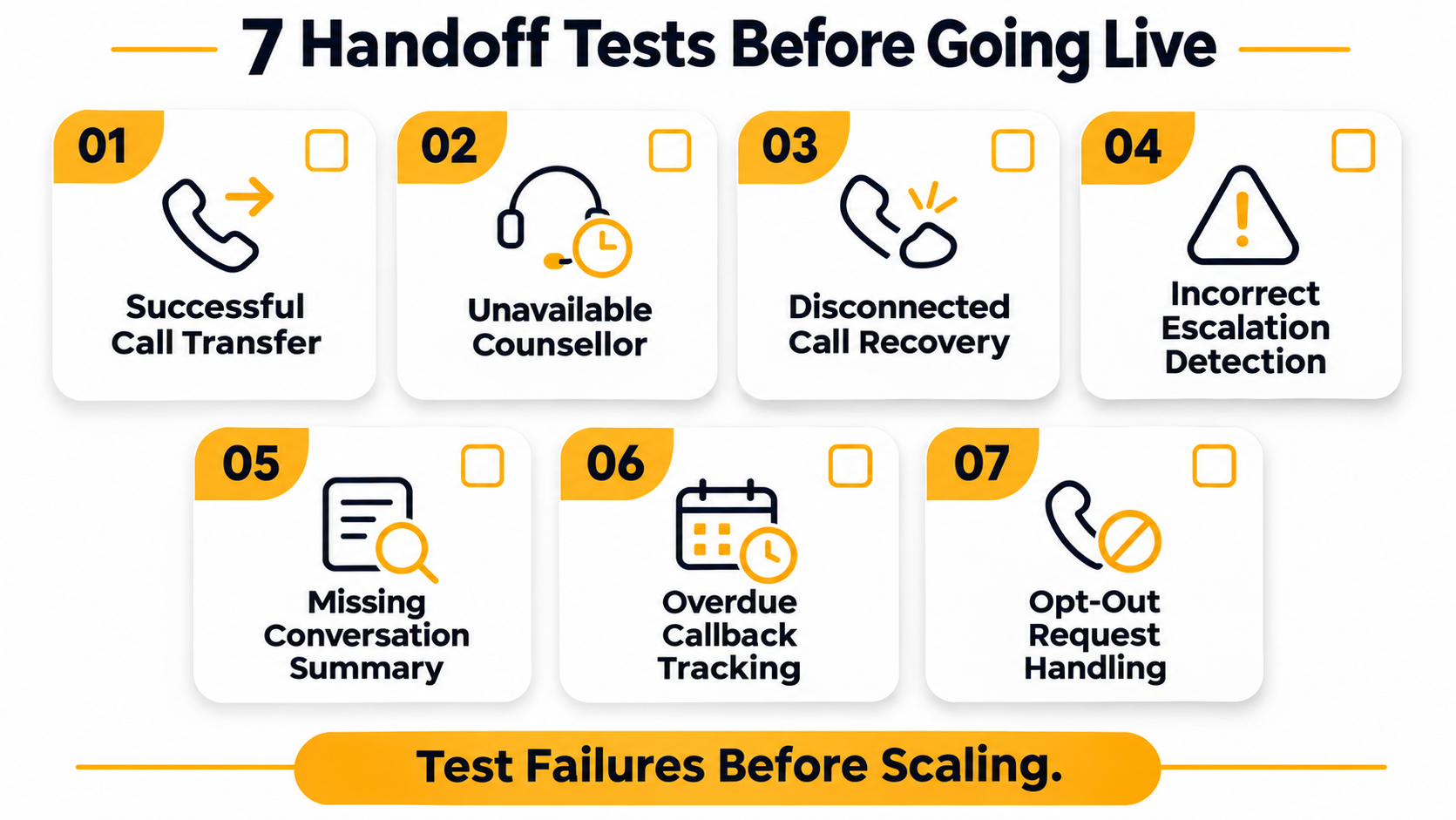
How to Test AI to Human Handoff in Counselling Before Going Live
Consultancies should test successful and unsuccessful handoffs before rolling out automated calling at scale.
Some suggested test scenarios involve:
- Effective transfer: Check that the call and situation are passed to the appropriate counsellor.
- Out-of-availability counsellor: Ascertain that there is an option for routing or callback.
- Missing call: See if the enquiry is documented and properly followed up.
- Incorrect escalation: Check that managers can recognise and fix incorrect escalation rules.
- Lacking conversation summary: Check whether the receiving counsellor can retrieve the information needed.
- Reminder Call: Verify that there are assigned tasks and unfinished tasks are visible.
- Opt-out request: Make sure communication preferences are updated and followed.
Test every situation with plausible student queries, regional accents, language alternation, and varying counsellor availability.
Do not expand deployment until critical failures are resolved.
TRAI and DPDP Considerations for Student Handoffs
When using AI to human handoff in counselling, Indian consultancies available have to assess any relevant telecommunications and personal data protection requirements.
TRAI Calling Requirements
In India, commercial communications are regulated by the Telecom regulator Telecom Commercial Communications Customer Preference Regulations (TCCCPR), 2018, and its amendments.
Outbound commercial calls made by consultancies are to check the agreement to the call, permission to call, customer preferences and telecommunications arrangements.
On 4 November 2026, TRAI Fourth Amendment Regulations, 2026, update the regulatory framework.
Any transfer of an automated call to a human counsellor does not eliminate the duties accompanied by the creation of the initial call.
DPDP and Student Information
The Digital Personal Data Protection Act, 2023 in India has a gradual implementation plan. Key substantive obligations will commence on 13 May 2027 under the official MeitY commencement notification.
To handle minors in student records, call recordings, data access, retention and enquiries, consultancies should put in place the right safeguards for student records.
Do not seek such passport information, financial data or identities in preliminary automated dialogues.
How to Measure AI to Human Handoff in Counselling Performance?
Instead of calling the transfer volume alone, consultancy owners need to assess successful outcomes achieved.
Some of the recommended performance indicators are:
- Rate of escalation: Escalated conversations /AI-handled conversations x 100.
- Successful transfer rate: Connected transfers/attempted transfers x 100.
- Callback completion rate: Completed callbacks/scheduled callbacks x100.
- Context completeness rate: Rate of complete handoff records/Reviewed records/100.
- Escalation accuracy: role-exemplification of the correct escalation decision / audited decision / 100.
These are suggested definitions of measurement, and not industry standards. Apply similar periods of reporting, and zero denominators should be considered not applicable.
A low rate of escalation is not always an indication of a successful automation. It is possible that AI is perpetuating human judgement conversations.
How Gateway EduConnect Supports Study-Abroad Consultancy Workflows
To ensure successful AI to human handoff in counselling, the student records should be organised, and resources and accountable functions should be assigned to the professionals as well.
Gateway EduConnect also offers profile evaluation, application processing and partner assistance services to education agents via its B2B study-abroad partnership programme.
Its GuaranteeAdmit partner CRM offers application filing, application-level tracking, as well as the visibility of commissions.
These are documented abilities which facilitate systematic education recruitment procedures. AI calling and their CRM should be assessed by consultancies, which need to independently confirm the functionality of live transfer, compatibility of integration, and available automation capabilities.
AI-to-Counsellor Handoff Implementation Checklist
Check that before introducing automated student calling, your consultancy has:
- Established AI roles and escalation policies.
- Appointed special counsellors to complex enquiries.
- Fallback and tested warm transfer procedures.
- Actualised requirements for conversation summaries.
- Recorded ownership and deadlines of call-backs.
- Audited data security and calling.
- Implemented performance monitoring and failure reviews.
FAQs
What is AI to human handoff in counselling?
It consists of removing the capability of an automated system of enquiring a student to a human counsellor via a live call, a scheduled follow-up call or a given follow-up activity.
In what instances should AI escalate a student enquiry?
These are suggested to be escalated to personalised assessments, visa issues, financial issues, complaints, verification of information and clear requests for human aid.
Are warm transfers helpful in inhibiting repeated questions by students?
Yes, where the counsellor who will receive has enough context of the conversation. Its success is determined by the capabilities of the platform and information sharing processes.
Is it possible to make AI handoffs during working hours?
Yes. Supported automated workflows will be able to capture enquiries and make arrangements in case of counsellor unavailability.
Is it possible to combine AI calling with an education CRM?
Other platforms facilitate the exchange of information regarding enquiries with other related systems. Before implementation, consultancies are supposed to check compatibility, fields of support data, and data error handling mechanisms.
Conclusion: Smarter Automation, Stronger Human Connections
The real value of AI to human handoff in counselling lies in knowing when technology should step back and human expertise should take over. Well-defined escalation rules and effective warm transfers allow consultancies to improve operational efficiency without compromising the quality of student guidance.
At Gateway Educonnect, we believe the next generation of international education recruitment will be shaped by intelligent technology, professional counselling and collaborative partnerships. Our vision is to empower education consultants to build scalable, student-focused recruitment operations.
Automate the routine. Preserve the human connection. Make every student conversation count.
Gateway Educonnect – Connect. Empower. Grow.
Together, let's redefine how education consultancies connect, counsel and grow.
Author Bio
Abhinav Jain - Founder, Gateway Educonnect and Director.
B.Tech, MBA, AI and Global Education Specialist.
More than 15 years of professional experience in leading students along international routes based on politics and innovation.