

28 Apr 2023 | Difference Between International Studies and International Relations

1
2117
Introduction
A revised brochure outlining a comparison of degrees with a global focus and their opportunities.
Comparing International Studies vs International Relations, the major distinction is that, most of the time, their focus is on academics. International Studies typically is a broader, interdisciplinary approach to world phenomena, comprising things like politics, economics, culture, development and society. International Relations is more inclined toward international politics, diplomacy, international foreign policy, international security, as well as the international system.
But the difference is not an absolute one. These degrees are different in different universities, and there may be a lot of overlap. Indicatively, American University's BA in International Studies as one of interdisciplinary nature with King's College London's International Relations BA blending history, IR theory, political economy, diplomacy, foreign policy and strategy.
International Studies vs International Relations: Quick Comparison
|
Factor |
International Studies |
International Relations |
|
Main approach |
Broad and interdisciplinary |
Greater emphasis on international politics |
|
Common areas |
Development, culture, economics, society, human rights |
Diplomacy, foreign policy, security, IR theory, political economy |
|
Suitable for |
Students interested in wider global issues |
Students particularly interested in politics and international affairs |
|
Career areas |
Government, NGOs, development, research, private sector |
Government, policy, international organisations, media, NGOs, professional services |
|
Important point |
Curriculum varies widely |
IR can also be interdisciplinary |
The table is a useful starting point, but the actual modules matter more than the degree title.
What Is International Studies?
International Studies examines global problems through several academic perspectives rather than concentrating entirely on international politics.
The Indiana University International Studies programme describes the field as offering a broad, interdisciplinary approach to international issues covering social, political, cultural and economic themes. American University similarly combines different social sciences within its International Studies curriculum.
This implies that the students can investigate interactions of politics and economics, culture, development, human rights, identity or regional issues.
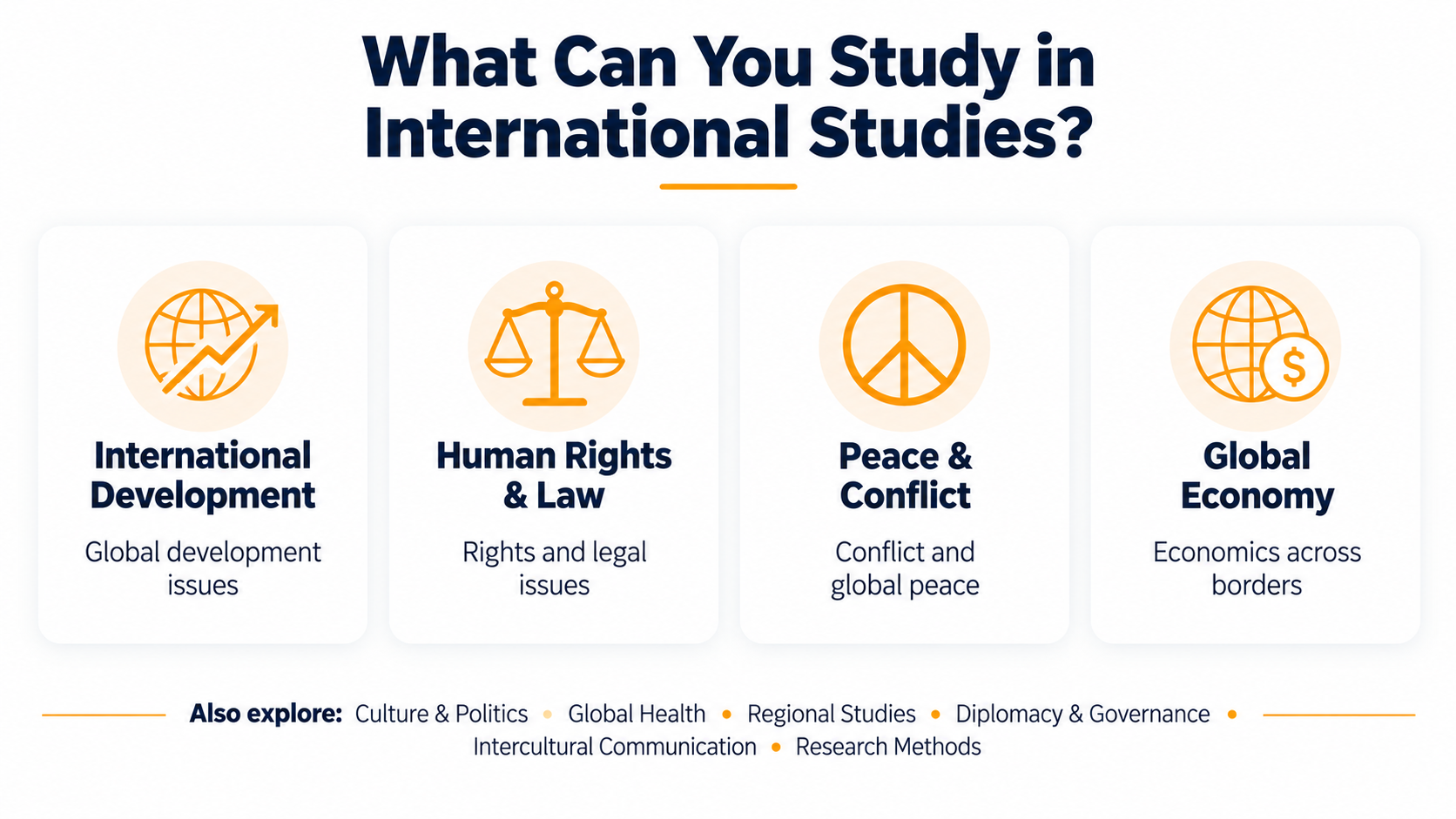
What do you study in International Studies?
Depending on the university, the modules are specific to that university, though examples are:
- international development
- human rights and international law
- culture and politics
- peace and conflict
- global economy
- environment and global health
- regional studies
- diplomacy and governance
- intercultural communication
- research methods
American University's International Studies programme details, for example, include research training, thematic areas and regional specialisation.
These are examples only. Students should never assume that every International Studies degree includes the same subjects.
Check out: Free IELTS Preparation: Complete Beginner Guide for 2026
What Is International Relations?
International Relations, commonly called IR, concentrates more directly on international politics and how states, institutions and other global actors interact.
A good example is King's College London's BA International Relations. Its programme is structured around International History, International Relations Theory, International Political Economy and International Practice, which includes diplomacy, foreign policy and strategy.
Similarly, the LSE BSc International Relations examines the international system, relationships between nations and the effects of power, economics and political structures on international affairs.
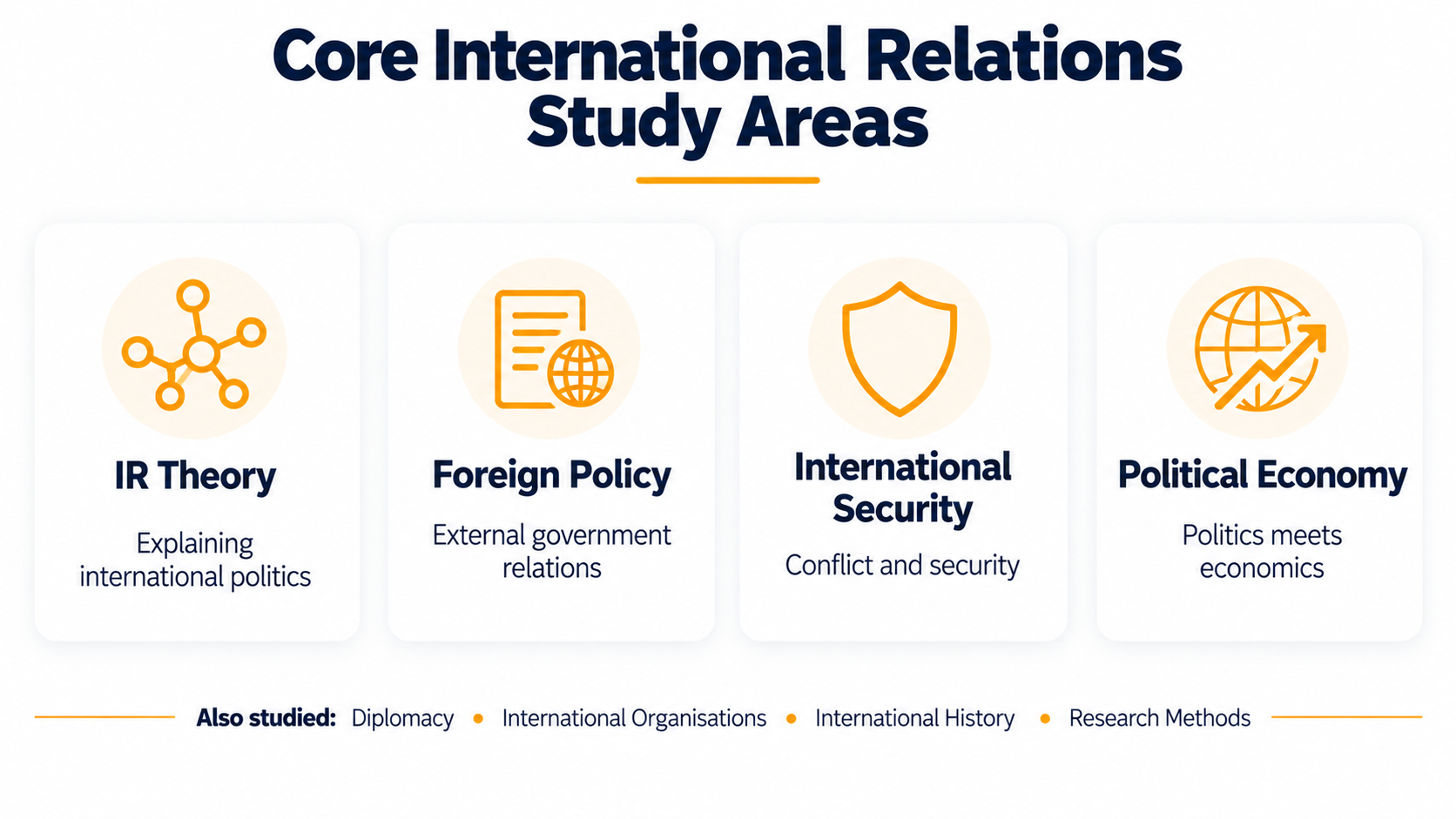
Common International Relations Subjects
|
Study Area |
What You May Explore |
|
IR theory |
Different explanations of international politics |
|
Foreign policy |
How governments approach external relations |
|
Diplomacy |
Negotiation and international statecraft |
|
International security |
Conflict and security challenges |
|
Political economy |
Interaction between economics and politics |
|
International organisations |
Institutions operating across countries |
|
International history |
Development of the international system |
|
Research methods |
Analysing political and international questions |
In most universities, however, International Relations is more specialized than International Studies, and does not necessarily concern diplomacy or government to government relations.
International Studies or International Relations: Which is better?
Both degrees are not equal.
This decision ought to be based on the subject you actually desire to learn.
Consider International Studies if you are interested in:
- global cultures and societies
- development
- human rights
- migration
- regional studies
- economic and social change
- environmental or global health issues
- studying global problems from different academic perspectives
Consider International Relations if you are interested in:
- diplomacy
- foreign policy
- geopolitics
- international politics
- security and conflict
- political economy
- international organisations
- policy analysis
The best approach to making the choice is by going through the course pages of the universities where you are thinking and contrasting the compulsory modules, electives, assessment techniques and specialisations.
Two degrees of various titles might harbor unbelievably close content.
Career Opportunities After International Studies and International Relations
Neither degree prepares you for only one occupation.
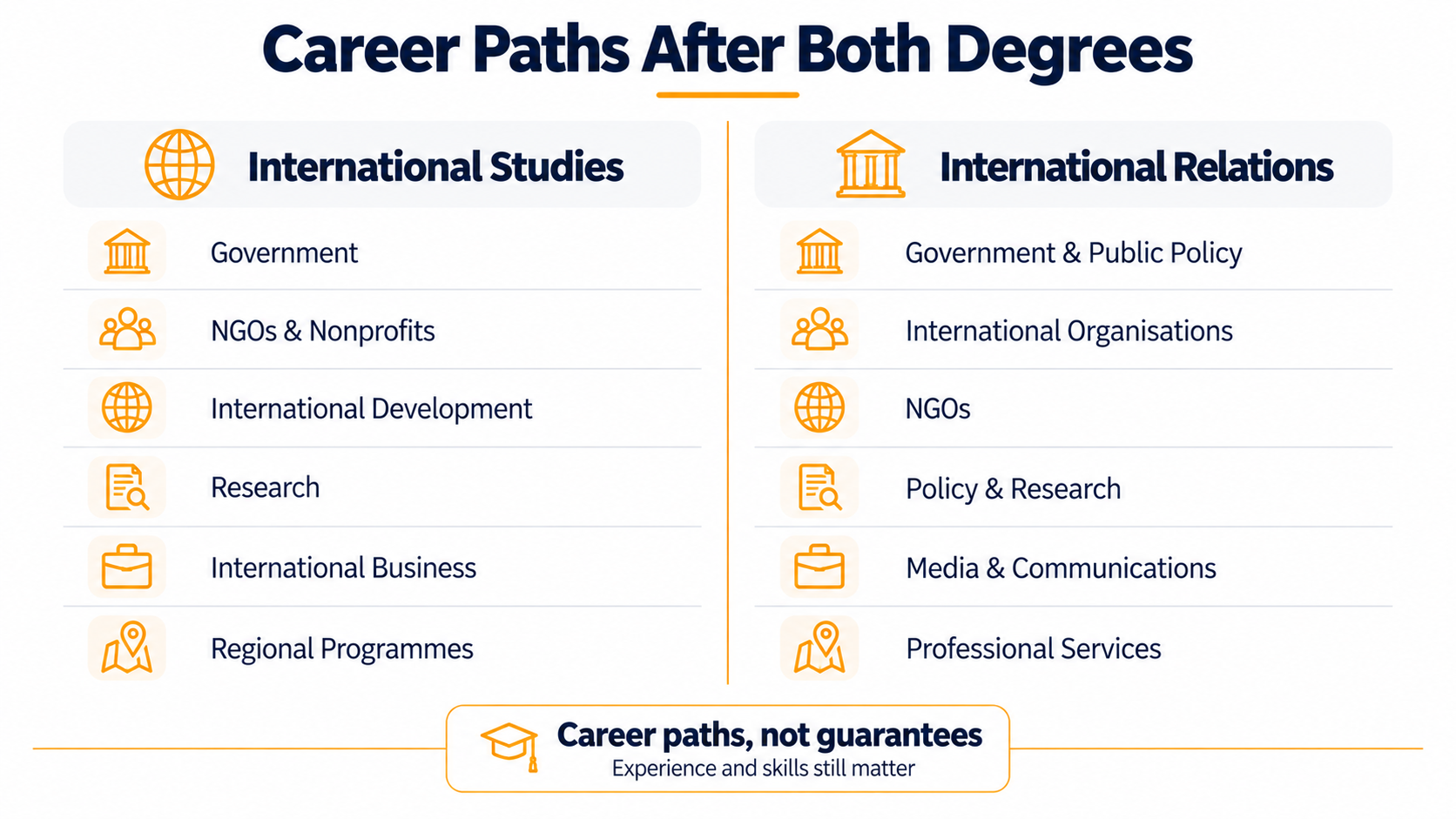
According to American University's School of International Service, its International Studies graduates enter government, nonprofit organisations and the private sector.
International Relations graduates can also move into several sectors. The LSE International Relations programme reports graduate pathways across government and public policy, international organisations, NGOs, professional services and other industries.
|
International Studies |
International Relations |
|
Government |
Government and public policy |
|
NGOs and nonprofits |
International organisations |
|
International development |
NGOs |
|
Research |
Policy and research |
|
Internationally focused businesses |
Media and communications |
|
Regional programmes |
Professional services |
These should be viewed as possible career areas, not guaranteed outcomes.
Your employability will also depend on factors such as internships, practical experience, communication skills, research ability, language skills and further qualifications.
Is it Possible to get International Relations to Diplomacy?
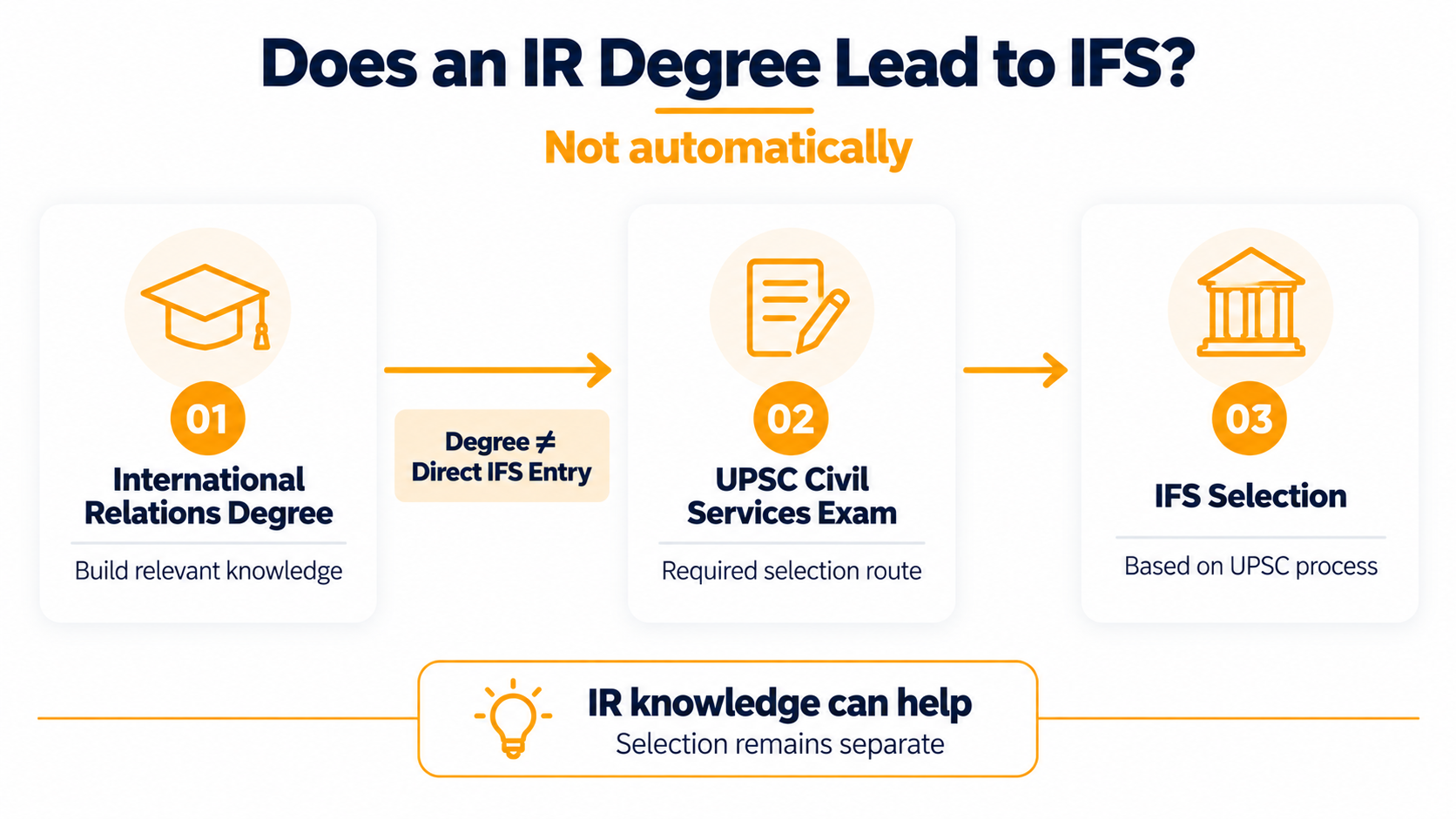
Yes, International Relations are capable of offering expertise applicable to the field of diplomacy but an IR degree does not necessarily turn you into a diplomat.
This distinction is particularly important for Indian students interested in the Indian Foreign Service.
The Ministry of External Affairs' Indian Foreign Service information confirms that selection into the IFS takes place through the combined Civil Services Examination.
The Sushma Swaraj Institute of Foreign Service also states that IFS Officer Trainees are civil servants selected by UPSC through the Civil Services Examination.
Therefore:
International Relations degree → relevant academic knowledge
but not:
International Relations degree → automatic entry into IFS
Students interested in diplomacy should keep this distinction clear before choosing a degree primarily for that career goal.
Do You Need Maths for International Relations?
There is no universal rule requiring advanced Mathematics for every International Relations programme.
However, saying that IR contains no maths would also be misleading.
Depending on the university, students may encounter:
- economics
- statistics
- quantitative analysis
- research methods
- political data
For example, King's includes International Political Economy within its IR programme, while research-oriented politics and international affairs programmes may combine qualitative and quantitative methods.
The safest approach is to check the entry requirements and individual modules of each university rather than making assumptions based on the course title.
What Skills Can These Degrees Develop?
International Studies and International Relations both have the ability to supply transferable skills.
According to King, the students of International Relations learn to gather and analyze evidence, to resolve complicated problems and present arguments both in writing and presentation.
Useful skills can include:
- research
- critical thinking
- analytical reasoning
- academic writing
- communication
- evidence evaluation
- independent study
- understanding different political and cultural perspectives
To some degree, these skills are the reason graduates are able to work in any sector, and not just traditional diplomat-related jobs.
Check Out: Best Universities in Dubai for Business Management 2026 Guide
Mistakes to Avoid Frequently.
- Choosing only by the degree title: Read the modules. The title alone tells you surprisingly little about the exact curriculum.
- Assuming International Relations guarantees diplomacy: It does not. Indian Foreign Service selection is through the Civil Services Examination.
- Assuming all IR programmes are identical: Universities can emphasise different regions, theories, political issues and specialisations.
- Believing International Relations has no quantitative content: Some programmes include economics, statistics or research methods.
- Choosing one country due to the fact that a blog has called it the best: There is no the best country to every student of International Relations. Instead, compare universities, curriculum, costs, opportunities and your career plans.
FAQs
What is International Studies vs. International Relations?
No. International Studies tends to be broader and interdisciplinary and International Relations tend to emphasize more on international politics, diplomacy, foreign policy and security. Nonetheless, there is a considerable overlap in the subjects.
So what level is the best degree to get in diplomacy?
Diplomacy, foreign politics and international policy often have a greater exposure in the field of International Relations. It however does not always ensure a diplomatic career.
Which degree is more successful in the career?
No, neither can be termed as better. The two have the capacity to result in a career in government, NGOs, research, international organisation and international private-sector jobs.
How can I be an IFS officer, post-International Relations?
According to the Ministry of External Affairs, an International Relations degree may be a valuable subject matter, although IFS recruitment is done via the UPSC Civil Services Examination.
Is Maths a requirement in International Relations?
Not universally. Economics, research methods, statistics or quantitative analysis can also be found in individual programmes.
Conclusion
The primary distinction between International Studies vs International Relations is the focus which is normally academic. The disciplines of international Studies broadly focus upon the world and its problems via a broader interplay of politics, economics, culture, development and society. The focus of International Relations is typically more on international politics, international diplomacy, foreign policy, international political economy and international security.
There is no strict line, and curricula in universities tend to overlap. Prior to applying, evaluate the actual modules, specialisations, their assessment methods and the career relevance of each of the programmes, as opposed to simply choosing the degree title.
For those who may not know the best course or university to pursue based on your scholarship and career interest, Gateway EduConnect will assist you in comparing the best study-abroad programs. Speak with Gateway EduConnect for free video or home counselling and support with your study abroad consultancy services and explore our wide range of offerings for students interested in Study in Australia, Study Abroad in Poland, Study in Canada, Study abroad UK, Study in germany, Study in New Zealand, Study Abroad in Ireland, Study Abroad in the USA, Study in Finland, Study Abroad in Italy, and many other countries

Author Bio
Abhinav Jain - Founder, Gateway Educonnect and Director.
B.Tech, MBA, AI and Global Education Specialist.
More than 15 years of professional experience in leading students along international routes based on politics and innovation.


