26 May 2026 | Digital SAT Exam Pattern 2026: Complete Format, Scoring System & Preparation Strategy Guide

0
124
Introduction
Being ready to apply to an international university is no longer just a matter of school grades. The standardised tests such as the SAT are still relevant to students wishing to pursue education in countries like the United States, Canada, the United Kingdom, Australia and others in the world. The exam is now completely digital and so to know the Digital SAT Exam Pattern 2026 is now vital to any student or parent intending to pursue higher education in a foreign country.
The reformed version of the SAT is more student friendly, adaptive and shorter as compared to the former paper-based test. Nevertheless, it is still necessary to master the exam format, scoring model, curriculum and plan of preparation thoroughly in order to succeed. We have covered all that the students should know in the Digital SAT Exam Pattern 2026 such as the adaptive testing pattern, syllabus section-by-section, scoring pattern, exam date as well as the skills of an Indian student in preparing well and passing the test.
What is the Digital SAT Exam?
Digital SAT is the computer-based entrance examination of the College Board for students who apply to undergraduate programmes in the United States, Canada, the United Kingdom, and other overseas countries.
The SAT, compared to the traditional exams where memorisation was emphasised, assesses the practical academic abilities, including:
- Critical reading and analysing information to gauge the achieved levels of understanding and logical thinking.
- Putting mathematical concepts into logical use by both problem-solving and real-life calculations.
- Using written arguments and data correctly to evaluate analytical skills.
- Answering questions under time pressure to assess time management and decision-making skills.
- Digital SAT Exam Pattern 2026 enables comparison of the students across various education systems with a common academic standard.
Digital SAT Important for College Admissions in 2026
Test-Optional Does Not Mean Test-Irrelevant
A good score will enhance an application even though a number of universities do not use SAT scores. Applicants who are prepared to take part in competitive programmes are usually those who can demonstrate their academic preparedness through standardised testing.
The Digital SAT Exam Pattern 2026 particularly matters to the students intending to join a programme with high demand, such as:
- Computer Science
- Business
- Engineering
- Economics
- Data Science
Better Scholarship Opportunities
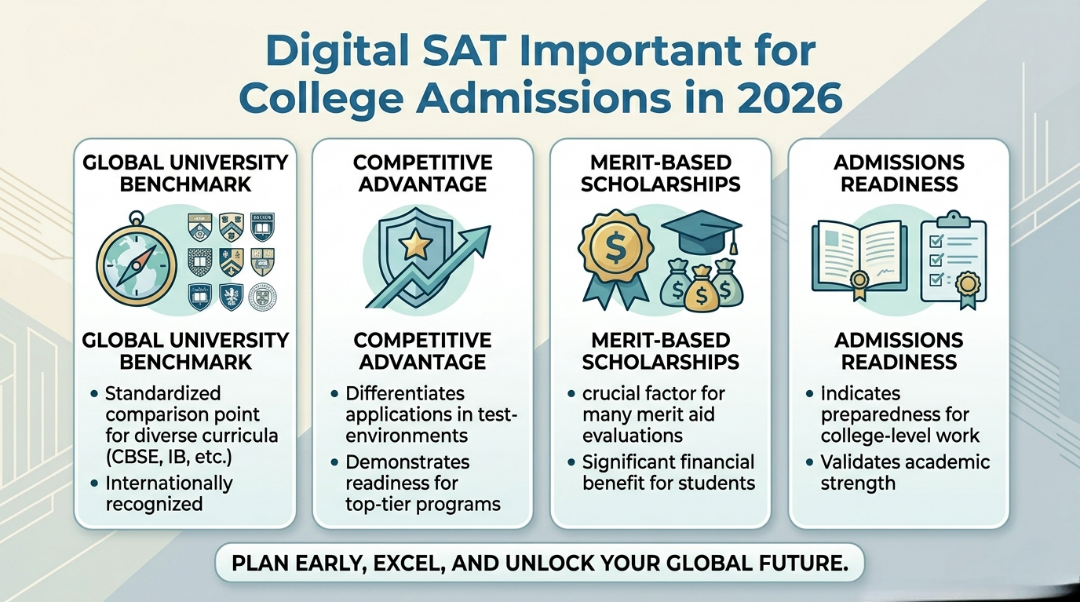
SAT scores are a common factor in the evaluation of many merit-based scholarships. A competitive SAT score can directly enhance the financial aid available to international students.
Stronger International Applications
The SAT is a standard comparison range of students in both CBSE, ICSE, IB, and State Boards among students other education systems globally.
That is why the Digital SAT Exam Pattern 2026 could be the key to enabling Indian students to compete more effectively at the international level.
Digital SAT Exam Structure for International Students
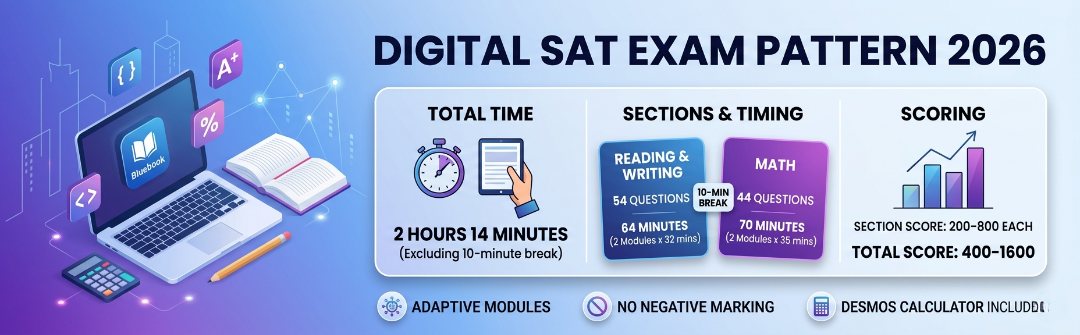
The new Digital SAT Exam Pattern 2026 is simpler and shorter as compared to the previous SAT format.
Digital SAT Structure Overview
|
Section |
Mathematics |
Reading & Writing |
|
Time Duration |
35 minutes for each module |
32 minutes each module |
|
Number of Questions covered |
Total 44 in the 2 modules. |
A total of 54 questions in the 2 modules. |
|
Main Skills Tested |
Skills in algebra, higher math, data analysis, geometry, trigonometry and problem solving. |
Grammar skills, reading comprehension, vocabulary, interpretation skills, and evidence-based analysis. |
|
Score Range |
It is around 200–800 |
It is around 200–800 |
|
Exam Format |
Adapt to the digital format of difficulty using previous performance. |
An adaptive online experience in which the difficulty of the second module is based on the performance of the first. |
|
Calculator Usage |
Allowed in the entire Math section. |
Not allowed |
Key Features of the Digital SAT
The Digital SAT Exam Pattern 2026 will have student-friendly features as follows:
- Passages to be read are shorter and the section is easier to handle and less time consuming.
- SAT is completely computerised, and the test can be taken using a tablet or computer.
- Computers are permitted in the Math part of the test, and they assist students in resolving issues more effectively.
- Scores are published promptly, enabling students to plan applications and retakes in time.
- This exam is taken in an adaptive digital SAT exam format, in which the module difficulty is adjusted depending on the student's performance.
Adaptive format refers to the difficulty of questions adapting to students' performance in previous modules.
Check Out: Scholarships Available for High Duolingo Scores
Understanding the Adaptive Digital SAT Exam
The most significant modification in the adaptive digital SAT exam is its two-stage adaptive structure.
How does Adaptive Testing Work?
There are two modules in each section of the adaptive digital SAT exam:
- In Module 1, a combination of easy, medium, and advanced questions will be provided to assess student performance across the board.
- Outcome in Module 1 determines the level of difficulty of Module 2 and makes the test more individualised and precise.
High-performing students in the initial module will be offered a more challenging second module worth more points.
Why Adaptive Testing is important.
The adaptive digital SAT exam acknowledges precision, uniformity and intelligent time management.
Students should:
- Pay attention to the initial module since there are no second chances to score in the future.
- Watch out against sloppy errors because speed is of the essence, not bolstering questions.
- Adaptive mock tests: Take appropriate practice to familiarise yourself with the improved difficulties.
- Give yourself enough time to manage the pressure with calmness to be focused during the two modules.
Good grades in part one can generate superior scoring chances in the subsequent part of the test.
Digital SAT Exam Pattern 2026: Reading & Writing Section
Students may encounter:
- Literary passages and historical correspondence that challenge interpretation, tone and understanding of context.
- Passages in scientific and social sciences which assess analytic reading ability and evidence-based thinking.
- Possessing data-supported text passages, which compel students to interpret charts, graphs and written material in achieving a unified outcome.
Topics Covered in Reading & Writing
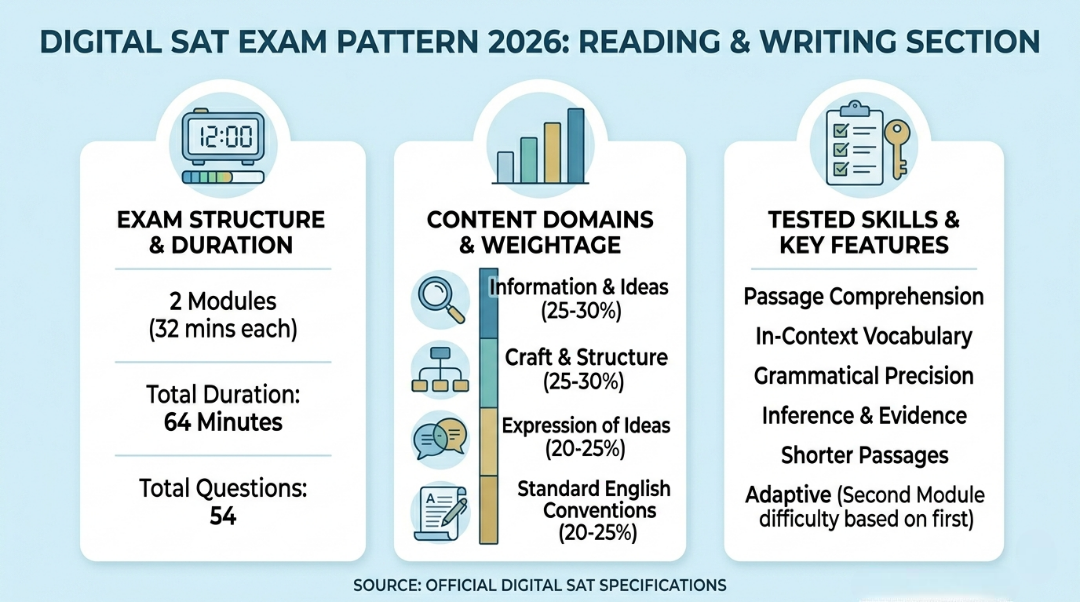
In this section, the Digital SAT Exam Pattern 2026 has:
|
Topic Area |
What It Tests |
Approximate weightage |
|
Expression of Ideas |
Assesses the capacity of a student to enhance the clarity, order and cohesiveness of sentences and passages. |
30% |
|
Standard English Conventions |
Tests proper written grammar, punctuation, sentence structure and standard English written rules. |
25% |
|
Information & Ideas |
Assesses evidence-based understanding, interpretation, and reading comprehension skills. |
25% |
|
Craft & Structure |
Determines the presence of vocabulary in the context, tone, purpose, and relationships among ideas within passages. |
20% |
Skills Tested
- Grammars and punctuations to detect that they understand the normal rules of written English.
- Contextual vocabulary to see if students can comprehend the meanings of words in sentences.
- Short academic/informational passages: Comprehension of reading in brief passages.
- The structuring and logical sequence in a sentence to determine the clarity and structure of writing.
- Analysis and reasoning skills to interpret and think critically based on evidence.
The new digital SAT Exam Pattern 2026 will prioritise real-world reading and communication over long passages.
Check Out: STEM vs non‑STEM courses – which one fits you?
Digital SAT: Mathematics Part 2026.
Digital SAT Exam Pattern 2026 Mathematics section assesses analytical reasoning, quantitative reasoning, and real-life problem-solving skills of a student. The questions are also structured to challenge the application of concepts rather than mere memorisation.
The Math and digital SAT Exam Pattern 2026 contains:
- The concepts of algebra, which pay attention to equations, variables and linear relationships.
- Advanced Math units that include testing of functions, expressions and solving of complex problems.
- DA questions that involve reading graphs and percentages, ratios, and tables.
- Concepts of geometry and trigonometry, which gauge spatial knowledge, angles, measurements and formulae.
- Functions and equations that test logical reasoning and mathematical accuracy when under time pressure.
Mathematics Question Distribution
|
Topic Area |
What It Tests |
Approximate weightage. |
|
Algebra |
Experiments with equations, variables and solving linear problems. |
35% |
|
Advanced Math |
Test of functions, nonlinear equations and advanced mathematical reasoning. |
35% |
|
Problem Solving & Data Analysis. |
Analyzes charts, ratio, percentages and real worlds. |
15% |
|
Geometry & Trigonometry |
Analyses shapes, angles, measurements and trigonometric applications. |
15% |
Example of SAT-Style Thinking.
For instance:
3x+5=203x + 5 = 203x+5=20
Such questions require students to logically and efficiently solve them under time pressure when they are taking the exam.
The Digital SAT Exam Pattern 2026 places greater emphasis on using ideas rather than memorising formulas.
Digital SAT Exam Scored in 2026?
SAT Score Range
The SAT has a possible total score of 400-1600 which consists of two large sections:
- The score of Reading and Writing ranges between 200-800 and gauges knowledge, grammar and critical thinking skills.
- The mathematical scores range between 200 and 800, and the score indicates problem solving, algebra and quantitative reasoning.
Key Features of the Digital SAT Scoring Pattern
- None is negative, i.e. there is no deduction of the total marks when the answer is incorrect.
- A scaled scoring system which transforms the raw performance into standardised section scores.
- Adaptive assessment, in which the performance in previous modules influences the difficulty of future questions.
- Rapid reporting on the scores so the students get the results and make the application planning more effective.
The digital SAT scoring pattern does not merely reflect the number of correct responses. Previous performance in past adaptive modules also influences the chances of scoring.
Adaptive Testing and Scores
Students who score highly on the first module of the adaptive digital SAT Exam Pattern 2026 can complete questions in the second module with a higher potential for scoring.
It is for this reason that early precision is important.
Check out: Course Comparison: Humanities v/s Social Sciences
Tips to Ace the Digital SAT Exam in 2026
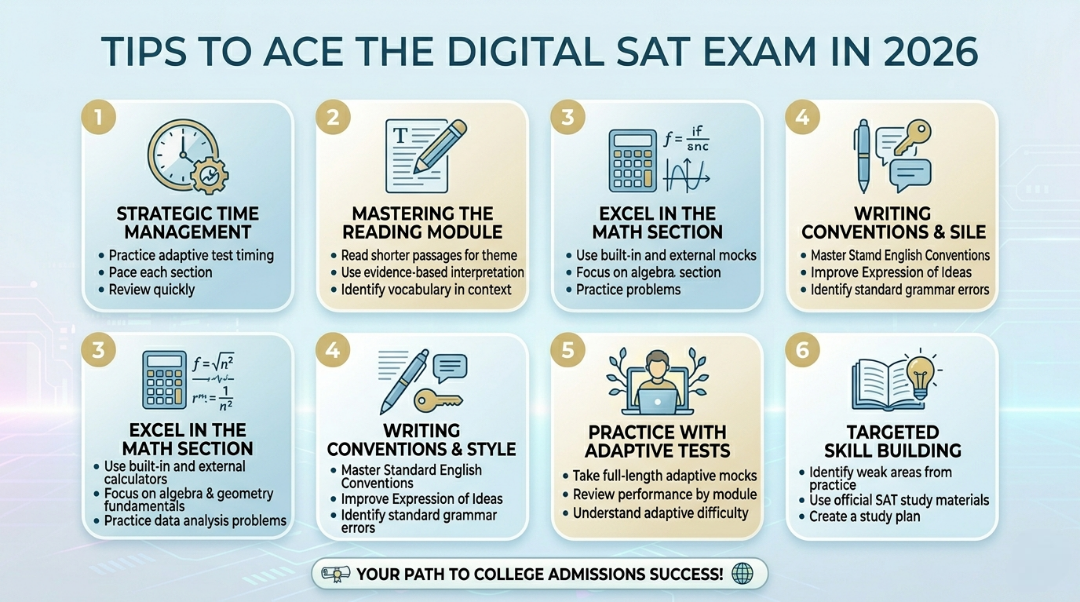
The key to studying the Digital SAT Exam Pattern 2026 requires really knowing strategies, time management and practice in order to plan ahead. Adhering to the right digital SAT preparation tips can help students improve their accuracy and confidence.
- Pay attention to the first module since it influences the level of difficulty of the second adaptive module.
- Complete lengthy filler test regularly to master speed, accuracy and confidence in the exam.
- One of the tips to remember during exam time is to save time on the questions that are not going to be answered on time and resume them at a later stage.
- Improve grammar, vocabulary and Math foundations according to the new digital SAT Exam Pattern 2026.
- Official SAT practice materials should be used to get better acquainted with the adaptive digital SAT Exam Pattern 2026.
- Revise after each practice test to check areas of weakness and do so slowly to get better at it.
By adhering to these tips of SAT preparation regularly, students are likely to have better SAT scores in their applications to international universities.
Digital SAT Exam Dates & Retake Policy 2026
Digital SAT Exam Pattern 2026 is likely to be administered in 2026 and thus to take the digital version of the SAT exam, students are advised to have exam schedule so that they can respond better, minimise stress and get maximum score in the exam.
The expected SAT Test Dates 2026.
|
Month |
Availability |
|
March 2026 |
International Test Date |
|
May 2026 |
International Test Date |
|
June 2026 |
Limited Test Regions |
|
August 2026 |
Selected International Regions |
|
October 2026 |
International Test Date |
|
November 2026 |
International Test Date |
Before registering, students must always confirm the latest Digital SAT Exam Pattern 2026 test dates on the official website of the College Board.
SAT Retake Policy
- 2 3 times maximum in order to enhance scores without over-examining them.
- Preparation gap between 2 and 3 months to work on the weak areas and ensure performance is enhanced.
The retakes must be used wisely; students need to work on improving their preparation, not on a failed attempt after not trying it.
SAT Costs for Indian Students
Before embarking on their studying abroad adventure, students intending to take the Digital SAT Exam Pattern 2026 ought to be able to learn the approximate cost of the exam and preparation process.
|
Type of expense |
Estimated expense |
Details. |
|
SAT Registration Fee |
Approximately $68 |
The registration fee amount charged by the College Board for the Standard exam. |
|
International Testing Fee |
About 43 |
An extra fee is charged to international students, including those from India. |
|
Preparation Resources |
Varies |
Costs will vary based on self-study, mock tests, and coaching. |
|
Score Reports |
Extra fees: |
An extra fee might be charged to send scores to more than one university. |
Aside from exam fees, the other costs that must be included when planning international education are university applications, visa applications, accommodation, and travel costs.
The Way Gateway Educonnect Benefits Students.
Training to pass the Digital SAT Exam Pattern 2026 is a single step in the study abroad journey. Admissions, scholarships, visas, and university choice are other areas where students require professional assistance.
- Our expert SAT instructions also assist students in training based on the Digital SAT Exam Pattern 2026.
- We help with the application to universities in the USA, UK, Canada, Australia, Germany, France, and Dubai.
- We have home and video counselling services to provide individual student services and career advice.
- We assist the students who have education loans, accommodation and scholarship advice to make life easier when studying abroad.
- Our application process is also fast, and the students can acquire offer letters within 24 hours using our platform.
Having been in existence for 15+ years and having supported 23,000+ students to realise their global reach in education, Gateway Educonnect continues to empower students to achieve their global education targets without reservations.
FAQs
Is the Digital SAT always connected to the internet?
No. The Internet needs to be set up and delivered. The actual examination is not conducted under unremitting internet connectivity.
What is included in the digital SAT syllabus 2026?
The digital SAT Exam Pattern 2026 consists of Reading, Writing, Algebra, Geometry, Data Analysis, and Advanced Mathematics.
How does the digital SAT scoring pattern work?
The digital SAT scoring pattern is graded using a scaled grading to the range of 400-1600 and minus.
Is it acceptable to use calculators on the SAT Math?
Yes. The students are free to use an approved personal calculator when navigating the full Math section, or an in-built calculator.
What are your top digital SAT preparation tips?
Adaptive mock tests, time management, grammar practice, and constant revision are the best digital SAT preparation tips.
Conclusion
The Digital SAT Exam Pattern 2026 will provide a more effective, user-friendly, and skill-based test. The SAT is more indicative of realistic academic preparation, with shorter reading passages, calculator-friendly Math sections, and quicker scoring and reporting.
As an Indian student who intends to study overseas, early knowledge of exam setup can enhance the quality of preparation, increase the availability of scholarship options, and improve competitive university applications worldwide.
At Gateway Educonnect, we assist students in leaving their exam preparation behind and smoothly sailing through the entire study abroad process. For more assistance, please visit our study abroad consultancy services and explore our wide range of offerings for students interested in studying in the USA, studying in the UK, studying in Canada, studying in Australia, studying in Ireland, and many other countries.

Author Bio
Abhinav Jain - Founder, Gateway Educonnect and Director.
B.Tech, MBA, AI and Global Education Specialist.
More than 15 years of professional experience in leading students along international routes based on politics and innovation.