08 Sep 2026 | Eligibility for Master’s in Germany 2027-2028: Complete Guide for Indian Students

0
27
Introduction
Understanding Germany masters eligibility Indian students need for 2027 is more important than simply checking your Bachelor’s percentage. German universities set their own programme-specific admission conditions, so there is no single percentage or qualification rule that applies to every Master’s course. Your eligibility can depend on your previous degree, subject background, academic performance, degree recognition, language proficiency and the specific requirements of the university and programme.
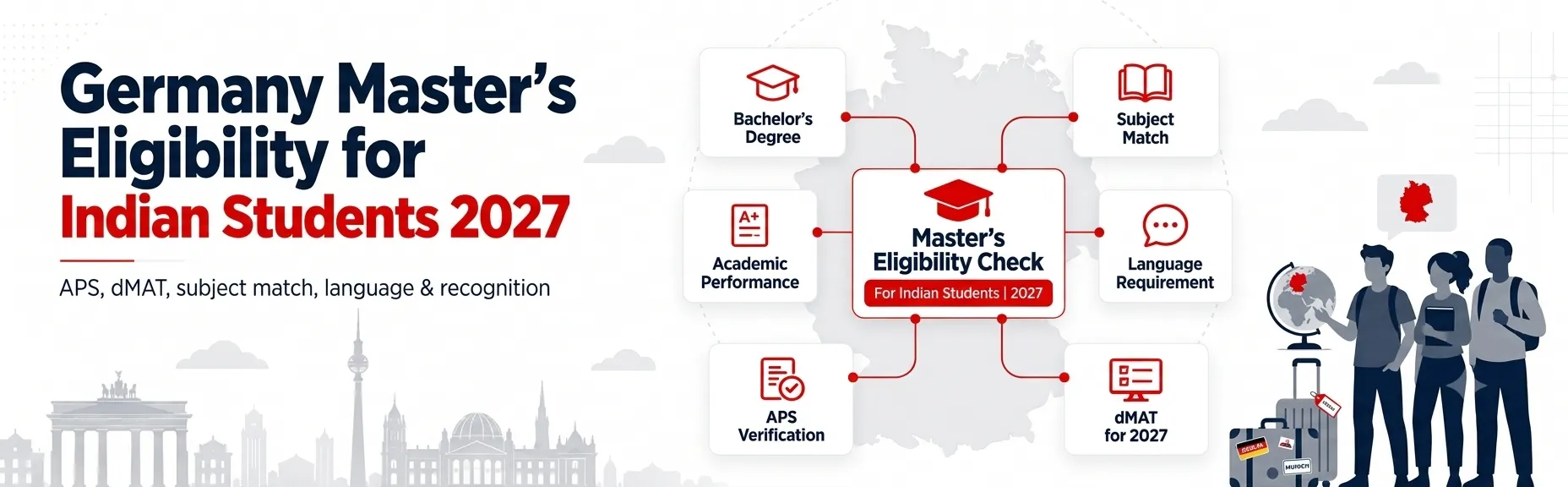
For Indian applicants, there is another important consideration for the 2027 intake: APS requirements now include the Digital Master Test, or dMAT, for selected Master’s applicants whose previous degree falls within specified subject fields. Thus, verification of the equivalence of Germany masters eligibility Indian students need not only include university admission criteria, but also the concerned process in APS.
Ready to check your eligibility?
Check Germany Eligibility with Gateway EduConnect
Germany Master’s Eligibility at a Glance
The following checklist gives you a starting point for assessing Germany masters eligibility Indian students should check before selecting universities.
|
Eligibility factor |
What you should check |
|
Bachelor’s degree |
Whether your completed degree is accepted as equivalent to the required German qualification |
|
Subject background |
Whether your previous studies match the Master’s programme |
|
Academic performance |
Whether the individual programme has a minimum grade requirement |
|
Language |
Whether you meet the German or English requirement specified by the programme |
|
Recognition |
Whether your institution and qualification meet the relevant recognition requirements |
|
APS |
Whether APS verification applies to your Indian academic qualifications |
|
dMAT |
Whether the new requirement applies to your previous degree and intended intake |
Do you Need a Bachelor’s Degree to Study a Master’s in Germany?
Yes, a completed undergraduate qualification is generally the starting point for Master’s admission. The previous qualification normally needs to be equivalent to the relevant German Bachelor’s qualification and should provide an appropriate academic background for the intended Master’s programme.
For Germany masters eligibility Indian students, this means you should not select a course only because its title looks similar to your Bachelor’s degree. Read the programme's admission requirements carefully and check whether it asks for specific subjects, credits, modules or an academic background.
The required Bachelor’s duration can also vary depending on the programme and qualification. The recognition of your individual qualification therefore matters more than relying on a simple rule such as “all three-year degrees are accepted” or “all four-year degrees are accepted”.
The safest approach is to compare your qualification with the specific programme requirements and use the official DAAD requirements guide for general guidance. You should then check the individual university and Master's programme requirements before applying.
What is the Minimum Percentage to Study in Germany?
One of the biggest misconceptions about Germany masters eligibility Indian students is that Germany has one fixed minimum percentage for every Master’s programme.
It does not.
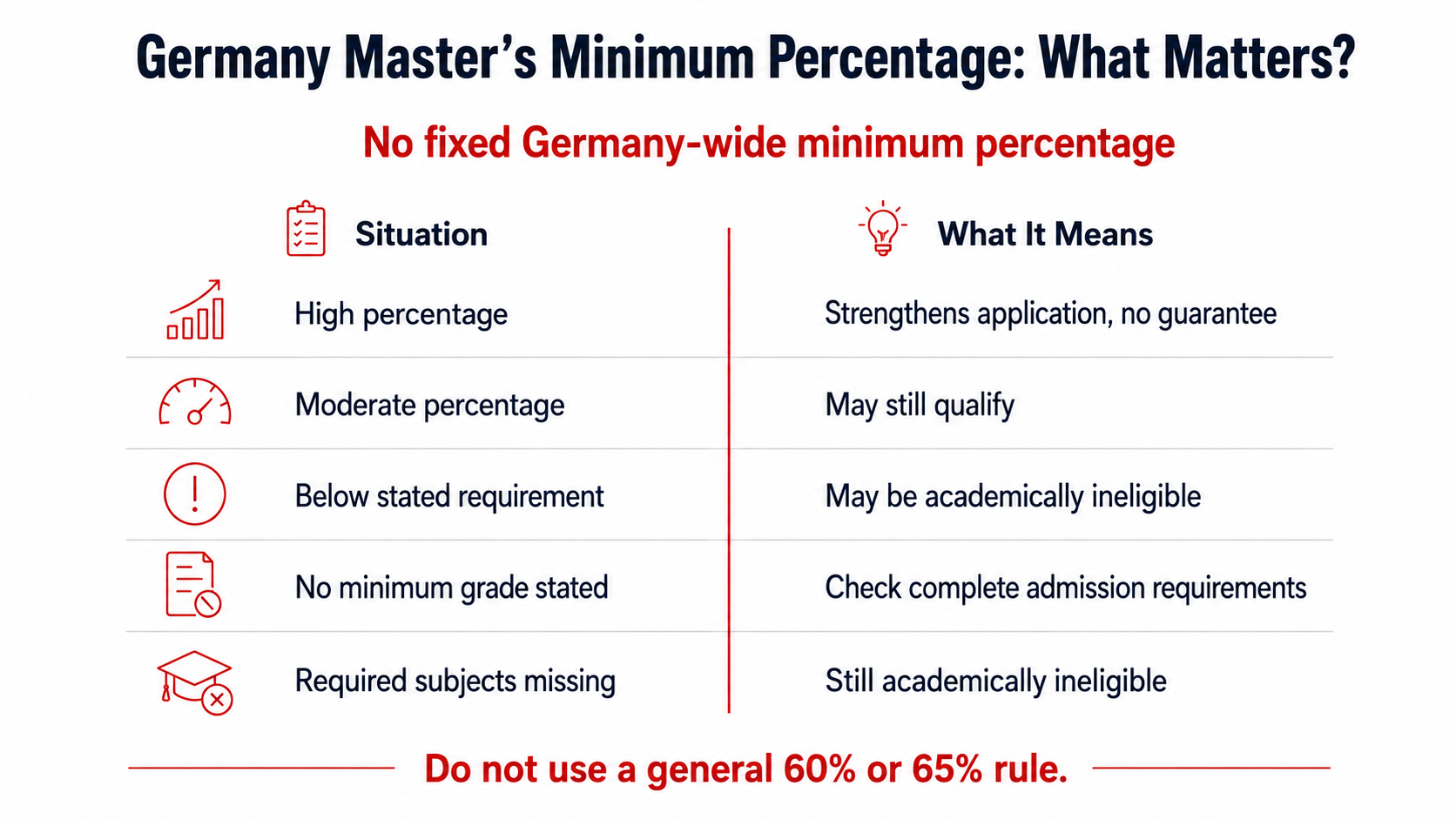
There is no single Germany-wide minimum percentage that guarantees eligibility for every Master’s course. Individual universities and programmes can set their own academic requirements, including minimum grades where applicable.
Minimum percentage to study in Germany: what Indian students should understand
|
Situation |
What it means |
|
You have a high percentage |
It can strengthen your application, but does not guarantee admission |
|
Your percentage is moderate |
You may still qualify for programmes whose requirements you meet |
|
Your percentage is below a stated programme requirement |
You may not meet that particular programme's eligibility |
|
No minimum grade is stated publicly |
Check the complete admission requirements before assuming eligibility |
|
You meet the percentage but lack required subjects |
You may still be academically ineligible |
The important point: Never use a general 60% or 65% rule to decide whether you can study in Germany. Check the exact course requirements.
This is particularly important when comparing Germany universities eligibility for Indian students, because two universities offering similar Master’s subjects can have different admission criteria.
Check out: SRH University Germany – English Programs, Fees & Admission
Does your Bachelor’s Subject need to Match the Master’s?
In many cases, yes, your previous academic background needs to be relevant to the intended Master’s programme.
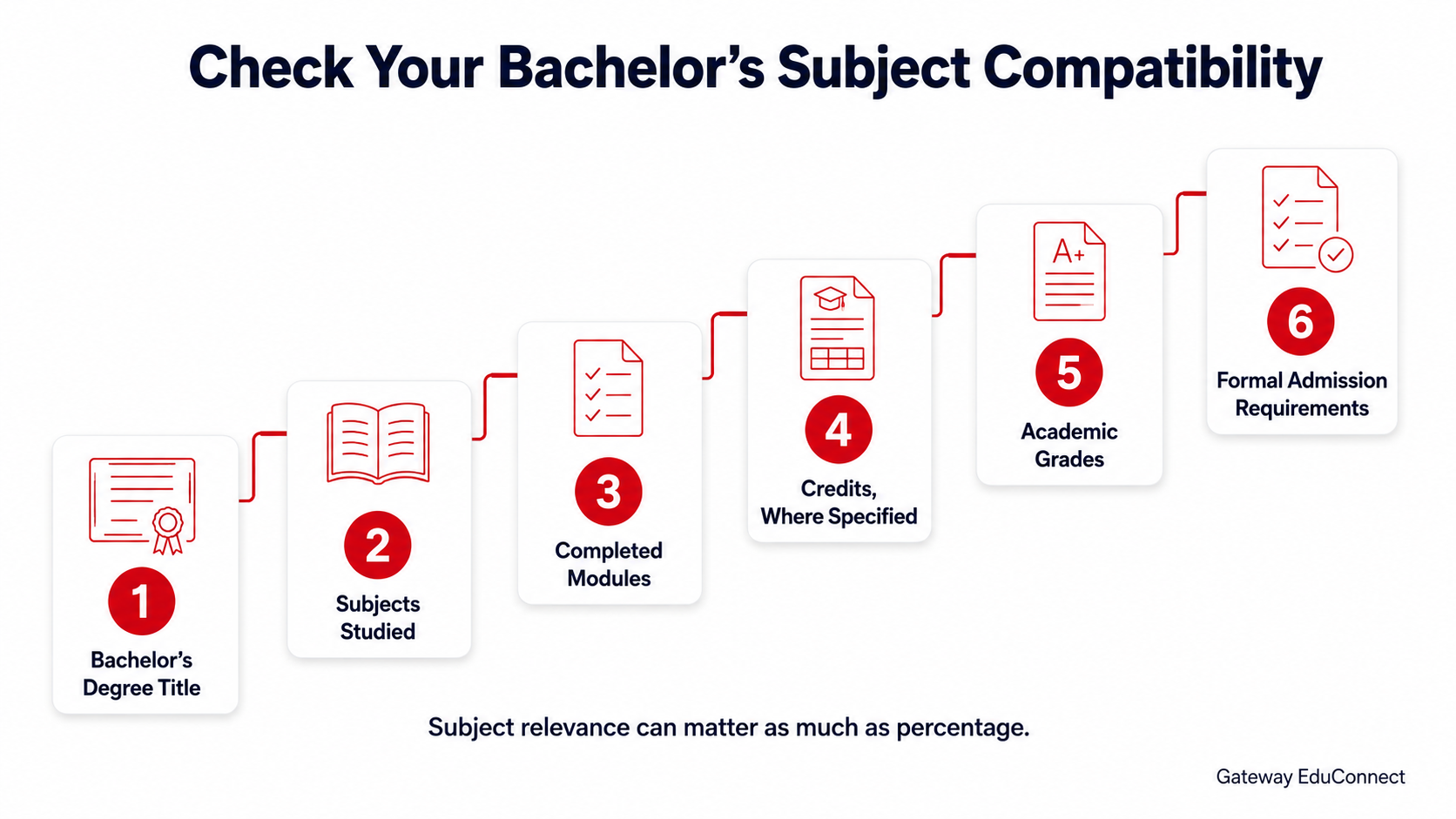
For Germany masters eligibility Indian students, subject relevance can be as important as your overall percentage. A university may look at the content of your previous studies and determine whether it provides the academic foundation required for the Master’s course.
For example, if a programme requires a specific academic background in a particular discipline, having a general Bachelor’s degree may not be enough. Some programmes can also specify particular subjects, modules or credits that applicants must have completed.
Therefore, before applying, compare:
- Your Bachelor’s degree title
- Your subjects
- Your completed modules
- Your credits, where specified
- Your academic grades
- The programme's formal admission requirements
The DAAD's official programme and admission resources can help you identify suitable programmes and understand the relevant requirements.
You can also use the DAAD Degree Programmes database to explore available programmes in Germany
Read this: Best Universities in Germany for Master's Programs in 2026
Does your Indian University and Degree need to be recognised?
Recognition is an important part of Germany masters eligibility Indian students should check before beginning the application process.
The DAAD admission database provides a non-binding orientation regarding whether foreign qualifications can provide access to higher education in Germany. Its information is based on recognition information associated with anabin and is prepared with uni-assist.
You can also check the official anabin database when assessing the status of your institution and qualification.
However, an important distinction is necessary:
University admission is not similar to recognition information.
A qualification can be recognised, but you still have to fulfil the criteria of the individual university, academic and programme-specific requirements.
Language Requirements you should meet
The requirements are based on the language of instruction and individual programme.
When you pick a German-taught programme, you might have to demonstrate the knowledge of German at the university-stated level. In a case with an English-taught programme, the university might necessitate an evidence of proficiency in English as per the admission requirements posted on it.
Therefore, Germany masters eligibility Indian students should be checked against the exact language requirement of each selected programme rather than assuming that one English or German certificate is accepted everywhere.
The official DAAD resources explain that language requirements depend on the degree programme and its language of instruction.
A simple rule
- English-taught programme → check its English-language requirement.
- German-taught programme → check its German-language requirement.
Do not assume that a particular language score automatically qualifies you for every university.
Read out: Fresenius University Germany – Courses, Fees & How to Apply
What Documents are Required for Germany University Admission?
The documents required can vary by university, programme and application route. However, international applicants may be asked for academic qualification documents, grade records, language certificates and identification documents. DAAD guidance also highlights certified educational documents and official translations where required.
For Indian applicants researching documents required for Germany university admission, a practical preparation checklist can include:
|
Document |
Why it may be needed |
|
Bachelor’s degree or provisional certificate |
Evidence of your completed undergraduate qualification |
|
Semester/year-wise marksheets |
Evidence of subjects and academic performance |
|
Class X and XII documents |
May form part of academic verification requirements |
|
Passport |
Identification |
|
Language certificate |
Evidence of required language proficiency |
|
Academic translations |
Required where documents are not accepted in the required language |
|
APS-related documents |
Required where APS verification applies |
|
Additional programme documents |
Depends on the university and course |
For applicants with a Bachelor’s or Master’s qualification, the official APS India Bachelor/Master information leaflet provides the applicable document and application guidance.
For APS-specific documentation, applicants should also check the relevant APS India checklist for their procedure.
The official DAAD application guidance is a useful starting point for understanding application documentation.
Read out: ₹10 Lakh Budget - Affordable European Countries
What is APS and why does it matter for Indian students?
APS India verifies academic documents and qualifications issued by Indian institutions for applicants who need APS certification under the applicable German procedure.
Indian applicants should always check the official APS India website for the procedure and requirements applicable to their academic background.
For Germany masters eligibility Indian students, APS should be understood as a verification process, not as university admission.
This distinction is important:
- University admission: The German university decides whether you meet the programme's admission requirements.
- APS: APS verifies the relevant Indian academic documents under its procedure.
- Anabin/recognition: Provides information used in assessing recognition and higher education access.
- dMAT: An additional APS documentation requirement for selected Master’s applicants.
APS India provides an official checklist for applicants with Bachelor’s and Master’s qualifications, including academic records and other supporting documents.
Applicants can follow the official APS application process to understand the main steps for submitting and tracking an APS application.
For additional clarification, applicants can refer to the APS India FAQ section before submitting their documents.
What is dMAT and who needs it for 2027?
The Digital Master Test, or dMAT, is one of the most important new points in Germany masters eligibility Indian students need to understand for 2027.
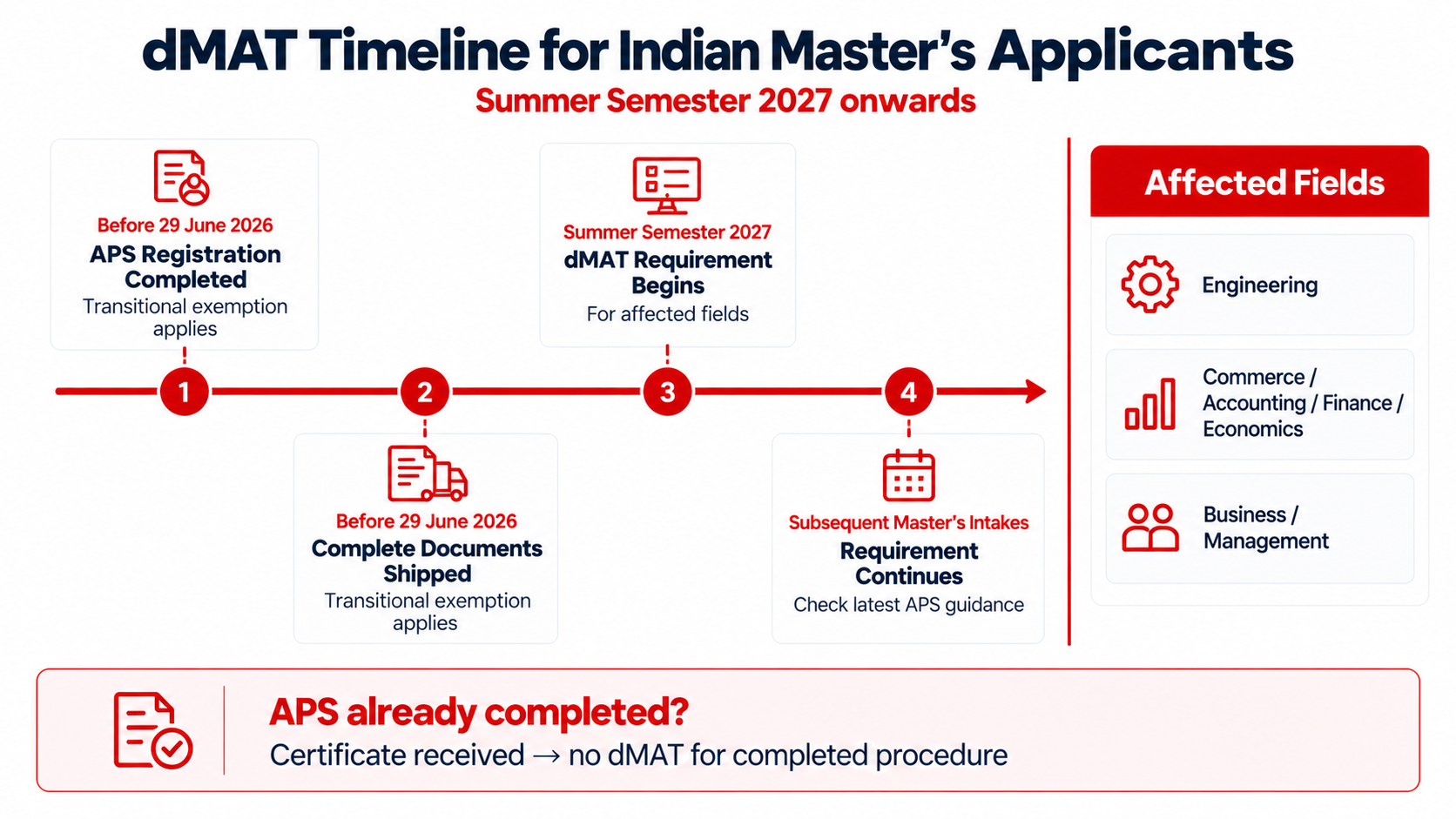
According to APS India’s official dMAT guidance, dMAT is an additional element of APS documentation for selected Master’s applicants from India whose previous degree falls within affected fields.
The affected fields currently include:
- Engineering
- Commerce / Accounting / Finance / Economics
- Business / Management
For applicants in these affected fields, the requirement applies to applications relating to the Summer Semester 2027 Master’s intake and subsequent Master’s intakes, unless a transitional exemption applies.
Applicants should check the latest APS dMAT requirements before applying because the requirement is intake-sensitive.
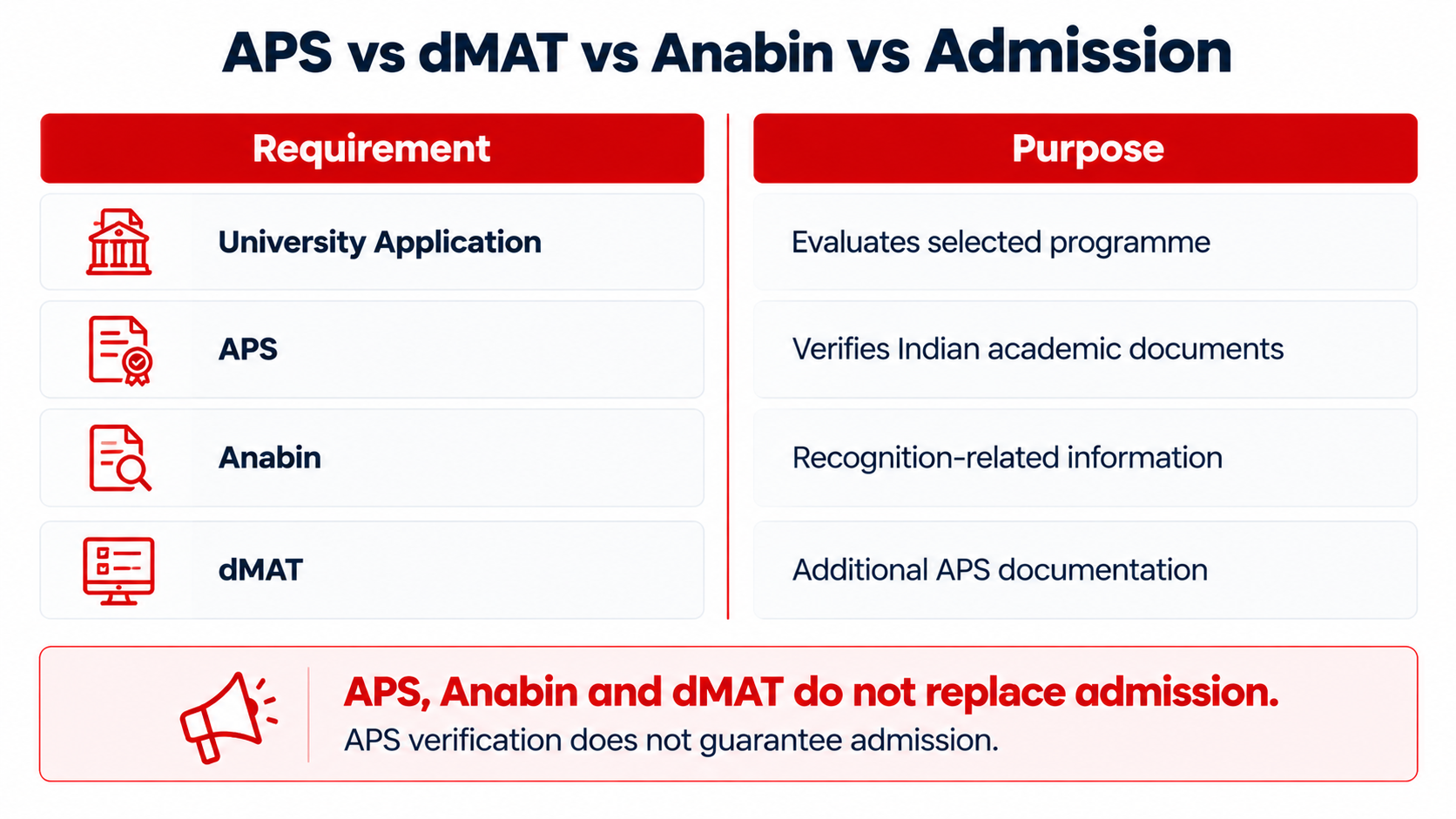
APS, dMAT, anabin and admission: what is the difference?
|
Requirement |
Purpose |
Replaces university admission? |
|
University application |
Evaluates you for the selected programme |
No |
|
APS |
Verifies relevant Indian academic documents |
No |
|
Anabin |
Provides recognition-related information |
No |
|
dMAT |
Additional APS documentation requirement for selected applicants |
No |
The dMAT does not replace APS document verification, anabin or the university's admission decision.
There are also transitional exemptions. APS India states that applicants who completed their APS online registration before 29 June 2026, or shipped their complete APS application documents before that date, are exempt under the stated transition for that APS procedure. Applicants who already completed the APS procedure and received their APS certificate do not need to take the dMAT for that completed procedure.
Because the dMAT classification can matter for interdisciplinary degrees, applicants should check the official affected-fields information instead of relying only on their course title.
How do you Apply to a German University?
The application route depends on the university, programme and your qualifications. International applicants may apply directly to a higher education institution or through an application service such as uni-assist, depending on the programme.
A sensible application process for Germany masters eligibility Indian students is:
- Step 1: Decide your intended subject.
- Step 2: Find suitable Master's programmes.
- Step 3: Read the exact admission requirements.
- Step 4: Check your academic subject and qualification compatibility.
- Step 5: Check recognition information where relevant.
- Step 6: Check language requirements.
- Step 7: Identify whether the application is direct or through uni-assist.
- Step 8: Prepare university and APS documentation.
- Step 9: Check whether dMAT applies to your case.
- Step 10: Submit the application within the programme deadline.
The official DAAD application process guide and uni-assist application information can help you understand the relevant process.
When should Indian students apply?
There is no single Germany-wide Master’s application deadline.
The deadline is set by the individual university and programme. This means Germany masters eligibility Indian students should be checked together with the programme's intake and deadline rather than following one general Germany deadline.
If your application is handled by uni-assist, check its official deadlines and processing-time guidance and allow sufficient time before the university's stated deadline.
For the 2027 admission cycle, it is especially important to plan early because academic documents, APS and, in some cases, dMAT may affect your application timeline.
Do not wait until the last few days to discover that an academic document, language certificate or APS requirement is missing.
Read More: APS Certificate for Germany Explained
What to Expect after University Admission?
German university admission is but one of the things.
After receiving admission, you must separately meet the applicable student visa requirements and provide the financial and other documentation requested by the German authorities. For current financial-documentation guidance, check the German Federal Foreign Office information on blocked accounts
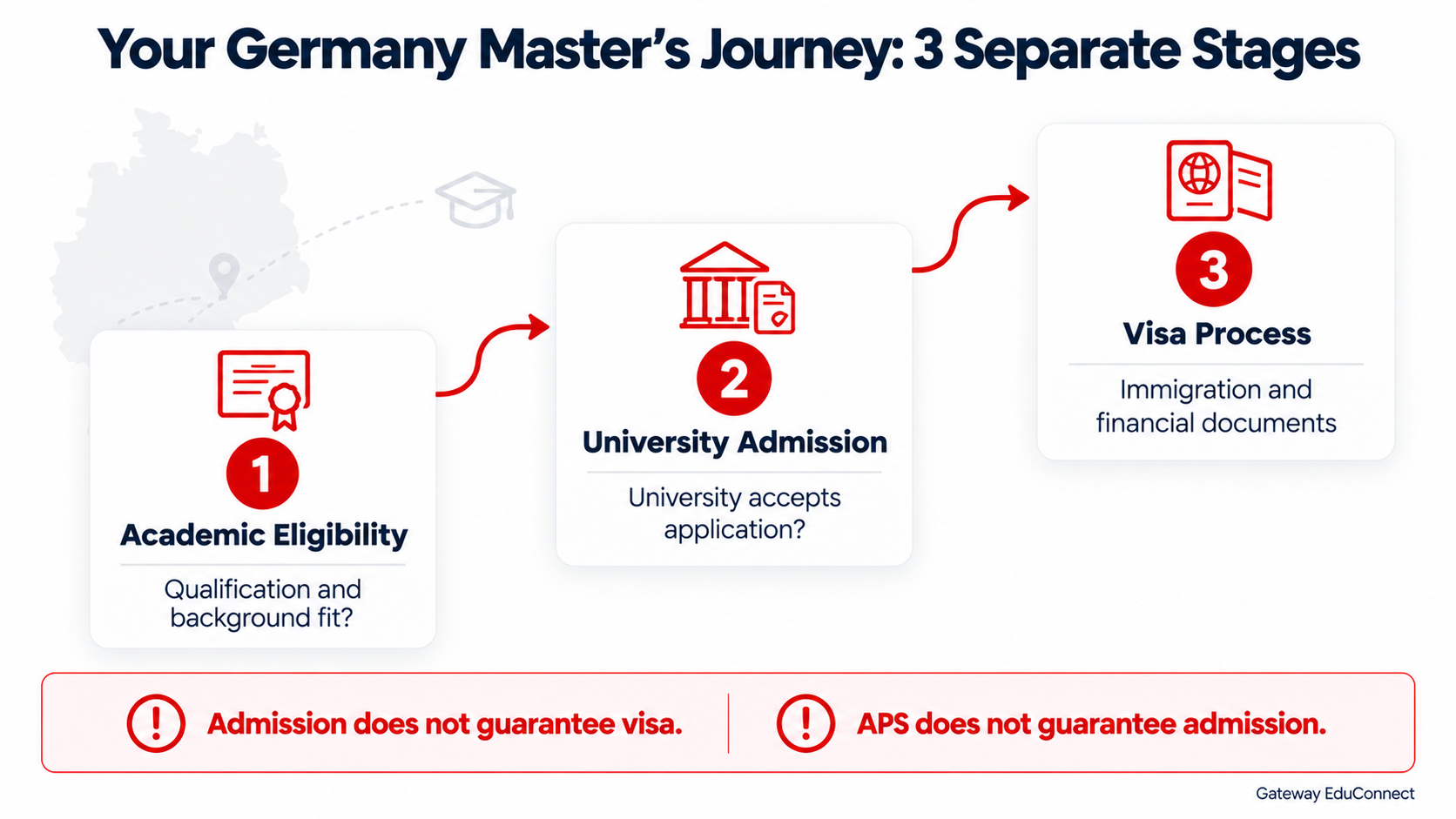
For Germany masters eligibility Indian students, it is useful to keep three stages separate:
- Stage 1: Academic eligibility
Can your previous qualification and academic background meet the programme requirements? - Stage 2: University admission
Does the university accept your application and offer you a place? - Stage 3: Visa process
Can you meet the applicable immigration and financial documentation requirements?
Do not treat an admission offer as a guarantee of visa approval. Likewise, APS verification does not guarantee university admission.
Read out: 10 Ways to Improve Your Job Prospects as an International Student in the UK 2026
Common Mistakes Indian Students should Avoid
When checking Germany masters eligibility Indian students, avoid these mistakes:
- Assuming 60% or 65% is a universal German requirement
- Choosing a Master’s without checking subject compatibility
- Checking only the university and ignoring the individual programme
- Assuming recognition automatically means admission
- Treating APS as university admission
- Ignoring the dMAT requirement when it applies
- Assuming every English-taught programme accepts the same language certificate or score
- Waiting until the deadline to arrange academic documents
- Using eligibility information from an older intake without checking the current programme page
- Assuming the same application route applies to every German university
FAQs
Is there a fixed minimum percentage for a Master’s in Germany?
No. There is no single minimum percentage that applies to every German Master’s programme. Individual universities and programmes may set their own academic requirements.
Can Indian students apply with a three-year Bachelor’s degree?
It depends on the qualification, programme and recognition requirements. Do not assume that every three-year degree is automatically accepted or rejected. Check the individual programme and relevant qualification assessment.
Is APS mandatory for every Indian student?
APS requirements depend on the applicable German procedure and applicant circumstances. Indian applicants should check the current APS India requirements rather than relying on older information.
Is dMAT required for every Master’s applicant from India?
No. The current APS rule applies to selected Master’s applicants whose previous degree falls within the affected fields. For the affected applicants, the requirement applies from the Summer Semester 2027 intake onwards, subject to the stated transitional exemptions.
Does dMAT replace APS?
No. dMAT is an additional element of APS documentation. It does not replace APS document verification.
Does APS guarantee admission to a German university?
No. APS verification and university admission are separate processes.
Is there one application deadline for all German universities?
No. Deadlines are programme-specific. Check the exact course page and application route before planning your submission.
Conclusion
The most important thing to remember about Germany masters eligibility Indian students need for 2027 is that eligibility cannot be decided by percentage alone. Your Bachelor’s qualification, academic background, subject relevance, recognition, language proficiency and the specific requirements of your chosen programme all matter.
For Indian applicants, APS is another important part of the process, and selected applicants now also need to consider the dMAT requirement for the Summer Semester 2027 and later Master’s intakes.
Do not rely on a generic “60% rule” or an old eligibility checklist. Start with your academic background, shortlist suitable programmes, check each university's current requirements and then plan your documentation and APS process accordingly. Planning to study in Germany? Speak with Gateway EduConnect for free video or home counselling and support with your study abroad consultancy services and explore our wide range of offerings for students interested in Study in Australia, Study Abroad in Poland, Study in Canada, Study abroad UK, Study in germany, Study in New Zealand, Study Abroad in Ireland, Study Abroad in the USA, Study in Finland, Study Abroad in Italy, and many other countries

Author Bio
Abhinav Jain - Founder, Gateway Educonnect and Director.
B.Tech, MBA, AI and Global Education Specialist.
More than 15 years of professional experience in leading students along international routes based on politics and innovation.