
04 Aug 2026 | How to Shortlist Universities Without Getting Confused 2026-27: Complete Guide for Indian Students

0
49
Introduction
An effective decision model that can be used by Indian students and parents in an attempt to sort out internationally, between universities, courses, costs and risk of being denied admission.
It is not a list of celebrities that make up a strong university shortlist. It is a rational collection of programmes that fits your academic character, career and financial capacity and risk of being denied admission. The guide describes how to shortlist universities abroad without browsing dozens of irrelevant universities. You will understand how to establish non-negotiables, obtain course content assessment, make eligibility and recognition assessment, guess the total amount of commitment, score each alternative and segregate the final list into ambitious, target and safe options. Different countries, universities and programmes have different requirements, and so any decision made must be verified with the official course page. The approach can be recommended to both undergraduate and postgraduate candidates, and further insight into how to choose a university to study abroad, and how to engage parents in the final decision.
Exchange rates, visa regulations, fees and requirements change and fluctuate. Always revisit the real university and government sites prior to application or remittance of any sum. Explore top online programs and expert guidance at Gateway Educonnect Online Courses.
University Shortlisting at a Glance
|
Stage |
What is the main question? |
What should happen? |
|
1. Define Your Goal |
What are your career goals, preferences and budget? |
Well-defined study objectives and priorities. |
|
2. Compare the Course |
Does the course fit with your career plans? |
Course relevance score |
|
3. Check Eligibility |
Do you meet the programme requirements? |
Eligibility and competitiveness evaluation. |
|
4. Check Recognition |
Is the course and university to be recognised? |
Status of accreditation and recognition. |
|
5. Prepare Your Budget |
Are you able to afford the cost of studying altogether? |
Budget and funding plan |
|
6. Compare Your Options |
Best overall value in universities? |
University comparison score |
|
7. Fill Your Shortlist |
Do you have a balanced and realistic shortlist? |
Safe university list, Ambitious, Target and Safe university list. |
The Reason Why Students are Confused during Shortlisting.
This is how confusion normally sets in: students will first go looking by ranking, country or social-media popularity, and then define the course they require. These search results then yield hundreds of institutions with varying curricula, admission requirements, prices and career results. The remedy is to narrow down the decision to similar questions. This is the basis how to shortlist universities abroad.
Start by isolating 3 concepts: reputation of university, quality of programmes and fit. Even a highly ranked institution might not provide modules that fit your purpose, or which are beyond your budget or experience. When hiring graduates to MS abroad, departmental strength, fit in research, prerequisites, and project opportunity are more important than the institutional status quo.
WHAT This Means to you: how to shortlist universities abroad, determine how to do it first by elimination of the unsuitable universities instead of attempting to determine the singular ideal university right now.
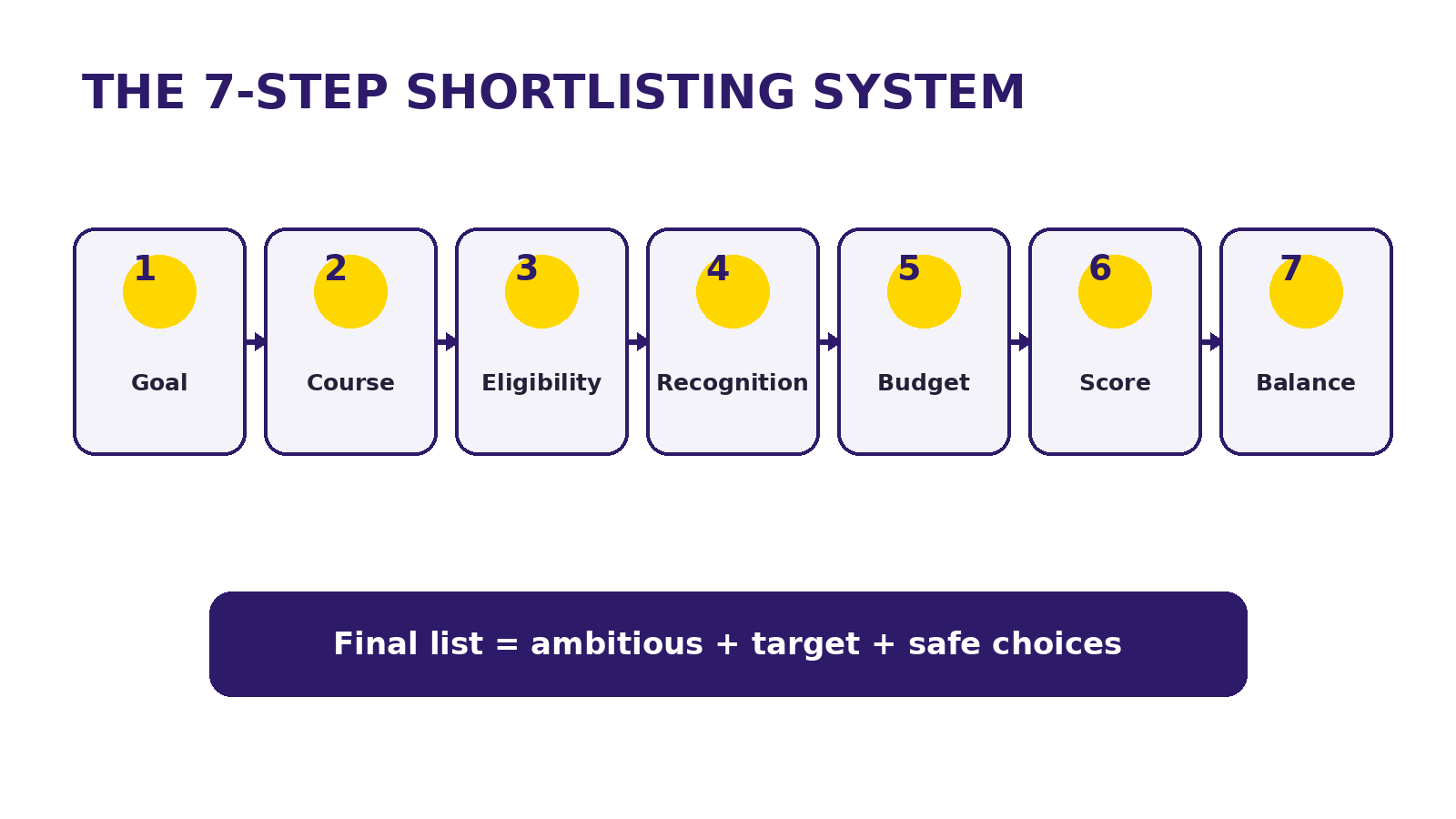
The 7-Step Shortlisting System
Step 1: Get your Goal First
Formulate one absolute outcome statement, the subject matter you would like to work on, the competency you would like to gain and the type of work or extra work you would expect in a later date and then list your non-negotiables which could be maximum first-year budget, length of programme, desirable intake, placement, internship access, or location, thesis option and professional recognition.
Student inquiries about how to choose a university to pursue a master's in a foreign country must also make a choice regarding taught, research and professionally oriented programmes. Compare requirements for previous study in particular fields, preparation of quantitative applications, work experience, a portfolio, interview or a research proposal.
TIP: PLAN Hardly more than five non-negotiables. The existence of too many filters will eliminate realistic selections; too few will give you an overwhelming list to deal with. This makes the manner of how to shortlist universities abroad.
Step 2: Compare the University Name Before the Course.
Similar programs may differ widely in terms of curriculum, style of teaching and professional achievement. Before deciding on how to shortlist universities abroad, compare the course modules, specialisation, methods of assessment, practical learning opportunities and accreditation and then compare the university. When shortlisting an MS abroad at a university, remember to select the programme that suits your career objectives and not only a catchy course name.
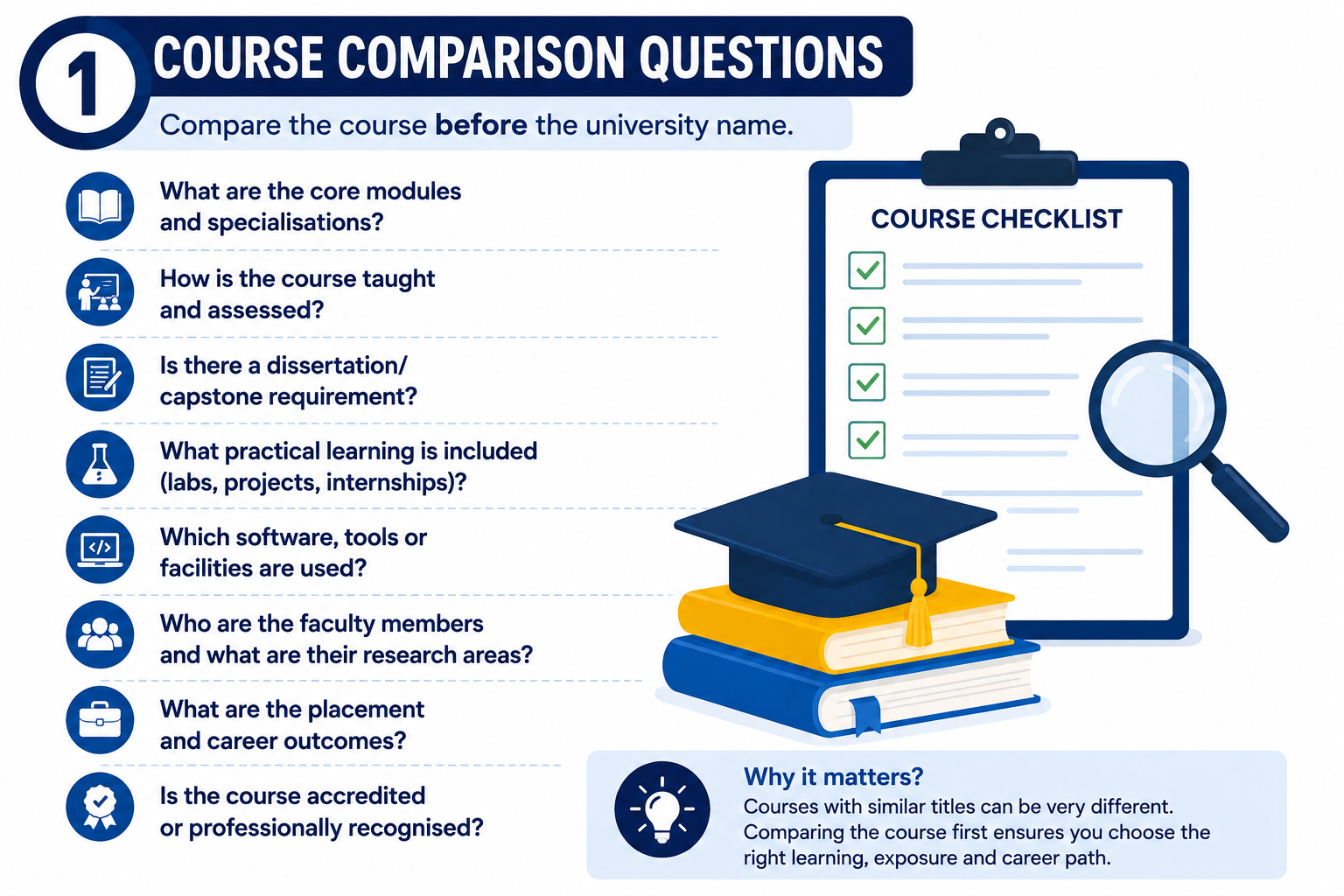
Course Comparison Questions
|
What to Compare |
Why It Matters |
|
Course Curriculum |
Make sure that subject areas suit your career objectives and interests. |
|
Specialisations |
Select programmes with your area of study of choice. |
|
Real-world experience |
Search internships, projects, lab or industry experience. |
|
Research opportunities |
Significant research or advanced study ambitions. |
|
Accreditation |
Critical to controlled professions like Nursing, Law or Architecture. |
|
Evaluation processes |
Understand the proportion between coursework, dissertations and exams. |
|
Career outcomes |
Research graduate employment, industry links and placements. |
|
Duration of the course |
You need to compare your study time and other things |
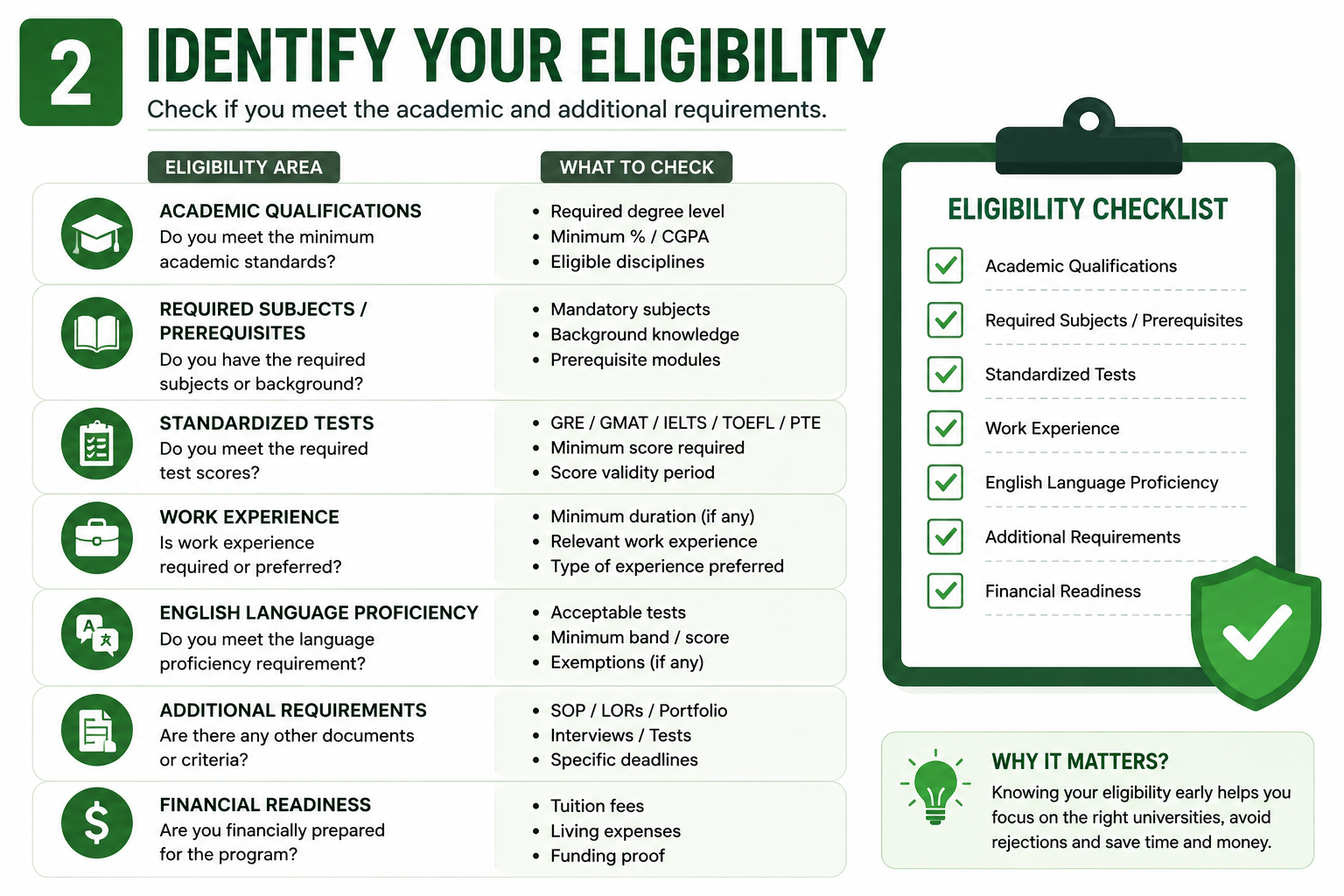
Step 3: Identify your Eligibility
- Examine the grades and subjects needed in school.
- Verify backlogs, research gaps and other work experience.
- Verify English language and standardised test requirements.
- Check portfolio, interview/research proposal requirements, as required.
- Determine your financial preparedness for the programme.
- Make a comparison of your profile and the official specification of the university entrance requirements.
- It is important to remember that the minimum requirements are not a sure way of admission.
- In case of shortlisting in MS abroad in a university, put emphasis on both eligibility and general competitiveness.
Read More: Oxford vs Cambridge: Which is Better for Indian Students 2026
Step 4: Make sure ranking of the university and other student services
In case of professional programmes, find out whether that course is licensing or registration-encouraging. Annual department review, course approval, teaching and assessment method, student services, international support, careers provision, student accommodation and accessibility.
One of the inputs, but not the decision, is rankings. Compare evidence at subject level, and be familiar with the methodology and year. Promotional claims should come second to national quality bodies and recognised government study portals where the official course pages are promoted. EducationUSA suggests prioritising and filtering options based on official institutional websites, accredited institution databases, fairs and advisers.
PARENT TIP: Parents ought to evaluate the academic worth and recognition prior to giving attention to the popularity of the city as well as word of mouth. One of the key inquiries in the process of how to shortlist universities abroad is recognition.
Step 5: Compare the Complete Cost and Funding Risk
Divide tuition, deposits, accommodation, food, utilities, local transportation, visa fees, insurance or health fee, exams, applications, flights, books, equipment, start-up, and emergency reserve. Turn costs into INR at a current exchange rate and include a buffer due to fluctuations in the rates and living costs.
When reading, find out how to choose a university for a master's abroad; do not compare the total cost of the course but the first tuition instalment only. Check scholarship eligibility, value, exclusions, renewal conditions and requirement of a separate application. In the case of loans, examine interest rate, processing fee, collateral requirement, requirement of co-applicant, margin money requirement, moratorium, the duration of repayment, covered expenses and disbursements.
BUDGETING RULE: Just because a university is likely to receive added income through admission does not guarantee financial success. Financial fit should be evaluated without considering admission possibility. This difference enhances how to shortlist universities abroad in a responsible manner.
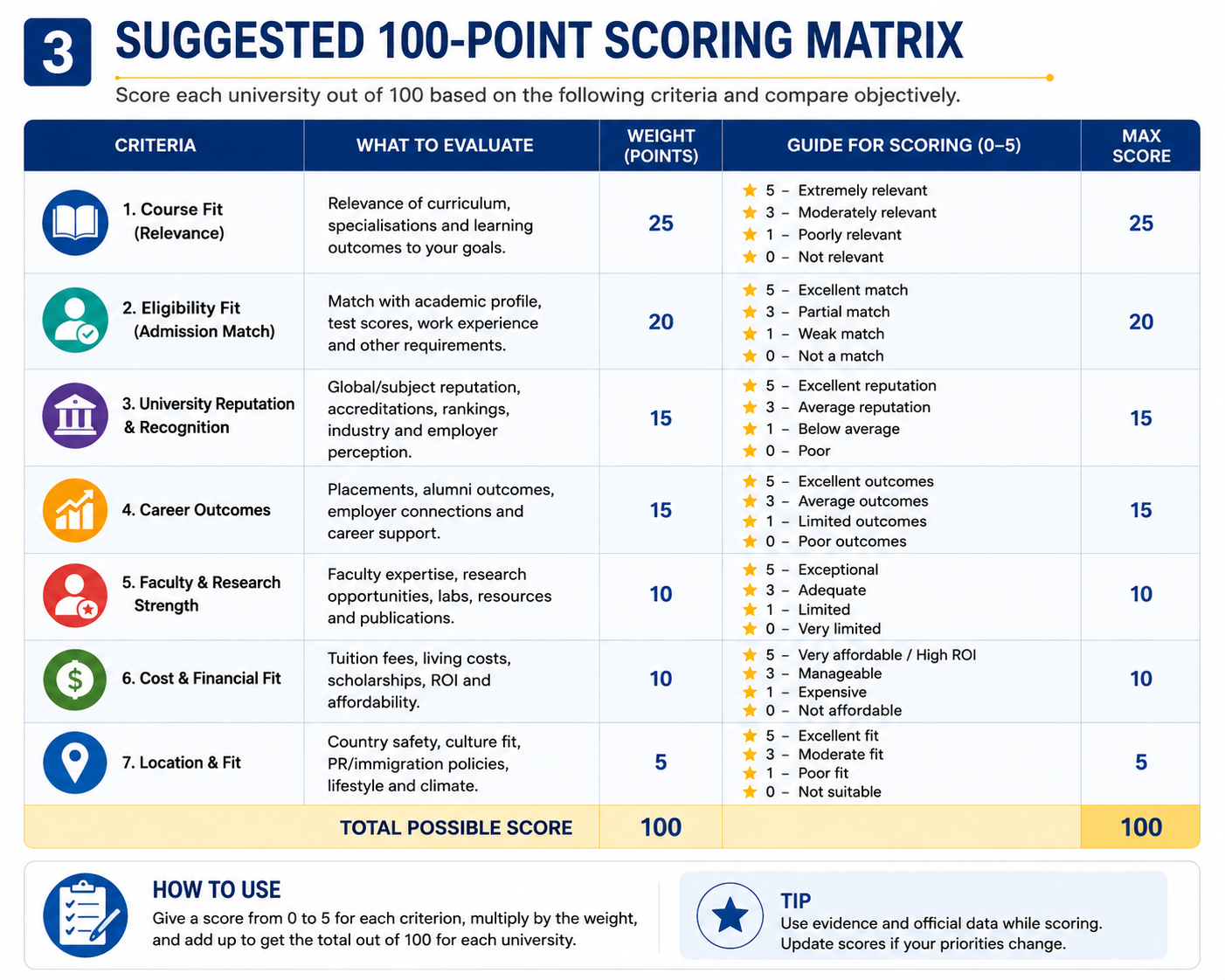
Step 6: Score Every University Using the Same Matrix
Suggested 100-Point Scoring Matrix
|
Criterion |
Weight |
Evidence |
|
Course fit |
30 |
Modules, projects, research or placement. |
|
Eligibility fit |
20 |
Published requirements and profile match. |
|
Total cost |
20 |
Full-course estimate and funding plan |
|
Recognition and quality |
15 |
Official recognition and course evidence. |
|
Career/practical learning |
10 |
Career assistance and practical opportunities. |
|
Location/lifestyle |
5 |
Accommodation, travel and personal fit. |
Read More: Cost of Studying in the USA for Indian Students 2026: Full Breakdown
Step 7: Build an Ambitious, Target and Safe Mix
Only compare your profile with the published entry requirements and then classify each university.
- Ambitious: More competitive than your profile.
- Criterion: Good overall match.
- Safe: Great strike, yet not certain.
Your dream universities list- safe, ambitious: should take into account chances of admission as well as affordability. When it comes to university shortlisting for an abroad MS, many students will apply to 6-10 universities, but the number of universities to apply to abroad depends on your profile, budget, deadlines and application quality.
A balanced shortlist would usually consist of 2-3 ambitious, 3-4 target and 2-3 safe universities. Through your list of safe, ambitious, and dream universities, review the list and send applications.
Balanced Application Mix
|
Category |
Planning range |
Meaning |
|
Target |
3–4 |
Reasonable evidence-based match |
|
Ambitious |
2–3 |
Potential, although evidently more competitive. |
|
Safer |
2–3 |
Descartes match; never certain. |
Interpretation: Modify the range of application charges, country systems, programme competitiveness and time required to generate good applications.
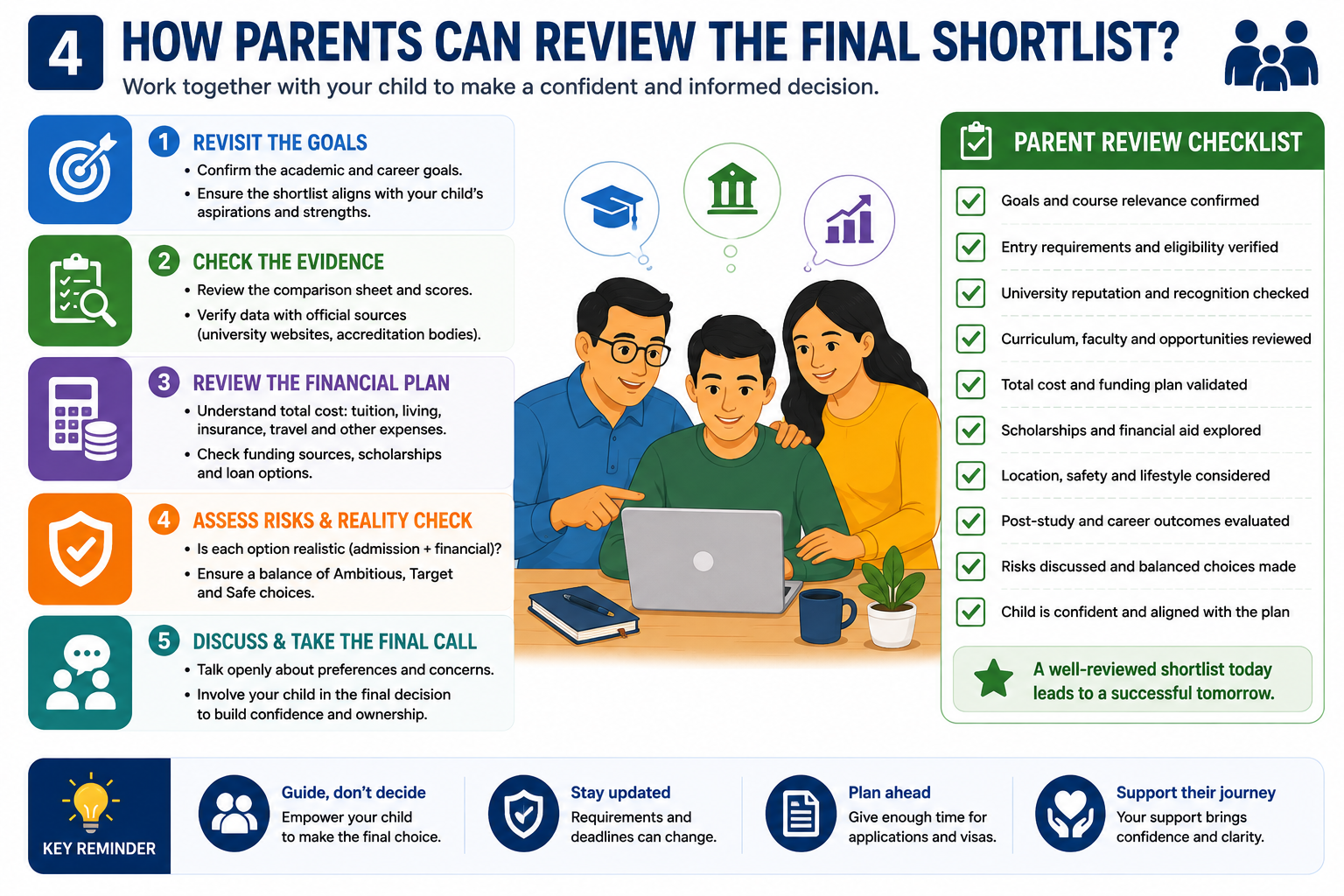
How Parents Can Review the Final Shortlist?
Parents are a significant part of final shortlist evaluation. They should go over:
- Quality of courses and recognition by the university.
- Complete cost- tuition and living expenses.
- Foreign scholarship and foreign education loan requirements.
- The success of graduates and their employment opportunities.
- Campus placement, lodging and security of students.
- Visa preparations and budgeting.
- Internship, placement and industry exposure.
- Refund, withdrawal and deposit.
- Emergency support and communication facilities.
Parents ought to make comparisons of the aggregate value of each university- not rankings or tuition. This method helps students for how to shortlist universities abroad and select a university best suited to their educational interests, financial plan and career planning.
Check Out: Computer-Based IELTS Tips 2026: How to Score Faster in the Digital Exam
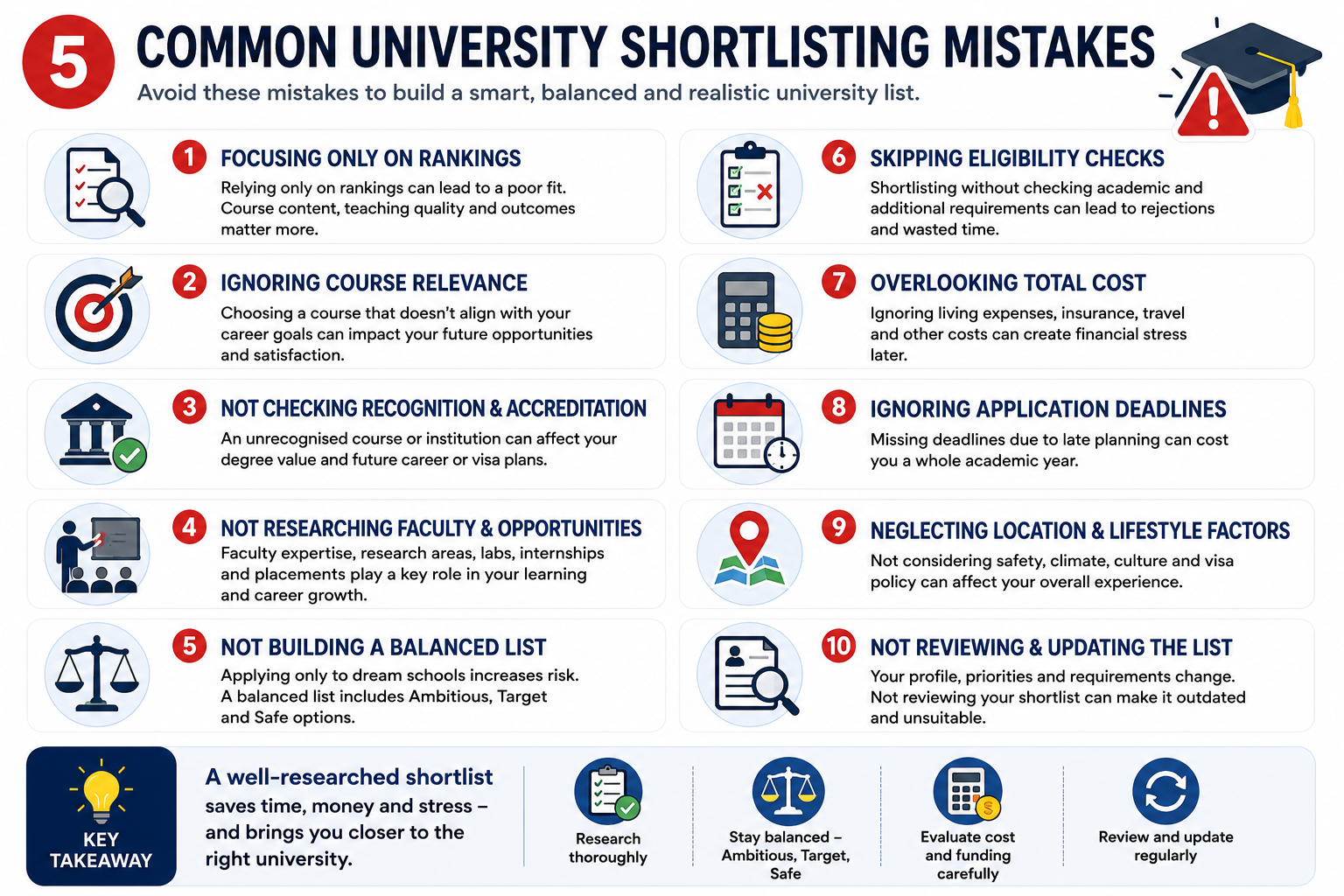
Common University Shortlisting Mistakes
Some of the pitfalls to avoid when learning how to shortlist universities abroad are:
- Making up your mind before you make up your mind about the country.
- Using merely the university rankings in general.
- Disregarding programme-specific criteria and requirements.
- Minimum eligibility is a guarantee of admission.
- Disregard of accreditation of regulated professions.
- Comparing tuition fees only as opposed to overall study costs.
- Applying the same SOP to all universities.
- Reliable sources: social media as opposed to official sources.
- Submitting applications only to the most competitive universities as opposed to developing a balanced, safe, ambitious dream universities list.
- Adding universities incessantly as opposed to completing your shortlist.
Taking a systematic approach to the shortlisting of universities in MS abroad assists you in making evidence-based decisions confidently.
Consultants, Gateway EduConnect, and Direct Applications
Students may directly apply using official university websites, but with professional guidance, it may be easier.
Gateway EduConnect helps students with:
- Free home counselling and video.
- Guidance on course and country selection.
- Selection of a university to pursue a master's abroad using profile assessments.
- Balanced approach to university shortlisting for MS abroad.
- Guidance on the SOP and application documents.
- Test preparation support.
- Education loan assistance.
- Accommodation assistance.
- Visa advice and pre-departure assistance.
Steer clear of filler consultants who assure to secure admission, scholarships, loans, jobs or visas. Be it the number of universities you apply to for a master's overseas, you need to be mentored according to your educational background, financial status and career aspirations, not promises.
Check out: Free & Low-Cost Universities in France for International Students 2026
Practical Shortlisting and Application Schedule.
Indicative Planning Timeline
|
Pre-intake times |
Priority action |
Anticipated outcome |
|
12–10 months |
Define goal, course and budget; start tests |
Longlist and preparation plan |
|
10–8 months |
Verify eligibility, recognition and course evidence |
Evidence-based shortlist. |
|
8–6 months |
Ready SOP, LORs, CV, Portfolio or proposal |
Docs to join the application. |
|
6–3 months |
Search and monitor scholarships or funding |
Offers and funding comparisons. |
|
3–1 months |
Financial pre-planning, visa, housing and departure |
Confirmed study plan |
Timelines vary. There are competitive scholarships, portfolio, supervisor approval of research, delay of test results, loan application, closed intake and availability of visa appointment. They may need to be done earlier.
FAQs
What is the number of shortlisted universities in the beginning?
Contact 15–20 universities, and reduce them to 6- 10 good applications. The number of universities you can apply to for a master's in foreign countries depends on your profile, the competitiveness of the programmes and budget.
What are the criteria for whether a university is safe or not in my profile?
A safe university is one in which your profile is greatly comparable to what is published. The list of your safe, ambitious dream universities should take into consideration the possibility of getting admission and cost.
Is it only rankings that would be my primary selection?
No. Although rankings are important, the process of how to shortlist universities abroad should be largely concerned with the quality of courses offered, eligibility, accreditation, prices and career prospects.
What is the best way to shortlist universities to do an MS or MSc?
To shortlist MS abroad universities, consider course modules, specialisations, faculty and research opportunities, internships and graduate outcomes and then decide.
Are only ambitious universities eligible?
It's not recommended. A safe ambitious dream universities list should have a number of ambitious universities, target universities and safe universities to enhance your college admission.
At what time should I embark on shortlisting of universities?
Start researching 10-12 months prior to intake to ensure that there is enough time to carry out tests, papers, scholarships and applications.
How can we easily compare universities?
Compare with a prepared spreadsheet of predetermined evaluation criteria. This brings the process of how to shortlist universities abroad and the process of university selection abroad more into order and objectivity.
Conclusion
An effective shortlist is not too big to handle, too narrow to risk too much on or too broad to prove. Determine your objective and situation, compare courses; ensure you are eligible and recognised, compute overall cost, mark every programme accurately and make a balanced application mix. Check official programme pages prior to application due to changing requests, fees and deadlines. This systematic way of deciding on how to shortlist universities abroad assists the students and their parents in shifting through haphazard searches to a clearer, cheaper and more scholarly organisation. Use the University Shortlist Template to keep a record of your criteria, evidence, scores and your final ambitious, target and safe choices.
DOWNLOAD THE UNIVERSITY SHORTLIST TEMPLATE: Finally, enter your criteria, evidence connections, providing scores, full-cost estimate and ambitious target-safe combination into a single decision sheet.
For more assistance, please visit our study abroad consultancy services and explore our wide range of offerings for students interested in Study in Australia, Study Abroad in Poland, Study in Canada, Study abroad UK, Study in germany, Study in New Zealand, Study Abroad in Ireland, Study Abroad in the USA, Study in Finland, Study Abroad in Italy, and many other countries

Author Bio
Abhinav Jain - Founder, Gateway Educonnect and Director.
B.Tech, MBA, AI and Global Education Specialist.
More than 15 years of professional experience in leading students along international routes based on politics and innovation.