05 Jun 2026 | Common IELTS Listening Traps and How to Avoid Them

0
91
Introduction: Common IELTS Listening Traps
IELTS has become a major prerequisite for university applications and visa requests, as many students about to study abroad are required to have a good IELTS score. Although reading, writing, and speaking are among the things that most candidates pay a bit of attention to, the Listening part can suddenly become a problem. The reason is that the test is designed not only to assess people's English comprehension but also to focus on concentration, attention to detail, and recognition of essential information. Most students lose marks to common IELTS listening traps, including distractors, corrections, and paraphrased information. These traps are important for understanding how to avoid quintessential listening errors when applying to IELTS and, more generally, in overall performance. This guide will explain the traps mostly used and how they can be overcome by getting tips that work better to enhance the listening scores.
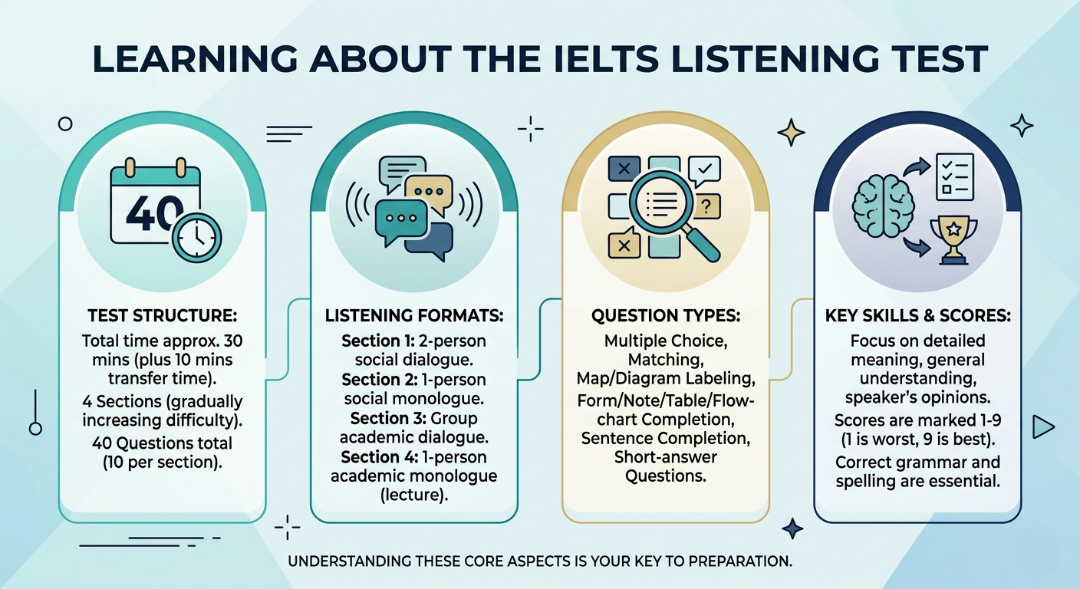
Learning about the IELTS Listening Test.
There are 14 questions in the IELTS Listening test and 40 questions. The level of difficulty of the test goes up gradually and the candidate should also be able to maintain concentration to the very end.
Students commonly encounter:
- Two people talking about such daily things as accommodation, travelling, or registration processes.
- A social monologue involved general information, announcements or directions.
- A scholarly debate where many participants state views, concepts and suggestions.
- Lecture with university-style requirements that imply the interpretation of the most intricate information and voting points.
Many of the IELTS listening traps are due to students not ranking the Listening module as highly complex and being unprepared.
🎓 Ready to turn your study abroad dream into reality? Explore top online programs and expert guidance at Gateway Educonnect Online Courses.
Check out: Band 8 Vocabulary for IELTS Speaking & Writing in 2026
Why Students Fall for IELTS Listening Traps?
Most students are shocked to find that their Listening scores are not as high as expected. This is primarily because IELTS has several tricks in its audio that IELTS examiners deliberately use as tests of real-life listening.
Some of the common pitfalls put by students in IELTS listening are:
- When hearing a keyword, many of the candidates hurry to write down an answer and overlook some crucial corrections in the conversation.
- Students do not necessarily pay attention to the whole meaning and context of the discussion but concentrate on particular words.
- After missing one answer, some candidates get distracted, thus impacting negatively on their concentration for the next question.
- Most test takers would anticipate speakers to use the verbatim language in the question as opposed to the perceived paraphrase of information.
- New accents often confuse students, and they often cannot even recognise important details without their knowledge.
Some IELTS Listening Tricks also How you can Avoid This
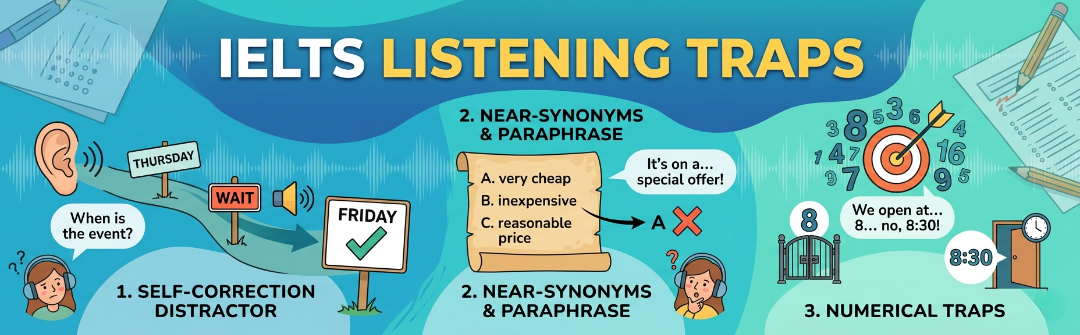
1. Information Correction Trap
Most common IELTS listening traps are found when an oral speaker modifies or corrects information has been previously stated.
For instance
“The seminar is going to be conducted during the morning on Tuesday. Sorry, I meant Wednesday morning.”
Immediate writers of Tuesday usually fail to correct and will lose the mark.
Strategy to avoid:
- It is always worthwhile to listen to the speaker till they are through with the entire sentence before you write your final response.
- Be mindful about words like actually, sorry, however, and instead which are used to, at times, mean corrections.
- The practise of using the actual IELTS recordings can familiarise you with these typical IELTS listening traps.
2. Distractor Information Trap
Distractors are specially introduced pieces of information to confuse the candidates.
For instance
“We originally thought of studying in Melbourne, but later on we thought that Sydney would be a good choice.”
The large number of students spell Melbourne since it is the first in the conversation.
Strategy to avoid:
- Concentrate on the final decision, not on the initial decision stated in the discussion.
- Pay attention to any alterations in opinion, suggestions, or plans and then reconsider your answer.
- Knowledge of distractors can be of great help in minimising typical listening errors in IELTS.
Check out: Best Free IELTS Apps in 2026 for Band 7+ Preparation
3. Similar-Sounding Words Trap
|
Similar-Sounding Words |
Why They Cause Problems |
|
Fifteen and Fifty |
Students tend to mix up numbers when in a haste to talk. |
|
Ship and Sheep |
Similar pronunciation can result in incorrect answers. |
|
Cheap and Chip |
Even such a slight variation in pronunciation completely transforms the meaning. |
|
Accept and Except |
When one is under examination, it is easy to misinterpret these words. |
Strategy to avoid:
- Frequently watch English podcasts, news, and IELTS practice sessions videos.
- Be exposed to British, Australian, Canadian and American accents to enhance understanding.
- Daily listening exercises will enable students to give more precise answers in IELTS listening.
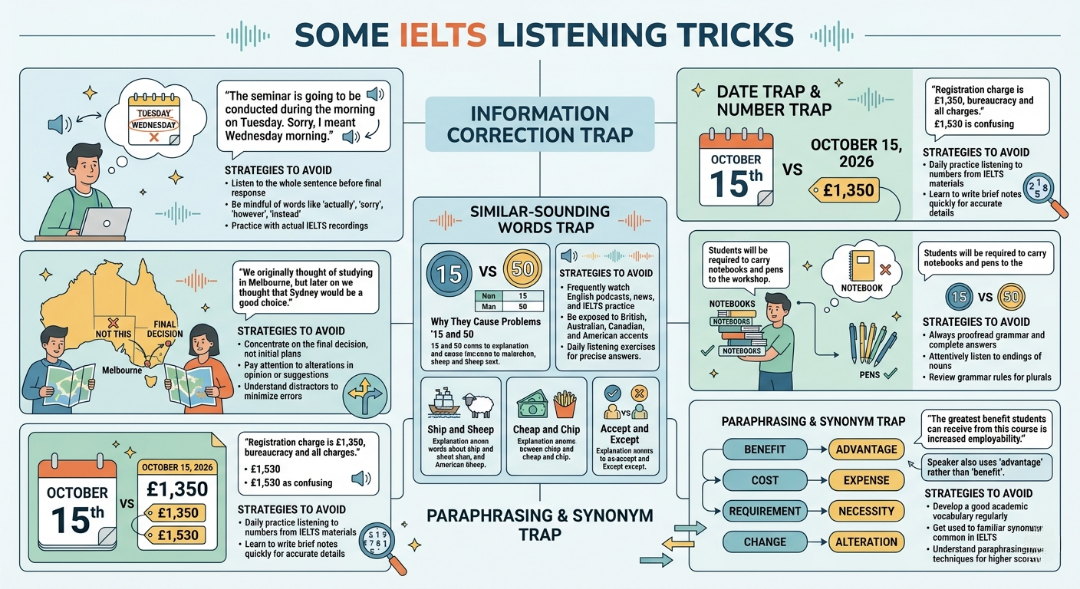
4. Date Trap Number Trap.
IELTS listening traps often tests numbers, dates, prices and phone numbers.
For instance
“Registration charge is £1,350, bureaucracy and all charges.”
Quite a few students are confused by the figure £1,530 and fail to earn some marks.
Strategy to avoid:
- Daily practise listening to numbers by using IELTS materials and listening to English audio.
- Learn to write brief notes in a short time period to get the most accurate information.
- Good numerical listening skills may tremendously enhance performance in listening scores.
5. Singular/Plural Trap.
Majority of the applicants lose points by not identifying whether the response is plural or singular.
For instance
“Students will be required to carry notebooks and pens to the workshop.”
An incorrect response will be got using a notebook as opposed to notebooks.
Strategy to avoid:
- It is best always to proofread grammar and complete your answers.
- Attentively listen to endings of nouns when listening to the recording.
- Reading grammar rules might also aid in the decrease of IELTS listening traps.
6. Paraphrasing and Synonym Trap
The questions in IELTS seldom repeat the same words.
For instance
“What is the main benefit of the programme?”
The greatest benefit students can receive from this course is increased employability.
The speaker also uses "advantage" rather than "benefit".
Strategy to avoid:
- Develop a good academic vocabulary by reading and listening regularly.
- Get used to familiar synonyms that are quite common in IELTS tests.
- The knowledge of the paraphrasing techniques can enable you to provide some significant scores in terms of listening.
Check out: Beyond TOEFL & IELTS: Alternative Online Exams for Scholarship to Study Abroad
Common Mistakes Students Make During the IELTS Listening Test
Although students can know the recording, simple mistakes and bad habits of taking tests can result in wrong answers and decrease the scores in IELTS listening traps.
- Most students take excessive time on one question and fail to get the answers to the other questions.
- Other candidates do not observe word limits but still fail to mark points even when they have the right answer.
- Students tend to be in a hurry to write answers and overlook valuable corrections by the speaker.
- Most of the test takers pay attention to key words rather than get the general meaning of the conversation.
- The candidates will often commit spelling mistakes, thus giving the wrong answers to the IELTS listening questions.
- The fact that one misses one answer causes some of the students to panic, and this can interfere with their focus during the test.
- Numerous learners are unable to identify typical consequences and distractors when it comes to IELTS audio.
By avoiding these listening mistakes in IELTS, you can manage to overcome some of the most common IELTS listening traps and score higher in listening tests.
A 7-Day Training Plan to Escape the IELTS Listening Traps.
It is important to understand the IELTS listening traps, but regular practice is what can get you a higher score. This is a simple 7-day schedule you can follow to minimise listening mistakes during the IELTS and score excellently on the listening exam.
|
Day |
Focus Area |
What to Practise |
|
Day 1 |
Information Corrections |
Train to discern answers when speakers correct or alter information. |
|
Day 2 |
Dates and Numbers |
The most frequent pieces of information to practise listening to are dates, prices, addresses, and phone numbers these are also tested in the Listening exam in IELTS. |
|
Day 3 |
Misleading Information |
Before choosing your ultimate answer, practise discerning falsehoods and fluctuations in opinion of the speaker. |
|
Day 4 |
Similar-Sounding Words |
Practise distinguishing commonly confused words and numbers. |
|
Day 5 |
Synonyms and Paraphrasing |
Determine the various ways speakers can convey the same thing. |
|
Day 6 |
Full Practice Test |
Full IELTS Listening test quiz 30 minutes in exam conditions. |
|
Day 7 |
Review and Analysis |
Examine errors and review where you are predisposed to see low marks. |
This plan will help you identify some pitfalls to avoid on the IELTS listening test, improve the precision of your IELTS listening results, and become more accustomed to common IELTS listening traps used in the test.
Check out: Test Takers Approach 7-Days Before IELTS Exam
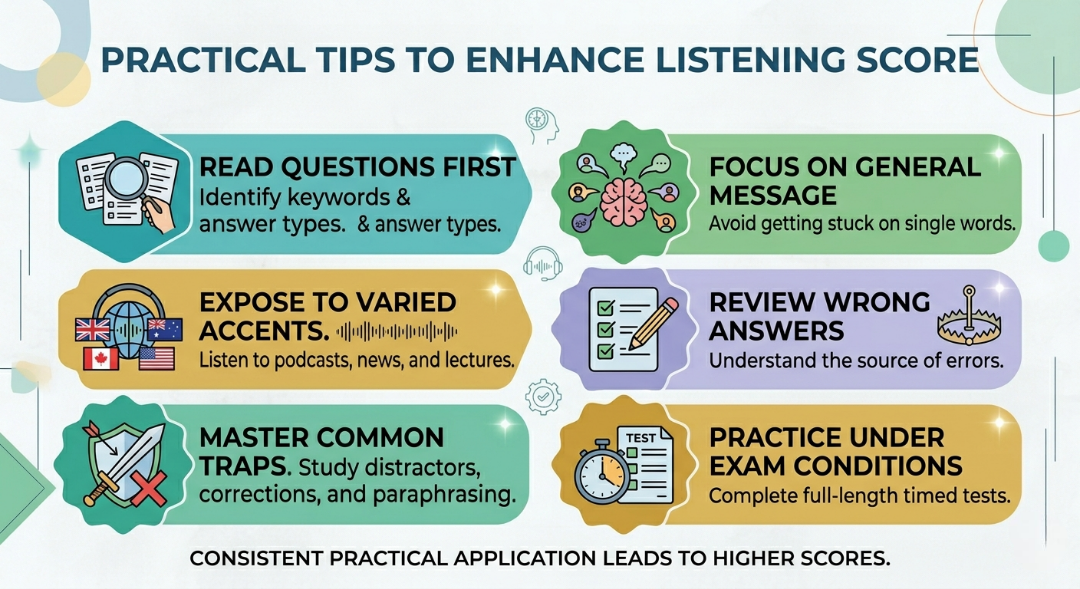
Practical Tips to Enhance Listening Score.
It is not only essential to practice tests to avoid IELTS listening traps. A focused practice plan could help you become more accurate and confident.
- The questions to read before the recording to find essential information more expeditiously.
- Pay attention to the general message of the speaker rather than using the keywords alone.
- Train on various accents of English to enhance listening comprehension.
- Check wrong IELTS listening answers to recognise common points of weakness.
- Study of typical IELTS listening traps, including distractors, corrections, and paraphrasing.
- Complete full-length practice exams as a method of gaining concentration and confidence in the exam.
With these strategies in mind, you may be able to minimise some listening errors in the IELTS, prevent some IELTS listening traps, and get a high score in listening.
The Support Gateway Educonnect offers to IELTS Aspirants.
Gateway Educonnect is an IELTS training organisation (15+ Years of Experience and 23,000+ students guided) that helps students get the most out of their IELTS training and avoid common IELTS listening traps before their exam.
Our support includes:
- Individualised IELTS advice to assist students in making mistakes when online listening.
- Full application-to-admission support at the university.
- Scholarship and housing funding to make the process of studying abroad easier.
- Flexible expert guidance with home counselling and video counselling.
- Mentoring by experts who guide students on how to improve their answers on the IELTS listening tests and general performance on the test.
- Students can apply using our portal with an offer letter within 24 hrs and have cashback benefits of up to 2499.
FAQs
What can I do to familiarise myself to boost my IELTS listening score?
To better the listening score one should get accustomed to listening, listening via different accents, learning the IELTS listening traps that are common.
Why are students at fault in listening in the IELTS?
The majority of errors made when listening in IELTS occur when students are not focused, are in a hurry to write answers, or miss aspects that are paraphrased.
How important are IELTS listening answers?
The correct answers in IELTS listening are quite important, as writing with many spelling and grammar errors may result in losing marks.
Are IELTS audio tricks applicable to all exams?
Most IELTS tests include a few audio-based tricks to assess attentiveness, comprehension, and critical listening.
Is it possible to avoid IELTS listening traps with regular practice?
Yes. Constant listening to IELTS-style recordings helps students learn the traps to avoid in IELTS listening and feel more confident.
Conclusion
Passing the IELTS Listening test does not merely require a broad knowledge of spoken English. Another ability it needs is the capacity to identify and avoid common IELTS listening traps, which examiners deliberately use to assess real-life listening abilities. Be it in correcting information or distracters, paraphrasing, or words that sound alike, these troubles can even hit well-prepared students. Through learning the general IELTS audio tricks, examining your errors, and practising using a well-organised practice schedule, you can minimise IELTS listening errors and give more correct IELTS listening responses. The secrets of a higher score are regular preparation and practice. Gateway Educonnect will help you take the next step confidently and clearly if you require professional assistance with preparing for the IELTS exam or studying abroad. For more assistance, please visit our study abroad consultancy services and explore our wide range of offerings for students interested in studying in the USA, studying in the UK, studying in Canada, studying in Australia, studying in Ireland, and many other countries.

Author Bio
Abhinav Jain - Founder, Gateway Educonnect and Director.
B.Tech, MBA, AI and Global Education Specialist.
More than 15 years of professional experience in leading students along international routes based on politics and innovation.