29 May 2026 | IELTS Speaking Confidence Hacks: How Introvert Students Can Score Band 7+

0
85
Introduction: IELTS Speaking Confidence Tips
Most students planning to take IELTS are of the opinion that extroverts tend to perform exceptionally in the speaking tests. Nevertheless, it is not the case. Introverts tend to be good observers, possess good vocabulary and have deep answers: attributes that will be great in IELTS. Confidence is normally the real challenge and not ability.
No matter how you have issues with hesitations, fear of making errors, feeling nervous when talking, you are not alone. IELTS speaking anxiety is a problem affecting many Indian students before the exam. The positive thing is that confidence can be built with the right preparation plan.
In this guide, Gateway Educonnect will provide practical, tested IELTS speaking confidence tips to build confidence that will help introverted students achieve fluency, reduce anxiety, and be ready to score a Band 7 or higher. With over 15 years of experience assisting over 23,000 students in attaining their global education objectives, we are well-acquainted with the real issues students face when preparing for the IELTS examination.
Why Introvert Students Often Struggle in IELTS Speaking?
IELTS speaking confidence tips is not intended to be a personality test and is meant to be a speaking test. However, introverted students may be clumsy in those scenarios where they are asked to talk ad-hoc.
Common reasons include:
- A lot of students feel IELTS speaking anxiety as they are worried about causing grammatical errors during the examination.
- Some students need extra time to digest questions, and this may influence fluency.
- Absence of English conversation can diminish confidence when practising the IELTS speaking.
- Students are afraid of being judged, and hence they fail to talk naturally.
The key to eliminating these problems is regular training and intelligent confidence-building measures.
🌍 Looking for flexible learning opportunities from leading international institutions? Browse the latest programs at Gateway Educonnect Online Courses.
Understanding What Examiners Actually Want
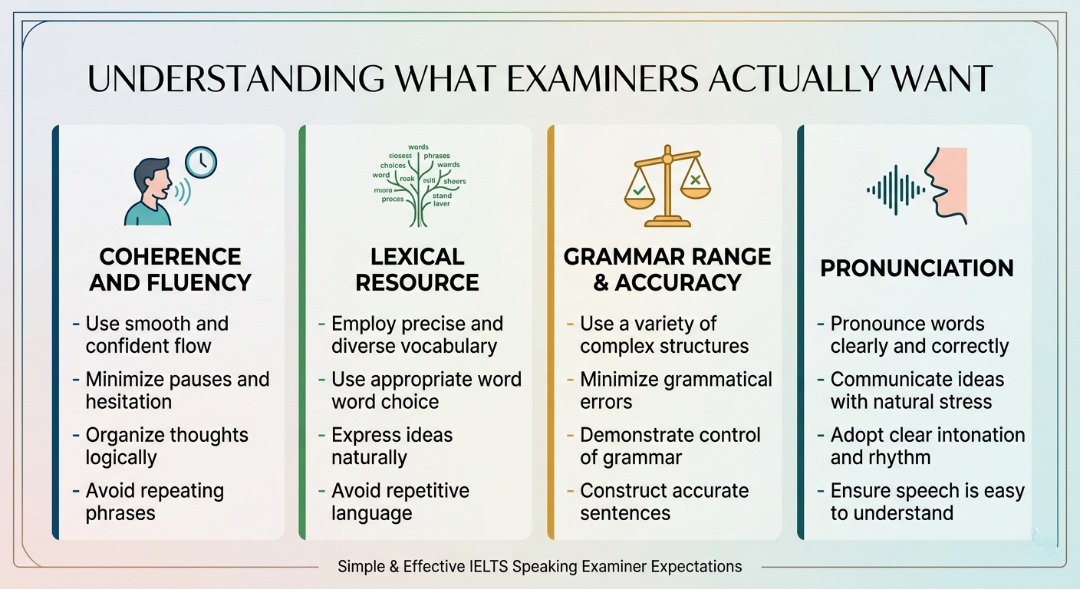
It is necessary to be aware of what will achieve a mark even before implementing any IELTS speaking confidence tips.
|
IELTS Speaking Criteria |
Examiners evaluation |
|
Coherence and Fluency |
The way you speak and pronounce words in a natural and clear manner, the way you organize your ideas and hold on to the flow of conversation without speaking much or having pauses and hesitations. |
|
Lexical Resource |
Your use of appropriate vocabulary and ability to express ideas naturally. |
|
Grammar Range and Accuracy |
Your skill in employing correct sentence construction with little or no grammatical mistakes. |
|
Pronunciation |
How clearly and confidently you pronounce words and communicate your ideas. |
This does not require that you have a perfect accent or a very high level of vocabulary. Only clear and confident communication is required.
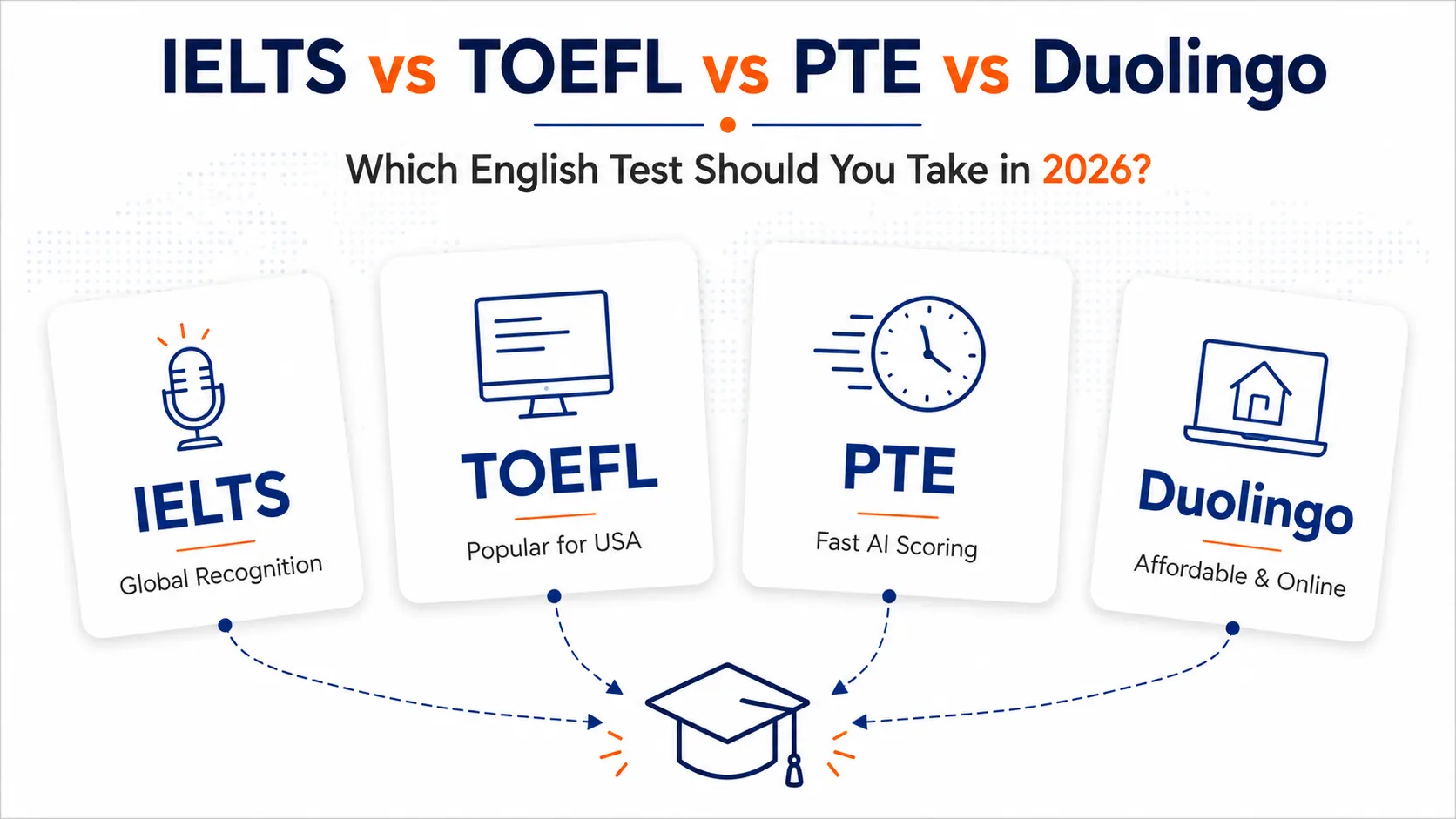
Check out: IELTS vs. TOEFL: Exam Format and Structure Guide
Top 10 IELTS Speaking Confidence Hacks as an Introvert student.
1. Skill Using before Speaking Before an Audience.
Starting small is one of the best IELTS speaking confidence tips for introverts.
Rather than directly participating in group discussions, start practising on your own. Talk before a mirror, record or practice reading by asking questions of IELTS daily.
By doing this, you are able to:
- Get used to speaking and listening in your own English voice regularly.
- Little by little, the self-consciousness and hesitation when speaking in English aloud should be diminished.
- Determine pauses, weaknesses, and speaking patterns to fix.
Just 15-20 minutes of daily solo IELTS speaking confidence tips can achieve great results in terms of confidence in the long term.
2. Concentrate on Fluency and not Perfection.
Most of the students who have IELTS speaking anxiety quit speaking upon minor mistakes. This is lessening fluency and scoring.
Remember:
- The IELTS examiners emphasised effectiveness and not on perfect English and challenging vocabulary.
- Even small grammatical or pronunciation errors are okay so long as people can comprehend what you are talking about.
- It is more vital to speak with confidence and naturalness than to provide memorised answers.
To become more fluent in IELTS, plan to speak in a steady flow of 1-2 minutes without pausing to correct yourself on general topics.
Some typical speaking topics would include:
- Hobbies
- Career goals
- Education
- Technology
- Family
- Travel
This is among the most viable band 7 IELTS speaking confidence tips for introverted learners.
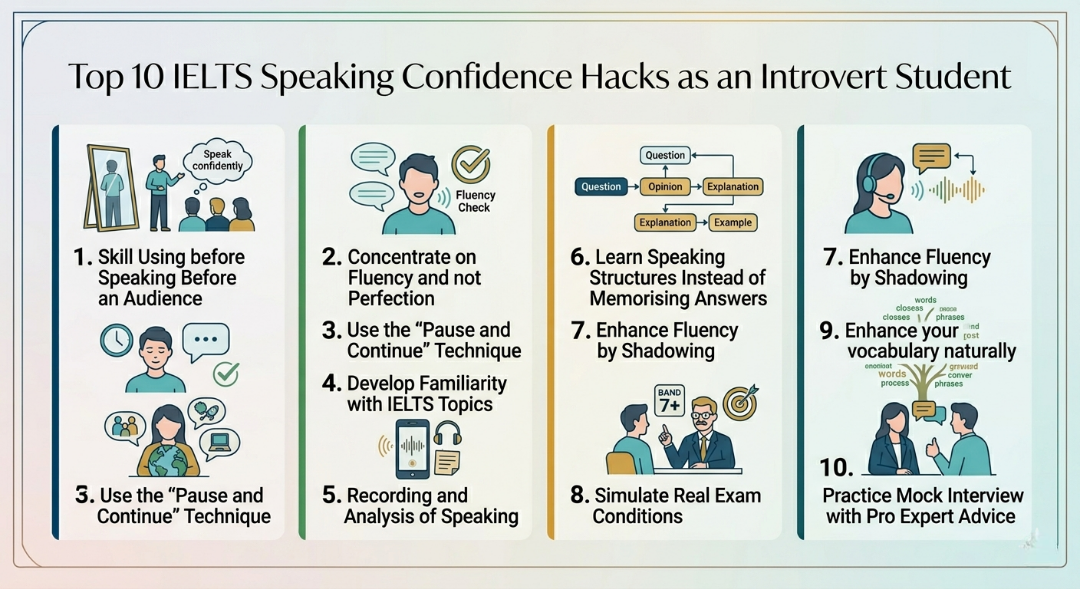
3. Use the “Pause and Continue” Technique
Introvert students tend to get panicked on forgetting a word. Learn to pause and go on talking; instead of freezing.
Natural transition phrases that you can use include:
- What an interesting question, and I believe...
- I would like to consider it for a while before I answer.
- I think this is relevant since, in my view, it matters, because...
Such transition phrases help to flow and minimise IELTS speaking anxiety in the exam.
This is the best IELTS speaking confidence tips of all, as it comes across as natural and professional.
4. Develop Familiarity with IELTS topics.
Confidence will also increase as students become more familiar with IELTS speaking confidence tips. Review a list of common questions and prepare simple ideas and examples to each topic.
- The objectives of the study abroad program, such as why a specific country or university was selected.
- Learning and hobby preferences, favourite courses and career goals.
- Your everyday routines, hobbies, activities are all a natural expression of your personality.
- Social media, technology and the effect digital platforms have on everyday life.
- Environmental issues, sustainability and thoughts on the present global problems.
- Goals in education, career development and self-development.
- Repeating the speaking practice on everyday topics in IELTS enhances the speed of response and also minimises nervousness.
When students create topic frameworks, they tend to acquire fluency in IELTS more naturally.
5. Recording and Analysis of Speaking.
One of the most helpful IELTS speaking confidence tips for introvert students is self-analysis. Write your answers to your phone and read them now and then.
Focus on evaluating:
- Your rate of speech to make your answers sound natural.
- Clear articulation to make your words clear in the IELTS test.
- Filler words, like umm, like or you know, that are used repeatedly can have an impact on fluency.
- Pauses or hesitation in response that may cause discontinuity in your responses.
Frequent self-assessment will assist students in teaching them where their weaknesses lie and in building confidence over time in preparation to take the IELTS exam. A simple weekly recording schedule can significantly decrease the IELTS speaking anxiety before the exam.
6. Learn Speaking Structures Instead of Memorising Answers
Stock answers are usually monotonous and can influence your mark in speaking English. Rather, practice the ability to speak in flexible structures that aid in speaking more naturally and with confidence.
For Opinion Questions
- Begin speaking your mind clearly, in a confident, natural manner.
- Give a clear and easy-to-understand explanation of the prime reason for your opinion.
- Be sure to add a pertinent example or life scenario to back your answer.
For Descriptive Questions
- Start by outlining the situation or subject simply and clearly.
- Reasons that made the experience, place or person memorable to you.
- To add to make the response more personal and human, share your experience or some other details.
These structures facilitate confident responses in IELTS speaking practice.
It is among the cleverest band 7 IELTS speaking confidence tips in that it enhances natural conversations.
7. Enhance Fluency by Shadowing.
The shadowing is an effective method in enhancing fluency in IELTS.
The mechanism of the Shadowing Technique.
One of the best ways of enhancing fluency as an IELTS student is through shadowing specially to introvert students who will eventually gain confidence in spoken English in a natural manner.
Best Resources to use in Shadowing Practice.
- BBC Learning English to simple, practical talking of English conversations.
- IELTS speaking confidence tips to specific and sample answers IELTS.
- TED Talks to become exposed to other speaking styles and words.
- Official IELTS speaking practice tutorial in the form of British Council IELTS Videos.
Shadowing can be practised daily and will go a long way toward alleviating anxiety in IELTS speaking over time.
8. Simulate Real Exam Conditions
Numerous students get ready and fail miserably on the test.
To avoid this:
- During IELTS speaking practices, set a clock to ensure time management and be confident when it comes to time.
- Train to respond to awkward questions that are not familiar in IELTS to get used to conversational skills.
- Sit straight and take a good position to imitate an actual IELTS speaking interview.
- Do not read off papers to teach yourself to speak free of reading notes and have strong confidence in speaking.
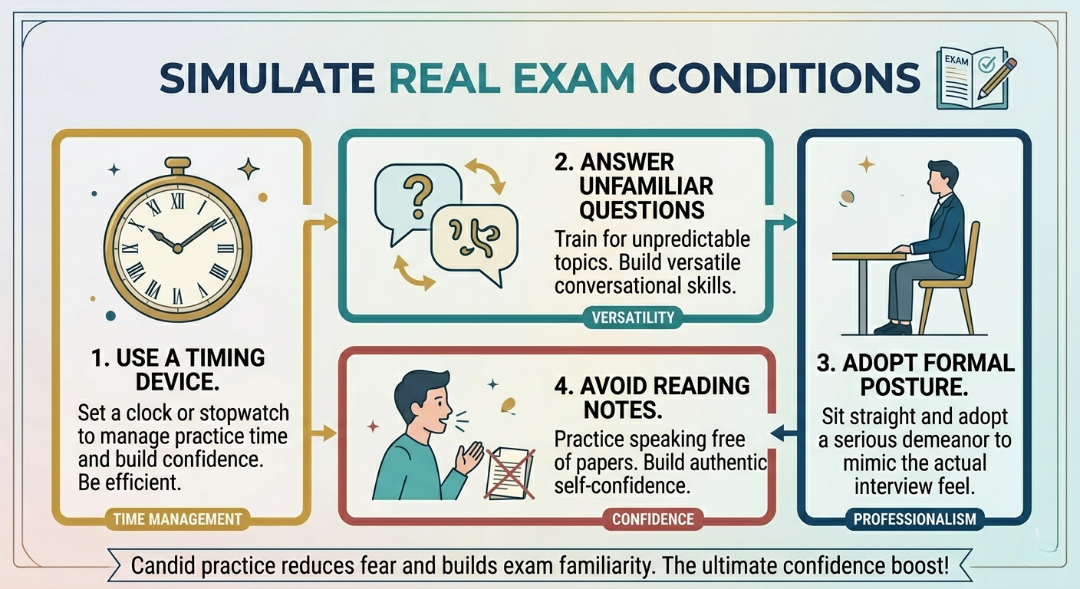
Candid IELTS speaking practice builds familiarity and reduces fear on the day of the exam.
It is among the best IELTS speaking confidence tips recommended by reputable trainers.
9. Enhance your Vocabulary Naturally.
Using complicated words is beneficial, although imposing more complex words can lower fluency.
Instead:
- Study vocabulary in a topic, rather than studying difficult words within a short period of time.
- Concentrate on the natural use of vocabulary in everyday speaking and IELTS answers.
- When conversing, use simple, clear and grammatically correct language confidently.
For example:
Instead of saying:
“International accessibility of education has been revolutionised by globalisation.”
You can say:
“Learning overseas is no longer a difficult task due to increased international options available to students.”
The recommendation of simple, clear communication is often appropriate for band 7 IELTS speaking confidence tips.
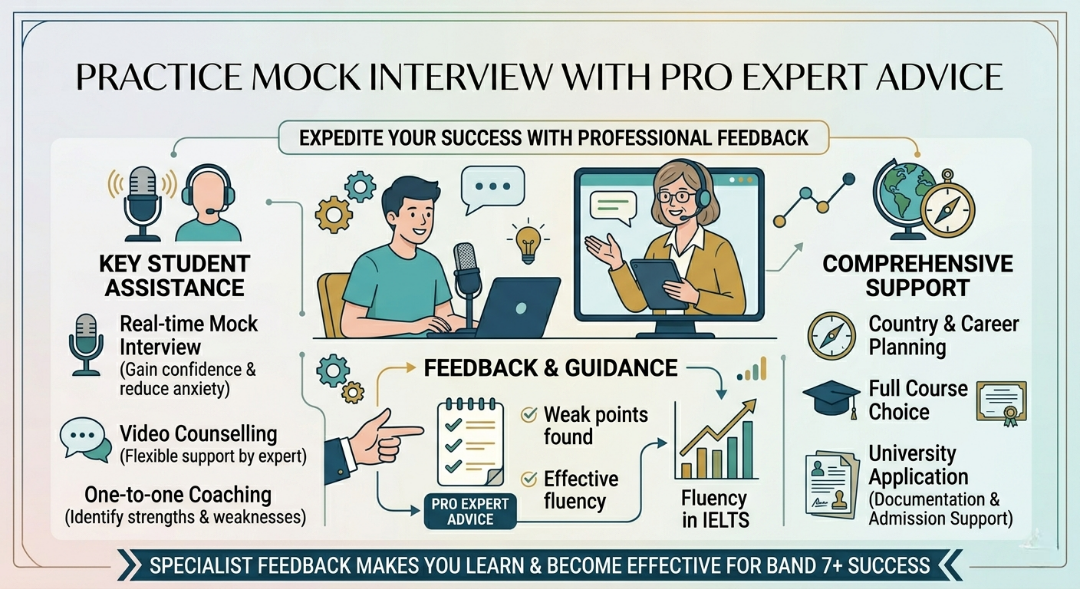
10. Practice Mock Interview with Pro Expert Advice.
It can be expedited by professional feedback.
Students at Gateway Educonnect seek assistance in the form of:
- One-to-one IELTS coaching advice on the individual strengths and weaknesses of the student.
- Individual video counselling with flexible and convenient support by the expert.
- Mock speaking interview in real-time to gain confidence and eliminate IELTS speaking anxiety.
- Full course choice, country and career planning counselling on studying abroad.
- University application support, such as documentation and admission support, through to the end.
- Feedback provided by trained specialists assists learners in finding out the weak points and learning to become more effective in terms of fluency in IELTS.
Gateway Educonnect, whose students are already spread across the United States, the United Kingdom, Canada, Australia, Germany, France, and Dubai, knows how IELTS scores can affect learners' ability to access education worldwide, with over 15 years of experience.
Daily Confidence Checklist with Introverts.
It does not take long to build confidence in IELTS speaking. A basic and uniform procedure can assist students to cope with the IELTS speaking anxiety gradually and thus gain communication skills spontaneously.
|
Time |
Daily Activity |
Purpose |
|
10 Minutes |
Listen to and read English podcasts or interviews |
Develops pronunciation, listening and sentence structures. |
|
15 Minutes |
Practice reading aloud on common IELTS topics |
Helps build fluency and gain confidence in IELTS. |
|
10 Minutes |
Document and analyse your responses |
Determines Pauses, grammatical errors, and pronunciation errors. |
|
15 Minutes |
Answer actual IELTS oral question exercises on time |
15 minutes gives familiarity with examination pressure and speeds up answering. |
|
10 Minutes |
Study and apply topic-related vocabulary to sentences |
Diversifies the vocabulary to communicate naturally and confidently. |
Check out: Boost Your PTE Score for Studying in Australia: Top Tips for Success
It is how it has to be every day, rather than spending hours at a time studying, that matters. Daily IELTS speaking practice can also help transform introverted students into more confident, exam-ready students, even in 1-hour sessions of focused practice.
How IELTS Speaking Confidence Helps Study Abroad Success
Good oratorical confidence is another way to ensure students' success in IELTS and throughout their international studies. Good communicators can readily adapt to life in foreign countries and engage better in the learning process.
Good IELTS speaking confidence has the advantages of:
- The students are more successful in university and visa interviews as they have no problem understanding questions and responding to them adequately.
- The constant IELTS speaking training will enable students to speak with ease to professors and students.
- Examining IELTS speaking anxiety will enhance confidence when it comes to making a presentation, discussing in groups, and even networking in other countries.
- Good communication will also aid part-time employment and career development in the global setting.
At Gateway Educonnect, we assist students to develop IELTS preparedness and practical communication assurance by assisting them with professional counselling, simulation interview, and customised advice on studying overseas.
FAQs
Is it possible to achieve Band 7+ in IELTS speaking by introvert’s students?
Yes. With regular IELTS speaking practice, systematic preparation and confidence aids, introvert students are capable of getting good scores.
What can I do to achieve IELTS speaking anxiety?
Regular practice in the mock test, talking to yourself every day, recording, and applying under the conditions of an exam will help you reduce IELTS speaking anxiety.
How long would it take to enhance the fluency of IELTS?
Most students start to become better after 68 weeks practice. The exercises in speaking must be done on a day by day basis so as to assist in enhancing fluency on IELTS.
What is the ideal introverted speaking practice technique for IELTS?
Solo speaking sessions, recorded mock interviews, and shadowing have been identified as the most appropriate methods (or one of the methods) to be used with introverted students.
Then, what is grammar? In comparison to fluency in IELTS speaking?
Adequate communication and fluency is vital and important. The majority of band 7 speaking strategies are concerned with the flow of conversation.
Is coaching IELTS speaking confidence?
Yes. Professional coaching offers systematic feedback, customised corrections, and realistic strategies to build IELTS speaking confidence, enhancing performance more quickly.
Conclusion
Introverted learners could have a IELTS speaking scoring 7+. Confidence is not an inborn gift, it is a process that is developed by preparing and practicing and with the right mindset.
These are the best IELTS speaking confidence tips for lowering IELTS speaking anxiety and carrying out consistent IELTS speaking practice, which will help students feel more natural and perform better on exam day.
Through specialist counselling and individual advice, Gateway Educonnect has assisted over 23,000 learners in dreaming of attaining their global education. We provide IELTS preparation, university admissions, scholarships, and visa assistance services, so our experts are available to help.
No plans to study abroad? Get Gateway Educonnect to lead you through every step. For more assistance, please visit our study abroad consultancy services and explore our wide range of offerings for students interested in studying in the USA, studying in the UK, studying in Canada, studying in Australia, studying in Ireland, and many other countries.

Author Bio
Abhinav Jain - Founder, Gateway Educonnect and Director.
B.Tech, MBA, AI and Global Education Specialist.
More than 15 years of professional experience in leading students along international routes based on politics and innovation.