02 Jun 2026 | Best IELTS Preparation Routine for Students Applying Abroad in 2026

0
87
Introduction: Best IELTS Preparation Routine for Students
If you are planning to study abroad in 2026, then you need to priorities your IELTS preparation routine. IELTS is an English proficiency examination in various countries such as the USA, UK, Canada, Australia, Germany, France and Dubai that is highly accepted. Having a good IELTS score will not only enhance admission opportunities in a college or university but also aid in scholarship and visa grants. However, not all students succeed because they do not plan and have a steady strategy when preparing. Organised routine also aids the students to build up all four modules of IELTS in a systematic manner and lessen the stress and enhance confidence. In this guide, Gateway Educonnect provides a practical daily IELTS study plan, expert-based preparation tips and an efficient IELTS preparation schedule to enable students to reach their desired target band scores successfully in 2026.
The Importance of the IELTS Preparation Routine in 2026.
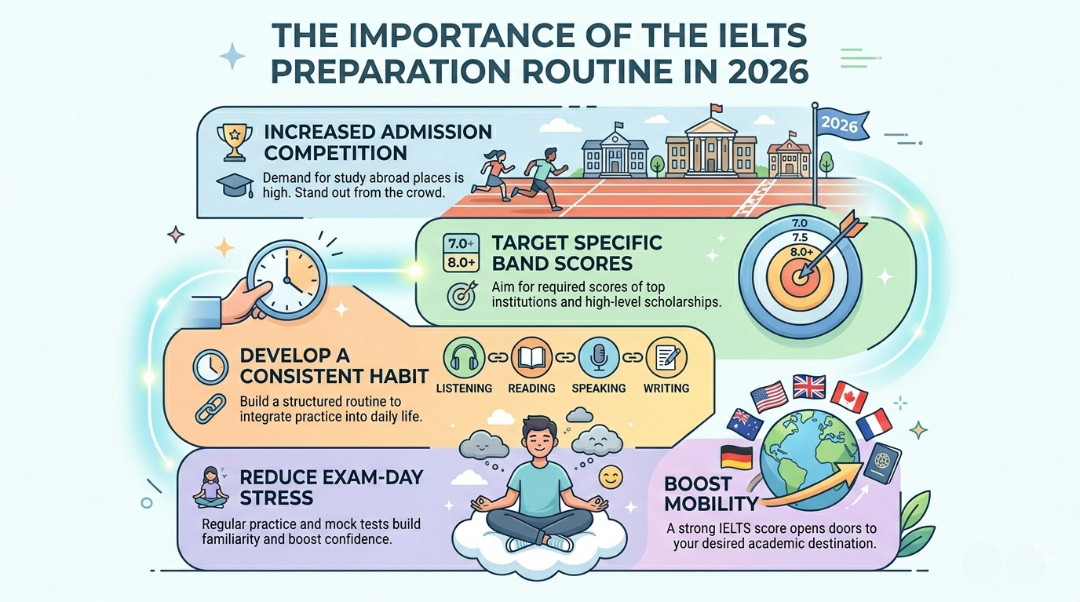
With a good IELTS preparation program, the students will be most consistent and they will not be under a lot of pressure to pass the exam and will be capable of coping with all four modules of IELTS. A student who has a properly structured plan is likely to have a better score than his counterparts who study randomly.
The competition in admissions and scholarships is going to be on the upswing in 2026. An excellent IELTS score has the capacity to enhance college application and visa acceptance opportunities.
Significant advantages of undergoing a programmed preparation regimen in IELTS.
- A timetabled study plan can assist students in enhancing regular listening, reading, writing, and speaking.
- Such a guided methodology enables students to recognise weak areas at an early stage and work towards them successfully.
- An effective IELTS study schedule will help one feel confident and less stressed on the eve of the exam.
- The structured IELTS preparation routine assists educationalists to accomplish their preparation more quickly and far more precisely.
- An intelligent preparation plan will enhance its chances of scoring Band 7 and more.
Check out: IELTS Speaking Confidence Hacks: How Introvert Students Can Score Band 7+
Best Daily IELTS Study Plan for Indian Students
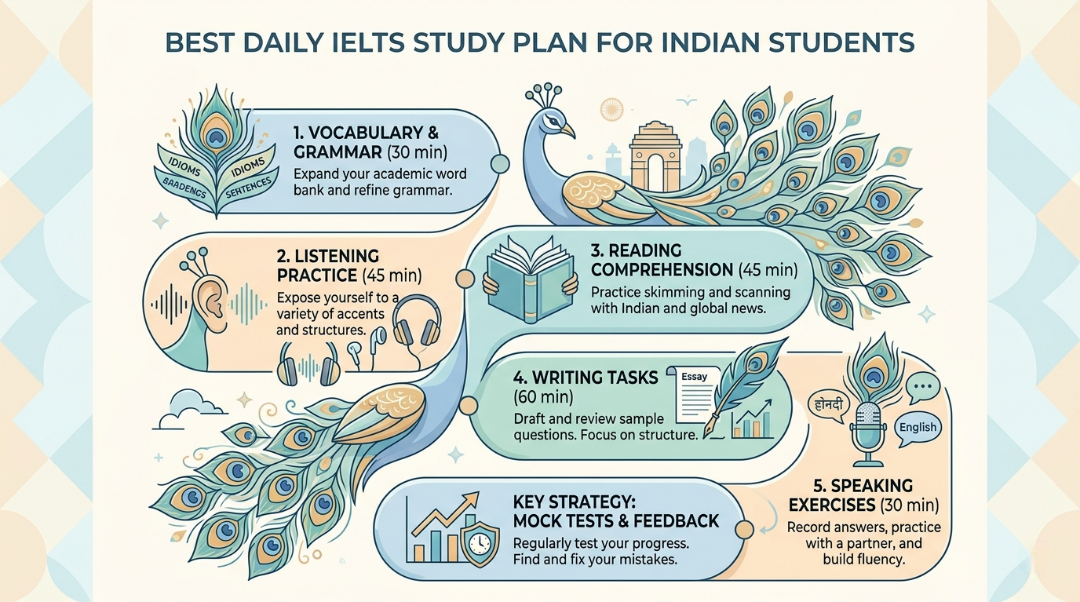
A successful daily IELTS learning strategy must aim at being consistent rather than putting in many hours of study, but unplanned. Students who are to apply to study abroad must engage in two or four hours of close studying.
|
Time Allocation |
Activities |
Key goals |
|
30 Minutes |
Vocabulary Practice |
Development of the academic vocabulary and pronunciation skills in everyday life. |
|
45 Minutes |
IELTS Reading Practice |
Increase in comprehension, skimming and scanning techniques. |
|
45 Minutes |
Listening Practice |
The comprehension of accents and the enhancement of the ability to note down. |
|
60 Minutes |
IELTS Writing Practice |
Training of the essay structure, grammar and quality of response to the assigned task. |
|
30 Minutes |
IELTS Speaking Exercise |
Effective fluency, confidence, and communication. |
|
Weekly Mock Test |
Complete IELTS Simulation |
Improving time management and performance on examinations. |
|
30 Minutes |
Vocabulary Practice |
Development of the academic vocabulary and pronunciation skills in everyday life. |
This IELTS preparation routine is suitable for school students, college students and working professionals planning to apply in 2026 in foreign countries.
Check out: Best Free IELTS Apps in 2026 for Band 7+ Preparation
Step-by-Step IELTS Study Tip to Higher Band Scores.
Following the proper IELTS study strategy also helps prepare the students and avoids confusion that the students face on the way to preparation.
1. Familiarize with IELTS Exam Pattern.
Before a student embarks on a good preparation process of IELTS, they should be aware of the proper format, the method of scoring and the type of questions posed in the exam.
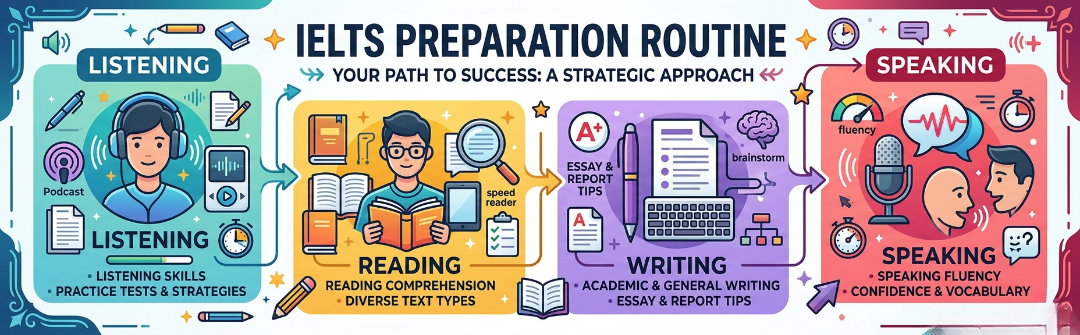
- Listening evaluates the knowledge regarding the spoken conversations and discussions in English.
- Checking reading: The skill of comprehension and the ability to analyse written academic content.
- Writing equates grammar and vocabulary, structure of sentences and organisation of the idea in response to time.
- Speaking is a test of fluency, pronunciation, confidence and communication when talking.
Knowing the exam structure assists students in developing a daily plan for IELTS study.
2. Start with a Diagnostic Mock Test.
A mock test is another important part of an effective IELTS study plan helping students to understand in what state of their success they are.
- Determine weaker areas that should be practised and improved in preparation time.
- Introduce common goal band scores in admissions to universities and scholarships in foreign countries.
- Design a point-making IELTS preparation routine, depending on strong areas and weak areas.
In our case, students with a low Speaking proficiency ought to devote more time to the speaking practice sessions each day.
3. Develop Vocabulary by Practical Usage.
The formation of vocabulary lies at the core of the sound IELTS preparation routine program, since vocabulary plays a role in all modules of IELTS.
- Read academic articles, blogs, and news to ensure that one develops the most relevant vocabulary in a natural and effective way.
- Get a vocabulary notebook containing synonyms, sentence example, and meaning which should be regularly used.
- Watch English interviews and educational videos to have a better listening comprehension and use of practical words.
- To memorise and be more confident in using the new vocabulary words, practice the new vocabulary in speaking and writing.
The naturalistic practice will enhance fluency without developing undue pressure in terms of preparation.
🌍 Looking for flexible learning opportunities from leading international institutions? Browse the latest programs at Gateway Educonnect Online Courses.
IELTS Preparation for Beginners: Complete Starting Guide
Most of the students are just left confused with starting IELTS preparation routine among beginners due to a lack of knowledge on the exam format and how to prepare. The most reasonable way is to start with small steps and easy attainable targets.
Start developing the Basic English competency.
- The initial step that the students need to undertake is to enhance the basic aspects of language, such as grammar, vocabulary, listening, reading and talking.
- Frequently check and test your grammar and sentence correctors to improve your writing and communication.
- Listening to English podcasts and listening to interviews every day to enhance the level of understanding and the pronunciation comes easily.
- Regularly reading short articles to improve vocabulary, familiarity and knowledge of the structure of the sentence.
- Using English to communicate with mentors and friends and gain fluency and confidence while speaking.
Relied on IELTS Preparation Materials.
High-quality material is essential in effective IELTS training among beginners since quality materials enhance the accuracy and confidence in preparation.
- Cambridge IELTS books of official style practice and a realistic level of the exam.
- Authentic study resources and helpful IELTS preparation routine tips at the British Council.
- IELTS Liz and other reputable sites to get writing samples, speaking hints, and how to prepare.
IELTS mock exams to familiarise the individual with the exam pressure, and to overall improve performance at ease.
Develop an IELTS Preparation Timetable.
First-time students are advised to adhere to a simple and pragmatic IELTS preparation routine as opposed to trying to prepare at an advanced level.
Proposed Advanced Level Study Plan.
|
Weeks |
Areas |
Goals |
|
Week 1 |
Learning IELTS Structure |
Knowing both the exam format, scoring system and questions in the exam. |
|
Week 2 |
Listening and Reading Practice |
Increasing understanding, vocabulary and comprehension of various question types. |
|
Week 3 |
Practical Speaking sessions |
Develop pronunciation confidence, natural conversation, and fluency. |
|
Week 4 |
Practice writing sessions |
Learn to write an essay, grammar, and how to organise answers. |
|
Week 5 |
Complete Mock Exam Periods |
Better time management, accuracy, and focusing on weak areas. |
|
Week 6 |
Revision and Performance Analysis |
Reviewing errors, working on areas to improve, and increasing confidence in exams in general. |
|
Week 1 |
Learning IELTS Structure |
Knowing both the exam format, scoring system and questions in the exam. |
This slow learning approach, or means, makes the IELTS preparation routine among beginners far less hectic and manageable.
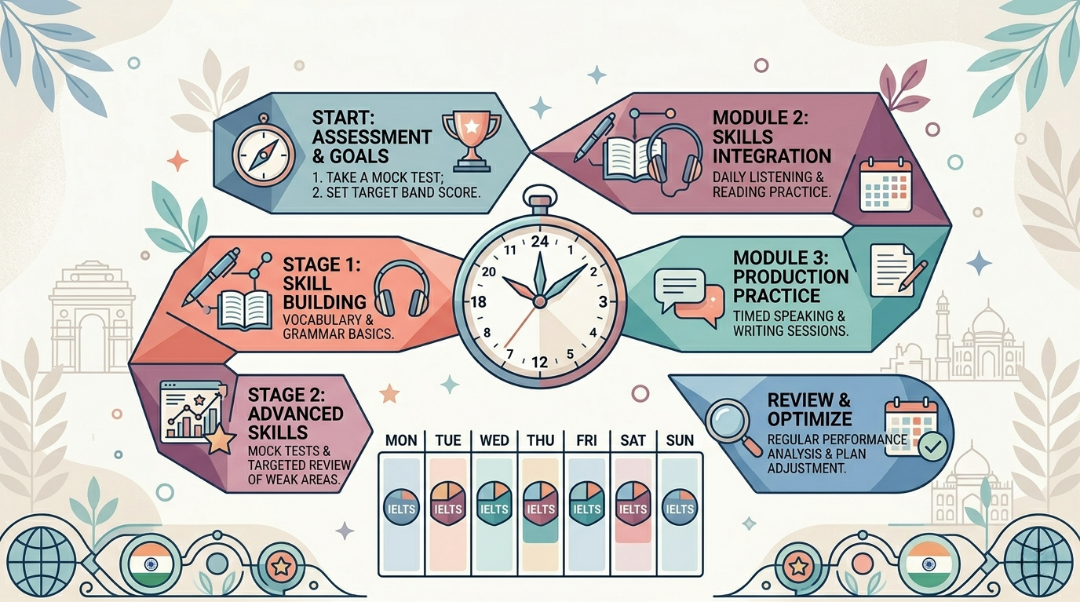
What Is the Duration of Preparation for IELTS?
The average length of preparation is for the majority of students.
- It normally takes four to six months of guided training before beginners can score with the confidence and consistency of the competitive IELTS scores.
- The intermediate-level students may need two or three months of specialised training and mock test pre-training lessons.
- In the case of advanced English users, it can take them four to six weeks to reach their target scores with the help of comprehensive preparation and practicality.
Regular discipline in a daily IELTS study schedule and on a weekly basis, with mock testing and expert feedback, is necessary among students who aspire to study in some of the best universities across the globe.
Common Mistakes to Avoid When Preparing for the IELTS.
The IELTS preparation routinen usually followed by many students is not enough to help them succeed due to the typical errors in its preparation. These mistakes can be avoided to increase scores and enhance preparation.
- Neglecting time management when practising can cause stressful situations in the real IELTS test.
- Learning speaking and writing answers decreases native communication and negatively impacts overall performance.
- Concentrating on strong areas and neglecting weak areas makes the preparative process skewed.
- An irregular everyday IELTS study schedule frequently results in deficient preparation and terrible revision.
- Frequent avoidance of mock tests influences the level of confidence, speed, and general readiness to test significantly.
- Combining too many study materials confuses one and compromises the general IELTS study plan.
These are the errors that can be prevented using a smart and continuous IELTS preparation routine, which will enable students to score higher band scores without embarrassment.
The Real-Life Tips to Reach IELTS Scores.
Individuals who want to achieve better scores and are keen on getting improved results quickly are also encouraged to focus on smart preparation as opposed to putting more hours in studying.
- Daily reading of English newspapers enhances reading, comprehension skills, understanding of sentence structure, and the use of elaborate vocabulary automatically, with time.
- Projection of English documentaries and interviews is particularly useful in making the students familiar with the foreign accent, besides enhancing listening focus to a significant level.
- The training of writing activities in time duration conditions enhances speed, clarity, grammatical accuracy and the logical organisation of ideas, at all times.
- With a realistic IELTS preparation routine, there would be balanced preparation without burnout or unnecessarily imposed academic pressure on students on a regular basis.
- Conducting weekly mock tests will assist students to open areas of preparation and enhance time management practice prior to the actual test.
A proper preparation schedule will not only avoid unscrupulous studying, but assist efficiently the preparation act.
FAQs
How many hours are the students advised to study per day to take the IELTS?
A realistic daily IELTS schedule of study will consist of two/four hours of research, targeting the current level of competence in English and the envisaged band scores.
Is it difficult for beginners with IELTS preparation?
No, getting ready to take IELTS as a beginner will be possible when they follow good Timetables of studying and use good preparation tools so that they could achieve the task.
What is the optimum IELTS planning timeline of students who will be applying in 2026 to study abroad?
An effective prototype of IELT schedule will entail day-to-day practising, vocabulary practise, weekly practice tests and the equal practising in all the four elements of IELTS.
Is it possible to prepare for IELTS at home?
Yes, having a clever IELTS study plan, practice tests and daily practice at home students will be prepared to pass in their exams.
What is the most difficult IELTS among Indian students?
The writing module is challenging to most Indian students since it entails good grammar, vocabulary, structure and organisation of ideas skills.
Conclusion
A thoughtful and well-informed IELTS training program can help raise the likelihood of a student studying abroad significantly by 2026. Those students who adhere to regular daily IELTS preparation routine, an achievable IELTS preparation schedule and a realistic IELTS study plan tend to score higher with minimal stress and high confidence. Starting at the bottom, or aiming to improve a stronger band score, proper training and professional instruction will always help a great deal.
Gateway Educonnect has assisted over 23,000 students in realising international education success in countries such as the USA, UK, Canada, Australia, Germany, France and Dubai. We offer guidance to students on all levels of the study abroad process, including University application and scholarships, accommodation, loans, visas, and counselling services. For more assistance, please visit our study abroad consultancy services and explore our wide range of offerings for students interested in studying in the USA, studying in the UK, studying in Canada, studying in Australia, studying in Ireland, and many other countries.

Author Bio
Abhinav Jain - Founder, Gateway Educonnect and Director.
B.Tech, MBA, AI and Global Education Specialist.
More than 15 years of professional experience in leading students along international routes based on politics and innovation.