
02 Jun 2026 | IELTS Speaking Follow-Up Questions 2026: What Examiners Really Expect

0
62
Introduction
Most of the students find themselves very confident when dealing with simple IELTS Speaking questions but when the examiner requires them to discuss in-depth questions in Part 3, the students will have difficulties. These IELTS speaking follow-up questions normally challenge the ability of the students to speak easily, using their imagination and continue with conversations under pressure. By 2026, the emphasis of the examiners will be on the clarity of the communication, logic, and fluency rather than on the memorized answers or hard-to-pronounce words only. Students who would know how to develop answers merely tend to score higher in IELTS speaking part 3. This guide, published by Gateway Educonnect, identifies what examiners do actually expect, pitfalls to avoid by students, and the real world tips that can be followed to enhance follow-up question responses to generate confidence. By Explicitly preparing the IELTS Speaking test and practicing, students will be in position to be fluent and are better people during the test.
Why are IELTS Speaking Follow-Up Questions Challenging?
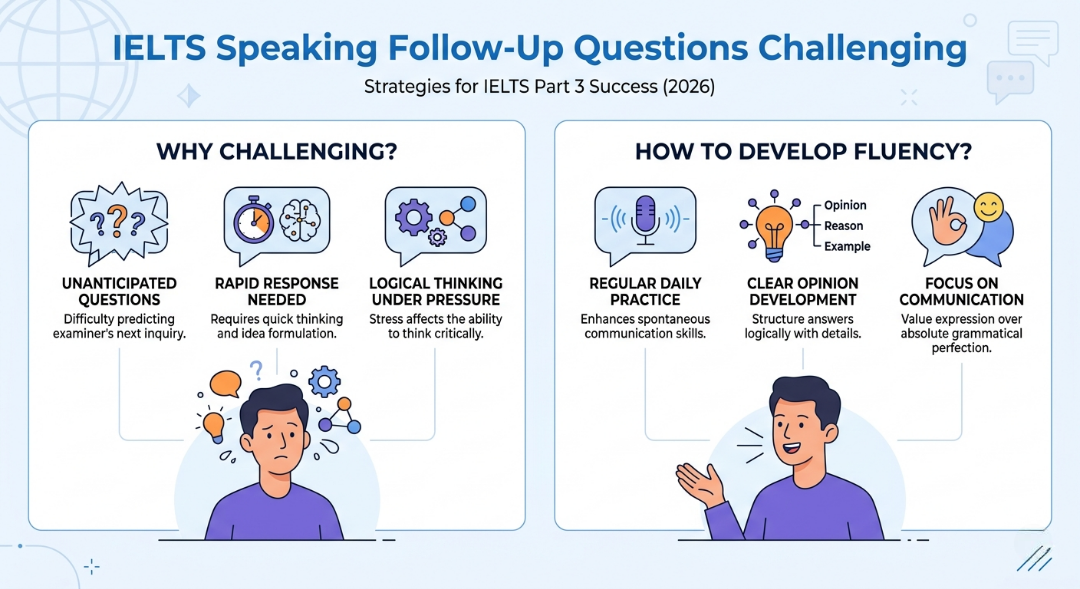
Students find it difficult to cope with the IELTS speaking follow-up questions in the speaking part, as such discussions involve natural communication and explanation.
There are several reasons why this section is problematic:
Many students lose their minds in the IELTS speaking part 3 because they cannot anticipate the next question the examiner may ask.
- There are those applicants who have strong grammar skills but fail to build quick follow-up question responses.
- Learners tend to study templates, thus implying that unnatural communication is formed in actual conversation.
- Minimal preparation in malleable IELTS speaking concepts tends to enhance stuttering and anxiety at the time of interviews.
- The negative impact of fear of errors is on both the spontaneous and deliberate fluency and confidence in longer speaking conversations.
Regular speaking practice (lessons) and attention to communication, not perfection, are the practices that tend to make students better at performing during IELTS speaking follow-up questions.
Check out: Understanding the IELTS Exam: Format and Structure
IELTS Speaking Following Questions?
During the IELTS Speaking test, follow-up questions always come up in Part 3 of the interview. In the examiner's role, once the cue card questions are completed, the examiner will pose general discussion questions on the same topic. The above questions are a test of confidence that allows students to discuss opinions, generate ideas, and keep conversations flowing.
As an example, should your cue card subject be that of travel, the examiner might question:
- What is the reason why people like international travel?
- Should students take the journey to other countries to study?
- What has happened to tourism in the past years?
Part 3 of the IELTS speaking test is more concerned with critical thinking, clarity and logical explanations as opposed to part 1 questions. Well-articulated responses to follow-up questions tend to have opinions, reasons and practical examples inherently.
What IELTS Speaking Part 3 Means to your Band Score.
IELTS speaking part 3 is undermined by many students, yet this part is influential with regard to the final scoring of speaking. In longer discussions, examiners test fluency, vocabulary, pronunciation and feel confident in communicating.
Good results in IELTS speaking follow-up questions help students automatically work on crucial scoring areas.
|
Speaking Requirement |
What Examiners Assess? |
|
Lexical Resource |
Words should be pertinent and sound in speech. |
|
Accurate grammar |
It is expected that students use adequate, concise sentence structures. |
|
Fluency and Coherence |
Students ought to speak fluently without necessarily needing much time or losing track. |
|
Pronunciation |
Patterns Speaking should be easily comprehensible to the examiners. |
- Effective confidence and fluency can be displayed through clear communication within the context of speaking part 3 of IELTS.
- Formulated follow-up question answers are an answer to better coherence and logical performance of speaking.
- Knowing about the official speaking band descriptors allows students to concentrate on realistic improvements in speaking.
- Fluent IELTS speaking concepts enable students to keep chatting without trembling with self-confidence.
What Examiners Really Expect in 2026?
IELTS examiners are paying more attention to natural communication, as opposed to memorized answers in 2026. Usually, students articulate ideas in a clear way and become confident and effective speakers in IELTS speaking follow up questions, which leads to higher scores.
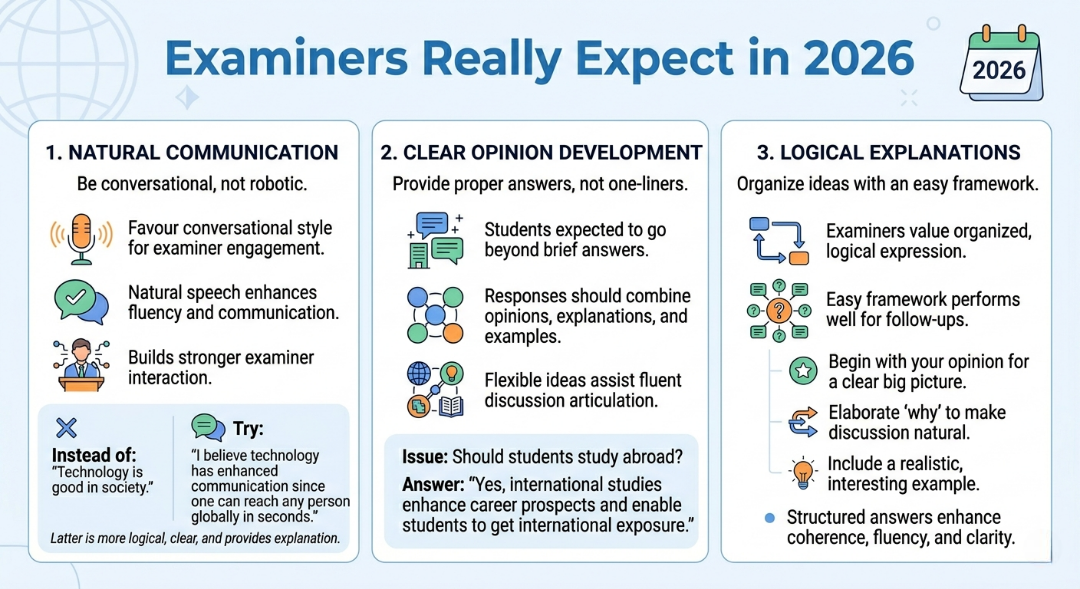
Natural Communication
Examiners favour students who are conversational rather than robotic when speaking.
- Natural speaking in the IELTS speaking follow-up questions enhances fluency and communication excellently.
- The assurance in communication within the IELTS speaking part 3 is more likely to build stronger examiner engagement.
For Instance
Instead of saying:
Technology is good in society.
Try saying:
“I believe that the technology has enhanced communication since, in a few seconds, one can reach any person anywhere across the world.”
The latter reply is more logical, as it describes the concept more clearly and offers a feasible explanation.
Check out: Best Free IELTS Apps in 2026 for Band 7+ Preparation
Clear Opinion Development
The students are expected to provide proper answers rather than a one-line answer.
- Powerful follow-up question responses tend to contain opinions, explanations and practical examples in combination.
- Flexible IELTS speaking ideas assist students to articulate ideas more fluently in the form of discussions.
For Instance
Issue: Should students study abroad?
Answer:
“Yes, international studies enhance career prospects and enable students to get international exposure.”
Logical Explanations
The examiners expect students to be able to organise ideas in an organised way during IELTS speaking follow-up questions.
An easy framework will tend to perform well with IELTS speaking follow-up queries:
- Begin with your opinion so that the examiner can easily get the big picture.
- Elaborate on why you gave your response to make the discussion flow naturally and confidently.
- Include a practical, realistic and interesting example to make your answer more interesting and practical.
- Prepared answers in part 3 of the IELTS speaking test enhance the sense of coherence, fluency, and clarity in communication.
- Follow-up questions are logical responses to queries that allow the examiners to follow through with your thoughts without discomfort in speaking discussions.
Most Common IELTS Speaking Follow up Questions
Knowing the patterns of common questions can assist students to plan better IELTS speaking ideas in advance of the test. In IELTS speaking part 3, the tests normally involve opinion-based questions, comparison questions, prediction questions and analytical questions to assess the confidence and logical reasoning ability in the process of communication.
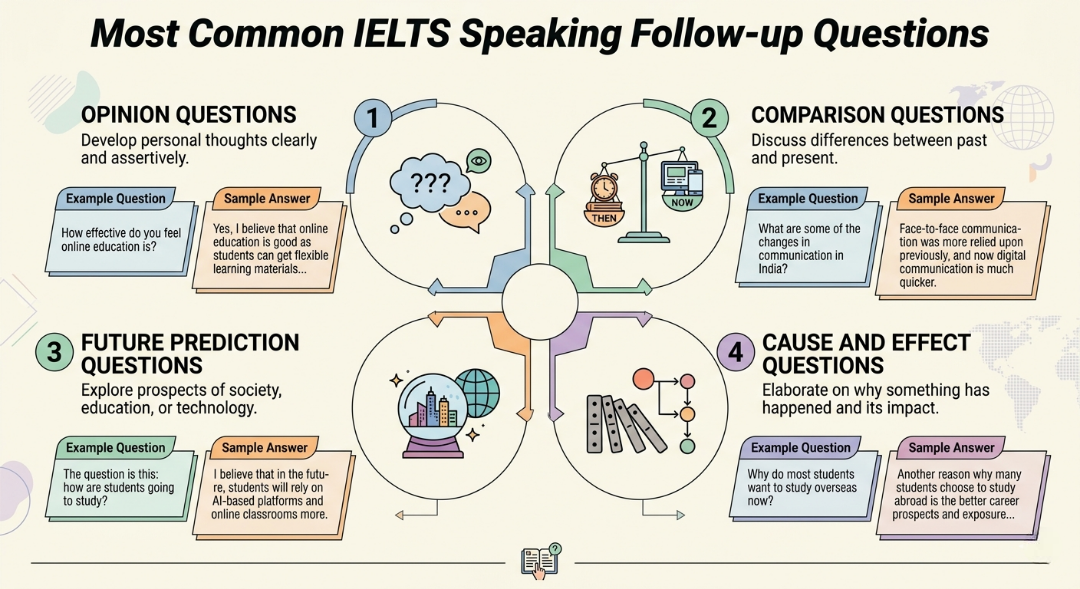
Opinion Questions
The opinion-based questions involve the learners developing personal thoughts articulately and assertively when approaching a problem.
For Instance
How effective do you feel online education is?
Sample Answer
“Yes, I believe that online education is good as students can get flexible learning materials from anywhere around the world.”
- The follow-up questions based on opinion answers on follow-ups should not give one-liner answers, but clarify their views.
- Students who provide support for their opinions by examples tend to do well when they are asked to provide more on their responses in IELTS speaking follow-up questions.
Check out: All You Need to Know About Cracking the Language Proficiency Tests for Abroad Study
Comparison Questions
Comparison questions involve the student in discussing differences between the past and the present.
For Instance
What are some of the changes in communication in India?
Sample Answer
“Face-to-face communication was more relied upon previously, and now digital communication is much quicker.”
- IELTS speaking follow-up questions based on comparison are a good way of testing the vocabulary flexibility and logicality of communication.
- Comparison-induced IELTS speaking ideas training enables students to arrange ideas in a design mode when engaging in conversations.
Future Prediction Questions
They are questions about the future and the prospects of society, education, or technology.
For Instance
The question is this: how are students going to study?
Sample Answer
“I believe that in the future, students will rely on AI-based platforms and online classrooms more.”
- Answers to future-oriented follow-up questions can assist examiners in assessing critical thinking and confidence in communication in a natural manner.
- Students who train about future-related IELTS speaking ideas tend to approach unforeseen discussions with ease.
Cause and Effect Questions.
These questions require students to elaborate on and discuss why something has happened and how it would affect them.
For Instance
Why do most students want to study overseas now?
Sample Answer
“Another reason why many students choose to study abroad is the better career prospects and exposure which international education is likely to accord them.”
- The causes and effects IELTS speaking follow-up questions would require the learners to make logical explanations using clear reasoning on the ideas.
- Planned answers in part 3 of the IELTS speaking also enhance fluency, coherence, and organisation of speech.
Most Effective Strategy to Easiest Answer Follow-Up Questions.
Many students lose IELTS speaking follow-up questions due to an emphasis on vocabulary rather than the quality of communication.
Apply the Opinion + Reason + Example Method.
The approach will assist students in formulating follow-up question answers that are natural and well-structured, without undue difficulty.
The most basic design is effective:
- Begin with an opinion of your own that the examiner can easily grasp the main idea you have to say.
- Justify why you think this by establishing a natural and comfortable flow of the conversation.
- Include a pertinent example to make your response sound more authentic and interesting.
For Instance
Issue: Can technology be useful in education?
Answer:
“Yes, I believe that technology can be helpful in education, as through it, students can access learning resources available online with ease. Indicatively, a large number of students have shifted to taking international classes online.”
Ordered answers in the IELTS speaking part 3 enhance fluency, coherence, and the clarity of communication, all subconsciously.
The answers to logical follow-up questions facilitate easier conversations between examiners and help them grasp concepts.
Avoid Memorised Answers
Memorising responses tends to be unnatural in natural speaking conversations.
- Elastic IELTS speaking concepts enable pupils to respond to unanticipated queries with more certainty and naturalness.
- The process of natural communication in IELTS speaking follow-up questions enhances speaking fluency and the interest of the examiner.
- Conversational students tend to achieve more than those who have pre-programmed talking scripts.
Practice Speaking Daily
Speaking daily enhances fluency and confidence in communication.
- Drilling practice on IELTS speaking follow-up questions enhances confidence and clarity in speaking effortlessly.
- Practising question answers as part of a daily follow-up will also enable the students to minimise nervousness at the speaking interview.
- Regular practice of various IELTS speaking concepts can enhance the flexibility in unexpected conversations.
Concentrate on Communication rather than Perfection.
Most students get too concerned about grammar mistakes when speaking in interviews.
- Effective communication in the IELTS speaking part 3 is more important than accuracy in perfect grammar.
- The theorists who seem to express ideas fluently tend to come out much better and more confident when being interviewed.
- Uncomplex and straightforward follow-up question answers tend to be more efficient than too complex ones.
Check out: IELTS Speaking Confidence Hacks: How Introvert Students Can Score Band 7+
Follow-Up Questions IELTS Speaking with Smart Answers.
When it comes to IELTS speaking follow-up questions, many students do not comprehend the extent or length of their responses. To express your concepts in a natural manner using simple reasons and examples is what the goal is not to provide absolute answers but do so.
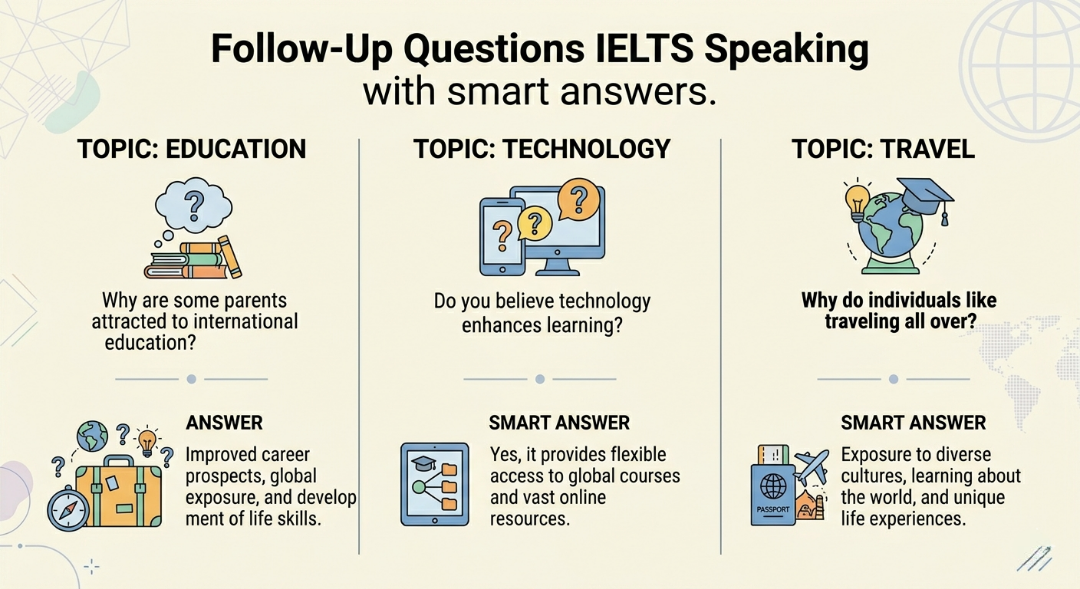
Topic: Education
Issue: What is the reason why parents are today attracted to international education?
This might have a good response:
“Most of the parents tend to prefer international education due to improved career prospects and providing exposure to the world. Learners also learn to communicate and become more autonomous when studying overseas.”
This response is effective because it explains the reason rather than offering only a brief opinion.
Topic: Technology
Issue: Do you believe technology enhances learning?
What may be a natural reaction would be:?
“Yes, learning has been enhanced by the availability of online courses, online libraries and global educational sites where one can access online education from anywhere.”
This kind of response is more conversational when discussing in the IELTS Part 3 speaking.
Topic: Travel
Issue: Why do individuals like travelling all over?
The way you can answer is you can say:
“International travel is good because, people get exposed to diverse cultures, they get to interact with new people and they also get more knowledge about the world in a more practical manner.”
Examples such as this are simple explanations which enhance fluency in the process of IELTS speaking follow-up questions.
🌍 Looking for flexible learning opportunities from leading international institutions? Browse the latest programs at Gateway Educonnect Online Courses.
The Benefits of Gateway Educonnect to IELTS Aspirants.
Gateway Educonnect helps students improve their IELTS speaking by focusing on IELTS and study-abroad advice.
Students are assisted with:
- IELTS training tips and practice on speech to enhance grade in the course of the IELTS speaking part three discussion.
- Individual student and career-focused counselling sessions, either at home or video-based.
- Financial aid in education loans, housing and guidance in scholarships to study in a foreign country at a low cost.
- Flexible practice sessions with practical IELTS speaking ideas and structured speaking strategies.
The simplified admission process through Gateway Educonnect also allows students to have an instant offer letter and cashback offers of up to 2499.
Check out: 30-Day Free IELTS Study Plan to Score 7+ Band at Home
FAQs
What are IELTS speaking follow-up questions?
These comprise questions that are discussed in the IELTS speaking part 3 format, immediately after the cue card section.
Why is part 3 of the IELTS speaking challenging?
Due to the IELTS speaking following questions, many students are unable to live up to the expectation of spontaneous communication and explanations.
What can I do to better follow up questions?
Fluency and confidence of communication are acquired through frequent speaking and the pliable IELTS speaking concepts.
Are speaking band descriptors important?
Yes, this form of official speaking band requires the evaluation of fluency, vocabulary, grammar and pronunciation in the speaking test.
Are IELTS speaking answers to memorise?
No, memorised answers to follow-up questions are unnatural and lower the quality of communication in interviews.
Conclusion
To achieve good results in IELTS speaking follow-up questions, understanding how to answer all types of questions correctly is more than mere memorisation of phrases or studying hard words. Examiners anticipate that in 2026, students will discuss fluently, present ideas coherently, and continue discussions without intimidation in the IELTS speaking part 3 test. Students who are oriented toward fluency, logical explanations, and practical examples tend to score higher when speaking. Flexible IELTS speaking ideas often help students feel comfortable in unpredictable conversations, which can be practised regularly. Knowledge of official speaking band descriptors enables speakers who want to improve their communication skills to do so more effectively. Planning to study abroad and require professional IELTS advice, university application advice, scholarships, and visa advice? With our full support and professional assistance, Gateway Educonnect can help you start your international journey to study the right way, with the right support and guidance. For more assistance, please visit our study abroad consultancy services and explore our wide range of offerings for students interested in studying in the USA, studying in the UK, studying in Canada, studying in Australia, studying in Ireland, and many other countries.

Author Bio
Abhinav Jain - Founder, Gateway Educonnect and Director.
B.Tech, MBA, AI and Global Education Specialist.
More than 15 years of professional experience in leading students along international routes based on politics and innovation.