28 Sep 2026 | Work and Career After Study in Ireland 2027-28: Complete Guide for Indian Students

0
18
Introduction
For Indian master’s students planning post-study work, employment permits and long-term career options in Ireland.
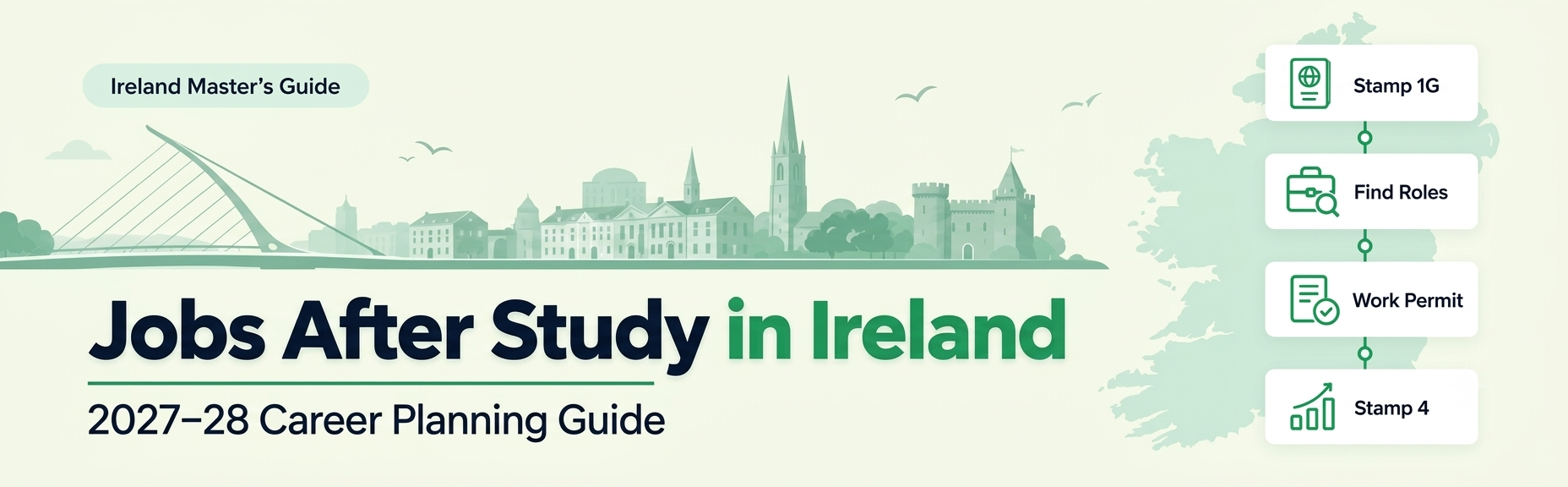
For students researching jobs after study in Ireland Indian students, the current route starts with Ireland’s Third Level Graduate Programme. Graduates with Eligibility Level 9 can be issued Stamp 1G during 12 months and may have an extension of 12 months provided they meet the renewal requirements and prove themselves to be acting appropriately in attempting graduate-level jobs.
This guide explains how that graduate period connects with career demand, employment permits, salary evidence and longer-term immigration planning. Students still deciding what to study should first understand how course choice connects with employability through Gateway EduConnect’s guide to choosing the right course abroad.
In this Guide
- Stamp 1G after a master’s degree
- Jobs and sectors showing current shortage signals
- Critical Skills and General Employment Permits
- Graduate employment and salary evidence
- Career-readiness checks before accepting an offer
- Job-search strategy
- Stamp 4 and longer-term planning
- Common mistakes and FAQs
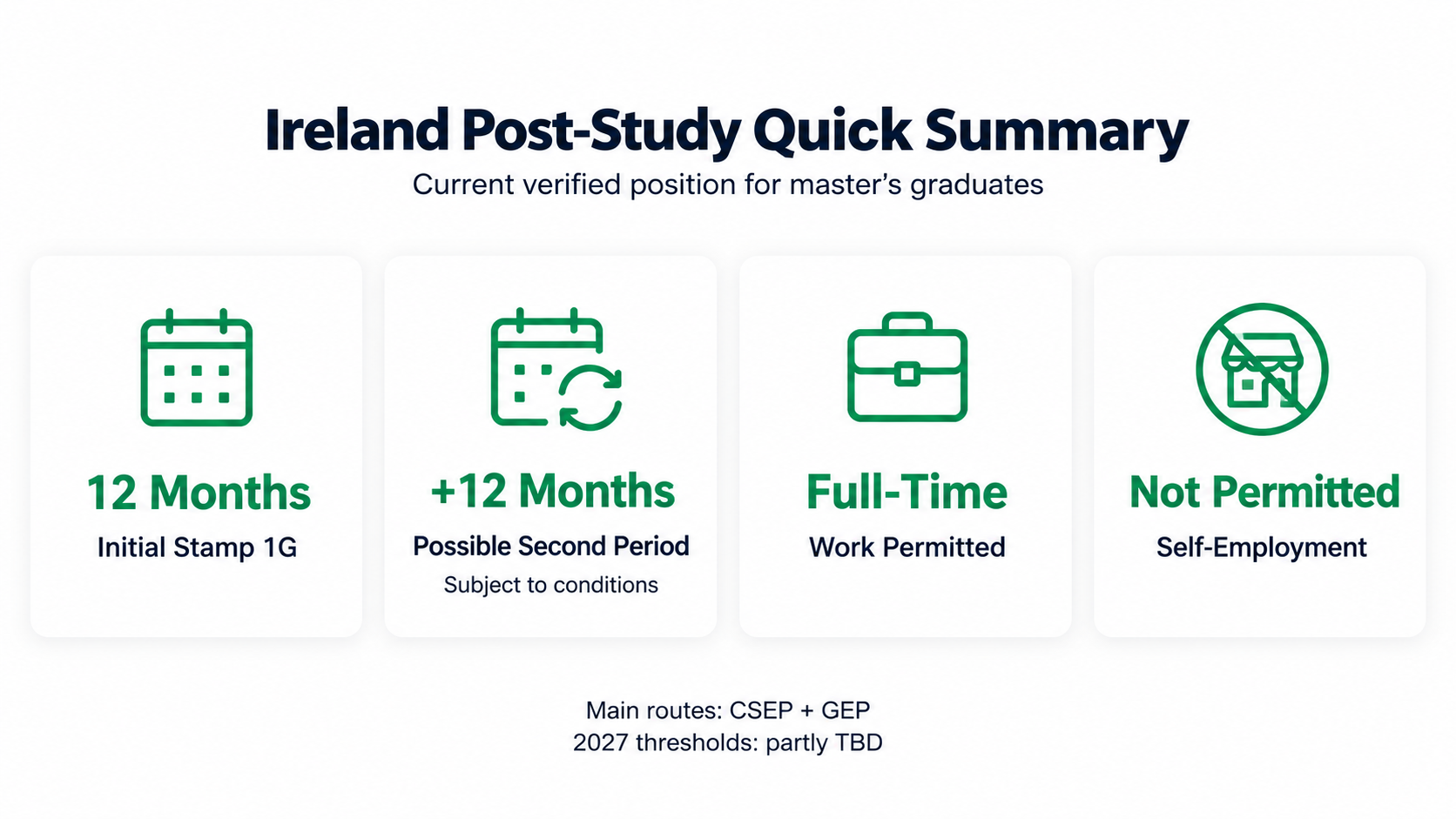
Jobs after Study in Ireland for Indian students: Quick Summary
|
Question |
Current verified position |
|
Initial graduate permission |
12 months on Stamp 1G for eligible Level 9+ graduates |
|
Possible second period |
Further 12 months, subject to conditions |
|
Full-time work |
Permitted on graduate Stamp 1G |
|
Self-employment |
Not permitted |
|
Exact 2027 salary thresholds |
Several remain TBD or index-linked |
|
Main employment-permit routes |
Critical Skills Greetings Permit and General Greetings Permit. |
The key point for jobs after study in Ireland Indian students is that Stamp 1G and an employment permit are not the same thing. Stamp 1G gives eligible graduates time to seek suitable work; continuing beyond it usually requires another qualifying permission.
Can Indian Master’s Students stay in Ireland after Graduation?
Yes, if they satisfy the Third Level Graduate Programme conditions.
Ireland’s Immigration Service states that eligible Irish-educated non-EEA graduates with qualifying Level 8 or Level 9 awards can remain after study for 12 months. For master’s graduates, a further 12 months can be provided subject to conditions. Applicants must hold current Stamp 2 permission and apply within six months of being notified that they achieved their award.
Students often search for post study work visa Ireland, but Stamp 1G is more accurately an immigration permission under the Third Level Graduate Programme.
For jobs after study in Ireland Indian students, this difference matters because the graduate period is temporary. Its purpose is to help eligible graduates seek graduate-level employment and, where possible, move to a General Employment Permit, Critical Skills Employment Permit or another qualifying route.
Students preparing for a master’s abroad can also use Gateway EduConnect’s study abroad after graduation guide to structure course, country and application decisions before reaching the career-planning stage.
What can you do on Stamp 1G?
Graduate Stamp 1G allows full-time work in accordance with employment law. However, graduates cannot operate a business or be self-employed under this permission. Read the official Stamp 1G conditions
That makes the post study work visa Ireland period useful for:
- applying for graduate-level roles;
- gaining relevant employment experience;
- identifying whether a role fits Ireland’s permit system;
- preparing for a CSEP or GEP application where eligible.
For jobs after study in Ireland Indian students, students should start checking employment-permit eligibility before Stamp 1G approaches expiry, not after receiving a random job offer.
Which Jobs Currently show Strong Demand or Shortages?
There is no Irish government list literally called high demand jobs in Ireland for international students. A more reliable approach is to combine labour-market shortage evidence from SOLAS with Ireland’s official occupation lists.
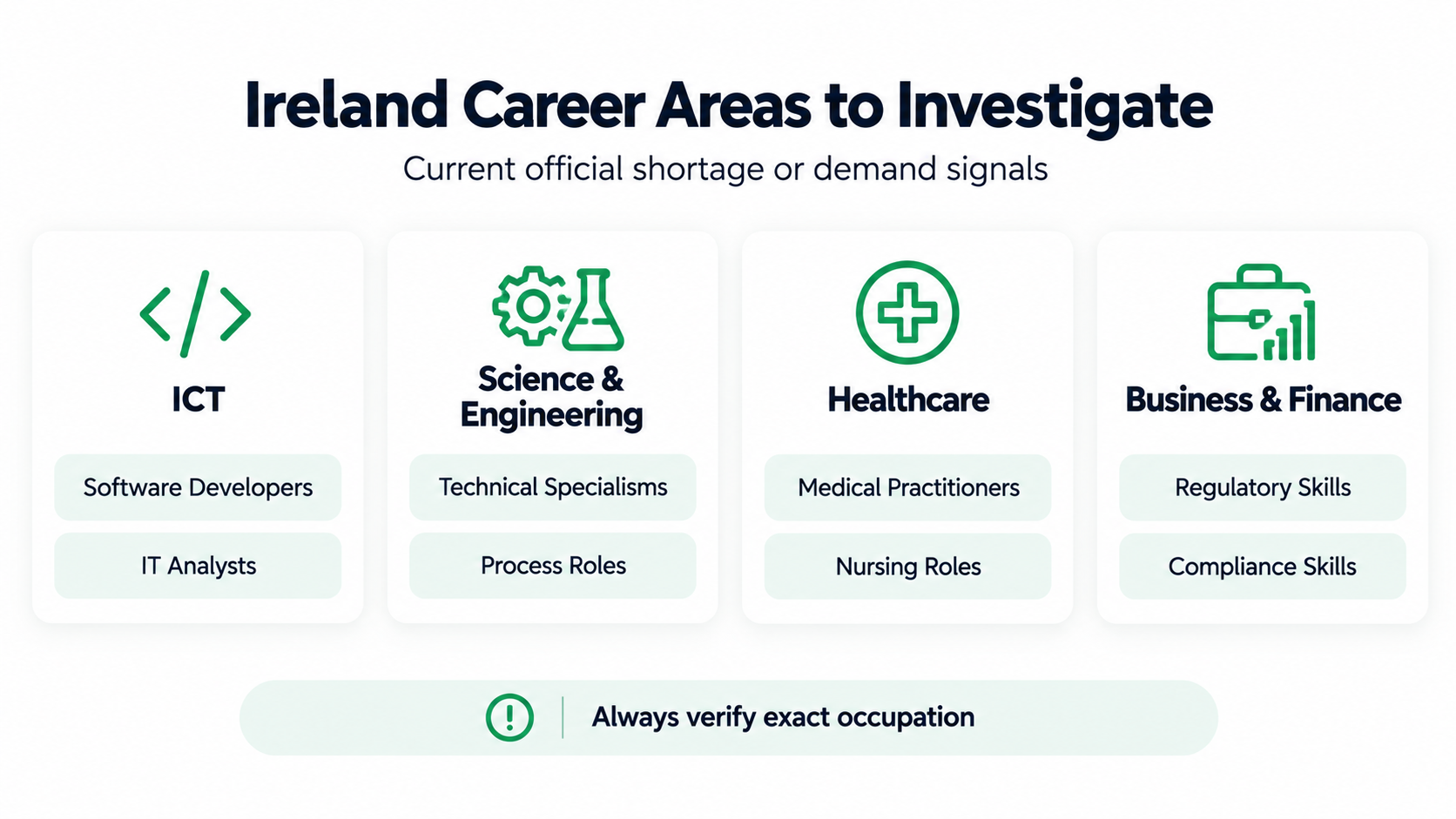
SOLAS’s National Skills Bulletin identifies areas of skills demand and occupations that can be difficult to fill. Its ICT analysis specifically identifies shortages for software developers/engineers and IT analysts/engineers. Explore the SOLAS National Skills Bulletin 2025
Check out: Documents Required to Study Abroad 2026-27: Complete Guide for Indian Students
Current areas worth investigating
|
Area |
Current official signals |
What students should verify |
|
ICT |
Software development and IT analysis shortages |
Exact occupation and specialism |
|
Science & engineering |
Demand across several technical specialisms |
Degree relevance and permit category |
|
Healthcare |
Shortages in selected professional occupations |
Professional registration and permit rules |
|
Business & finance |
Demand for specialised technical, regulatory and compliance skills |
Exact role rather than broad sector name |
|
Construction |
Shortages in selected professional and skilled occupations |
Occupation-list eligibility |
SOLAS reports that business and financial employers continue to seek technical skills, including AI, machine learning, cybersecurity, regulatory, compliance and sustainable-finance capabilities.
For students researching high demand jobs in Ireland for international students, the next step is checking the exact role against the Critical Skills Occupations List. The current list took effect on 13 May 2026 and makes clear that certain broader occupations qualify only where specific capabilities or specialisms apply.
For jobs after study in Ireland Indian students, “technology”, “finance” or “engineering” alone is therefore too broad. The precise occupation matters.
Check out: Free IELTS Speaking Topics with Sample Answers (Band 7+)
Which Employment Permits Matter after Stamp 1G?
The two routes most relevant to many graduates are:
- Critical Skills Employment Permit (CSEP)
- General Employment Permit (GEP)
Current permit thresholds
|
Permit category |
Current 2026 figure |
January 2027 position |
|
Standard GEP |
€36,605 |
TBD |
|
GEP Irish Graduate |
€34,009 |
Index-linked |
|
CSEP with relevant degree |
€40,904 |
TBD |
|
Critical Skills Graduate |
€36,848 |
Index-linked |
|
CSEP without relevant degree |
€68,911 |
TBD |
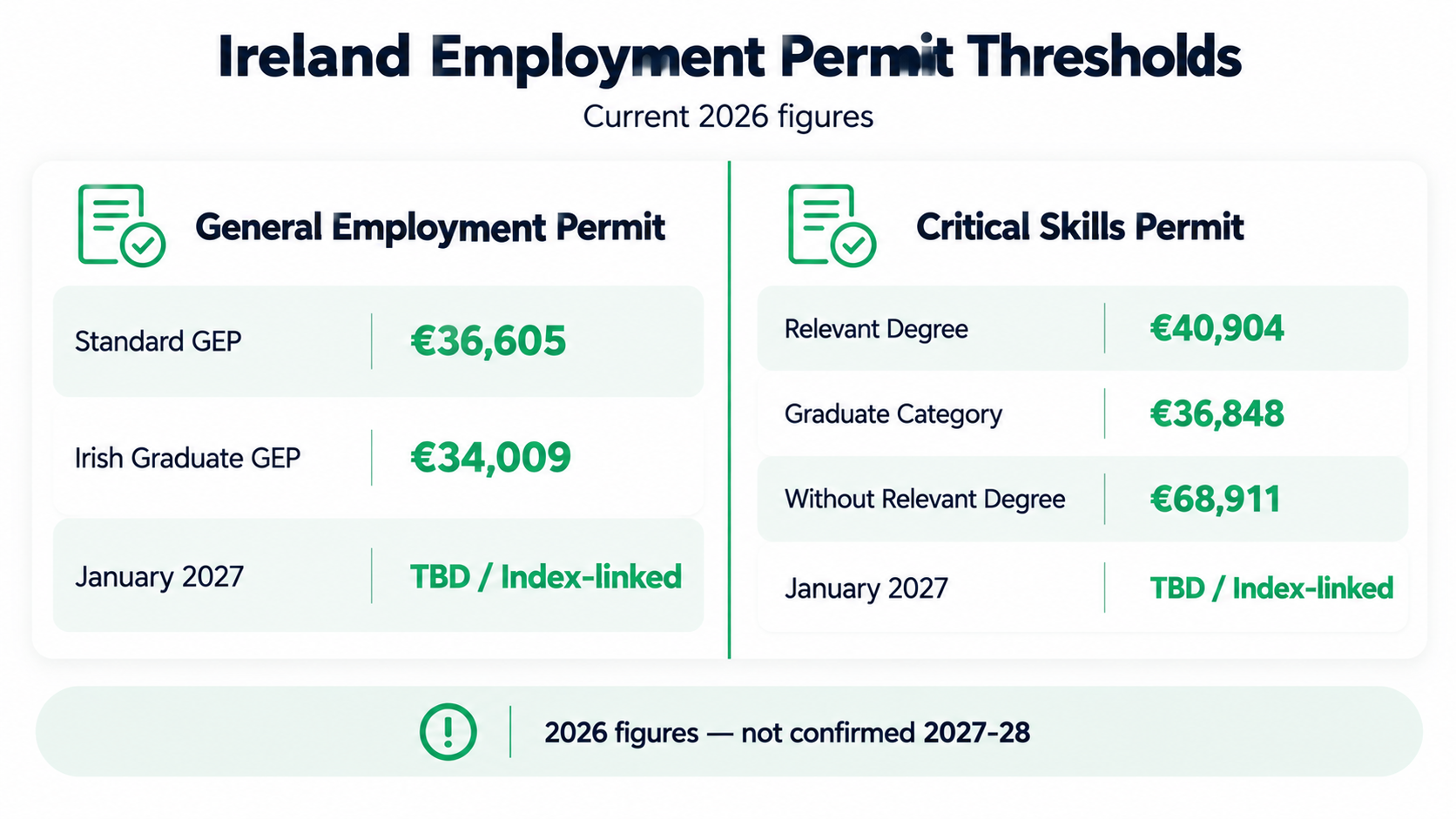
Important: These euro amounts are current 2026 figures, not confirmed 2027-28 thresholds.
The current General Employment Permit rules give a general remuneration threshold of €36,605 and €34,009 for the applicable recent Irish graduate category.
The current Critical Skills Employment Permit rules specify €40,904 for relevant degree-qualified applicants in listed strategically important occupations, with €36,848 applying to the relevant recent-graduate category. Applications must be received at least 12 weeks before the proposed employment start date.
Ireland’s Minimum Annual Remuneration roadmap says further increases will be phased through 2030. Key January 2027 figures remain pending or index-linked.
For jobs after study in Ireland Indian students, never decide that an offer “qualifies” just because its salary looks high enough. The role, occupation code, qualifications and rules in force on the application date all matter.
Students should also check Ireland’s Ineligible List of Occupations before relying on a role as a long-term option.
Career Readiness Matrix: is a Job offer Useful for your Long-term Plan?
This is where jobs after study in Ireland Indian students need to be evaluated more carefully.
|
Question |
Positive signal |
Warning sign |
|
Is the occupation eligible? |
Exact role fits the relevant permit rules |
You only checked the industry |
|
Does the salary qualify? |
Offer meets the threshold in force |
You used an old salary figure |
|
Does your profile fit? |
Degree, skills and experience match |
Only the job title looks relevant |
|
Is professional registration needed? |
Registration route is understood |
Requirement discovered after offer |
|
Is there enough time? |
Permit planning starts early |
Stamp 1G is close to expiry |
For jobs after study in Ireland Indian students, this matrix is more useful than a generic list of “best jobs”. It connects employability with immigration practicality.
Students choosing programmes primarily for career outcomes may also find Gateway EduConnect’s guide to career-oriented courses abroad useful as a starting point for course research.
What is the Average Salary after Masters in Ireland?
There is no approved official India-specific figure that can honestly be presented as the average salary after masters in Ireland.
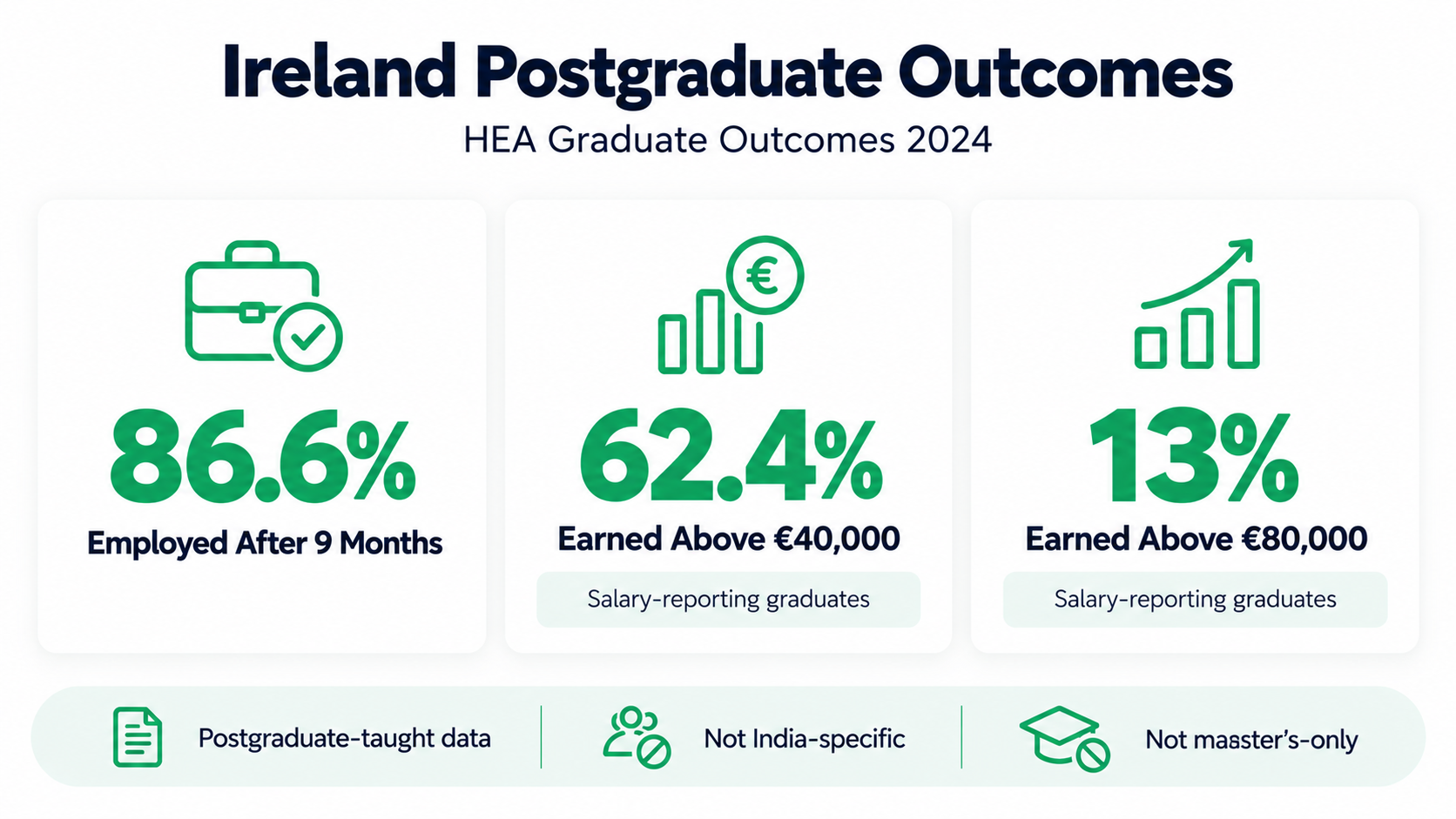
The Higher Education Authority provides more defensible graduate evidence. Findings of its Graduate Outcomes 2024 indicate that 86.6% of graduates of its postgraduate taught programmes were working 9 months after graduating. Of the individuals who reported a salary, 62.4 percent earned over 40,000 and 13 percent more than 80,000 each year. View HEA Graduate Outcomes 2024
However, “postgraduate taught” includes postgraduate certificates, postgraduate diplomas and taught master’s programmes. It is not an Indian-only or master’s-only population.
So an average salary after masters in Ireland should not be manufactured from those figures.
For jobs after study in Ireland Indian students, salary data should be used as context, not as a guaranteed starting package.
What does Ireland’s Current Labour Market look like?
The Central Statistics Office said that in Q2 2026, 2,839,300 people were employed, the employment rate among people aged 15-64 was 74.3 and the unemployment rate among the ones aged 15-74 was 5.1. View the CSO Labour Force Survey Q2 2026
These are national labour-market figures. They do not represent Indian master’s graduates specifically.
That distinction matters when evaluating jobs after study in Ireland Indian students. A healthy overall labour market does not guarantee a particular international graduate a job.
How should Indian students search for Jobs after Graduation?
A practical plan for jobs after study in Ireland Indian students should begin before graduation.
- Define specific target roles. Replace broad goals such as “IT job” with actual occupations.
- Check the Critical Skills list. Confirm whether your exact specialism appears.
- Check the Ineligible List. Do not assume every vacancy can support a permit.
- Identify the likely permit route. Understand CSEP versus GEP before applying heavily.
- Match your profile. Align projects, internships, tools and experience with the vacancy.
- Use Ireland’s public employment service. Intreo provides employment and job-search support.
- Track Stamp 1G timing. Do not leave permit planning until permission is close to expiry.
- Re-check salary thresholds. This number which will be used in 2027 or 2028 might not be the same as it is now.
This framework helps students compare jobs after study in Ireland Indian students against real immigration conditions instead of relying on broad career lists.
For jobs after study in Ireland Indian students, starting these checks during the master’s programme is safer than waiting until graduation.
Check Out: Online Study Abroad Programs: Your Gateway to Global Education
Can Employment Eventually Lead to Stamp 4?
Potentially, subject to the applicable conditions.
Current Immigration Service guidance says eligible workers may qualify for Stamp 4 after 21 months from the commencement of employment based on a Critical Skills Employment Permit. For a General Employment Permit, the corresponding period is 57 months. Check the official Stamp 4 upgrade rules
Stamp 4 can permit employment without an employment permit, subject to its conditions. It should not be described as automatic permanent residence.
For jobs after study in Ireland Indian students, the broad progression can therefore be:
Master’s → Stamp 1G → suitable employment → qualifying employment permit → possible Stamp 4 when eligible
Mistakes to avoid
- Assuming the second 12 months of Stamp 1G is automatic.
- Treating every role in a growing sector as a Critical Skills occupation.
- Using 2026 permit thresholds as confirmed 2027-28 figures.
- Assuming high demand jobs in Ireland for international students means guaranteed hiring.
- Treating one salary band as the average salary after masters in Ireland.
- Ignoring the Ineligible Occupations List.
- Waiting until Stamp 1G is almost finished before checking permit eligibility.
- Assuming any job offer automatically qualifies for an employment permit.
FAQs
Is there a post study work visa Ireland option after a master’s?
Students who (i) have successfully completed Level 9+ and (ii) who are eligible to proceed to Level 10 can at present have the Third Level Graduate Programme and Stamp 1G upon initial taking of 12 months, and a subsequent 12 months, but again, under certain conditions. Post study work visa Ireland is the most popular search term, however, the official name as Stamp 1G is more precise.
What do you think the principal employment prospects in Ireland are after graduation?
Current SOLAS evidence identifies shortages or strong demand signals in parts of ICT, engineering, science, healthcare, construction and specialised business and finance. Job opportunities in Ireland after graduation still need to be checked against the exact occupation and permit conditions.
What are high demand jobs in Ireland for international students?
Examples include software developers and engineers, IT analysts and engineers, plus selected engineering and other specialised occupations. The phrase high demand jobs in Ireland for international students should never be treated as a guarantee of employment.
What is the average salary after masters in Ireland?
There is no official India-specific average salary after masters in Ireland in the approved evidence. HEA instead publishes broader postgraduate-taught employment and salary distributions.
Are the 2027 employment-permit thresholds confirmed?
Not for several major categories. Ireland’s remuneration roadmap phases further adjustments through 2030, and important January 2027 values are not yet available as fixed euro amounts.
Conclusion
Jobs after study in Ireland Indian students can follow a structured route, but no stage is automatic. Eligible Level 9 graduates can currently receive 12 months of Stamp 1G and may qualify for another 12 months while seeking suitable graduate employment. Official labour-market evidence also points to shortages in selected skilled occupations.
The main uncertainty for 2027-28 is future employment-permit salary thresholds. For jobs after study in Ireland for Indian students, check the exact occupation, current salary requirement, qualification criteria and immigration permission before relying on any job offer.
For personalised help with course and destination planning, book a free Gateway EduConnect consultation.
Speak with Gateway EduConnect for free video or home counselling and support with your study abroad consultancy services and explore our wide range of offerings for students interested in Study in Australia, Study Abroad in Poland, Study in Canada, Study abroad UK, Study in Germany, Study Abroad in Ireland, Study Abroad in the USA, Study in Finland, Study Abroad in Italy, and many other countries

Author Bio
Abhinav Jain - Founder, Gateway Educonnect and Director.
B.Tech, MBA, AI and Global Education Specialist.
More than 15 years of professional experience in leading students along international routes based on politics and innovation.