17 Jul 2026 | Study Abroad After BTech 2026: Best Courses, Countries & Career Options

0
43
Introduction
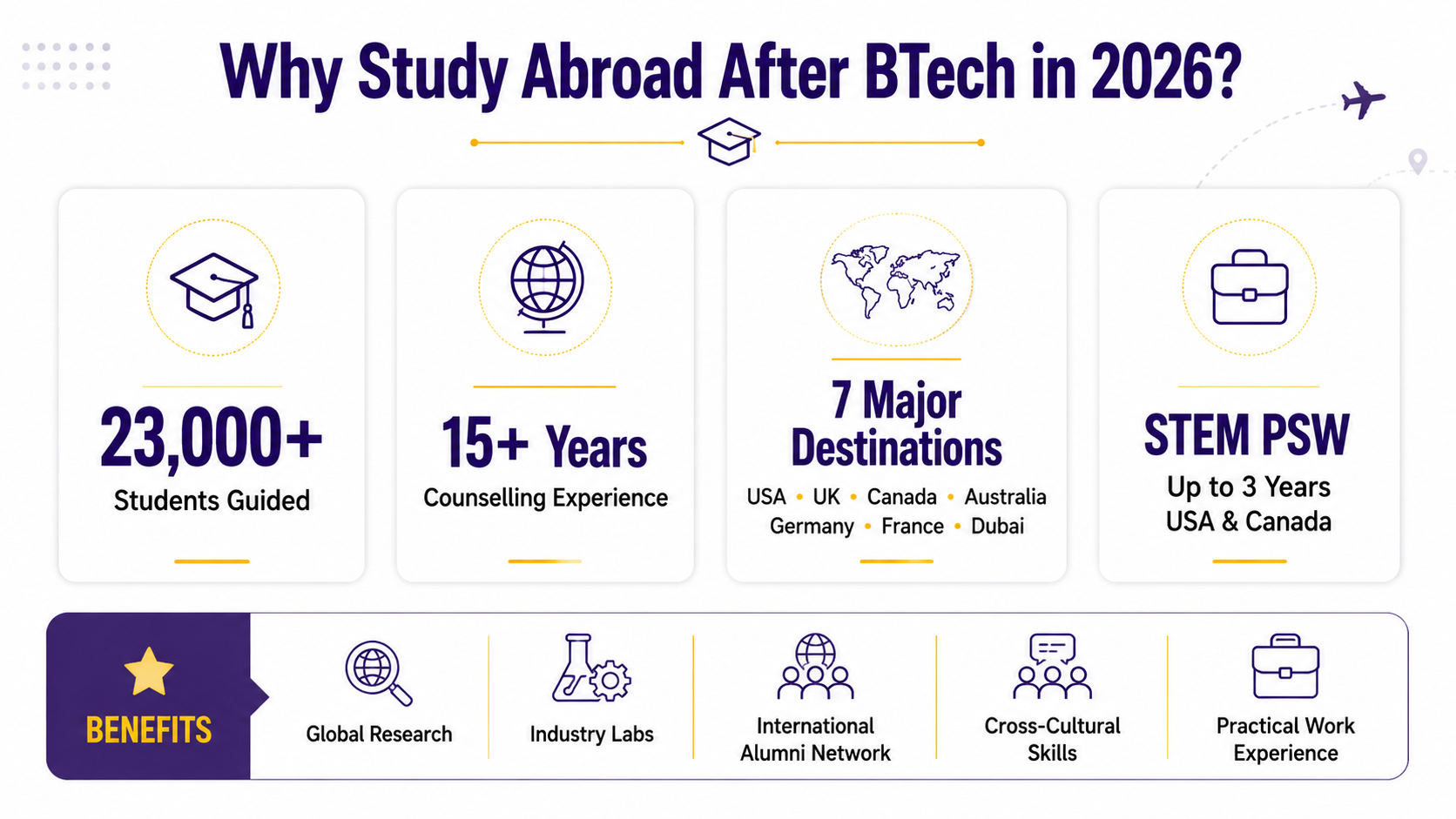
It was all fifteen years ago, when I was at the table with my first student, a BTech graduate with no clue where to begin to get an MS in USA after BTech. Now this figure has already exceeded 23,000 students, and whenever this goes on, I find myself having to open the same way, with the same question: is study abroad after BTech worth it to me?
The truthful answer to that is yes, so long as you select the right nationality, course or academic program, and time. The same questions are being raised by families every year: which country should they consider for the highest return, how much they can and will have to spend, and which course will lead to a good career. This roadmap distils all I have learned in assisting students to go through this process - the real costs, the real countries, and the real career results in 2026- and is designed to provide you with clarity rather than confusion. Ready to turn your study abroad dream into reality? Explore top online programs and expert guidance at Gateway Educonnect Online Courses.
Why Study Abroad After BTech Makes Sense in 2026
The engineering students are not only competing with peers in the same college as they are today. They are playing at the international level. By deciding to study abroad after BTech, you have a chance at accessing labs, industry-connected courses and faculty unmatched by most Indian colleges at the undergraduate level.
- An MS after BTech abroad also provides highly specific, research-based knowledge actively sought by recruiters in new technologies.
- There are soft skills such as cross-cultural communication being developed on a global scale, and there is little scale-based teaching of such skills in Indian campuses.
- The majority of the countries that are friendly towards STEM provide post-study work visas, which provide the graduates with practical experience before either coming home or establishing residence in a foreign country.
- Alumni of the best international universities open gates which cannot be opened by a national degree alone.
One of my students, Riya, who had graduated in Computer Science and earned her BTech at Pune, told me when she was leaving: "I did not want another degree, I wanted something different. It is this mentality that has led her to work as a data engineer in Toronto.
Check out: Best Country to Study MBA at Low Cost: Top Affordable Options for Indian Students
Best Countries to Study Abroad After BTech
The choice of the best countries to study abroad after BTech is seldom based on anything other than abstract claims about which country is best. It pertains to which country is within your budget, your career ambitions, and your risk tolerance. The student destinations we counsel at Gateway Educonnect have seven major destinations, each with a different type of student.
United States: best in Research and tech careers.
Those students who wish to pursue an MS in USA after BTech have found the USA the best bet since seven of the top ten universities in the world are American. The tuition for a masters degree is usually between 20,000 and 65,000 each year, with the tuition differing, according to the type of school university.
- Relatively cheap tuition of about 25,000 a year is offered in universities such as UT Austin and Arizona State, which are publicly funded.
- Elite and Ivy League schools can charge up to 60,000 to 90,000 per annum with fees.
- MS programs with a STEM design are eligible for up to three years of OPT (Optional Practical Training) to extend the time frame to acquire US work experience.
- The average initial salaries of the MS graduates in other areas, such as computer science and cybersecurity, range between $90,000 and 160,000 a year.
I never fail to remind parents of the same thing when they seek home counselling: the total two-year expenses for an MS in USA after BTech are typically between 60 lakh and 1.2 crore, at all costs. Most families are surprised by this number when they first hear it, and that is by design, as it prompts us to develop a detailed cost sheet before any application is made.
Check out: IELTS One Skill Retake 2026: Everything International Students Need to Know
UK: Fast-tracked, Shorter Degrees.
The UK is good for students who would like to study abroad after BTech without committing to 2 years. The average UK master's course lasts only one year, which saves on tuition fees and the period of unemployment.
- Average annual tuition is between 20,000 and 35,000 pounds, based on the university and course.
- The Graduate Route visa enables students to remain and work for two years post-graduation without having a job offer initially.
- Such cities as London, Manchester or Edinburgh have robust fintech, consulting and engineering markets.
Canada: Ideal for post-study work and settling.
Canada is always amongst the top countries to study abroad after BTech due to its post-graduation work permit (PGWP) (up to three years of the most liberal in the major destination).
- Tuition ranges from CAD 25,000 to CAD 55,000 per year.
- The IELTS score of Canadian universities is low at 6.5 and there is no SAT requirement upon a desire to graduate.
- Toronto, Vancouver, Waterloo, and other cities have booming tech scenes, so there is always an extensive range of opportunities to pursue post-BTech in foreign countries.
Australia: Most Cost and Ranking-effective.
Australia is in a comfortable position relative to the UK and Canada in terms of costs and global university rankings, which is why many students shortlist Australia as their second or third choice. It has a two-to four-year post-study work visa, which is determined by the level of qualification and the place of study.
Germany: Zero-Tuition Public Education is Best.
Full of doubts, Germany stands out as the most affordable option among the best countries to study abroad after BTech. The tuition is totally free at the public universities, with students having to pay a contribution of between approximately €150 and €350 every semester.
- Education costing of four year in total incorporates the living cost of the expense that ranges at three lakh rupees (45 lakh rupees to 65 lakh rupees).
- Germany has a good engineering/ automobile base with good rates of internship-to-job conversion.
- The most fundamental grasp of the German language is beneficial, but numerous technical master's courses are delivered in English only.
France and Dubai: Innovative and Realistic options.
France has competitive tuition at government-run Grandes Écoles, as well as strong aerospace, luxury, and business engineering programs. Dubai, by the way, has earned favour for its tax-free salary, lack of language barrier, proximity to India, and international exposure, all without massive relocation.
Check Out: Neoma Business School France – MBA, Fees & Admission
Country Comparison Table
|
Country |
Annual Tuition (Approx.) |
Duration of the course |
Score of IELTS |
Annual living cost (Approx.) |
Total Budget for 2 years |
Post-study visa (PSW) |
|
Australia |
AUD 25,000–45,000 |
Between 1.5–2 years |
6.5–7.0 |
AUD 18,000–22,000 |
₹35L–₹70L |
2–4 years |
|
UK |
£20,000–£35,000 |
Between 1 year |
6.5 |
£12,000–£15,000 |
₹35L–₹65L |
2 years (Graduate Route) |
|
Dubai |
AED 40,000–70,000 |
Between 1–2 years |
6.0–6.5 |
AED 30,000–40,000 |
₹18L–₹32L |
Varies by employer |
|
Germany |
€150–€350/semester |
Between 2 years |
6.0–6.5 |
€10,000–€12,000 |
₹15L–₹25L |
18 months |
|
Canada |
CAD 25,000–55,000 |
Between 1–2 years |
6.5 |
CAD 12,000–15,000 |
₹28L–₹68L |
Up to 3 years (PGWP) |
|
USA |
$20,000–$65,000 |
Between 2 years |
6.5–7.0 |
$10,000–$25,000 |
₹60L–₹1.2Cr |
Up to 3 years (STEM OPT) |
|
France |
€3,000–€15,000 |
Between 2 years |
6.0–6.5 |
€9,000–€12,000 |
₹18L–₹35L |
1–2 years |
Best Courses to Study Abroad After BTech
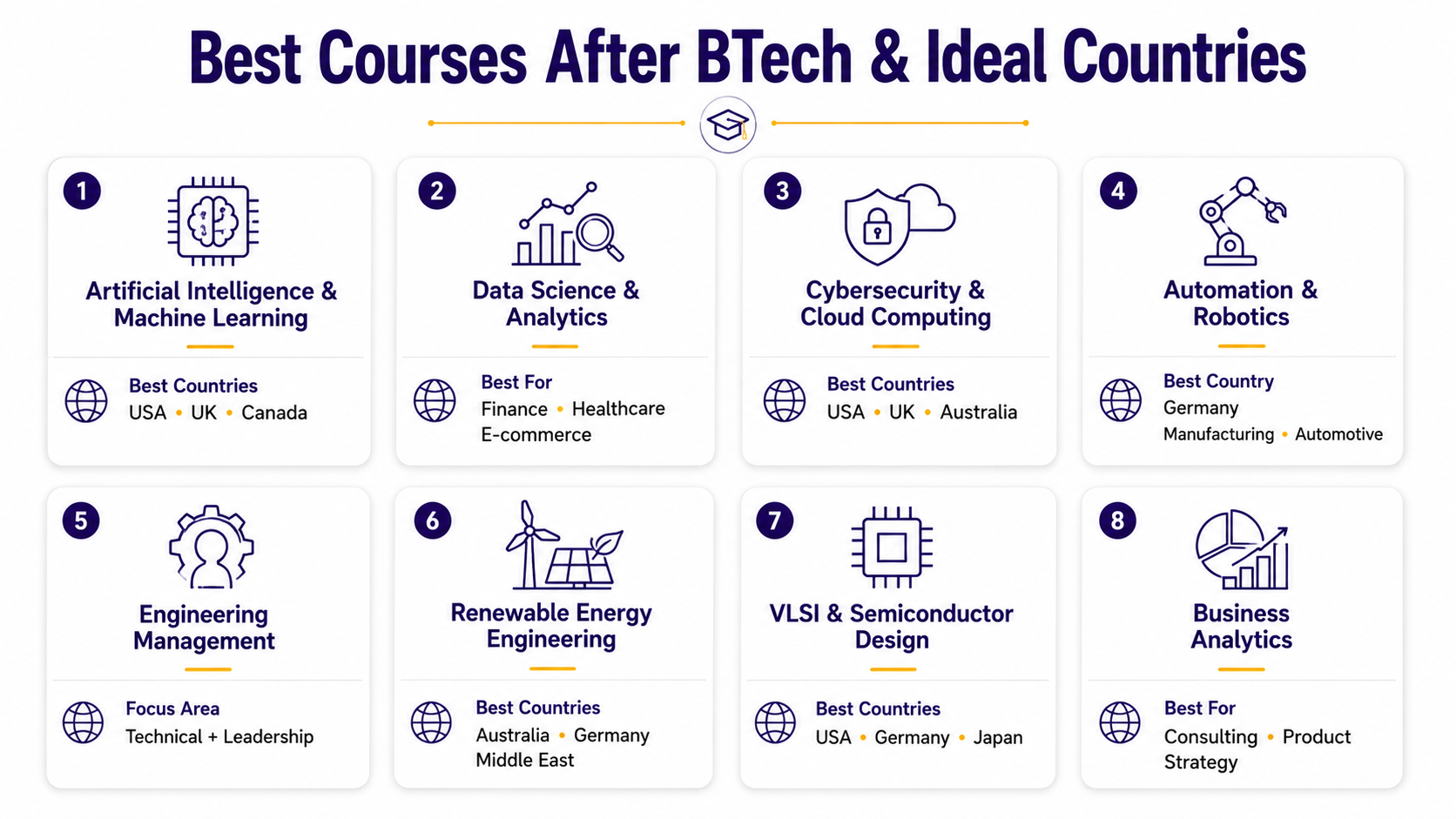
Not all BTech graduates have to undertake a Master's course upon moving abroad in the same subject they have studied. Career direction must be the guide when choosing courses, and not custom. Judging by what has been successful for our students aged over 15 years, these fields have consistently provided good career options after BTech abroad.
Artificial Intelligence and Machine Learning remain the most popular worldwide in terms of employment, with robust courses being taught at universities in the USA, the United Kingdom and Canada.
Analytics and Data Science: In finance, healthcare and e-commerce markets as well as being one of the quickest paths to a well-paid introductory position in a foreign country.
Cybersecurity and Cloud Computing: As one of the skill-shortage areas of the USA, the UK and Australia that strengthens immigration, as well as employment opportunities.
Automation and Robotics: In Germany, particularly, as it is a manufacturing and automobiles industry hub.
Engineering Management: Combinations of both technical and leadership: This is the best track to take when a student ultimately desires to switch to management.
Renewable Energy Engineering: This field is expanding rapidly in Australia, Germany and some Middle Eastern countries as they invest in clean energy infrastructure.
VLSI and Semiconductor Design: With the USA, Germany and Japan increasing the manufacturing scale of domestic chip manufacturing, the market is on fire.
Business Analytics: An increasingly trendy field course in engineering to prepare graduate engineers for consulting, product or strategy positions.
We do not simply look at rankings when advising students on course selection. Even matching their BTech specialisation, target job market, and long-term objectives, we chart their course of action before suggesting a course, because it is not a prestigious one that someone ought to study abroad after BTech, but rather a course that offers them a specific destination after they graduate.
Check out: Best Free IELTS Apps in 2026 for Band 7+ Preparation
Career Options After BTech Abroad
There are many more options than the immediately evident common one of becoming a software engineer overseas, in the career options after BTech abroad. In my counselling sessions, I recommend that students consider three career paths: corporate, research, and entrepreneurial careers.
|
Career Track |
Best Suited Countries |
Avg. Starting Salary |
Common Roles |
|
Tech manager |
France, Germany |
Approx. €45,000–€75,000 |
Automotive Design Engineer, Robotics Engineer |
|
Consulting and Management |
UK, USA, Canada |
Approx. $95,000–$150,000 |
Technical Consultant, Engineering Manager |
|
Research |
UK, USA, Germany |
Funded stipend + tuition waiver |
PhD Scholar, Research Associate, R&D Engineer |
|
Engineer manager |
UK, Canada, Germany, USA, |
Approx. $90,000–$160,000 |
Cloud Architect, AI Engineer, Cybersecurity Analyst |
|
Entrepreneurial |
UK, USA, Dubai |
Variable |
Product Lead, Startup Founder, Technical Co-founder |
|
Data and Analytics |
USA, Canada, Australia |
Approx. $85,000–$140,000 |
AI, Business Analyst, Data Scientist, ML Engineer |
The Benefits of Gateway Educonnect for Your Study Abroad Adventure.
We have 23,000+ students and have built our services around the real pain points families experience when they decide to study abroad after BTech, with a 15+ year history.
- Home Counselling and Video Counselling: We go to the family wherever they are, be it in person or video-textually, and once there, each question is answered without being pressured.
- Loan Assistance: We assist in filling out education loans and making them within your means rather than pulling the family to its tipping point.
- Accommodation Support: We can assist students in securing safe and valid accommodation before they arrive in their countries of destination.
- Test Prep: We prepare students for specific scores required at their target universities, be it IELTS or GRE.
- One- click apply in 100 seconds: begin your applications to world universities in 100 seconds- quick, effortless and easy to apply.
Check out: Digital Education Counselling: The Future of Student Guidance in India
Steps to Apply to an MS After BTech Abroad
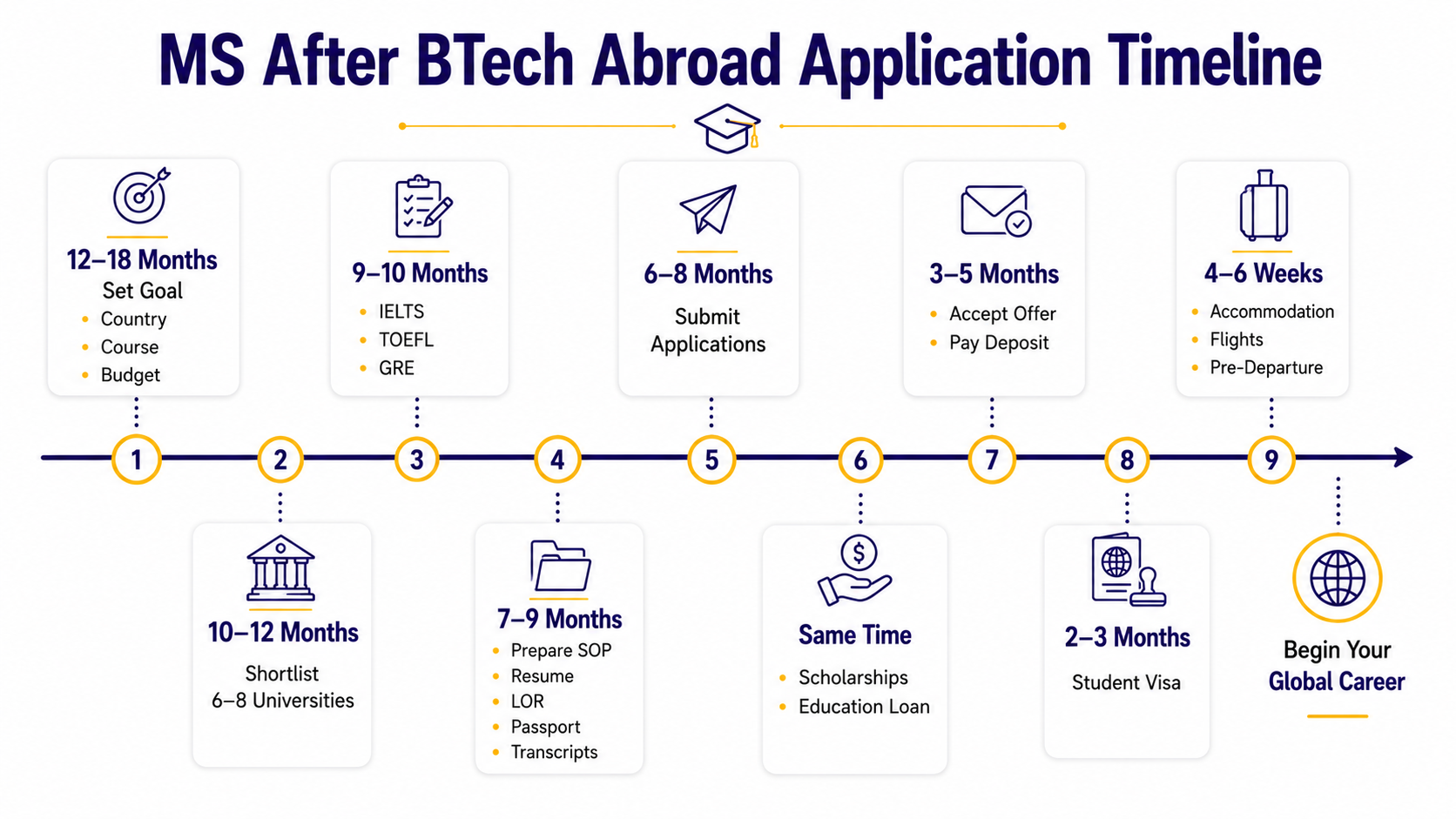
Pursuing an MS after BTech abroad is not a one-size-fits-all solution. The following is the order of events we take students through at Gateway Educonnect, typically over 12-18 months.
- Set your goal (12-18 months before intake). Before shortlisting any university, decide on your target country, course, and approximate budget.
- Shortlist 6–8 universities (10- 12 months pre-intake). Choose your profile and preference for the place of study and target country to explore balanced reach, match and safe universities.
- Complete standardised tests (9-10 months Pre-intake). Register Early so you can get your dates IELTS, TOEFL or GRE.
- Make arrangement of application papers (7-9 months before intake). Create proper SOP, Updated resume, LOR, passport, and academic transcript.
- Meet and adhere to deadlines (6-8 months before intake). Submit applications to the respective deadline to each university with a partiality to early decisions where feasible.
- Apply for scholarships and educational loans (similar to applications). Pre-apply for your loan, as grant letters are often submitted with your visa application.
- Accept and pay deposit (3 -5 months before intake). Request confirmation of your seat, and start preparing the visa paperwork.
- Apply online student visa (2 3 months prior to intake). Turn in all the financial documents, acceptance letters and your test results to your visa interview.
- Make arrangements and pre-departure arrangements (4-6 weeks ahead of departure). Check-in housing, medical coverage and flight, and a pre-departure briefing.
Check Out: Online vs Offline Study Abroad Consultancy: Which Is Better for Indian Students?
Summary
Deciding to study abroad after BTech is one of the most significant decisions a young engineer can make, and it should not be based on mere conjecture. But, similar to whether you find you are attracted to an c, Canada and its business-friendly visas or Germany and its tuition-free universities, or the UK with its shorter degrees, it will be your personal goals, financial means and long-term career plan that decide which program you gravitate toward and which one you find yourself lacking peer pressure and direction toward. This is what Gateway Educonnect has over a 15+ year learning period, which spans 23,000+ students: good guidance, supported by experience, transforms results. We have experienced student-to-student confusion on the initial meeting to student-to-student confident offer letters, and we would be glad to offer you some. With Gateway Educonnect, you can book your free study abroad consultation today or apply now to study at a global university in 100 seconds.
For more assistance, please visit our study abroad consultancy services and explore our wide range of offerings for students interested in Study in Australia, Study Abroad in Poland, Study in Canada, Study abroad UK, Study in germany, Study Abroad in Ireland, Study Abroad in the USA, Study in Finland, Study Abroad in Italy, and many other countries

FAQs
Should one study abroad, or should one get work experience first after BTech?
It will be based on which country you are targeting. The USA and the UK also tend to accommodate fresh graduates, and certain programs in Australia and Canada may place importance on 1-2 years of work experience.
What are the best countries to study abroad after BTech to pursue a technology career?
The strongest in tech-oriented MS programs are the USA, Canada, and Germany for BTech, due to their visa policies and industry demand, driven by the stimulating elements of STEM.
Approximately how expensive is an MS in USA after BTech?
The total expenses for two years' fees and living expenses range from ₹60 lakh to ₹1.2 crore, depending on the university and city.
What is my most preferred career choice upon getting out of BTech in a foreign country?
The operational careers, such as AI engineering, data science, cybersecurity, robotics, and research, as well as the increasing entrepreneurial prospects, are popular.
At what age should I start thinking about study abroad after BTech?
Preferably, 12-18 months before when you are supposed to intake, so that you will have time to carry out tests, applications and visa.
Author Bio
Abhinav Jain - Founder, Gateway Educonnect and Director.
B.Tech, MBA, AI and Global Education Specialist.
More than 15 years of professional experience in leading students along international routes based on politics and innovation.