17 Apr 2026 | US F-1 Visa Rejections 2026: Why Approvals Dropped 60%

0
113
Introduction: US F1 Visa Rejection Rate 2026
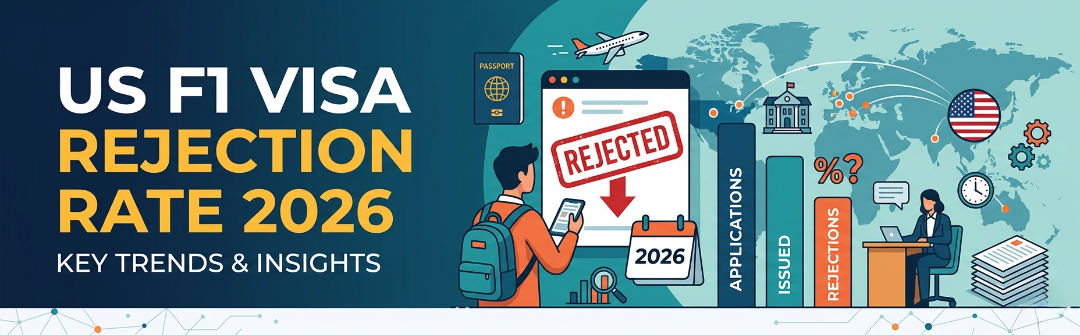
America dream of studying has been a dream to thousands of Indian students each year and 2026 has given minimal shift in the visa mission. According to the recent trends, the US F1 visa rejection rate 2026 is increasingly growing and the rate has resulted in nearly 60 per cent cut in the approvals that had been registered over the previous years. It has come as a sudden twist thus creating doubt in the minds of the students and parents who are unsure of their prospects of having a visa approval as US students.
However, even though there was no cause that it happened as it was, the stronger tendencies of screening, alteration of the immigration policies, and the greater interest to the true intent of the student, caused the decline. Before deciding to undertake one or more studies in the US, the following are just a few of the things one should be aware of. Here, in this blog we dissect the actual reasons, why the US student visa India reduction took place, the major factors leading to rejection, and the actual steps that you can take, to increase your odds, and safely embark on your study abroad adventure.
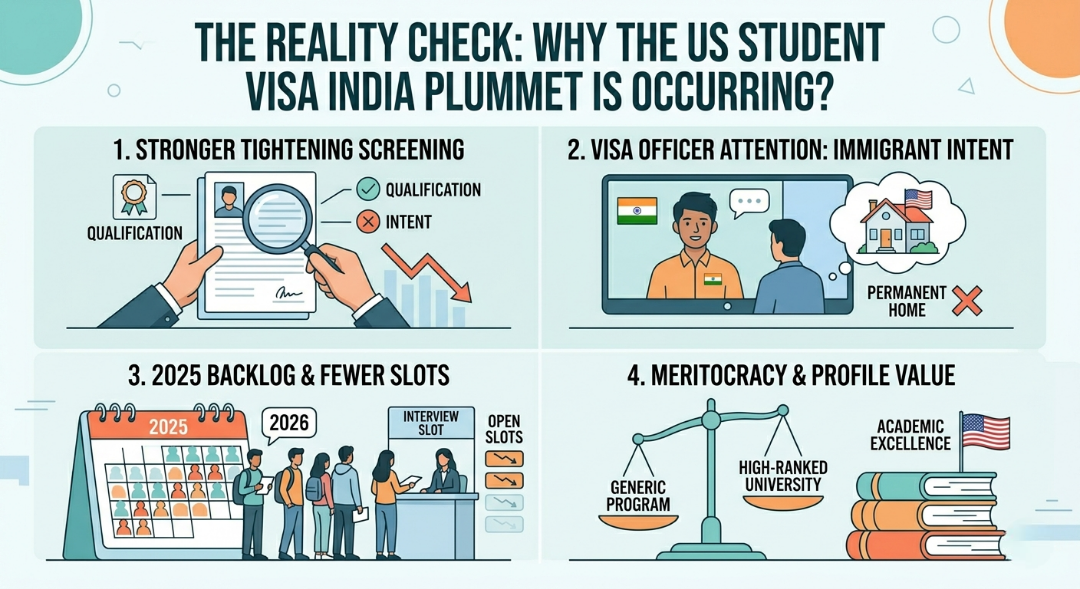
The Reality Check: Why the US Student Visa India Plummet is Occurring?
The challenges facing the US application of the student visa among the Indian applicants are on the rise, therefore, it can be strongly argued at this point that the challenges can actually be ascribed towards the enactment of tighter immigration policies in 2026.
Main reasons behind the decline:
- Another tightening screening has been initiated by the Department of state of the U.S which concerns less the qualification which is essential but more of the reason and long term strategies.
- The visa officers are giving a lot of attention to the issue of immigrant intent, where the students are supposed to go back to India after they have completed their studies.
- The 2025 backlog has greatly reduced the chances of getting interview slots because it has now become a competition.
- It is time that students justify their plans of study more to lessen the increased US F1 visa rejection rate 2026.
- This has directly brought about the US F1 visa rejection rate 2026, despite the student being accepted into the best universities.
Important insight:
It has now become important to start your application at least 10-12 months beforehand, as there will not be enough vacancies to interview with.
The Digital Look: US Visa Social Media Security Check.
US visa social media check has since come to be an obligatory process to any visa screening procedure that has been initiated in 2026 and is provided to all people that require visas.
What is it about?
- Consular officers have examined as much of your social media history as they can get to gain a sense of your background and intentions.
- Types of platforms: LinkedIn, Instagram, Facebook and X are some of the platforms which are actively checked during the visa process.
- To make sure that all your information is consistent, officers examine your application, your answers in an interview, and your web footprint.
A discrepancy between what you say (that you will go back to India) and what you write on social media (that you are settling in the US) can lessen the probability of getting a US student visa by a drastic factor.
How to prepare:
- Market yourself on social media, in which case, make sure your profiles are clear about your academic and career objectives in view of studying abroad.
- Do not publicise details of a permanent migration since such information can have a negative impact on your application.
- No, remain consistent using all platforms to make sure that your story is believable during the US visa social media check.
US social media checks on the US visa have become one of the primary factors towards the US F1 visa rejection rate 2026.
Merit and Form I-129 Propensity.
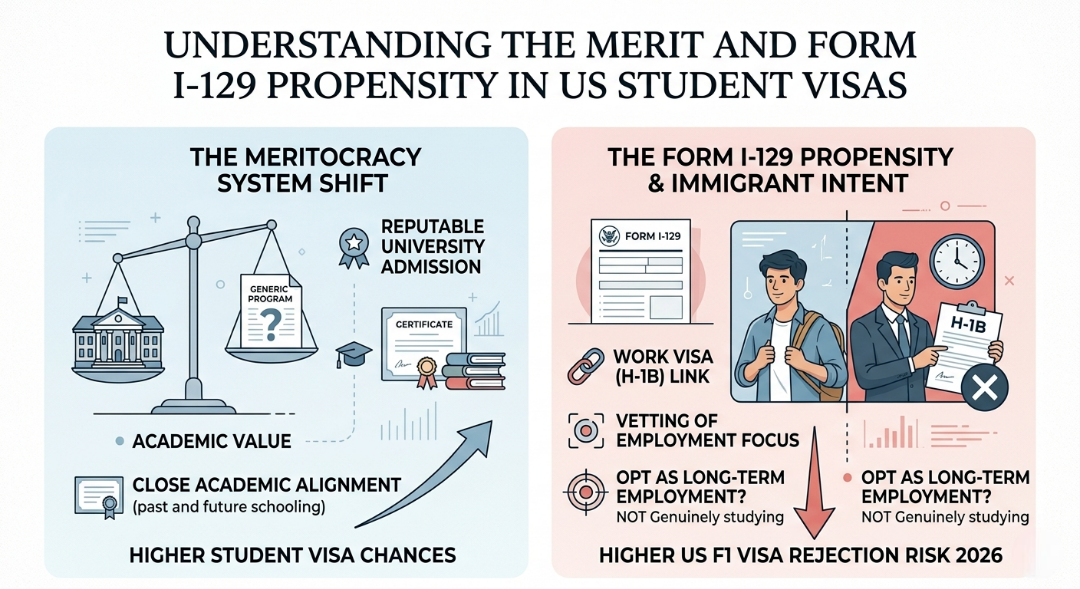
The US has shifted towards a meritocracy system, which will impact the US student visa in India.
What this means:
- This means that the students who are eager to be accepted into the most reputable university have more chances of being accepted to obtain a US student visa due to their perceived academic value.
- Visa officers have been scrupulous of generic, or low-quality, program applications.
- Close academic correspondence with regard to past schooling outcomes and upcoming goals has been necessitated to allow.
Role of Form I-129
- The changes in Form I-129 (linked with work visas, like H-1B) have made a difference in the student visa decisions:
- Visa officers are becoming wary of the students who seem to go to school as a means of reaching long-term employment.
- Too much emphasis on the issues of Optional Practical Training (OPT) can be discouraging to the interviews.
- This entails that the applicants must demonstrate that they are indeed interested in studying and not employment opportunities upon completion of the studies.
This change of policy has played a major part in the current US F1 visa rejection rate 2026.
The Top Reasons why the US F-1 Visa Receives the Thumbs-Down in 2026.
Knowing the pitfalls will enhance your chances of being successful in obtaining the US student visa.
|
Reason to be Rejected |
Effect to Approval |
Criterion on Overcoming. |
|
Poor Interview Skills |
Medium |
Learn to organise answers and enhance communication using practice as a mock interview. |
|
Vague Career Goals |
Medium |
Obviously, align your US degree with particular career opportunities in India. |
|
Social Media Red Flags |
High |
Be able to live up to the US visa social media background check by sanitising and harmonising your online image. |
|
Financial Gaps |
Medium |
Prove sufficient and reasonable finances with sufficient documentation for at least one year of study. |
|
Section 214(b) |
High |
Display close relations with India, like a family, employment or business, to justify your purpose of coming back. |
The percentage of US F1 visa rejection rate 2026 reveals that, now more than before, preparation is of paramount importance.
Essential F1 Visa Interview Tips by 2026.
To overcome the rising rate of US F1 visa rejection rate 2026, students should emphasise preparation.
Tips to pass the F1 visa interview:
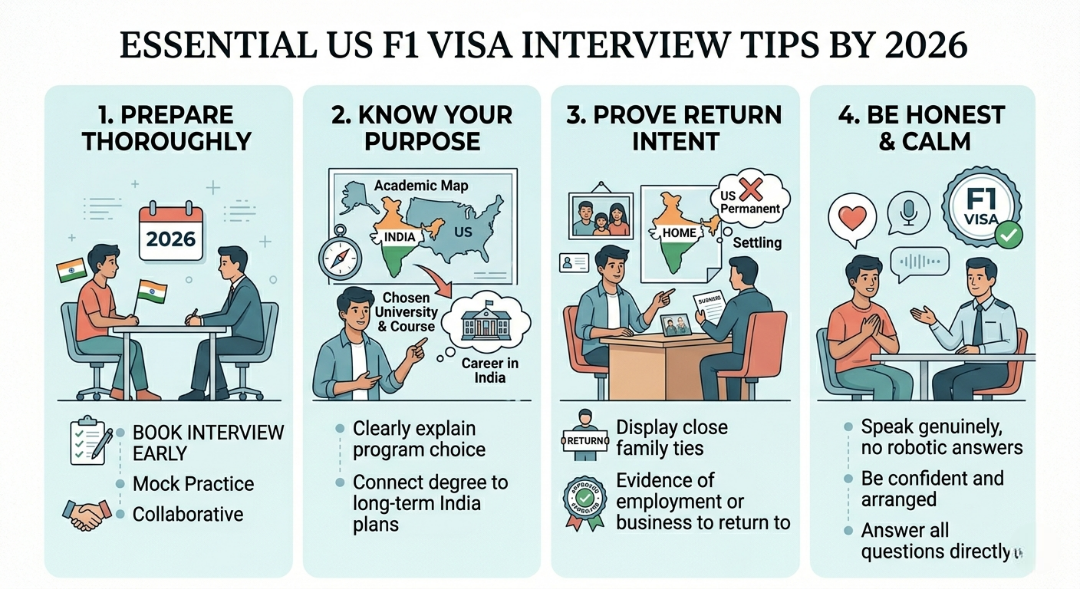
- Indicate clearly why you have chosen your particular course and university and the ways in which it is going to help you achieve your long-term plans in India.
- Be frank and at ease on the interviewing table, without memorised or robotic answers.
- Demonstrates a positive wish to return to India, discussing career and family/business relationships.
- Learn the ins and outs of your financial documents to such an extent that you can reply to questions pertaining to funding with confidence.
Pre-commence when you need to be interviewed. Summon the strength to negotiate any questions related to social media, and check with the US visa.
Additional tips:
- Effective introduction, 30s strong introduction, and making sure that you communicate well what you are about and your background.
- Good body language and eye gaze to demonstrate good confidence and openness.
- Give no answers to crime but answer in a confident and ordered fashion.
These are the rules to follow in interviewing F1 visas and it could put you way ahead in winning the lottery of obtaining a visa to the US as a student.
What can you do to get More of your Conversions on Getting your US Student Visa?
The average US F1 visa rejection rate 2026 is quite high, yet, it is possible to win with the assistance of the right strategy and preparation.
Actionable strategies:
- Application to reputable universities that makes your profile have some credibility to the visa officers.
- Be academically well off and do what is best to make you a success in the application.
- Draw up open financial records with easy sources of funds.
- Be regular in your application, SOP and online activity so that you can pass the social media check on a US visa application.
Strategy, clarity and planning are required to make your chances of being successful in getting a student visa to the US a reality.
Justification of why the US F1 Visa Rejection Rate 2026 is increasing further.
The US F1 visa rejection rate 2026 is also on the rise because of:
- The US government is also tying the knot with institutions of low quality, which are at times referred to as visa mills.
- Certain restrictions on the number of student visas to be issued at a certain time within a year have made the applicants more competitive.
- Visas are approved on a general profile approach as opposed to the basis of study only.
This means that you must have a profile not only good academically, but also good strategically.
How to Navigate the US Student Visa India Drop with Experts?
Though the decline of the US student visa may appear daunting to thousands of students, they can still acquire the visa after the right preparations.
Students can learn more to: By working with experts, students can learn better to:
- Hone your US visa social media examination through a coherent and tidy online profile.
- Go through tricky scenario-based interview questions that are asked by visa officers.
- Create good and valid profiles which are up to date with visa expectations.
In this case, professional advice is the key.
The Way that Gateway Educonnect Can Make You a Success.
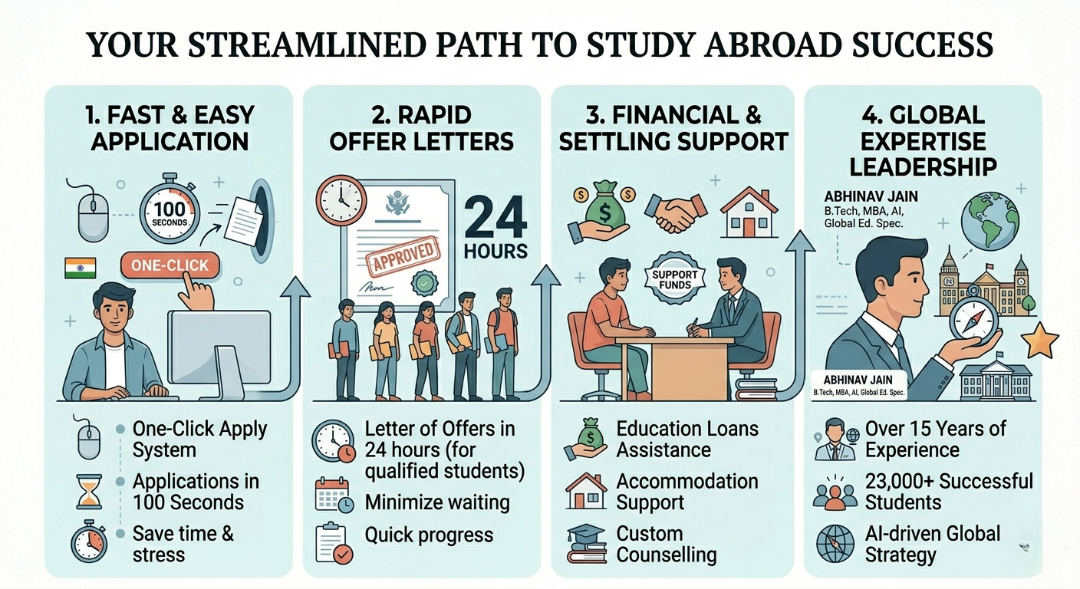
They have had over 23,000 successful students and 15+ years of experience, which has given them a sure footing internationally in the education industry.
Our unique advantages:
- We have our One-Click apply system, which can enable students to fill out university applications in 100 seconds without being stressed.
- Our lean system is capable of offering letters to the qualified students in 24 hours.
- We also come with a CASHBACK of up to 2499 in three working days or four working days, to enable your study abroad endeavour.
- Our services encompass full support of education loans, accommodation and custom counselling.
Under the leadership of Abhinav Jain (B.).Tech, MBA, AI, and Global Education Specialist), we will ensure that you are streamlined to the present-day US F1 visa rejection rate 2026.
Frequently asked questions: US F1 Visa Rejection Rate 2026.
1. What is the reason why the US F1 visa rejection rate 2026?
The rejection rate has risen as a result of increased screening, a filtering that is based on merit, and the introduction of the US visa social media check.
2. What do I need to do to increase my chances of being approved to come as a US student visa?
All you can do to push them is advance your academic profile, train for interviews, and follow the greatest tips by the gurus on the F1 visa interview.
3. What is the effect of social media on visa acceptance?
Yes, social media checks by the US visa system are quite an essential aspect of determining your intentions and stability.
4. What is the US student visa India drop caused by?
Stiff immigration policies, fewer interview slots and heightened scrutiny have been of help too.
5. May I reuse it in case of rejection?
Yes, you can reapply with better paperwork, better preparation and better clarity to increase your probability of being granted your US student visa.
Conclusion
The US F1 visa rejection rate 2026 is a wake-up call to the students to make sure that they are better prepared and more tactical. Though the decline in student visas from India to the US is a hint of harder action that will be taken, it will guarantee that the real and ready students succeed.
By following your academic record, online presence and the interview preparation, one can overcome these hurdles and live up to your dream of being an international student studying in the US. For more assistance please visit us study abroad consultancy, and avail of our wide range of services for students on destinations like study in USA, study in UK, study in Canada, study in Australia, study in ireland and many more country.

Author Bio
Abhinav Jain - Founder, Gateway Educonnect and Director.
B.Tech, MBA, AI and Global Education Specialist.
More than 15 years of professional experience in leading students along international routes based on politics and innovation.